

Anglers fish for bass in various areas, including lakes, bays, deep basins, and coastlines. They also use different rigs for trolling and catching this fish. From the Carolina and Texas Rigs to the Wacky and the Hudson Rig – anglers have a delicate taste for bass fishing rigs.
However, the most popular and – undoubtedly – the most effective is the Carolina rig. There are many reasons why this rig is a favorite among anglers and why it easily allures the bass.
In this article, we’ll dive deep into the characteristics of the Carolina Rig for Bass, its setup, and how to use it properly.
Let’s throw those hooks!
What Is the Carolina Rig for Bass?
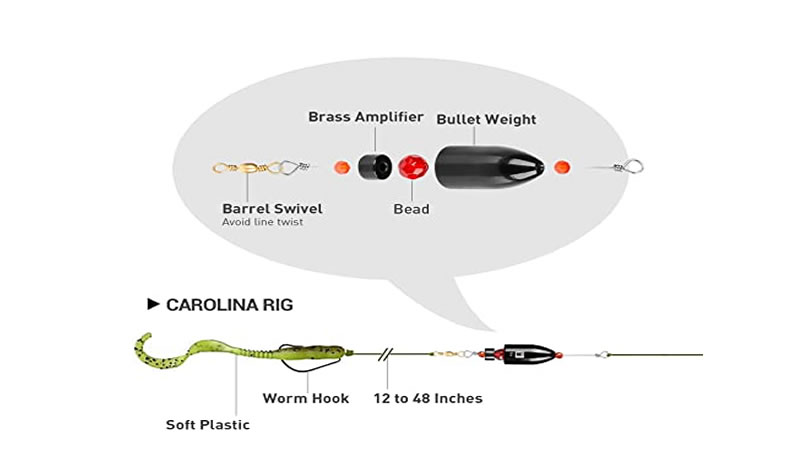
The Carolina rigs for bass are among the most popular gear for catching this cunning yet populous fish. The Carolina rig and Texas rig both use a soft-plastic bait, but the weight placement is different. On a Carolina rig, the sinker slides on the main line above a bead and swivel, while the bait trails behind on a separate leader. On a Texas rig, the bullet weight sits directly ahead of the hook and bait.
The rig has a straightforward design consisting of a hook, a bead, a swivel, a sinker, and soft plastic. You can order and purchase these components separately or get them as a part of the complete Carolina rig kit. It has a very pleasing and minimalistic design, with a sliding sinker (egg, barrel, or bullet), the bead, and the swivel placed between the main and the leader line.
The Carolina rigging for bass works quite simply – once you throw the bait into the water, the lure starts moving in a circular motion. These movements attract the bass and make it strike the bait instantly.
Experts also recommend the Carolina rig for bass fishing because anglers can attach heavier weights for deeper waters. The rig can also be effective in winter when bass are relating to bottom structure, but productive depth depends on the lake, forage, water temperature, and where fish are actually holding.
Carolina Rig for Bass Fishing: Should You Go for It?

There are many reasons you should choose a Carolina rig for bass fishing. Firstly, the Carolina rig is easy to use, and you’ll quickly master the art of tying, casting, fixing lures, etc. Secondly, the rig performs incredibly during the pre-spawn or the post-spawn bass season, when the fishes start to migrate towards and from their spawning areas.
Bass often use points, breaks, channels, flats, and other transition routes before and after the spawn. Adjust sinker weight to depth, wind, current, bottom composition, and casting distance; common Carolina-rig weights range from light finesse sizes to around 1 ounce or more when conditions require it. The bait trails behind the weight rather than moving in a fixed circular pattern.
Ultimately, the Carolina rig is compatible with almost all bait types. You can use worms, creature baits, plastic lizards, and flukes. Following are some of the main advantages of using a Carolina bass rig over other rigs:
- An ability to reach bottom feeding;
- Great for pre-spawn and post-spawn seasons;
- Great for fishing bass during the summer;
- Efficient with isolated piles of brush and grass;
- Lures flexibility.
How to Fish a Carolina Rig for Bass?

Once you’ve held the Carolina rig in your hands, you’ll never forget how to use it again! Fishing with the Carolina rig is simple – you just cast the rig and then start dragging along the targeted water area.
You position your pole parallel to the water’s surface and move the lure sweepingly. Keep in mind not to jerk the rig. A smooth sweep will do you all the work! However, before you cast and drag, you must know the Carolina rig setup for bass and how to manipulate it correctly.
The process is quite simple, yet you’ll have to choose the right combination of weights, beads, and knots to attach your hooks, swivels, and leader line. Following is a step-by-step guide on how to fish a Carolina rig for bass:
- Pick a bullet or egg weight and slide it onto your line: If you’re fishing in shallow water, pick a weight of ½ oz or a heavier one for deeper waters.
- Add a bead to the line: The Carolina rig is quite versatile – you can add a plastic, glass, or metal bead.
- Tie a swivel at the end of the line: The swivel will protect your line from twisting. Tie the swivel securely with a dependable knot. Swivel size and strength should match the line, sinker, and tackle being used; there is no universal 80-pound standard for bass fishing.
- Connect the hook to the swivel: Tie the leader line to the other end of the swivel to attach the hook.
- Attach the hook to the end of the leader line: Make another Palomar knot to connect the hook with the leader line.
- Attach the bait: Lastly, attach the bait at the hook’s end.
Once you’ve finished all the steps, you can start casting and dragging the rig along the targeted water area. Make sure you position it parallelly to the water and move it slowly to leave some time for the bass to strike.
Carolina Rigs for Bass: The Final Take
The Carolina rig is among the most famous fishing rigs for catching bass. If you ask an experienced angler about this rig, you’ll most certainly get positive remarks about its usage, versatility, and efficiency.
The main advantage of the Carolina rig is its flexibility. You can change soft-plastic style, leader length, hook size, bead, and sinker weight to match depth, cover, bottom type, and fish behavior. It works especially well across points, shell, gravel, sparse grass, brush edges, and other places where bass relate to the bottom.
Lastly, the Carolina rig saltwater use is easy and fun to use. You must master a few simple steps: attach the bead, tie the swivel, and connect the hook and the bait – and you’re ready to go!
If you like this article, you should consider this one on chatter bait bass fishing or the best baits for largemouth bass.


I do believe all the ideas you’ve presented for your post. They are really convincing and will certainly work for novices anglers, thanks for the post!
Thanks for taking the time to stop by; hope you continue to follow!
Very Interesting article, which is carried out very well in this read.
Thank you appreciate the comments and your readership!
Only a few have reached us, good information!
Thank you for the comment, glad you enjoyed!