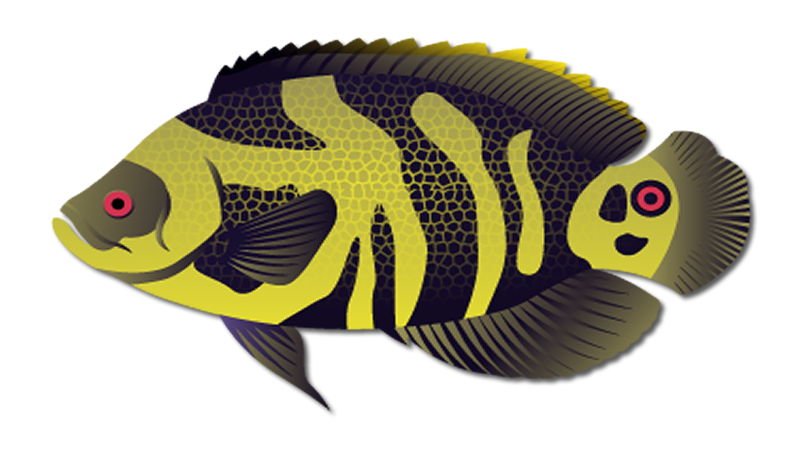
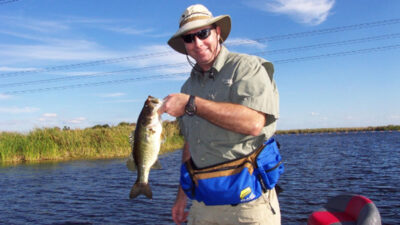

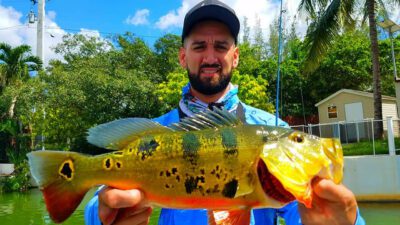























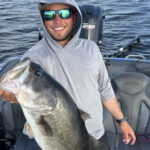
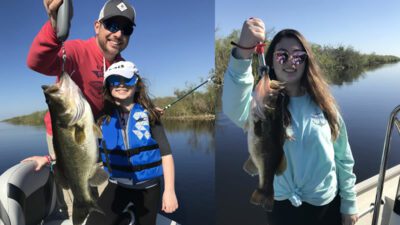
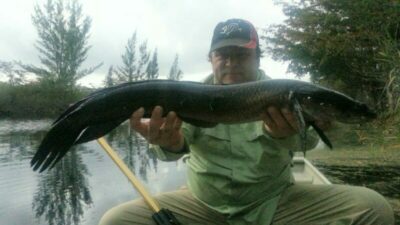
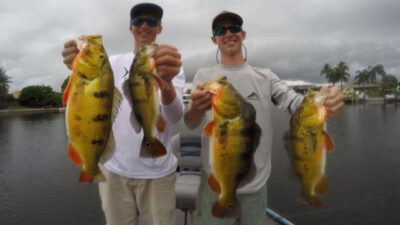
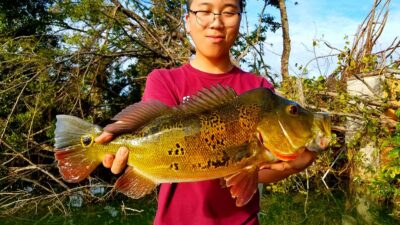
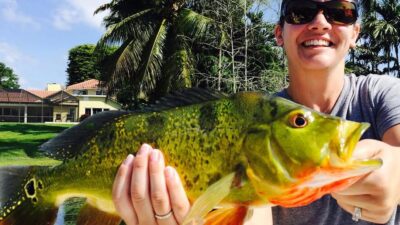
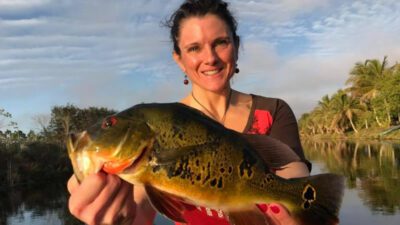








The Oscar fish (Astronotus ocellatus) is a hard-fighting, nonnative cichlid established in South Florida. Anglers encounter Oscars most often in warm canals connected to the Everglades and water-conservation areas, especially across Collier, western Miami-Dade, Broward and Palm Beach counties. In Florida they are more than an aquarium fish: they support a popular light-tackle fishery and can be caught on natural bait, small jigs, spinnerbaits and flies.
What Is an Oscar Fish?
Oscar fish are large South American cichlids native to the Orinoco, La Plata and Amazon river basins. They are also called Oscar cichlids, tiger Oscars and velvet cichlids. Florida populations are nonnative and became established after aquarium-trade introductions during the twentieth century.
Wild Oscars have a deep, oval body, strong jaws and a distinctive eyespot near the base of the tail. Adults are commonly olive, dark green or brown with orange or red markings. Juveniles often show stronger white-and-orange banding. Their heavy body and aggressive strike make them feel more powerful than many panfish of similar length.
Where Are Oscar Fish Found in Florida?
According to the Florida Fish and Wildlife Conservation Commission, Oscars are most abundant in canals associated with Everglades and water-conservation habitats in South Florida. They also occur in coastal canals, ponds and lakes from central Florida southward, although their abundance can vary sharply after cold weather.
The USGS Nonindigenous Aquatic Species database documents established Florida populations and records from Everglades, Big Cypress, Kissimmee and southeast-coast drainages. Recent observations continue to confirm Oscars in South Florida.
Good places to begin looking include marsh-connected canals and warm South Florida systems around the Everglades, Tamiami Canal and other canal networks with abundant cover and forage. Always verify legal access before fishing.
Oscar Fish Habitat
Oscars favor warm freshwater and are especially successful in canals running through marsh habitat. They also use ponds, lakes and slower-moving waters. Structure matters: shoreline vegetation, canal edges, culverts, submerged wood, bridge shade and transitions between open water and cover can all concentrate fish.
Cold weather is one of the biggest natural limits on Florida Oscar populations. USGS reports a lower lethal temperature near 12°C (about 54°F), and FWC describes the fishery as “boom and bust” because severe winters can cause major die-offs. After a series of mild winters, numbers can rebound strongly.
How Big Do Oscar Fish Get?
Most Florida Oscars are much smaller than the largest specimens reported from their native range. FWC notes that Everglades fish average about 10 inches and roughly three-quarters of a pound, while a two-pound Oscar is considered large. Exceptional fish can exceed that size. The species has been reported to reach roughly 18 inches and about 3.5 pounds under favorable conditions.
Size is only part of their appeal. Oscars have a compact, muscular body and fight hard on light spinning or fly tackle, which is why many South Florida anglers treat them as a legitimate sport fish rather than just an exotic curiosity.
Best Baits and Lures for Oscar Fish
FWC lists cut fish, cut shrimp, crickets and worms among productive natural baits. Small jigs tipped with bait and small spinnerbaits are effective artificial choices, and fly fishing can also be productive.
- Natural bait: worms, crickets, cut shrimp and small pieces of fish.
- Small jigs: fish them around canal edges, shade, vegetation and current breaks.
- Spinnerbaits and small moving lures: useful when Oscars are actively feeding and willing to chase.
- Fly tackle: small streamers, baitfish patterns and buggy presentations can work well in clear, accessible canal water.
Light or medium-light tackle makes the fight enjoyable, but use enough line strength to keep hooked fish away from vegetation and canal structure.
What Do Oscar Fish Eat?
Wild Oscars are opportunistic predators. FWC says they feed primarily on small fish, insects and crustaceans. That diet explains why both baitfish-style lures and natural offerings work well for anglers.
In captivity, aquarium Oscars need a varied, nutritionally complete diet rather than a steady supply of feeder fish. High-quality prepared cichlid foods supplemented with appropriate frozen or fresh foods are generally safer than introducing live feeder fish that may carry parasites or disease.
When Is the Best Time to Catch Oscars in Florida?
Oscar fishing is generally best when South Florida water temperatures are warm and populations have not recently been reduced by a severe winter. FWC reports that spawning typically occurs when water temperatures warm into approximately 82-91°F. During productive periods, catch rates in Everglades-related canals can be excellent.
On the water, focus on periods when fish are active along edges and cover. Early morning and late afternoon can be comfortable times to fish, but local water temperature, weather and recent cold fronts matter more than a fixed clock time.
Oscar Fish Reproduction
Oscars are substrate-spawning cichlids. They normally spawn on flat, solid surfaces, and both parents may guard eggs and young. FWC notes that a female can lay around 3,000 eggs. In the wild, warm-water periods support spawning activity.
Male and female Oscars are difficult to distinguish by appearance alone. That is one reason hobbyists often struggle to identify breeding pairs without observing spawning behavior or examining the fish closely.
Oscar Fish as Aquarium Pets
Oscars are intelligent, interactive aquarium fish, but they grow large, produce substantial waste and need more space and filtration than many beginners expect. Aquarium strains include tiger, red and albino forms.
Aquarium care and Florida wild-fish biology should not be confused. Color strains common in captivity may look different from wild fish, and releasing aquarium fish into Florida waters is not an acceptable way to dispose of an unwanted pet. FWC regulates the introduction and release of nonnative freshwater fish.
Can You Eat Oscar Fish?
Yes. FWC describes Oscar meat as white, flaky and good flavored. As with any freshwater fish, anglers should review current Florida fish-consumption advisories for the specific waterbody before eating their catch.
Florida Regulations for Oscar Fish
FWC currently lists Oscars as a nonnative freshwater fish with no statewide bag or size limit. Local Fish Management Areas or other waters can have additional rules, so check the current Florida freshwater fishing regulations before your trip. Most anglers also need an appropriate Florida freshwater fishing license unless an exemption applies.
Do not move or release live nonnative fish into another waterbody. Florida regulates introductions of nonnative freshwater species to protect native ecosystems.
Oscar Fish vs. Other Florida Exotics
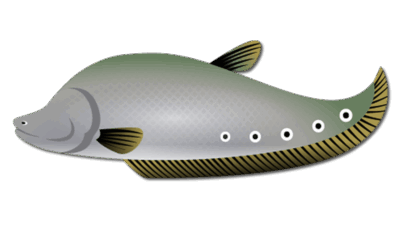
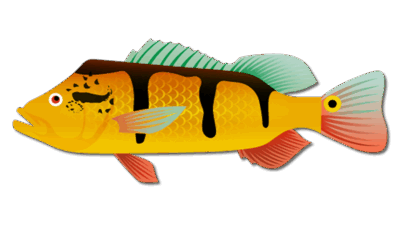
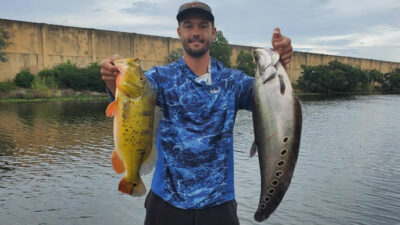
Oscar fish share South Florida waters with several other introduced species, including peacock bass, Mayan cichlids, clown knifefish and tilapia. Oscars are distinguished by their deep cichlid body, heavy mucus coat, orange-to-red markings and the prominent eyespot near the tail.
For a broader trip-planning view, explore our fishing spots guide and South Florida lake and canal pages. The related Places, Lakes and Fishing Guides shown on this page are selected from BassOnline’s structured location system.