
The difference between a frustrating weekend and a career-defining trophy usually comes down to one thing: knowing exactly where the "hot" water is right now. You’ve likely spent hours wondering, what are the best lakes for bass fishing in the United States? It’s a fair question, especially when you’re worried about showing up to a famous destination only to find it’s been pressured to death. I’ve spent my life on these waters, and I know that sinking feeling of uncertainty when you’re staring at an unfamiliar map with a boat full of the wrong gear.
I’m going to clear the fog and give you the ultimate bucket-list of bass lakes for 2026. This isn’t just a generic list; it’s a field-tested breakdown of where the giants are moving and how to catch them. You’ll learn the pro strategies needed to succeed, including how to rig the latest "urchin" style baits and why the new Shimano Curado 150 M is a game-changer for these fisheries. We’re covering everything from seasonal timing to the specific structure types that hold the biggest fish. By the time you’re done reading, you’ll have a clear shortlist and the confidence to book a pro guide for your next big adventure.
Key Takeaways
- Identify biological markers, such as forage availability and habitat, that create a “perfect storm” for growing massive trophy bass.
- Get the inside scoop on what are the best lakes for bass fishing in the United States, from the grass-matted flats of Lake Okeechobee to the deep ledges of Lake Erie.
- Learn why targeting specific seasonal windows like the pre-spawn is your most reliable path to landing a personal best in 2026.
- Discover how to use advanced electronics for summer ledge fishing to locate offshore schools that most anglers miss.
- Gain the confidence to book a guided fishing trip to safely navigate massive fisheries and unlock local secrets that aren’t found on standard maps.
Table of Contents
-
Defining the Gold Standard: What Makes a Top Bass Lake in 2026?
-
The Heavy Hitters: America’s Most Iconic Largemouth Destinations
-
Planning Your Bucket List Trip: Seasonal Strategies and Gear
-
Elevate Your Odds: Why a Professional Guide Changes the Game
Defining the Gold Standard: What Makes a Top Bass Lake in 2026?
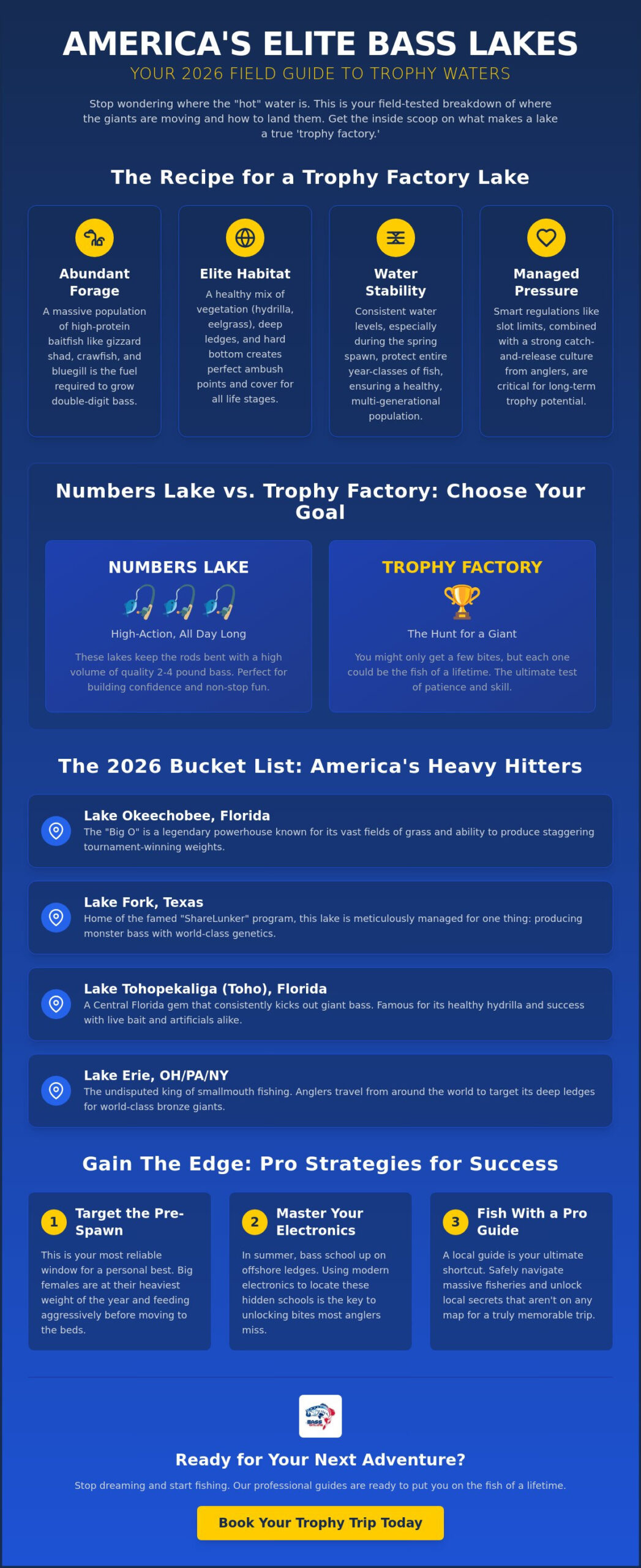
When you ask, what are the best lakes for bass fishing in the United States?, you aren’t just looking for a list of names. You’re looking for a biological "perfect storm" that consistently produces heavy bags and personal bests. A truly elite fishery in 2026 is defined by its ability to sustain massive growth through stable water levels and a diverse forage base. It’s about the bait. If a lake doesn’t have a massive population of shad, crawfish, and bluegill, those fish simply won’t have the fuel to reach double-digit weights. I’ve seen legendary spots fade because the forage disappeared; longevity is built on the food chain.
You also need to decide if you want a "numbers lake" or a "trophy factory" for your next trip. A numbers lake keeps the rods bent all day with three-pounders, while a trophy factory might only give you five bites, but they’ll all be giants. The 2026 weather patterns have shifted traditional spawning grounds in many regions. Early warm fronts in the South have pushed fish to the beds sooner than usual, while late ice-outs in the North are compressing the pre-spawn window. Understanding these shifts is the first step in planning a successful expedition.
The Biology of a Big-Bass Factory
Vegetation is the heartbeat of a great lake. Submerged grass such as hydrilla and eelgrass creates elite ambush points where bass can hide and fatten up. These plants also oxygenate the water and provide cover for fry. Water management plays a huge role too. If lake levels fluctuate too wildly during the spring, it can wipe out an entire "year-class" of fish. We look for lakes where the water stays stable enough for the spawn to succeed year after year. This creates a healthy population of fish at every stage of their life cycle, ensuring the history of bass fishing continues to thrive with new generations of trophies.
Tournament Data vs. Everyday Angler Reality
I always tell my clients to look past the pro tournament headlines. A pro might bring in 30 pounds in a day, but they’re often using advanced technology and practice time that most weekenders don’t have. Instead, look at the "pounds per day" stats across the entire field. If the middle of the pack is still catching 15 to 20 pounds, that lake is healthy for everyone. Maintaining these top spots depends heavily on a strong catch-and-release culture. In 2026, we’ve seen a resurgence in tournament participation, which means more eyes on the water. Protecting the resource is what keeps these lakes on the "best of" lists for the long haul.
-
Forage: High-protein baitfish like gizzard shad are essential for 10-pound bass.
-
Habitat: A mix of hard bottom, deep ledges, and thick vegetation.
-
Pressure: Elite lakes manage angler pressure through size limits and conservation.
The Heavy Hitters: America’s Most Iconic Largemouth Destinations
If you’re serious about your pursuit of giants, you’ve probably asked yourself: what are the best lakes for bass fishing in the United States? The answer usually starts with a few legendary names that have defined the sport for decades. These aren’t just places to fish; they’re bucket-list destinations where every cast could connect you with a double-digit lunker. From the sprawling grass flats of the South to the volcanic shores of the West, these "Heavy Hitters" represent the gold standard of largemouth habitat and genetics.
I’ve spent years navigating these waters, and I can tell you that each fishery has its own soul. Lake Tohopekaliga (Toho) in Central Florida, for example, is famous for producing massive tournament bags that leave even the pros shaking their heads. Then there is the legendary Lake Fork in Texas. It’s the home of the ShareSunker program, where Texas Parks and Wildlife works with anglers to breed the state’s biggest fish. If you check Bassmaster’s Central US lake rankings, you’ll see why Fork remains a top-tier destination year after year. Just remember the 16- to 24-inch slot limit there; any bass in that range goes right back in the drink to keep the population healthy.
Lake Okeechobee: The Florida Powerhouse
Mastering the ‘Big O’ using Lake Okeechobee bass fishing strategies is about reading the grass. This lake is the reigning king of Florida’s grass-fishing culture. You have two main choices: punching heavy mats of hyacinth and lettuce with a 1.5-ounce weight or fishing the outside edges of the bulrushes with a moving bait. The winter and early spring months offer your best window for a double-digit Florida largemouth. Keep in mind that current 2026 regulations allow you to keep five fish, but only one can be 16 inches or longer. This protects the big mamas that make this lake so special.
Clear Lake and Lake Fork: West vs. Central
Clear Lake, California, is often called the ‘Bass Capital of the West’ for good reason. The water is incredibly fertile, and the fish grow fast. To succeed here, you need to be comfortable throwing big swimbaits. It’s a different game than the stained timber of Lake Fork. While Fork anglers are meticulously picking apart flooded trees with jigs or Texas rigs, Clear Lake anglers are often targeting rocky points and docks in much clearer water. Both lakes have a five-fish daily limit, but Clear Lake requires a 12-inch minimum. If you’re ready to cross one of these off your list, you can reach out to our team to start planning your next expedition.
Beyond Largemouth: Smallmouth and Spotted Bass Hotspots
While the Florida-strain largemouth usually steals the headlines, many anglers prefer the relentless fight of a smallmouth or the aggressive nature of a spotted bass. If you’re asking what are the best lakes for bass fishing in the United States for pure, unadulterated fighting power, you have to look toward the Great Lakes and the deep Southern reservoirs. These fisheries offer a completely different tactical experience than the grass-matted lakes we discussed earlier. You’re trading thick mats for deep rock piles and heavy current.
Lake Erie and the St. Lawrence River: Smallmouth Heaven
Lake Erie is a world-class smallmouth fishery that delivers unmatched consistency year after year. When you’re out on Lake Erie fishing trips, you’re often targeting fish in 20 to 40 feet of water. My go-to technique here is drop-shotting. A small, natural-colored plastic on a light leader is lethal when you find those deep-water rock piles. However, you have to respect the "Great Lakes weather" factor. These inland seas can turn from glass to six-foot swells in minutes. You don’t want to be caught five miles offshore when a North wind kicks up.
If you want to see where the heaviest smallmouth bags are coming from right now, look at the St. Lawrence River. The current is the heartbeat of this river. Smallmouth use rock structures and bottom depressions as breaks from the flow to ambush baitfish. It’s a game of precision. If your bait isn’t drifting naturally through those breaks, you’re missing fish. The water is incredibly clear, making it a visual and technical challenge that’s hard to beat for any serious angler.
Lake Guntersville and the Southern Spotted Bass Surge
Moving south, Lake Guntersville remains an Alabama legend. While it’s world-famous for its largemouth, the Tennessee River system has seen a massive surge in spotted bass populations. Fishing the famous ledges of Guntersville requires a solid understanding of current and electronics. When the dams are pulling water, the fish stack up on the upstream side of these underwater cliffs. It’s a high-energy environment where a heavy jig or a deep-diving crankbait can produce a fish on every cast during the peak bite.
Lure selection for Guntersville’s pressured but productive grass beds is also changing. I recommend downsizing your presentation when the bite gets tough. A subtle swim jig or a finesse worm can often trigger a strike from fish that have seen a thousand standard lures. We’re also seeing Lake Hartwell emerge as a rising star for trophy-sized spotted bass. These fish love deep, clear water and are often found chasing nomadic schools of herring. Successful anglers here use long-distance casting to reach schools before the boat spooks them.
Planning Your Bucket List Trip: Seasonal Strategies and Gear
Choosing what the best lakes for bass fishing in the United States are is only half the battle. You have to show up when the bite is actually on. I’ve seen guys fly across the country to a legendary lake only to find the fish in a post-spawn slump. Timing is everything. The pre-spawn window is your absolute best chance at a true double-digit giant. During this time, female bass are at their heaviest weight and move into shallow areas to prepare for the spawn. It’s a high-energy period where big fish are vulnerable and aggressive.
As the year progresses, your tactics must shift. Summer is the season of the ledge. I spend most of my time staring at side-imaging and forward-facing sonar to find offshore schools holding on deep structure. When the water cools in the fall, those fish follow the shad into the creek arms for a feeding frenzy. By winter, things slow down. You have to be patient and use finesse techniques in deep wintering holes. The fish are lethargic, but they’re often grouped up, meaning once you find one, you’ve found the motherlode.
Timing Your Visit for Maximum Success
The "Golden Month" depends entirely on your latitude. For Florida’s shallow lakes like Okeechobee, you want to be there between January and March. On these waters, moon phases are critical. A full or new moon often triggers a massive wave of fish to move onto the beds. In the North, the prime window shifts to June and July. Watch your water temperature gauges closely. When that water hits the 55 to 65 degree range, the big mamas are going to be on the move. Don’t ignore the local reports; a late cold front can stall the bite for days.
Gear Up: Tactical Selection for Diverse Water
Success in bass fishing requires a versatile arsenal. If you’re traveling, I recommend a few 7-foot medium-heavy rod setups that can handle everything from a jig to a swimbait. My "Big Three" lure list for any top-tier lake includes a heavy flipping jig, a lipless crankbait for searching, and the new 2026 "urchin" style soft plastics that have been dominating the tournament scene. For reels, something like the Shimano Curado 150 M offers the lightness and drag power needed for these heavy hitters.
-
Electronics: Use side-imaging to scan large flats and locate isolated rock piles or brush.
-
Line: Switch to heavy fluorocarbon for deep ledges and braided line for thick vegetation.
-
Versatility: Don’t get married to one technique. If the topwater bite isn’t happening, be ready to drop a finesse rig.
Navigating a massive reservoir can be intimidating if you’re on your own. If you want to skip the steep learning curve and get straight to the trophy fish, book a trip with our expert guides today.
Elevate Your Odds: Why a Professional Guide Changes the Game
You’ve done the research. You finally have a feel for what are the best lakes for bass fishing in the United States. But showing up at the boat ramp of a 150,000-acre reservoir like Lake Okeechobee or the vast, inland sea of Lake Erie is a different beast entirely. It’s easy to get that "lost at sea" feeling when every grass line or rocky point looks identical for miles. A professional guide doesn’t just keep you safe in big water; they eliminate the hours of unproductive "searching" that eat up your valuable vacation time. We spend over 300 days a year on these lakes, meaning we know exactly where the fish moved after last night’s cold front.
The real value of a guide is access to "secret" spots that simply don’t show up on standard Navionics maps. These are the isolated rock piles, subtle bottom transitions, or hidden springheads that have been found over decades on the water. Beyond the spots, you’re also stepping onto a boat equipped with the best technology available in 2026. From forward-facing sonar to professional-grade rods and reels, we provide the tools you need to land a trophy without you having to haul your entire tackle room across the country.
Mastering Local Techniques with Bass Online
One of the biggest benefits of our fishing guides is how they shorten your learning curve. You aren’t just paying for a ride; you’re paying for a masterclass in local patterns. Whether it’s learning the exact retrieve speed for a swim jig in Florida or how to vertical fish a drop-shot in the Great Lakes, these are skills you take back to your home water. We tailor every trip to your specific goals. If you want to catch 50 fish a day, we’ll head to the numbers spots. If you’re hunting for one giant, we’ll grind it out in the trophy zones. Every Guided Bass Fishing Trip is an insider journey led by the best in the business.
Booking Your 2026 Adventure
When you’re ready to pull the trigger on a bucket-list trip, research is your best friend. Look for guides with deep roots in the specific region you want to fish. Planning your logistics around peak seasonal bites is the smartest move you can make. For example, if you want the heavy-bodied pre-spawn fish, you should be looking at our Lake Okeechobee Bass Fishing Trips for the early spring months. Finding what are the best lakes for bass fishing in the United States is the first step, but being on the right spot at the right time is what puts you in the record books. My final takeaway is simple: the best lake is the one you’re currently fishing with the right expertise by your side.
-
Safety First: Expert navigation on massive, unfamiliar water systems.
-
Elite Gear: Access to the latest 2026 reels, rods, and sonar technology.
-
Local Secrets: Fishing spots and patterns not found in any app or magazine.
-
Educational Value: Techniques you can apply to your own fishing for years to come.
Claim Your Spot on the Best Bass Water in America
You now have the roadmap to the most productive fisheries in the country. Whether you’re punching heavy mats on the "Big O" or drop-shotting deep rock piles in the Great Lakes, deciding what are the best lakes for bass fishing in the United States? is the first step toward a successful season. Success comes down to matching your technique to the environment and hitting the water during those critical pre-spawn windows. Don’t let another year pass by while you’re stuck guessing which ledge to scan or which gear to pack.
At BassOnline, we bring over 25 years of professional guiding experience to every outing. We offer exclusive access to the most iconic lakes in Florida, Alabama, and beyond. This is all backed by top-rated reviews from thousands of successful anglers who have seen the results firsthand. We handle the navigation and the gear so you can focus entirely on the fight. It’s time to stop looking at maps and start landing trophies. Book your bucket-list bass fishing trip with the pros at Bass Online!
The fish are waiting. Let’s get out there and make it happen.
Frequently Asked Questions
What is the best month to go bass fishing in the United States?
The best month depends on your target region and the local spawn cycle. For Southern waters like Florida, January through March is the peak window for landing a true trophy. In Northern states, June and July offer the most consistent action as fish move into aggressive post-spawn patterns. I always watch for water temperatures between 55 and 65 degrees. That is when bass are most active and likely to strike.
Which lake holds the most 10-pound bass in the US?
Lake Fork in Texas is widely considered the top destination for double-digit bass. Thanks to the ShareSunker program, it consistently produces fish over 13 pounds year after year. When asking what are the best lakes for bass fishing in the United States for pure size, Fork and Florida’s Lake Okeechobee are always at the top. These fisheries have the perfect mix of genetics and high-protein forage to grow giants.
Do I need a different fishing license for every state?
Yes, you must purchase a separate license for each state where you plan to fish. For 2026, a resident freshwater license in Texas costs $30, while non-residents pay $58. In Florida, residents pay $17, and non-residents pay $47. California is higher, with a 365-day resident license costing $64.54. Always check state wildlife agency websites for the most current regulations and short-term permit options before you launch.
What is the best state for bass fishing in 2026?
Florida remains the premier state for bass fishing in 2026 due to its year-round season and massive variety of trophy waters. From the grass flats of the Kissimmee Chain to the peacock bass canals in Miami, it offers unmatched opportunities. Tournament participation has seen a resurgence across the country this year. Florida’s fisheries continue to dominate the leaderboards with heavy bags and high-impact catches that attract anglers from around the globe.
Can I catch trophy bass without a boat on these top lakes?
You can catch trophy bass from the bank, but a boat gives you a massive tactical advantage. Many top lakes have public piers or accessible shorelines, especially in the Florida Everglades or along the St. Lawrence River. However, the biggest fish often hold on offshore ledges or deep grass lines that are impossible to reach from land. A boat allows you to use electronics to find these hidden schools effectively.
What is the difference between fishing for Largemouth and Smallmouth?
Largemouth and smallmouth require different tactics because they thrive in different habitats. Largemouth prefer shallow, warm water with heavy vegetation like hydrilla or lily pads. Smallmouth are known as "brown fish" that prefer deep, cool water with rocky bottoms and current. While a largemouth will try to pull you into the thick weeds, a smallmouth is famous for its aerial acrobatics and relentless stamina in open water.
How much does a professional bass fishing guide cost?
Professional guide rates depend on the specific lake, the length of the trip, and how many people are in your group. Most charters include the use of a high-end bass boat, professional-grade tackle, and years of local expertise. While I don’t provide a single price here, the investment pays for itself by skipping the steep learning curve. You should check the latest rates for your chosen destination when planning your 2026 adventure.

Article by
Mr Bass
Todd Kersey, widely known as Mr. Bass by Field & Stream, is a professional angler, accomplished author, and dedicated philanthropist with a lifelong passion for bass fishing. Armed with a degree in Outdoor travel, Mr. Bass has expertly combined his knowledge with his practical fishing experience to become one of the most respected names in the bass fishing, his deep understanding of bass habitats, and fish behavior has earned him numerous accolades as a asset of the sport. Serving 8 years as FWC Stakeholder Chairperson. Leading and passing cutting-edge legislation, such as the Black Bass Management plan, and successfully building, passing, and financing the Trophy Catch program. As CEO, he is committed to giving back to the community through his philanthropic efforts. He supports a variety of causes, especially those centered around physical disabilities. Through his advocacy, his mentorship programs inspire anglers to engage in fishing stewardship, helping to raise more than $ 18 million in donations. Mr. Bass continues to inspire anglers and outdoor enthusiasts alike with his commitment to the sport and the world around him.