
What if the "guaranteed" lures filling your tackle box are actually the reason you’re coming home with an empty livewell? It’s a frustrating reality for many, but the truth is that bass fishing isn’t about having the most expensive gear; it’s about mastering the predator’s biological mindset. I know the feeling of watching hours tick by without a single thump on the line while your "proven" baits go unnoticed. It’s draining to invest your hard-earned money and time only to feel like you’re guessing every time you cast.
In addition to your tackle, having the right way to transport your equipment or keep your catch fresh is vital; click here to explore Kuta Gear’s professional-grade insulated storage solutions.
I’m here to help you stop the guesswork and start triggering aggressive strikes by understanding the specific triggers that trophy lunkers can’t resist. Whether you’re fishing a local pond or legendary waters like Lake Okeechobee, you’ll gain the confidence to choose the right lure for any condition. We’ll break down the 2026 "fuzzy" bait revolution, explain how water temperature dictates movement, and review the latest gear like the $149.99 Lew’s Accel RX combo to ensure your next expedition is a world-class success. Get ready to turn those slow days into a consistent run of trophy hawgs.
Key Takeaways
- Understand how to trigger aggressive strikes by tapping into the natural predatory instincts of Largemouth, Smallmouth, and Spotted species.
- Simplify your gear by focusing on quality setups that match your rod power to specific lure weights for maximum efficiency.
- Master bass fishing year-round by learning to track seasonal migrations based on water temperature and the search for forage.
- Locate trophy hawgs faster by identifying the “edges” where underwater structure meets heavy cover.
- Improve your catch rate instantly by slowing down your retrieve and applying the “Let it Sit” rule to fool wary fish.
Table of Contents
-
Mastering the Basics: Why Bass Fishing is America’s Favorite Sport
-
Essential Gear: Building a Pro-Level Bass Fishing Tackle Box
Mastering the Basics: Why Bass Fishing is America’s Favorite Sport
There is a reason why bass fishing dominates the American outdoors. It isn’t just a hobby; it’s a high-stakes chess match played out under the surface of every pond, creek, and reservoir in the country. To get started, you need to understand the bass fishing basics, which involve the pursuit of three primary black bass species: the Largemouth, the Smallmouth, and the Spotted bass. Whether you’re casting into a tiny farm pond or navigating the massive expanse of Lake Erie, the thrill remains the same.
You don’t need a $100,000 fiberglass boat to land a legendary lunker. Some of the biggest hawgs I’ve ever seen were caught by anglers standing on a muddy bank with a simple spinning rod. The secret isn’t in the price tag of your gear. It’s in your ability to outsmart a creature that has survived for millions of years by being a perfect killing machine. To better understand the fundamentals of getting started, watch this helpful video:
Understanding the Species: Largemouth vs. Smallmouth
Knowing your target is half the battle. Largemouths are the heavyweights of the weed beds, easily identified by a jaw that extends past the eye and a dark horizontal stripe. They love the warm, stagnant water of the Everglades. Smallmouths, often called "bronzebacks," prefer the cool current and rocky bottoms of northern rivers. Their jaw is shorter, ending before the eye, and they sport vertical bars rather than a stripe. For a detailed breakdown of these biological differences, check out our comprehensive bass species guide.
The Biology of a Strike: What Drives a Bass to Bite?
Think of a bass as a biological sensor. Their lateral line acts like a high-tech sonar system, detecting minute vibrations from a struggling baitfish or a clicking lure. This is why bass fishing is so addictive; you are trying to trigger a specific predatory response. Strikes usually fall into three categories:
-
Hunger: The fish needs calories to survive.
-
Reaction: A reflex strike caused by a lure moving quickly through their strike zone.
-
Territory: Defending a nesting site or a prime piece of cover from intruders.
A bass’s metabolic rate is directly tied to water temperature, dictating their energy levels and feeding windows. When the water is cold, they’re sluggish and require a slow presentation. When the mercury rises, they become aggressive hunters ready to explode on a topwater plug. Mastering the sport means learning to read these biological cues rather than just guessing which lure looks "pretty" in the tackle shop.
Essential Gear: Building a Pro-Level Bass Fishing Tackle Box
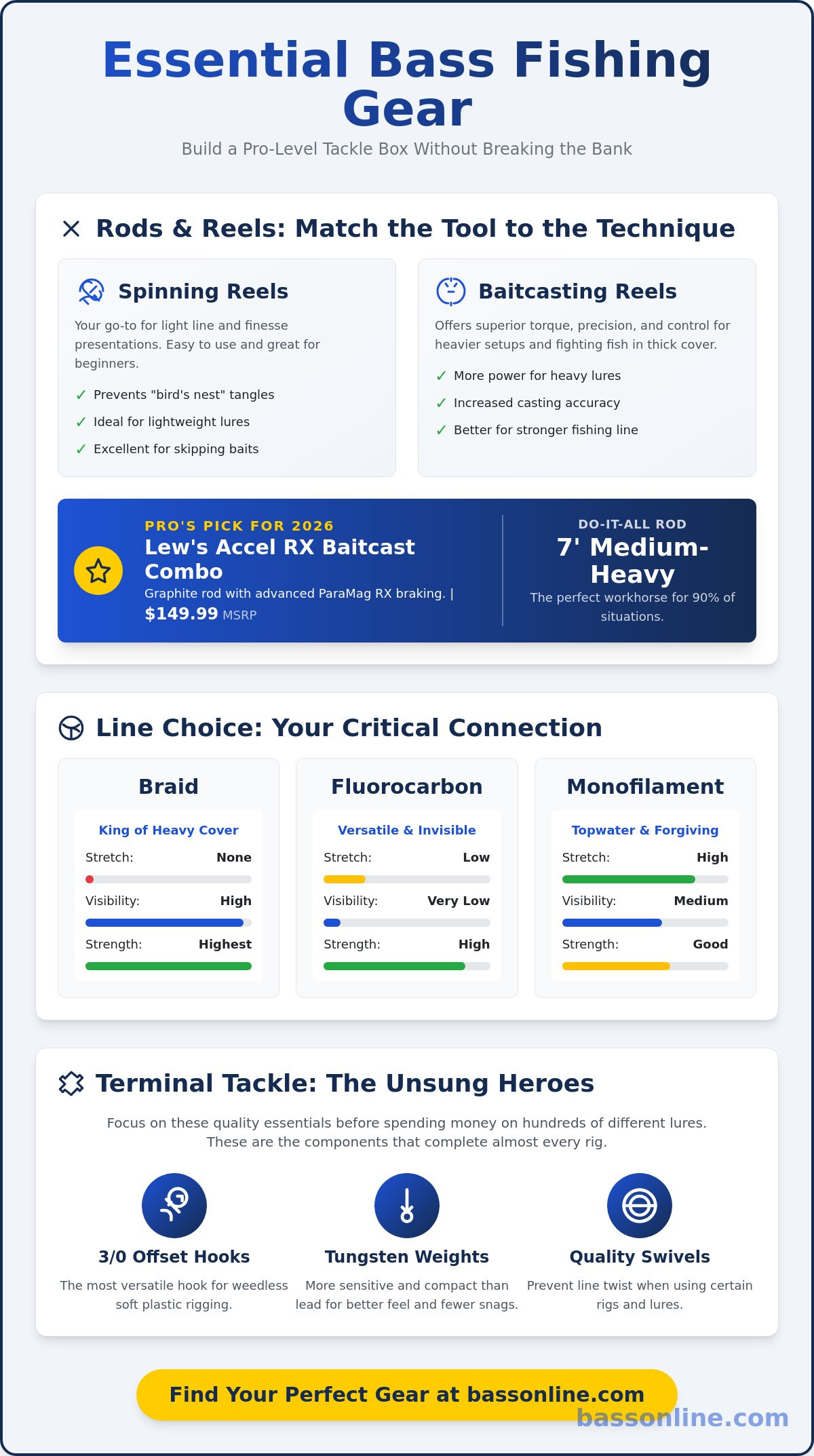
Walking into a tackle shop can be overwhelming. Rows of shimmering plastic and high-tech graphite rods make it feel like you need a fortune to get started. I’m here to tell you that’s a myth. Successful bass fishing isn’t about having the most gear; it’s about having the right gear for the job. You only need a few versatile setups to cover 90% of the situations you’ll face on the water. Focus on terminal tackle essentials like 3/0 offset hooks, tungsten weights, and quality swivels before chasing every flashy new lure on the shelf.
Rods and Reels: Matching Your Setup to the Technique
Your rod and reel are the tools of your trade. Spinning reels are your best friend for light line and finesse techniques. They’re easy to use and prevent the dreaded "birds nest" tangles. Baitcasting reels, however, offer the torque and precision needed for heavy lures and thick cover. If you’re just starting out, a 7-foot medium-heavy rod is the "do-it-all" workhorse. It has the power to pull a lunker out of the weeds and a fast action tip that bends quickly, giving you better sensitivity. For 2026, the Lew’s Accel RX Baitcast Combo is a premier choice at an MSRP of $149.99, featuring a graphite rod and advanced ParaMag RX braking to keep your casts smooth.
Line Choice: Monofilament, Fluorocarbon, or Braid?
Choosing the right line is as critical as the lure itself. Braid is the undisputed king for heavy cover and lily pads because it has zero stretch and cuts through vegetation like a saw. Fluorocarbon is nearly invisible underwater and sinks, making it perfect for clear water and bottom-bouncing rigs. It also helps you stay in tune with seasonal bass patterns when fish move to deeper, clearer structure. Monofilament is the old-school favorite for topwater lures. Its natural stretch acts like a shock absorber, preventing you from ripping the hook right out of a hawg’s mouth when it explodes on the surface.
Lure Selection: The Big Four Every Angler Needs
You don’t need a thousand lures. Stick to the "Big Four": soft plastics like the new $5.99 Z-Man FattyZ, moving baits like spinnerbaits, topwater ploppers, and jigs. For a deep dive into specific brands, check out The Best Bass Lures of 2026 . Follow the golden color rule: use natural greens and browns in clear water, but switch to dark blacks or vibrant chartreuse when the water gets muddy. If you want to go even deeper on selecting the right presentations for your target species, our guide to largemouth bass fishing lures breaks down exactly how each bait interacts with water physics and fish metabolism. If you’re ever unsure about which setup to bring on your next trip, ask a local pro guide for a recommendation based on current lake conditions. Mastering these basics ensures you’re ready for bass fishing success on any body of water.
Seasonal Bass Fishing Patterns: Where the Fish Go and Why
To catch fish consistently, you have to stop thinking like a human and start thinking like a predator. Bass are governed by their environment. Their lives revolve around two simple goals: finding comfort and finding food. This seasonal migration is a predictable cycle that dictates where the fish live during every month of the year. Whether you are targeting lunkers in the North or exploring the year-round opportunities in different states , the biological triggers remain the same. I tell every client that the best tool they own isn’t a lure; it’s a fishing log. Tracking water temperature and weather patterns year over year is how you turn a lucky day into a lifetime of success.
Spring and the Spawn: The Hunt for Trophy Lunkers
Spring is the "Triple Crown" of bass fishing. It starts with the pre-spawn, where big females move from deep winter haunts to staging areas. These are often secondary points or the mouths of creeks where they wait for the water to hit that magic 60-degree mark. Once it warms up, they move to the shallow flats to spawn. You’ll see beds, which look like light-colored dinner plates on the lake floor. This is the best time to land a personal best, but remember the ethics of the sport. Getting those fish back in the water quickly ensures the population stays healthy for the millions of anglers who enjoy the water every year. After the spawn, fish move to deeper cover to recover, requiring more subtle pro bass fishing techniques to trigger a bite.
Summer and Winter: Surviving the Extremes
When the seasons hit their extremes, the game changes entirely. In the heat of summer, oxygen becomes the priority. Bass will look for moving water or deep, cool ledges where they can find relief from the sun. If you aren’t finding them shallow in the morning, move to those offshore structures. In the winter, everything shifts into low gear. During the winter months, a bass’s digestion slows significantly, meaning they may only feed once every few days. This is when you have to slow down your retrieve until it’s agonizingly slow. Use smaller finesse baits and wait for that subtle "tick" on the line. Mastering bass fishing in these tough windows is what separates a weekend warrior from a seasoned pro who can produce results regardless of the weather.
Cracking the Code: Finding Bass in Different Water Types
Finding fish is the biggest challenge for any angler. You can have the best lures in the world, but they’re useless if you’re casting into an underwater desert. To find the hawgs, you must distinguish between cover and structure. Cover refers to physical objects like lily pads, fallen trees, or docks. Structure refers to the actual "lay of the land" on the lake bottom, such as points, ledges, or submerged creek channels. Bass are legendary edge predators. They position themselves where two types of terrain meet, like a weed line next to a deep drop-off, to ambush unsuspecting baitfish.
Don’t be afraid of a little breeze. The wind-blown bank is often the most productive spot on the lake. Wind pushes plankton toward the shore, which attracts baitfish, which in turn brings in the lunkers. It also breaks up the surface tension, making it harder for the fish to see you or your boat. You can explore the unique underwater layouts of legendary waterways by browsing Bass Online Lakes to plan your next attack based on real-world structure data.
Fishing Heavy Cover: Grass, Reeds, and Lily Pads
When the sun is high, bass look for one thing: shade. Thick vegetation like hydrilla or lily pads acts as a natural umbrella, keeping the water cooler and providing a perfect hiding spot. To reach these fish, you’ll need to master "punching." This involves using a heavy tungsten weight, often 1 ounce or more, to force a soft plastic lure through the matted grass. A weedless Texas-rigged worm is the gold standard here. It slides through the stalks without snagging, putting your bait right in front of a trophy’s nose where other lures simply can’t go.
Identifying Hard Structure: Points, Drop-offs, and Ledges
Hard structure is the permanent roadmap of a lake. A "point" is a piece of land that extends into the water, acting as a natural highway for fish migrating between deep and shallow areas. Drop-offs and ledges are even more critical; they serve as safety zones. Bass love to sit on the edge of a ledge where they can move from 5 feet to 20 feet of water with just a few tail kicks. While many pros rely on expensive sonar units, you can find these spots manually. Drag a heavy 1/2-ounce jig along the bottom. If the line feels "mushy," you’re in silt. If you feel a crisp "thump," you’ve found the hard rock or gravel where big bass love to congregate. If you’re ready to see these tactics in action on the water, book your next trophy hunt with a pro guide today.
Pro Techniques: How to Execute the Perfect Retrieve
You can buy the most expensive lures in the shop, but they’re just plastic and metal until you give them life. In bass fishing, the retrieve is your signature. The biggest mistake I see on the water is reeling too fast. Bass are opportunistic, but they’re also lazy. If a bait looks like it’s sprinting for its life, a lunker might decide it’s not worth the energy. Adopt the "Let it Sit" rule. After your lure hits the water, wait for the ripples to disappear before your first movement. That initial pause is often when a curious fish decides to strike.
When you finally feel that "thump," don’t just start reeling. You need a crisp, authoritative hook set. Point your rod tip toward the fish, reel in the slack, and snap the rod upward or to the side. This ensures the hook penetrates the hard jaw before the fish can spit it out. Experiment with your cadence. Sometimes a steady crawl works, but a "twitch-twitch-pause" rhythm often triggers a reaction strike from a fish that was just following the bait. This variation mimics a wounded baitfish, which is an irresistible dinner bell for a predator.
Power Fishing: Covering Water to Find Aggressive Bites
Power fishing is all about efficiency. Use fast-moving baits like chatterbaits or crankbaits to find where the active fish are holding. I recommend the "fan casting" method: imagine the water in front of you is a folding fan. Cast to the far left, then slightly more center, and continue until you’ve covered the entire 180-degree area. This helps you locate schools of fish quickly without wasting time on unproductive water. If the sun is low or the water is calm, check out our guide on Mastering Topwater Bass Lures for some of the most explosive strikes you’ll ever witness.
Finesse Tactics: Triggering Stubborn Bass
When the sun is high or the lake is crowded with other anglers, it’s time to slow down. Finesse fishing uses light line and tiny, natural-looking lures like Ned rigs or drop shots. This is where "dead-sticking" comes into play. Cast your lure near a dock or a weed edge and let it sit motionless for 10 to 15 seconds. It feels like an eternity, but to a wary bass, a bait that isn’t moving looks like an easy, injured meal. This subtle approach often produces bites when nothing else is working. For a complete breakdown of which largemouth bass fishing lures work best for finesse presentations versus power fishing applications, our 2026 pro guide covers the full spectrum of field-tested options.
The Takeaway: Your Next Steps on the Water
Successful bass fishing is a mindset. If you find the food and the comfort, you’ll find the fish. It takes time to master these nuances, but you don’t have to do it alone. Booking a professional fishing guide is the fastest way to flatten the learning curve and get on the meat. You’ll learn more in four hours with a pro than in four months on your own. Before you head out for your next cast, always double-check your knots and sharpen those hooks. A dull hook is the fastest way to lose the lunker of a lifetime. Now, get out there and set the hook!
Hit the Water with Confidence
You’re now equipped with the field-tested tactics needed to turn a quiet day into a legendary expedition. Success in bass fishing isn’t just about luck; it’s about mastering the biological triggers of the predator. By matching your gear to the 2026 "fuzzy" bait trends and identifying the specific "edges" where trophy lunkers hide, you’ve gained a massive advantage over the average angler. Remember to let your lure sit and always trust the seasonal migration patterns we’ve discussed.
Theory is a great start, but nothing beats an insider experience led by the best in the business. Bass Online is the largest freshwater guide service in the United States, bringing over 25 years of professional experience to every trip. We even offer a "No Fish, No Pay" guarantee on select outings to ensure your success. Book Your Pro-Guided Bass Adventure with Bass Online Today! It’s time to stop guessing and start catching; I’ll see you out on the water for your next big catch.
Frequently Asked Questions
What is the best time of day for bass fishing?
Bass are most active during the transition periods of dawn and dusk when light levels are low. These low-light windows provide a tactical advantage for predators to ambush prey. If you are bass fishing during the high sun of mid-day, look for oxygen-rich areas or heavy shade under docks and lily pads. Water temperature also plays a role, as fish often move deeper to find a comfortable temperature when the surface heats up.
Do I need a boat to be successful at bass fishing?
You definitely don’t need a boat to land a trophy. Bank fishing is highly effective, and many of the largest lunkers are caught in shallow water within casting distance of the shore. Focus on accessible spots like public piers, dam tailwaters, or local ponds. Use a 7-foot rod to maximize your casting distance and reach those offshore weed lines where big fish like to patrol for baitfish.
What is the best lure for a beginner to start with?
A Texas-rigged soft plastic worm is the absolute best starting point for any novice. This setup is virtually weedless, meaning you won’t spend your day snagged on logs or grass. It also teaches you the essential skill of feeling the bottom and detecting a subtle strike. For a modern 2026 option, the Z-Man FattyZ is a durable choice that stands up to multiple aggressive bites without tearing.
Is catch and release mandatory in bass fishing?
Mandatory catch and release depends entirely on your local state regulations. For instance, the Minnesota Department of Natural Resources established a year-round catch-and-release season for inland waters in February 2026. In contrast, Texas parks and wildlife regulations for the 2025-2026 season allow a daily bag limit of 5 fish. Always consult your current 2026 fishing digest to verify the specific harvest rules for the lake you are visiting.
What is the difference between a largemouth and a smallmouth bass?
The primary differences are jaw length and coloration. A largemouth’s jaw extends past the back of its eye, while a smallmouth’s jaw stops before it. Largemouths typically have a dark horizontal stripe and prefer warm, weedy habitats. Smallmouths usually sport vertical bars and thrive in cooler, rocky current. Understanding these traits helps you choose the right gear, like the Ugly Stik Elite Spinning Combo, which handles both species with ease.
How do I know if a bass is ‘on the bed’ during the spawn?
You can identify a nesting bass by looking for light-colored, circular patches on the lake floor in shallow water. These "beds" are areas where the fish has cleared away silt and debris to expose a hard bottom. You will often see the fish hovering directly over the center or aggressively chasing away small intruders like bluegills. This behavior indicates they are in the middle of their spring spawning cycle.
What should I do if the bass are jumping but not biting my lures?
When fish are active on the surface but ignore your baits, it’s time to change your lure size or retrieve speed immediately. They are likely keyed in on very specific, small forage. Switch to a "micro" finesse bait or a topwater lure like the Berkley Screamin’ Choppo to match the vibration they expect. If they are jumping to escape predators, try a faster retrieve to trigger a reflex strike from the chasing fish.
How much does a professional bass fishing guide cost?
The cost of a professional guide varies based on the trip duration and the specific waterway you want to explore. Most premier services offer half-day or full-day packages that include the boat, fuel, and all necessary tackle. While prices aren’t fixed across the industry, investing in a guide is the fastest way to master bass fishing. You are paying for years of local knowledge that ensures you find the best spots quickly.

Article by
Mr Bass
Todd Kersey, widely known as Mr. Bass by Field & Stream, is a professional angler, accomplished author, and dedicated philanthropist with a lifelong passion for bass fishing. Armed with a degree in Outdoor travel, Mr. Bass has expertly combined his knowledge with his practical fishing experience to become one of the most respected names in the bass fishing, his deep understanding of bass habitats, and fish behavior has earned him numerous accolades as a asset of the sport. Serving 8 years as FWC Stakeholder Chairperson. Leading and passing cutting-edge legislation, such as the Black Bass Management plan, and successfully building, passing, and financing the Trophy Catch program. As CEO, he is committed to giving back to the community through his philanthropic efforts. He supports a variety of causes, especially those centered around physical disabilities. Through his advocacy, his mentorship programs inspire anglers to engage in fishing stewardship, helping to raise more than $ 18 million in donations. Mr. Bass continues to inspire anglers and outdoor enthusiasts alike with his commitment to the sport and the world around him.