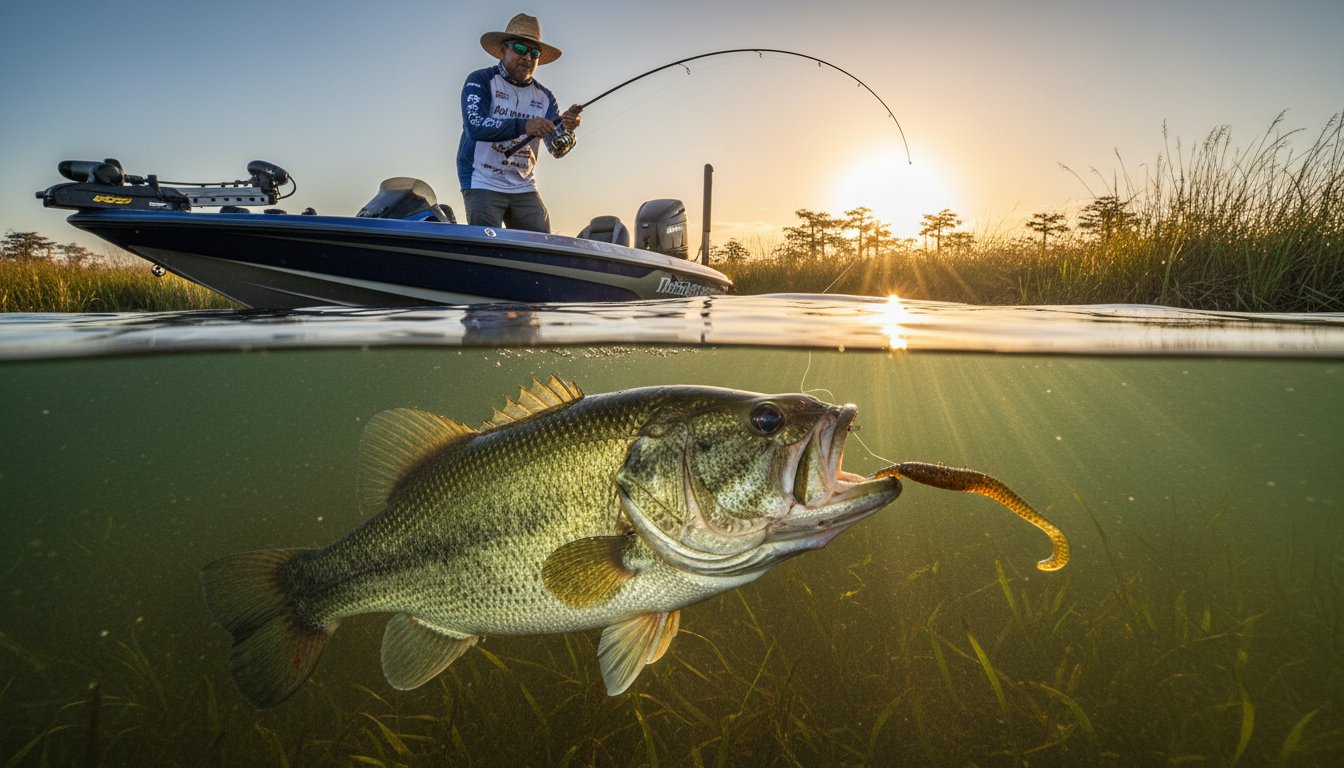

Last Tuesday on Lake Okeechobee, one of our guides watched a 10-pound trophy bass ignore a flashy spinnerbait only to inhale a simple plastic worm that mimicked a dying bluegill. It’s a scene we see often. Even the most aggressive predators won’t bite if the presentation doesn’t match the local menu. You’ve probably spent hundreds of dollars on lures that looked great on the shelf but stayed silent on the water. It’s frustrating to fish a "perfect" spot for three hours without a single thump because you’re offering steak to a fish that only wants shrimp.
This guide will teach you exactly what bass eat across different seasons so you can stop guessing and start matching the hatch like a world-class pro. You’ll master the secrets of the bass food chain to predict their movements and choose the perfect lure for every cast. We are breaking down the natural forage of trophy lunkers from the Everglades to the Great Lakes and showing you how to build a tackle box that triggers a strike every time.
Key Takeaways
-
Learn how the "Gape Limit" rule determines exactly which prey a bass can target, ensuring you always select the right lure size for the job.
-
Master the silver standard of baitfish and crustaceans to understand exactly what do bass eat across different reservoirs and river systems.
-
Discover how to track seasonal shifts, from targeting high-protein crawfish in the spring to following shad spawns into deep-water summer haunts.
-
Apply the "Golden Rule" of matching size, profile, and color to mimic local forage and fool even the most pressured trophy hawgs.
-
Learn the pro-guide secret of using electronics to locate "forage clouds," putting your bait exactly where the biggest fish are actively feeding.
Table of Contents
-
Understanding the Bass Diet: From Opportunistic Scavengers to Apex Predators
-
Seasonal Feeding Patterns: Tracking the Menu Throughout the Year
Understanding the Bass Diet: From Opportunistic Scavengers to Apex Predators
Bass are the ultimate playground bullies of the water. As opportunistic predators, they don’t follow a strict menu. Instead, they attack almost anything that moves and fits inside their mouths. If it’s alive and vulnerable, it’s a target. This survival instinct is why understanding what do bass eat is the first step to becoming a better angler. From small insects to other fish, their diet changes as they grow, but their aggressive nature remains the same.
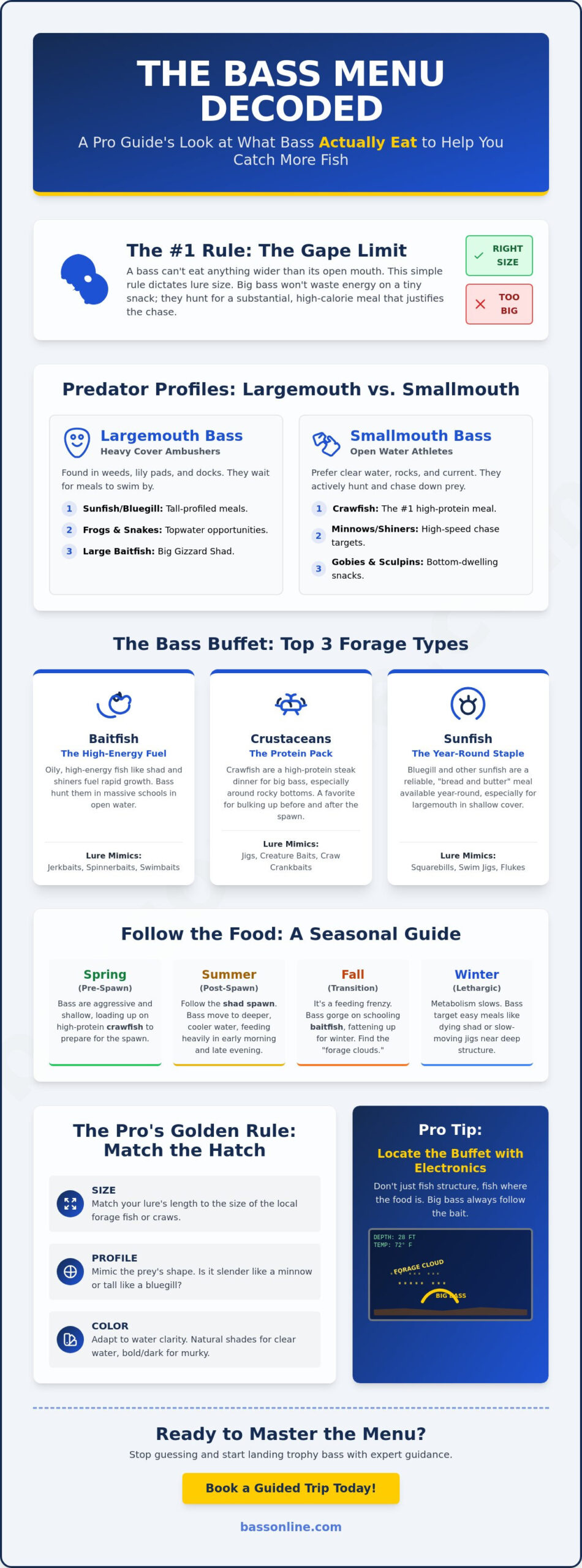
A critical concept every pro guide knows is the ‘Gape Limit.’ This isn’t a complex scientific term; it just means a bass can’t eat anything wider than its open mouth. While a juvenile might snack on tiny aquatic insects, a double-digit trophy is looking for a substantial meal. Caloric efficiency drives this behavior. A lunker won’t burn 50 calories chasing a 5-calorie minnow. It will wait for a high-fat shad or a slow-moving crawfish to ensure the energy gained outweighs the effort spent. The bass diet is a strategic balance between what is easiest to catch and what provides the most energy to survive.
To better understand how these fish target their prey, watch this helpful video:
The Physics of the Strike: Suction Feeding
Bass don’t just bite; they inhale. When a bass opens its mouth rapidly, it creates a powerful vacuum that sucks in water and the prey along with it. This suction feeding happens in milliseconds, allowing them to grab forage from several inches away. Your lure needs to move water to be noticed. Their lateral line, a sensory organ running down their side, picks up vibrations from struggling forage long before they see it. This is why lure weight and water displacement are vital. If your bait doesn’t "feel" like a meal to their senses, they won’t commit to the strike.
Largemouth vs. Smallmouth: Different Menus?
While they share the same family, their dining habits differ based on where they live. Largemouth bass love heavy cover. You’ll find them in lily pads or thick grass looking for frogs, snakes, and big-bodied baitfish like bluegill. According to the Largemouth bass diet, they are highly adaptable, often eating prey that is 25% to 35% of their own body length. They are the kings of the ambush, waiting for a meal to swim by their hiding spot.
Smallmouth are the athletes of the clear water. They prefer high-speed pursuits in open current, chasing down shiners or scouring rocky bottoms for crawfish. Water clarity is the deciding factor here. In murky water, bass rely on vibration and bulk to find food. In gin-clear water, they use their sight to pick out specific colors and realistic profiles. If you want to see more about these different bass species, understanding their specific environments is key. Knowing what do bass eat in your specific lake helps you match the hatch and land more hawgs.
The Primary Menu: Baitfish, Crustaceans, and Forage Species
If you want to land a trophy lunker, you have to think like a predator. Bass are opportunistic feeders, but they don’t just wander around aimlessly hoping for a snack. They target specific high-calorie forage based on the season and the habitat. To answer the question of what do bass eat, we look at the big three: baitfish, crustaceans, and sunfish. According to state-level research on bass diets, their food choices shift as they grow, moving from tiny insects to massive forage like 10-inch shad or even other bass.
Shad represent the silver standard for reservoir and river bass across the country. These oily, high-energy fish move in massive schools and provide the fuel for rapid growth. In smaller ponds, bluegill and sunfish serve as the reliable bread and butter forage. They’re available year-round and provide a consistent meal for every size of bass. If you’re looking for the high-protein steak that triggers aggressive bottom-feeding, look no further than the crawfish. These armored snacks are a favorite for big hawgs looking to bulk up quickly.
Baitfish: The High-Speed Chase
Identifying the specific baitfish in your local lake is critical for lure selection. Gizzard shad can reach sizes over 12 inches, which means you need a massive swimbait to get a big bite. Threadfin shad stay smaller, usually around 2 to 4 inches, making them the perfect target for crankbaits. In the Southeast, especially when targeting a Florida Bass , golden shiners are the king of the food chain. Always watch for nervous water. If you see ripples or flickering silver at the surface, it’s a sign that a school is under attack. Throw your bait right into the chaos for an immediate strike.
Crustaceans: The Secret to Big Bites
Crawfish are more than just a snack; they’re a nutritional powerhouse. Bass go crazy during the molting cycle when these crustaceans shed their hard shells. These soft-shell craws are defenseless and easy to digest. Match your colors to the environment for the best results. Use reds and oranges in the early spring when craws are most active. Shift to olive greens or browns for summer patterns. Focus your efforts on rocky points, clay banks, and rip-rap. These hard structures are prime real estate for crustaceans and the predators that hunt them.
Insects and Amphibians: The Surface Game
The frog bite is legendary for a reason. When summer heat pushes bass into heavy lily pads, a hollow-body frog is your best friend. It mimics the amphibians that live in the thick cover. Don’t ignore smaller snacks either. Massive hatches of dragonflies and mayflies can drive huge surface action, especially in the early morning. Springtime is the peak for salamanders and lizards. This is why creature baits work so well during the spawn. Bass see these as threats to their nests and will crush them with pure aggression. If you’re ready to test these patterns yourself, our pro guides can show you exactly what’s biting right now.
Seasonal Feeding Patterns: Tracking the Menu Throughout the Year
To consistently land a trophy lunker, you have to understand that the underwater menu changes with the calendar. Bass are cold-blooded, meaning their metabolism and appetite are dictated by water temperature. If you want to master what do bass eat, you have to track their seasonal movements. In the spring, it’s all about protein. Bass move into shallow water looking for crawfish to fuel up for the spawn. These high-protein snacks provide the energy needed for the most stressful time of their lives. As the water hits that magic 55 to 65-degree range, the hunt intensifies.
By the time summer peaks, the shallow flats often become too warm. Bass migrate toward deep-water ledges or areas with heavy current to find cooler, oxygen-rich "thermal refugia." They shift their focus to schooling baitfish like shad or blueback herring. When the leaves start to turn in the fall, a massive "Shad Migration" occurs. Bass follow these baitfish into the backs of creeks for a final feeding frenzy to bulk up before the lean winter months. Once winter arrives, their metabolism craters. They won’t chase a meal; they want a slow-moving, easy target that requires minimal effort to swallow.
The Spring Transition and Spawn
During the spawn, bass behavior shifts from pure hunger to defensive aggression. They spend weeks guarding nests in shallow water. Bluegill and crappie are notorious egg-eaters, and a protective parent will strike anything that looks like a threat. You aren’t always fishing for a "hunger strike" here. You’re often triggering an aggression strike. The best baits for this phase include:
-
Bluegill-pattern swimbaits: These mimic the primary nest-raider.
-
Texas-rigged lizards: These look like salamanders that feast on bass eggs.
-
White tubes or jigs: These are easy to see, helping you detect when a bass has moved the lure off the bed.
According to expert insights from Bassmaster, the opportunistic nature of bass means they will capitalize on whatever forage is most abundant in their specific environment. This adaptability is why they thrive in almost every pond, lake, and river across the country.
Summer Heat and Fall Flurry
Summer fishing is a game of depth and current. When the midday sun beats down, big hawgs move to 15 or 25-foot ledges where the water stays stable. You have to slow down. A methodical, crawling retrieve with a large plastic worm or a football jig is the ticket. You’re looking for those "community holes" where shad congregate in the cooler depths. It’s a patient man’s game, but the rewards are world-class.
When the fall transition kicks in, throw the "slow and steady" rule out the window. As shad move toward the backs of creeks, bass become incredibly aggressive. Look for birds diving or bait skipping across the surface. This is the time for fast, erratic retrieves. Use topwater plugs, lipless crankbaits, or spinnerbaits. You want to mimic a fleeing, injured baitfish. If your lure isn’t moving with some speed and flash, you’re likely going to get bypassed by the more active fish in the school.
Matching the Hatch: Choosing Lures Based on Natural Forage
Matching the hatch is the golden rule of professional angling. It means your lure should mirror the size, profile, and color of the local bait exactly. If the lake is full of 3-inch shad, throwing a 10-inch swimbait might scare off more fish than it attracts. To truly master what do bass eat, you need to observe the water before you even tie a knot. Look for flickers of silver near the surface or crawfish shells in the shallows to determine the daily special.
While realism is usually the goal, smart anglers know when to break the rules. In muddy or stained water with less than 12 inches of visibility, natural colors disappear. This is when you reach for "shock" colors like firetiger, neon chartreuse, or solid black. These high-contrast shades create a distinct silhouette that helps a lunker track your bait in the gloom. You can find more details on gear selection in our guide to The Best Bass Lures of 2026.
Sound also plays a massive role in your presentation. In heavy cover or dark water, lures with internal glass or brass rattles help bass find the target using their lateral lines. In ultra-clear water where visibility exceeds 6 feet, a silent lure is often better. A loud rattle in clear water can spook a pressured hawg, whereas a silent approach feels more natural and less threatening.
Mimicking Baitfish with Hard and Soft Plastics
Baitfish are the primary fuel source for trophy bass. To mimic them effectively, you need to match your lure category to the specific species in the lake. Use deep-diving crankbaits to imitate wandering shad schools and paddle-tail swimbaits to mimic the wider profile of a bluegill. Jerkbits are the ultimate tool for mimicking wounded minnows in cold water because they hang suspended in the water column.
-
Sunny Days: Use lures with chrome, silver, or gold "flash" to reflect high light.
-
Overcast Days: Switch to flat, opaque colors like bone white or pearl to create a solid profile against a grey sky.
-
The Retrieve: Don’t just reel in a straight line. Use a "stop-and-go" retrieve to mimic a dying baitfish. That momentary pause is usually when the strike happens.
The Art of the Crawfish Presentation
When bass aren’t looking up at baitfish, they are looking down at the buffet on the floor. Crawfish are high-protein meals that stay close to the structure. A jig paired with a plastic trailer is the undisputed king of crawfish imitations. The key here is "bottom contact." If your lure isn’t bumping into rocks, logs, or clay, you aren’t in the strike zone.
Vary your movement based on the water temperature. In the spring, a "hop" that moves the jig 6 to 10 inches off the bottom can trigger aggressive reaction bites. In the heat of summer or the dead of winter, a slow "drag" is more effective. This mimics a crawfish scurrying across the sand. If you want to see these tactics in action on the water, it is time to book a trip with a local pro guide and land your next trophy.
Mastering the Food Chain: How Pro Guides Land Trophy Bass
Professional guides don’t just guess where the fish are hiding. We spend significantly more time staring at high-definition electronics than we do actually casting. Why? Because trophy bass are calculated, lazy predators. They won’t move far from their primary grocery store. When we see a massive "forage cloud" of shad or bluegill on the sonar, we know the hawgs are lurking right underneath. It’s about total efficiency on the water. You simply can’t catch what isn’t there. Identifying exactly what do bass eat in a specific lake allows us to narrow down 30,000 acres of water into three or four high-traffic feeding zones.
We look for specific patterns on the screen to guarantee a successful day:
-
Tight bait balls that indicate predators are actively herding the forage.
-
Large arcs positioned on the edges of creek channels or submerged ledges.
-
Baitfish suspended at specific depths that match the current thermocline.
Our "No Fish, No Pay" policy isn’t just a marketing slogan; it’s a professional commitment to your success. It means we have to be right every single day, regardless of the weather or season. We track water temperatures, barometric pressure, and bait migrations to ensure you’re casting where the action is happening. If the bait moves 50 yards deeper because of a sudden cold front, we move with it. That’s the secret to landing a lunker when other anglers are coming home with empty livewells. Book your pro-led bass charter today!
The Advantage of Local Expertise
Our fishing guides spend over 250 days a year on these waters. They see the seasonal shifts in real-time as they happen. A weekend angler might spend three years trying to figure out why the bite turned off, but a pro knows it’s because the crawfish transitioned to the hard-bottom rocks. On legendary spots like Lake Okeechobee, the difference between "fishing" and "catching" often comes down to knowing which specific grass line holds the most golden shiners. We save you the years of trial and error so you can focus on the adrenaline of the hookset.
Your Next Step on the Water
Success on the water starts with understanding the food chain. When you know the forage, you control the game. Whether you’re chasing schooling bass in open water or flipping heavy cover, matching the local diet is your ticket to a trophy. Explore our outdoor blog for more field-tested tips from the pros who live for this sport. There’s nothing like the raw excitement of a double-digit bass blowing up on your lure. Let’s get out there and land the catch of a lifetime!
Master the Menu and Land Your Next Trophy
Understanding exactly what do bass eat gives you a massive edge on the water. You’ve learned that these predators are opportunistic, shifting from silver baitfish in the spring to heavy crawfish diets when the water warms. Matching the hatch isn’t just a catchy phrase; it’s the professional secret to triggering strikes from the biggest fish in the lake. When you align your lure choice with the local forage and seasonal patterns, you stop guessing and start catching.
At BassOnline, we’ve spent over 25 years mastering these patterns to become the largest freshwater guide service in the USA. Our team relies on real-world results to lead successful expeditions every single day. We’ve earned thousands of 5-star reviews from real anglers by putting them on trophy bass using these exact strategies. You don’t have to figure out the food chain alone when you’re fishing with the best in the business. We’ve got the local knowledge and the gear to make your next outing legendary.
Book Your World-Class Bass Fishing Trip Now!
Grab your gear and get ready to haul in a lunker. We can’t wait to see you out on the water!
Frequently Asked Questions
Do bass eat birds or small mammals?
Yes, big bass are opportunistic predators that will absolutely eat small birds and mammals. I’ve seen 8-pound lunkers inhale ducklings and marsh rats right off the surface. If it fits in their mouth and moves, it’s on the menu. This is why topwater frogs and rat lures are so effective during the summer months when these critters are active near the shoreline.
What is a largemouth bass’s favorite food?
While they aren’t picky, a largemouth’s top choice is usually high-protein forage like bluegill or threadfin shad. In Florida lakes like Okeechobee, a 10-pound hawg often targets 6-inch bluegill to get the most energy for the least effort. Understanding what do bass eat in your specific local water helps you pick the right match for your lure’s profile and color.
Do bass eat other bass?
Bass are notorious cannibals and will eat their own kind without hesitation. A study from the University of Florida showed that juvenile bass can make up 10 percent of an adult’s diet in crowded environments. When you see a school of fry, there is almost always a bigger bass nearby looking for an easy snack. This is why baby bass colored crankbaits work so well.
How often do bass need to eat?
A bass typically needs to eat every 24 to 48 hours to maintain its weight, but this changes with the seasons. In 80-degree water, their metabolism kicks into high gear and they might hunt several times a day. During the winter, that same fish can go 5 to 7 days without a full meal because their digestion slows down significantly in colder temperatures.
Does water temperature change what bass eat?
Water temperature dictates both the bass’s metabolism and where their food lives. When temps hit the 70 to 75-degree range, bass aggressively target fast-moving baitfish like shad. Once it drops below 50 degrees, they switch to slower targets like crawfish on the bottom. Knowing what do bass eat at different temperatures is the secret to staying on the bite all year long.
Can bass see the color of their prey?
Bass have sophisticated vision and can definitely distinguish colors, especially reds and greens. Research shows they see best in the medium-to-long wavelength spectrum, which helps them spot a crawfish or a perch in stained water. I always tell my clients to use bright charts in muddy water and natural ghost patterns when the water visibility exceeds 4 feet for the best results.
What do baby bass eat?
Baby bass, or fry, start their lives eating microscopic zooplankton and tiny insects. Once they reach 2 inches in length, they transition to eating smaller minnows and even their own siblings. By the time they hit 5 inches, they are fully capable of hunting small crawfish and grass shrimp. This high-protein diet allows them to grow up to 1 inch per month in prime conditions.
Why do bass stop eating during the spawn?
Bass don’t actually stop eating entirely during the spawn, but their focus shifts to defending the nest. A trophy female might ignore a meal to protect her eggs from a marauding bluegill. Most bites during this time are actually reaction strikes where the fish is trying to kill or move a threat rather than consume it. This protective phase usually lasts about 14 days per cycle.

Article by
Mr Bass
Todd Kersey, widely known and labeled by Field & Stream as Mr. Bass, is a professional angler, accomplished author, and dedicated philanthropist with a lifelong passion for bass fishing. Armed with a degree in Outdoor travel, Mr. Bass has expertly combined his knowledge with his practical fishing experience to become one of the most respected names in the bass fishing, his deep understanding of bass habitats, and fish behavior has earned him numerous accolades as a asset of the sport. Serving 8 yrs as FWC Stakeholder Chair person. Leading and passing cutting edge legislative like the Black Bass Management plan, also successfully building, passing and financing the Trophy Catch program. As CEO he is committed to giving back to the community through his philanthropic efforts. He supports a variety of causes, especially those centered around physical disabilities. Through his advocacy, his mentorship programs inspire anglers to engage using fishing stewardship, helping to foster more than 18 million dollars in donations. Mr. Bass continues to inspire anglers and outdoor enthusiasts alike with his commitment to the sport and the world around him.