




















ALSO FAMILY OF: Redband trout in areas east of the Cascade mountains in the US and the upper Fraser River of British Columbia : Oncorhynchus mykiss
Rainbow Trout Oncorhynchus mykiss
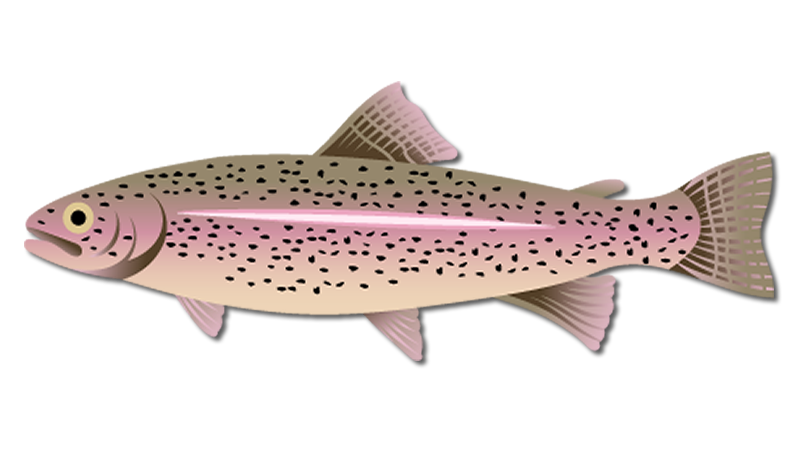
Rainbow trout (Oncorhynchus mykiss) is a colorful North American Salmonidae and a popular freshwater game fish in the salmon family. They are coldwater fish often associated with healthy, clear mountain stream habitats and distinguishable by their black spots and reddish band on both sides. This trout species is a Salmonidae; it’s adronomous and can osmo-regulate to thrive in both fresh and saltwater.
Salmonidae is a family of ray-finned fish and the only living family currently placed in the order Salmoniformes. This family includes trout, salmon, chars, graylings, and freshwater whitefish.
Scientifically Speaking
The rainbow trout, scientifically known as Oncorhynchus mykiss, is native to the North Pacific Ocean, along with the cutthroat trout. Different freshwater trout species inhabit every continent except Antarctica, but are most abundant in North America and Europe. The other main species of freshwater trout are brook trout, brown trout, cutthroat trout, and lake trout.
They are currently found all over the world, similar to the salmon’s existence. The main subspecies of rainbows are Golden Trout and Redband Trout, which have populations naturally living in specific rivers in the Pacific States and the Midwest of the United States, and are stocked outside of those areas. Rainbow trout are often called redband trout in areas east of the Cascade Mountains in the United States and the upper Fraser River of British Columbia.
Rainbow trout are prevalent among anglers and are in the top five sport fish in North America. Many anglers consider this trout species to be the most essential sport fish west of the Rocky Mountains.
Range and Life History
Rainbows are native to the North Pacific Ocean and its associated drainages, including the Amur River in eastern Asia, northeastern Russia, and along the Pacific slope of North America, from Alaska to northern Mexico. Rainbows and Yellowstone cutthroat trout are the only two species of Pacific trout.
In North America, Rainbow trout were native only to the lakes and rivers west of the Rocky Mountains. They ranged from Alaska to Mexico, including British Columbia, Washington, California, Oregon, Nevada, and Idaho. Native rainbows typically inhabit watersheds west of the Cascades. Most rainbow trout populations outside of their native range are domesticated steelhead.
Because of its popularity as a game fish, the rainbow trout population has expanded into cold lakes and streams worldwide. Their range has extended into the Great Lakes region, central Canada, the Great Plains, and southwestern Mexico.
Appearance
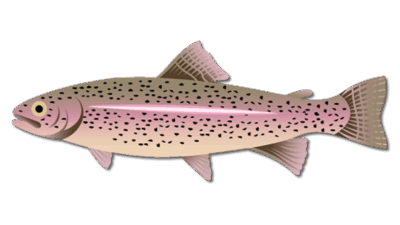
Rainbow trout fish get their name from the shiny, colorful markings of their skin. The colors of this fish vary depending on gender, habitat, and age. The coloration on their back generally ranges from Olive to brown to dark blue. Rainbow trout are torpedo-shaped and have a pinkish stripe that runs along the side of their bodies. They have a silvery underside that fades into a pearl white on the mid-belly. Rainbow trout have small black spots all over their bodies, including their backs, fins, and tails.
They reach maturity at around 16 inches in length and weigh between two and eight pounds. Males have an elongated snout, while females have a short, rounded nose.
Like their salmon cousins, they can grow rather large, averaging 20 to 30 inches in length and eight pounds. However, they can grow as large as four feet long and weigh 53 pounds. The average life span of a rainbow trout population in the wild is four to six years.
Habitat and Diet
Rainbow trout (Oncorhynchus mykiss) prefer cool, freshwater streams with a gravel bottom and abundant natural cover, such as trees and rocks. They prefer water temperatures between 55°F and 60°F but can tolerate temperatures ranging from 32°F to 70°F. When the water temperature reaches 68 degrees, they will begin to get stressed. If the water temperature continues rising to 75°F for an extended period, it can be lethal for rainbow and brown trout.
Rainbows tend to frequent deeply shaded areas similar to brook trout. These trout are opportunistic feeders with a broad diet, but they prefer waters rich in vegetation for producing good food sources. Rainbows eat aquatic insects, terrestrial insects, fish eggs, small minnows, crustaceans, and worms. The diet of a rainbow trout consists mainly of invertebrates, specifically aquatic insects. It feeds on smaller fish and other fish eggs, giving it a predatory appearance.
Those who dwell on the lake may grow a liking for eating plankton. Others located in a competitive ecosystem will feed on fish carcasses.
If the school of rainbow trout is farm-grown, which means there is a dedicated pool for breeding, they will eat fish treats in the form of pellets.
Spawning and Lifespan
Spawning
Rainbow trout spawn at about two years old, earlier in their lives than most other trout species. Rainbow trout, including steelheads, spawn in spring and early summer as water temperatures rise.
As adult trout near spawning maturity, they begin to change their color, behavior, and anatomy—the trout’s exterior shifts from a silvery color to bright red, pink, and green. The closer to the spawning event, the easier it is to distinguish between the male and female trout. The streak on males turns a brick red when mature, and the streak on females turns more pinkish than red.
Unlike salmon, trout don’t die after spawning and can participate in spawning multiple times in their lives. During a spawning season, a single female rainbow trout can spawn 200 to 8,000 eggs.
Record
According to the International Game Fish Association, the largest rainbow trout was caught in Canada, weighing 48 pounds and measuring 42 inches in length.
Edibility
According to the US agencies, Environmental Protection Agency (EPA), and Food and Drug Administration (FDA), one of the healthiest fish choices is the rainbow trout. It contains one of the largest concentrations of omega-3 fatty acids.
Its meat is mild, with a nut-like flavor but delicate. The flesh of a rainbow trout can be colored white, orange, or pink, and all variety feels flaky, tender, and soft.
Since stocked fish are usually raised on pellets, they often don’t taste as good as wild fish.
Rainbow Trout VS Steelhead
Rainbow and steelhead are the same species and genus of trout; their lifestyles set them apart, as they can thrive in both freshwater and saltwater. Rainbows are called “steelhead” when they are at sea even though they are still the same species, Oncorhynchus mykiss.
A standard rainbow trout never leaves its freshwater stream, spending its entire life there. A rainbow trout that ventures into the salty ocean to spend its life and returns to the freshwater stream only to spawn is called a steelhead.
There can be some distinctions in coloration. A steelhead has a metallic color, whereas a rainbow trout exhibits a variety of colors. Both can grow up to 45 inches in length and over 50 pounds in mass, but the steelhead, being anadromous, is usually larger than a rainbow trout due to being anadromous.
Fishing
Rainbow trout are an exciting game fish, but also the most commonly caught of all trout species. These trout often jump after being hooked and are especially fun on light tackle. A bonus to the trout fishing experience is that the areas they inhabit are usually very scenic mountains and rivers.
Rainbow trout eat various prey in general, but they are often picky eaters on a day-to-day basis. Trout anglers usually have to try multiple baits, lures, or flies to figure out what they want that day.
Prime depths for trout fishing are 4 to 8 feet unless no flats exist at those depths. Trout feed deeper, too, but when they do, it often occurs just past the lip of the first significant drop leading to these shallow flats.
Trout spook very easily, so anglers must move lightly whether in a boat, onshore, or wading.
The Feeding
Trout will feed throughout the entire day, but early morning and late afternoon seem to offer the best trout fishing on most days and most seasons. Trout will feed throughout the day, but they are most active when the sunlight is the weakest.
This is especially true for the more aggressive brown trout; however, rainbow and brook trout will also feed at night.
Trout love to feed in the rain; trout fishing, as heavy rain sets in, can be some of the best times to fish as the rain triggers trout activity. Insects on the banks get washed into the water and are the primary source of food for the trout.
They are most active in water temperatures between 52 and 64 degrees Fahrenheit.
When the water is colder or warmer, you’ll need to adapt your strategies to tempt them. It’s best to take special precautions to protect the fish in extreme conditions when the water is frigid and icy or when it’s over 70 degrees.
Techniques
Popular lures for rainbow trout are Roostertail spinners, Mepps Aglia spinners, Panther Martin spinners, Blue Fox spinners, Kastmaster spoons, Phoebe spoons, Krocodile spoons, and Rapala X-Rap.
Their eyes are also more sensitive to the red end of the spectrum than humans. They perceive green the least and see blue the best. Rod cells are susceptible to low light and give the trout excellent night vision.
It’s best to use lures that match the trout’s current forage, depending on the time of year. The best lure colors can be white, gold, brown, green, black, silver, pink, orange, yellow, and red, depending on the current hatch and prominent local food sources.
They also attack live bait such as bugs, nightcrawlers, and small fish. Popular terrestrial insects in the rainbow trout’s diet are grasshoppers, beetles, and crickets.
Rainbow trout will eat many different lures, including spinners, spoons, plugs, and jigs in the 1″-3″ size range. It’s best to pack a wide variety of lures as trout will often turn on to one and turn off to another lure that they were biting the day or even the hour before.