
















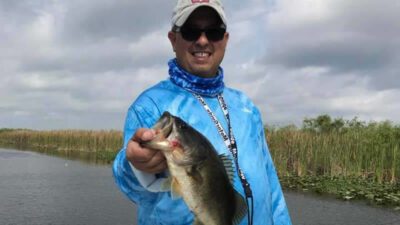

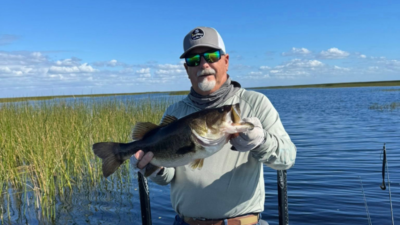
Other Names: sergeant fish, robalo : centropomus undecimalis
Description:
There are five different species of snook fish in Florida, all of which can be found in brackish and freshwater. The five snook species are the common snook, large-scaled fat snook, small-scaled fat snook, tarpon snook, and sword spine snook. Some snook species prefer waters with less salinity, such as the sword spine snook.
The common snook (Centropomus undecimalis) is the most abundant of the snook species and the one most people think of.
Snook used to be seen rarely in the panhandle or anywhere above Jacksonville, except during the hottest summer months, but these days snook can be found just about anywhere. They also seem to be getting more tolerant to cold water temperatures, which may be the reason for their spread.
Snook are a favorite fish among many anglers, responsible for bringing millions of dollars to the Florida economy, because of fishermen coming from around the world to catch snook. Catching snook is fun since they are known for their hard runs. They shake their heads, but they also have a delicious taste. Additionally, the common snook is recognized as the world’s premier inshore fighter. This is why anglers travel to catch this active fish.
Most snook retreat into freshwater canals or brackish rivers in winter to survive the coldest months. This is because snook can’t handle water temperatures below 60 degrees for very long. The darker-colored freshwater will absorb the winter’s sun’s heat energy better than the clear water from the Gulf or the Atlantic Ocean.
Appearance of Common Snook
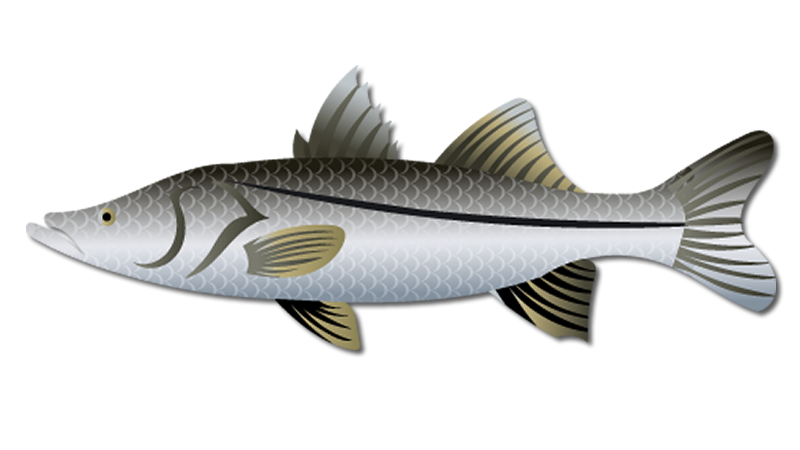
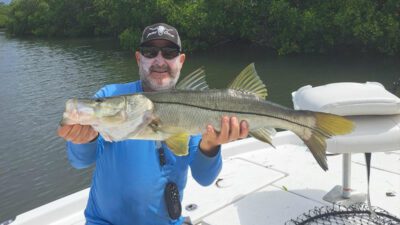
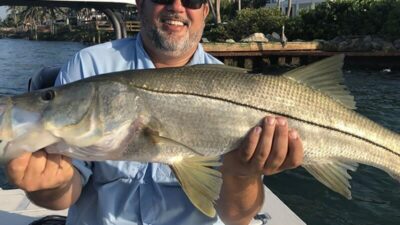 The common snook is best recognized by its elongated body, concave snout, protruding lower jaw, and sloping forehead. However, the most prominent and known characteristic of a common snook is its black lateral line, formed by 67-72 pored scales, and extends into the caudal fin. Common snooks also have a divided high dorsal fin and a yellow pelvic fin.
Range
The common snook is found in South Florida in coastal waters from about Cape Canaveral on the east coast. Around the Florida peninsula, to near Tarpon Springs on the west coast. They aren’t in significant numbers in northern Florida or the panhandle, but they are there.
Habitat
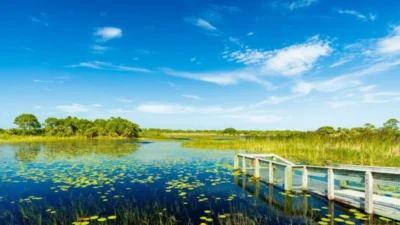
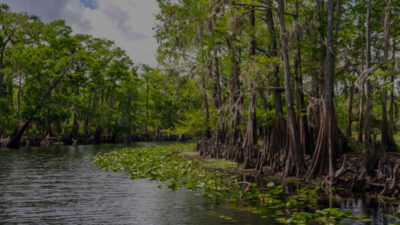
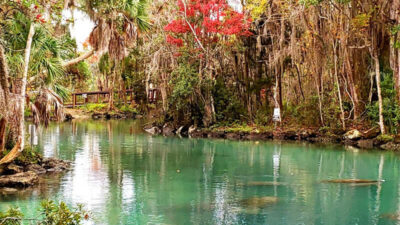
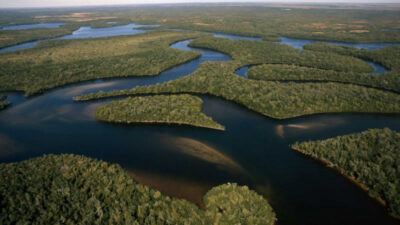
Snook mostly live inshore in the coastal waters, especially around mangrove shorelines, beaches, seagrass beds, and nearby structures. Freshwater snook will inhabit any freshwater or lightly brackish waterway they encounter and often congregate near spillways. Freshwater snook is commonly found in even the most minor residential canals throughout Florida.
All species of snook can live in freshwater; even large snook are found in freshwater canals throughout Florida. Some 40-inch-plus big snooks inhabit water that is 100% fresh.
They are in southern freshwater rivers over 20 miles from the Gulf Coast or Atlantic coast in Florida. There are even some snook species as far inland as Lake Okeechobee.
Globally, snook are found anywhere from South Carolina to Brazil, including Florida to Texas, along the Gulf of Mexico. Regardless of the location, they can live in almost any habitat as long as it has good water quality and temperatures above 60°F, since they are sensitive to cold temperatures.
Age and Growth
The common snook can grow much more significantly than other snook species, reaching up to 48 inches or 50 pounds. It’s the largest of the species that live in the Atlantic. Snooks grow faster and are generally larger in Atlantic waters compared to the Gulf of Mexico.
Behavior and Spawning
Freshwater snook start life as males, then when they reach 18 to 22 inches long, some become females. They form schools during the spawning season and can often be seen cruising the South Florida beaches close to the shoreline during the summer. Snook congregates in large schools yearly in deep passes and inlets to spawn.
Feeding Habits
Freshwater snook primarily feed on other fish and large crustaceans.
Freshwater Snook Species
Every snook species and size can be found in freshwater or brackish environments on Florida’s east and west coasts. The largest and most well-known is the common snook; the sword spine snook is the smallest species and is most known for its strong preference for freshwater or lightly brackish areas.
The sword spine snook has an anal fin that extends to its tail, which is the primary distinguishing feature between it and its relatives. They are also tiny, with a large one reaching up to 15 to 16 inches, but most stay under 10 inches in total length. Swordspine snook also has larger scales compared to other snook species.
The sword spine snook would live in freshwater permanently if it could. They prefer waters that are entirely freshwater or slightly brackish. The sword spine snook will avoid saltwater bodies of water entirely.
The sword spine snook is the smallest of the Florida snook species, and they thrive within the mangrove roots and brackish estuaries that are fresh enough for their liking but too salty for largemouth bass to thrive in.
Snook Fishing
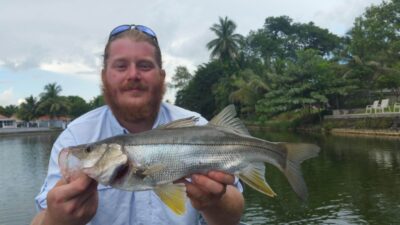 Freshwater snook fishing is excellent year-round in Florida and can be caught in most canals anytime. But often, the best time of year for freshwater snook fishing is during the winter when the Florida fish is seeking warmth.
Many common snooks will run into Florida rivers or canals to find warm water. They eat like largemouth bass and snakehead, feeding on bluegill, crawfish, frogs, small mullet, snakes, ducks, and baby alligators.
If anglers are looking for saltwater snook in the winter, they will usually have to look deeper and further out in inlets, bridge pilings, or offshore wrecks.
Saltwater and freshwater snook will orient themselves to face moving water and wait for prey to be carried by the current to ambush. Then, this acrobatic fish will jump clear above the water, similar to tarpon, and burst into hard and long runs once hooked.
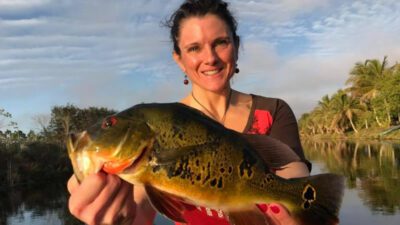
It’s not uncommon for Florida anglers to land the ultimate freshwater grand slam of largemouth bass, peacock bass, and snook in one trip.
Fishing Tips
Anglers often have the best luck catching snook with live pinfish, mullet, or live shrimp. Other effective methods are free-lined sardines, which can be fished off the bottom with a fish finder. Most shrimp or baitfish baits are effective throughout the year, but it can be helpful to adjust your tactics based on the season.
This famous Florida fish will mainly feed on shrimp, bivalves, and mud crabs during the summer. During the fall, freshwater snook feed primarily on pinfish and shrimp. They will feed mainly on mud crabs, snapping shrimps, and worm-like invertebrates during the winter.
Also, contrary to what many anglers believe, your baitfish or shrimp doesn’t have to be significant to catch a big snook. Even large snook have been caught on the smallest baits if cast in the right spot.
Snook fishing is the ultimate Florida fishing experience and is best in the shallow waters near grass flats, mangroves, oyster bars, or beautiful urban canals.
Edibility
Freshwater snook meat is white and has a medium firmness, making it best eaten fresh, like most seafood. Snook meat isn’t as delicate as trout meat, but it isn’t as dense as swordfish meat.
Records
The Florida state record is 44 pounds 3 ounces, caught in Ft Myers. The fly-caught record is 30 pounds, 4 ounces.
The IGFA world record is 53 pounds 10 ounces, caught in Parismina Ranch, Costa Rica.