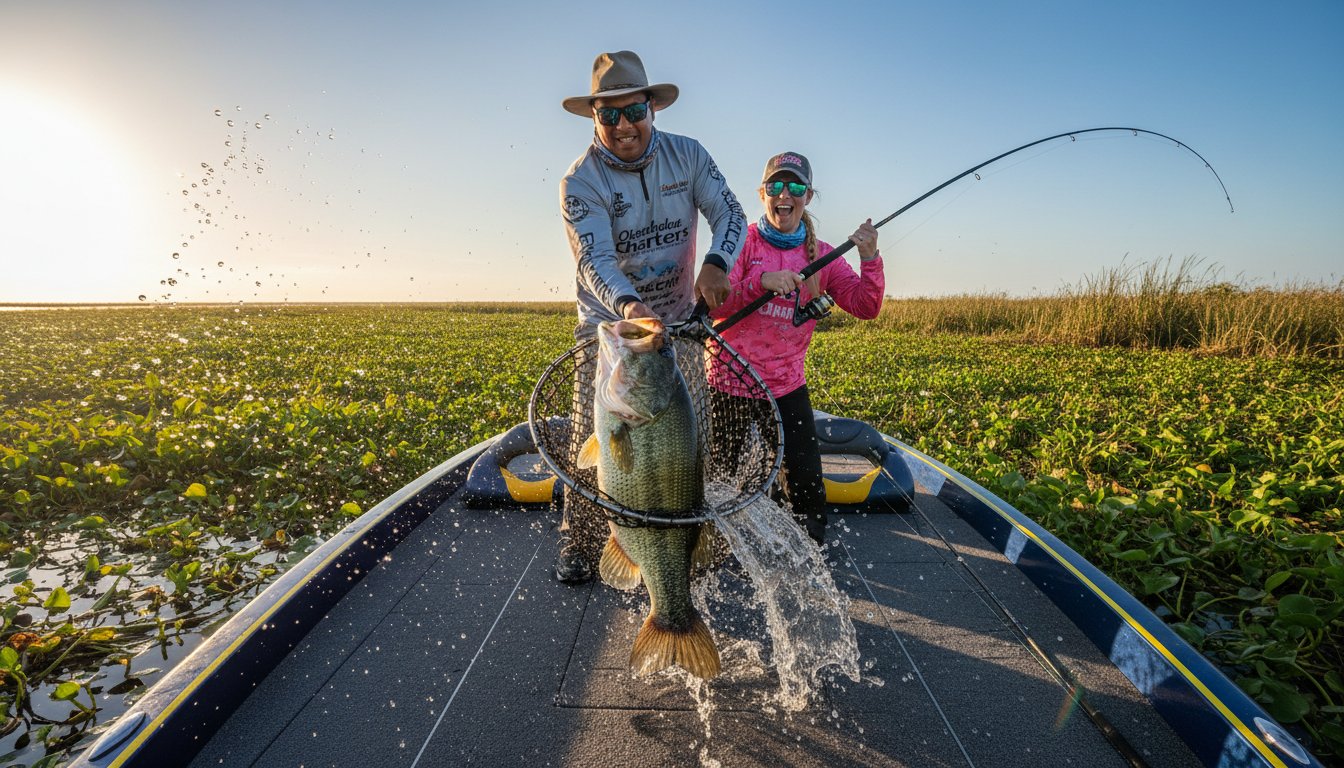

Most anglers look at 450,000 acres of Lake Okeechobee vegetation and see a graveyard for their favorite lures, but the pros see a roadmap to a double-digit trophy. It’s easy to feel overwhelmed by the scale of this place, especially when you’re constantly picking weeds off your hooks or wondering if the bass moved since your last trip. I get it; there’s nothing more frustrating than losing a big fish because your gear wasn’t up to the task of winching a hawg out of a thick mat. Mastering Lake Okeechobee bass fishing techniques isn’t about luck. It’s about understanding how these fish use the grass as a highway.
In this pro guide, I’m going to show you how to read the vegetation like a local and choose the right tools for the job. We’ll cover why the current 11.60-foot water levels are pushing fish into the Kissimmee River and surrounding canals, and how you can exploit the massive bluegill spawn happening right now in May 2026. You’ll learn the field-tested tactics required to find oxygen-rich water and finally land that 10-pounder you’ve been dreaming about. Let’s get to work and turn this massive lake into your personal playground.
Key Takeaways
- Learn to identify the specific vegetation types that hold trophy bass and why heavy-duty punching rigs are essential for reaching fish buried in thick mats.
- Master the most effective Lake Okeechobee bass fishing techniques for covering massive grass flats, including how to use vibrating jigs to trigger aggressive reaction strikes.
- Discover the free-lining secrets used by pro guides to present wild golden shiners naturally; it’s the most reliable method for landing a double-digit giant.
- Understand how to adjust your strategy based on seasonal migrations and fluctuating water levels to find active schools even when conditions get tough.
- Gain the confidence to select the right tungsten weights and stout hooks that prevent gear failure when winching heavy bass out of dense vegetation.
Table of Contents
-
Understanding the Big O: Why Your Standard Techniques Must Change
-
Heavy Cover Tactics: Punching and Flipping the Thickest Mats
-
Putting it Together: Seasonal Cadence and Professional Guidance
Understanding the Big O: Why Your Standard Techniques Must Change
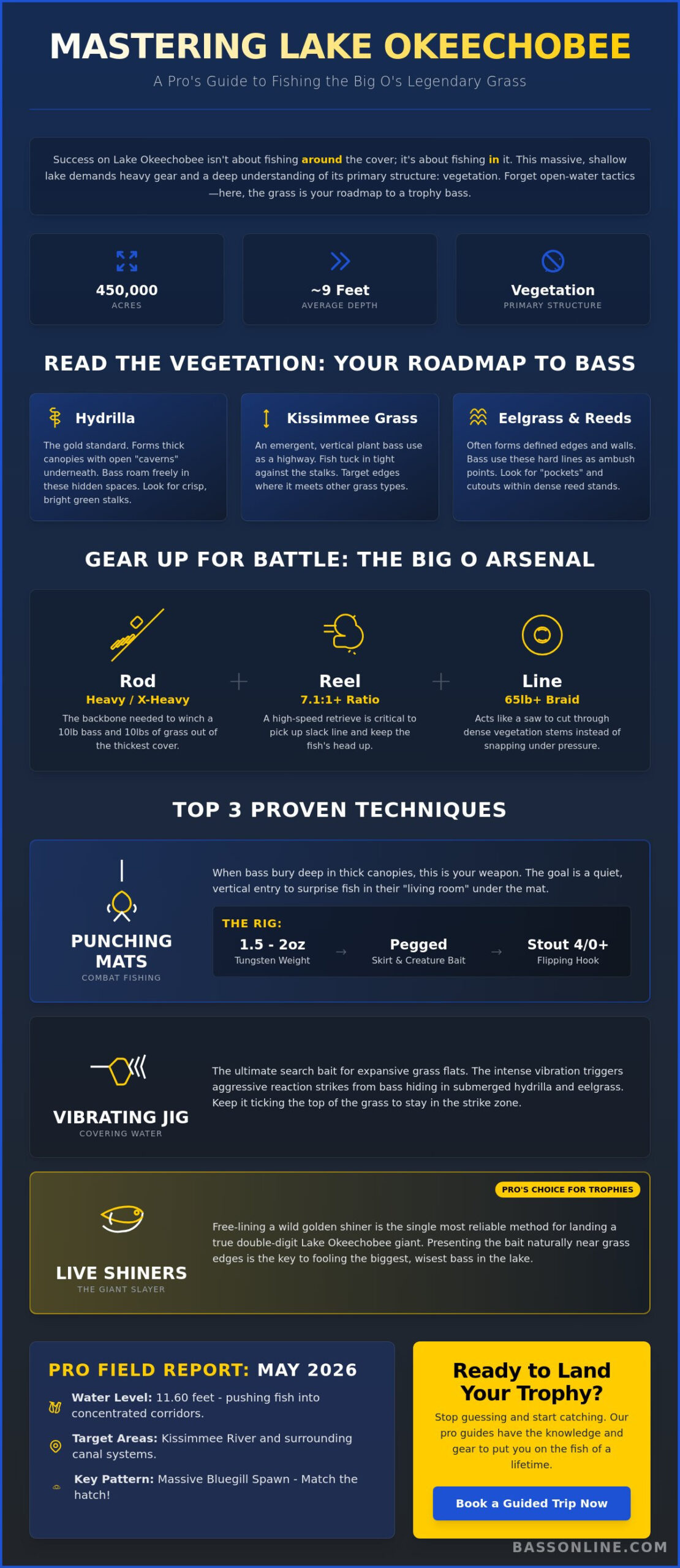
Lake Okeechobee is a massive, shallow inland sea that demands respect and a total shift in your tactical mindset. Covering nearly 450,000 acres, this lake averages only about nine feet in depth. Most anglers arrive with standard reservoir habits; they look for deep ledges, rocky points, or submerged timber. On the Big O, those features don’t exist. Here, the grass is the only game in town. Lake Okeechobee’s unique ecosystem relies on vast littoral zones where vegetation serves as the primary structure, oxygen source, and ambush point for trophy largemouth.
Standard Lake Okeechobee bass fishing techniques fail when you try to fish "around" the cover. To be successful, you have to fish "in" it. With the water level at 11.60 feet as of May 2026, the fish are concentrating in specific corridors, such as the Kissimmee River and major canal systems. You aren’t just looking for water; you’re looking for the right kind of life. Mental preparation is half the battle. You have to be willing to throw your lure into places that look impossible to retrieve from, trusting that your heavy-duty equipment will win the fight.
Reading the Vegetation: Hydrilla, Eelgrass, and Kissimmee Grass
Not all grass is created equal. Hydrilla is the gold standard for many, creating a thick canopy with open "caverns" underneath where bass can roam. Look for crisp, bright green stalks; if it’s brown or slimy, move on. Kissimmee grass is a different beast entirely. It’s an emergent, vertical plant that bass use as a highway. While fish hide under hydrilla, they tend to tuck tightly into the stalks of Kissimmee grass. I always look for "edges" where two types of grass meet or "pockets" within a solid mat. These transitions are the primary strike zones where a big girl is waiting to pounce.
The Gear Reality Check: Why You Need 65lb Braid
If you bring a medium-action rod and 12-pound test to this lake, you’re bringing a knife to a gunfight. When a 7 or 8-pound bass hits, its first move is to bury itself in ten pounds of wet vegetation. You need 65lb braided line because it acts like a saw, cutting through thick stems instead of snapping. Your rod needs to be a Heavy or Extra-Heavy power "stick" with enough backbone to winch a fish out of the jungle. I also insist on a high-speed reel with at least a 7.1:1 gear ratio. You need to pick up the line fast to keep that fish’s head up; once they get their nose down into the roots, the battle is usually over.
Section Takeaway: Forget everything you know about open-water fishing. Success on Lake Okeechobee requires heavy gear, a deep understanding of grass types, and the confidence to fish in the thickest cover on the planet.
Heavy Cover Tactics: Punching and Flipping the Thickest Mats
When a Florida cold front slams the lake or the afternoon sun gets high, the bass don’t head for deep water. They bury themselves in the thickest, nastiest mats they can find. This is when Lake Okeechobee bass-fishing techniques shift from searching baits to surgical strikes. You’re looking for the living room under the grass. I look for bird tracks left by herons walking on the vegetation or small blowouts where a bass previously broke the surface. These are your high-percentage targets. To get to them, your lure has to slip in like a needle. If it splashes or hangs up on top, you’ve already lost the element of surprise. According to the Florida Fish and Wildlife Conservation Commission, these vegetation mats are critical habitats that concentrate fish during temperature swings, making them the most reliable places to hunt for a trophy.
The anatomy of a punching rig is built for combat. You need a heavy tungsten weight, usually between 1.5 and 2 ounces, to penetrate the canopy. I always use a pegged skirt to add bulk and a stout, straight-shank flipping hook that won’t flex under pressure. If you want to see these mats in person and learn the timing of the strike, reach out to our team to book a day on the water.
The 5-Step Punching Sequence for Trophy Bass
-
Step 1: Identifying the canopy. Look for the densest matted vegetation, specifically where hydrilla is topped out and trapped against a reed line.
-
Step 2: The vertical drop. Pitch your bait slightly into the air so it falls vertically. This ensures your weight pulls the bait straight through the debris instead of dragging it across the top.
-
Step 3: The double-jig. Once the bait hits the bottom, lift it a few inches and let it drop twice. This triggers a reaction strike from the bass that were watching it fall.
-
Step 4: Feeling the thump. You won’t always feel a hard hit. Often, the line just feels heavy or moves slightly to the side. Watch your slack line closely.
-
Step 5: The aggressive hookset. When you feel that weight, reel down the slack and snap the rod upward with everything you’ve got to clear the fish from the roots.
Lure Selection for the Jungle
In the jungle of Lake Okeechobee, profile is everything. Slim creature baits and craw-style plastics are the best choices because they offer less resistance when sliding through the grass. While some guys like big worms, they often get tangled in the canopy. Color theory on the Big O is simple: stay dark. Black and blue or June Bug dominate because they provide the best silhouette in the stained water beneath the mats. Always peg your weight with a rubber stopper. If your weight slides up the line, your bait will hang on the top of the grass while the weight sinks alone, ruining your presentation.
Section Takeaway: Successful punching requires a vertical entry, heavy tungsten, and the ability to detect the subtle "thump" of a bass buried deep in the grass.
Covering Water: Search Baits for Expansive Grass Flats
You can’t punch every square inch of a 450,000-acre lake. When the bass aren’t buried deep in the mats, they’re often roaming the massive grass flats of the Big O, hunting for shad and bluegill. To find them, you need a "Search and Destroy" mindset. This means using Lake Okeechobee bass-fishing techniques that let you to cover water quickly while still triggering strikes from neutral fish. Your goal is to locate active schools by identifying high-percentage areas within the vast sea of green. With water levels at 11.60 feet in May 2026, these flats are shallower than usual, concentrating fish in the healthiest remaining vegetation.
Vibrating jigs, or Chatterbaits, are my gold standard for this job. They offer the perfect blend of vibration, flash, and weedlessness. However, your success depends on how you handle specific grass types. In submerged hydrilla, you want your lure to skim the very top of the "carpet." In Kissimmee grass, which grows in vertical stalks, you need to weave your bait through the lanes between the stems. Unlike the thick mats we discussed earlier, these flats require a more horizontal approach to find where the fish are staging. If you want to refine your approach, learn more about Bass Fishing 101 to master these fundamentals before hitting the water.
The "Tick-Tick-Boom" Cadence
The secret to search baits isn’t just a steady retrieve. It’s the "Tick-Tick-Boom" cadence. As you reel, you want your lure to occasionally "tick" the top of the vegetation. When you feel the blade stop vibrating because it’s caught a piece of grass, don’t just pull slowly. Give the rod a sharp, sudden "rip." This burst of speed and the sudden clearing of the debris causes an instinctual reaction strike from nearby bass. It looks like a baitfish escaping cover, and for a big largemouth, it’s an invitation they can’t refuse. Adjust your retrieval speed based on the water temperature; faster in the heat of May, and slower if a late-season cool spell hits.
Topwater Explosions: Timing and Location
There is nothing more heart-pounding than a trophy bass blowing up on a hollow body frog. I commit to the surface bite during the low-light hours of early morning and late evening, or whenever I see "nervous water." Nervous water is a subtle rippling or flicking on the surface caused by baitfish being pushed from below. When you see this, get your frog in there immediately. The most critical rule for frog fishing is to "Wait for the Weight." When the splash happens, your instinct is to set the hook. Stop. Wait until you actually feel the weight of the fish on your rod. If you pull too early, you’ll just snatch the lure away from a giant.
Section Takeaway: Use vibrating jigs and frogs to find active schools on the flats, and always use the "rip" technique to turn a grass snag into a trophy strike.
The Big O Specialty: Live Bait Techniques for Trophy Bass
Artificial lures are fantastic for covering water, but if you want the highest mathematical probability of landing a double-digit giant, wild golden shiners are the undisputed king. This isn’t just "live bait fishing"; it is a specialized subset of Lake Okeechobee bass fishing techniques that requires a deep understanding of predator-prey dynamics. A native 8 to 10-inch shiner emits a specific distress vibration that Lake Okeechobee largemouth have been keyed into for centuries. When a trophy bass is nearby, your shiner will tell you. You’ll feel a distinct "nervous" vibration through the rod tip as the bait tries to escape. Paying attention to these signals is what separates the pros from the amateurs.
Rigging for these Florida brutes requires heavy-duty hardware. I typically use a 5/0 or 6/0 Kahle hook, which has a wide gap designed to clear the large bait and find purchase in the bass’s jaw. Depending on the thickness of the cover, I’ll run a 20lb fluorocarbon leader or go straight to 65lb braid. If you want to see exactly how we rig these for the big girls, book a guided bass fishing trip with us and we’ll show you the ropes in person.
Corking vs. Free-Lining
I use a large foam float, or "cork," when I need to keep the bait at a specific depth or prevent it from diving into the bottom muck. This is especially useful in May 2026, as the lower water levels make the bottom vegetation even more entangling. However, free-lining is my secret weapon for reaching the smartest fish. By removing the float, you allow the shiner to swim naturally into the deepest pockets of the reed lines. You can actually "steer" your bait; by applying light rod pressure in the opposite direction you want the shiner to go, the bait will swim away from that pressure and deeper into the strike zone.
Handling the Strike
The biggest mistake I see anglers make is setting the hook too early. When a bass hits a shiner, you’ll see the "run-off." The bass inhales the bait and swims away to turn it in its mouth. You must let the fish run for several seconds before tightening the line. For more shiner secrets, check out our Lake Okeechobee Bass Fishing Guide . When you’re ready, don’t use a snap-set. Instead, use a long, sweeping pull to drive the hook home. Once she’s hooked, keep the rod tip high and the pressure constant. Any slack gives a Lake Okeechobee bass the chance to wrap you around a reed and break free.
Section Takeaway: Wild golden shiners are the ultimate trophy tool. Master the art of free-lining and the "run-off" to land the fish of a lifetime.
Putting it Together: Seasonal Cadence and Professional Guidance
Mastering Lake Okeechobee bass fishing techniques requires more than just the right lure; you have to understand the lake’s seasonal rhythm. Winter is the undisputed trophy season. From January through March, the spawn is in full swing. I focus my efforts on shallow reed lines using slow-moving presentations like Senkos or free-lined shiners. This is your best shot at a double-digit giant. As we move into Spring, specifically May 2026, the post-spawn fish are hungry and aggressive. With the bluegill spawn currently in full effect, targeting bream beds on the outer edges of the grass flats is a winning pattern.
When the Summer heat cranks up, oxygen becomes the priority. Bass retreat to the shade of the thickest mats where the water is slightly cooler and more oxygenated. This is the prime time for the punching tactics we discussed earlier. By Fall, the game shifts to bait migration. As the shad move toward the mouths of canals and the Kissimmee River, follow the birds and the "nervous water" to find feeding schools. Regardless of the season, remember the daily bag limit is five black bass, and you’ll need your Florida freshwater fishing license, which is $17 for residents or $47 for an annual non-resident pass as of May 2026.
Why a Guide Makes the Difference
This lake is an inland sea, and it doesn’t give up its secrets easily. Finding the 1% of the water that holds 90% of the fish in a 450,000-acre grass field is a daunting task for any angler. Safety is another critical reason to go with a pro. With water levels at 11.60 feet as of May 1, 2026, hidden rock hazards are a serious threat to your boat. Our Professional Fishing Guides spend thousands of hours on this water every year. We know the safe routes and the exact grass patches where fish were yesterday. Hiring a pro isn’t just about catching more bass; it’s about accelerating your learning curve and staying safe while doing it.
Final Takeaway for Your Trip
The most successful anglers on the Big O are the ones who commit. Don’t fall into the trap of switching lures every five minutes. If the water is stained and the sun is high, stay with the punching rig. If it’s early morning on a flat, stick with the frog. Persistence is the key to unlocking a trophy. This lake remains the world’s top destination for a reason. The rewards are worth every snag and every lost lure. If you’re ready to experience the thrill of a lifetime, Book Your Lake Okeechobee Bass Fishing Trip Today , and let’s get you on a giant.
Section Takeaway: Match your technique to the season, prioritize safety in low water, and trust a professional guide to put you on the 1% of the lake where the giants live.
Claim Your Victory on the Big O
Success on this massive lake isn’t about luck; it’s about the execution of specialized Lake Okeechobee bass fishing techniques. You’ve learned how to read the grass, master the "run-off" with live bait, and punch through the thickest canopies to find those buried giants. Now, all that’s left is to get on the water and put these field-tested secrets to work. The Big O doesn’t reward hesitation, but it surely pays off for the angler who arrives prepared and ready for a fight.
We’ve spent over 25 years professionally guiding on these legendary waters, and our team has been featured on major outdoor networks for a reason. With thousands of 5-star reviews from anglers just like you, we know how to turn a daunting 450,000-acre lake into a successful expedition. We’ll handle the navigation and the strategy while you focus on the strike. Book Your Trophy Lake Okeechobee Bass Fishing Trip Now! The giants are waiting in the reeds, and there’s no better time than right now to land your new personal best.
Frequently Asked Questions
What is the best time of year for bass fishing on Lake Okeechobee?
The peak window for catching a trophy-sized bass is from January through March during the spawning season. This is when the biggest females move into the shallow reed lines to bed. However, in May 2026, catches are currently high, at 25 to 40 bass per day. If you want aggressive topwater action and high numbers, the late spring months are hard to beat.
Do I need a special boat to fish Lake Okeechobee?
You don’t need a tournament bass boat, but a vessel with a shallow draft is essential for navigating the lake’s vast vegetation. As of May 2026, water levels are low at 11.60 feet, which exposes dangerous rock hazards. I strongly recommend a boat with a GPS mapping system and a trolling motor to move quietly through the grass without damaging your engine.
What is the most effective lure for Lake Okeechobee bass?
A vibrating jig, commonly known as a Chatterbait, is the most versatile artificial lure for mastering Lake Okeechobee bass fishing techniques across the flats. It allows you to cover massive areas while triggering reaction strikes from fish hiding in the hydrilla. For the thickest mats, a 1.5 to 2-ounce punching rig is the only way to reach the giants buried deep in the cover.
Is live bait better than artificial lures on the Big O?
Wild golden shiners are the most effective choice for targeting trophy-sized bass, while artificial lures are better for covering water and catching high numbers. While artificials like frogs and swim jigs are exciting to fish, a native 8-inch shiner provides the scent and vibration that a double-digit largemouth can’t resist. Most pros use both to ensure a successful day.
Which pound-test line should I use for Lake Okeechobee?
I recommend using 65-lb braided line for the vast majority of Lake Okeechobee bass-fishing techniques involving heavy vegetation. This heavy braid is necessary to winch big fish out of thick hydrilla and Kissimmee grass without snapping. If you’re fishing the clearer outer edges or canal ledges, you can drop down to a 20lb fluorocarbon leader to remain less visible to the fish.
Can I catch a 10-pound bass on Lake Okeechobee?
Yes, Lake Okeechobee is a premier destination for landing a 10-pound trophy largemouth. While these giants are caught year-round, your best statistical chance is during the winter spawn from January to March. Recent reports from May 2026 show several fish up to 8 pounds being caught, proving the big girls are active and feeding heavily right now around the bluegill beds.
How deep is Lake Okeechobee on average?
Lake Okeechobee is an exceptionally shallow basin with a natural average depth of approximately 9 feet. Current water levels as of May 2026 are sitting at 11.60 feet, which means many of the traditional grass flats are even shallower than usual. This low water forces bass to congregate in deeper transit routes, such as the Kissimmee River and major canal systems.
Is a fishing license required for Lake Okeechobee?
Yes, a valid Florida freshwater fishing license is required for all anglers unless you’re under 16 or a Florida resident 65 or older. As of May 2026, a resident annual license costs $17.00. For non-residents, options include a 3-day license for $17.00, a 7-day license for $30.00, or an annual license for $47.00. You can purchase these online through the FWC website.

Article by
Mr Bass
Todd Kersey, widely known as Mr. Bass by Field & Stream, is a professional angler, accomplished author, and dedicated philanthropist with a lifelong passion for bass fishing. Armed with a degree in Outdoor travel, Mr. Bass has expertly combined his knowledge with his practical fishing experience to become one of the most respected names in the bass fishing, his deep understanding of bass habitats, and fish behavior has earned him numerous accolades as a asset of the sport. Serving 8 years as FWC Stakeholder Chairperson. Leading and passing cutting-edge legislation, such as the Black Bass Management plan, and successfully building, passing, and financing the Trophy Catch program. As CEO, he is committed to giving back to the community through his philanthropic efforts. He supports a variety of causes, especially those centered around physical disabilities. Through his advocacy, his mentorship programs inspire anglers to engage in fishing stewardship, helping to raise more than $ 18 million in donations. Mr. Bass continues to inspire anglers and outdoor enthusiasts alike with his commitment to the sport and the world around him.