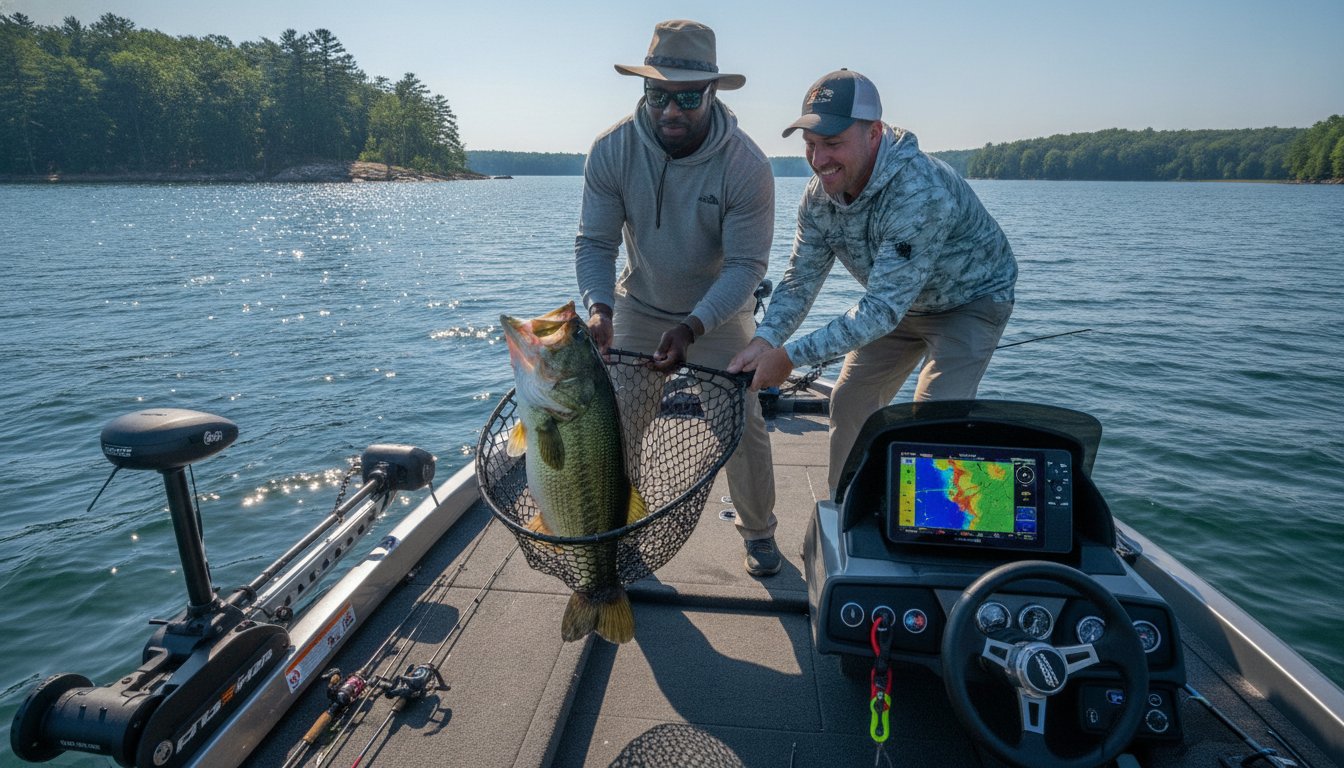

Most anglers spend their hottest summer days beating the bank for a single bite while the real monsters are stacked like cordwood thirty feet below their hull. It’s a common mistake; when the shallows go cold, the elite bags are caught where the river channel meets the flats. Mastering ledge fishing for bass in summer isn’t just about finding a drop-off on your GPS. It’s about understanding the subtle timing of the Tennessee River or the St. Johns, where current flow and oxygen levels dictate exactly where trophy largemouth set up their ambush points.
You’ve likely spent hours scanning offshore structure only to find dead water, or worse, you’ve located a massive school that simply won’t bite. We understand that frustration. This playbook is designed to bridge the gap between seeing fish and catching them. You’ll learn how to read high-definition lake maps to identify high-percentage ledges and how to position your boat to exploit current seams. We’ll also dive into the specific lure rotations, from deep-diving cranks to heavy jigs, that force a school to ignite. By the time you’re done, you’ll have the confidence to leave the shoreline behind and hunt the giants of the deep.
Key Takeaways
- Identify why trophy largemouth abandon the banks for the thermal refuge of deep river channels when surface temperatures soar.
- Decode your electronics to find the spot on the spot, like rock piles or stumps, that hold the most aggressive schools of fish.
- Master the heavy-hitter lure rotation of deep-diving cranks and football jigs to trigger reaction strikes from deep-water giants.
- Learn the technical boat positioning and retrieval angles essential for ledge fishing for bass in summer to keep your lure in the strike zone longer.
- Discover how a guided masterclass can shorten your learning curve by teaching you to interpret side imaging and current flow like a pro.
The Summer Ledge Pattern: Why Bass Move Deep
When the midday sun starts baking the shallows, the big girls don’t just stop eating; they move. Successful ledge fishing for bass in summer requires a shift in mindset from looking for cover to looking for structure. Ledge fishing is the strategic targeting of offshore structural changes where shallow flats meet deep river channels. These drops create the perfect environment for schools to congregate, but you have to understand the “why” before you can master the “how.”
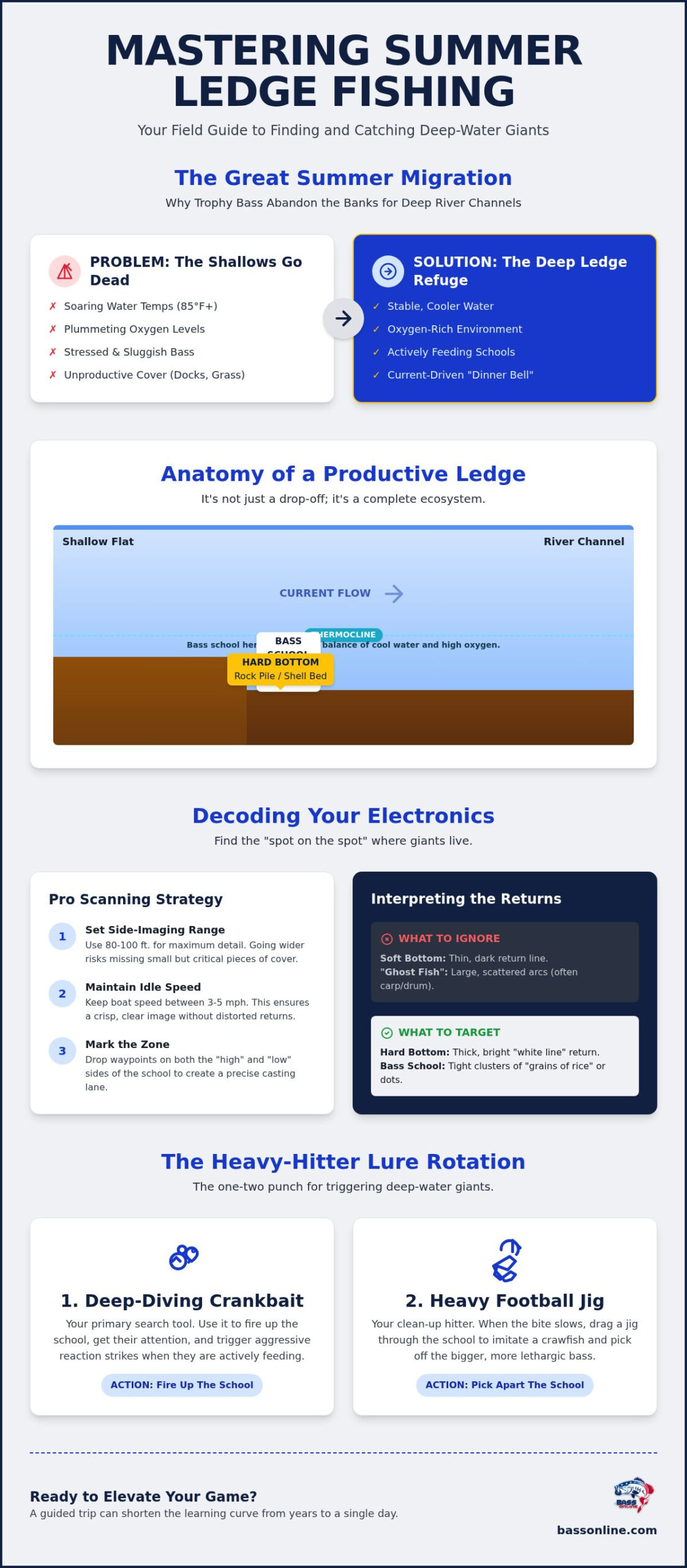
The primary driver is the thermal refuge. As water temperatures on the bank climb into the high 80s or 90s, oxygen levels often drop, making the fish sluggish and stressed. Deep water offers a more stable, cooler, and oxygen-rich environment where largemouth can thrive. Current acts as the ultimate dinner bell in these areas. Whether it’s a power generation schedule on a reservoir or natural flow, moving water pins baitfish against the ledge, triggering a feeding frenzy that can last for hours. This transition usually starts in the post-spawn weeks, with fish moving to deep-water residency by mid-summer.
Understanding the Offshore Migration
Shallow cover like grass and docks becomes less productive as the water heats up. Bass are opportunistic predators, and they won’t stay where they’re uncomfortable. They follow massive schools of shad and blueback herring as they migrate toward the main lake basins. On famous ledge lakes like Lake Guntersville, you can track this movement by checking transition spots. Before the fish hit the main river ledges, they often stage on secondary points and creek channel bends. Mastering ledge fishing for bass in summer means intercepting these schools as they move from the spawning flats to their summer haunts.
The Science of the Ledge
Success offshore isn’t random; it’s dictated by the thermocline. This is the invisible layer where warm surface water meets the cold, oxygen-depleted depths. Bass typically position themselves just above this line where the water is coolest but still holds enough oxygen to breathe. The composition of the bottom matters just as much as the depth. You want to find hard bottom areas like rock piles, gravel beds, or shell bars. Soft silt rarely holds the crawfish and baitfish that bass crave. A ledge is an underwater highway for forage.
Decoding Your Electronics: Identifying ‘Live’ Ledges
Scanning a massive channel wall without a plan is like driving in the dark. To master ledge fishing for bass in summer, you’ve got to see what others miss. It’s rarely about the entire thousand-yard stretch. Instead, focus on the “irregularities.” Look for sharp corners, subtle points, and small indentations along the channel wall that break the current. These are the natural collection points for baitfish and the predators that hunt them. Use your 2D sonar to hunt for the “white line.” A thick, bright return indicates a hard bottom like gravel or rock, while a thin, dark line suggests soft silt that bass generally avoid.
Don’t let “ghost” fish burn your time. Large, scattered arcs on the graph are often carp or drum. True bass schools appear as tightly packed, uniform clusters of “grains of rice” or dots. They’ll often be tucked right behind a piece of structure or hovering just off the bottom in the current’s slipstream. If the returns aren’t stacked tight, they probably aren’t the green fish you’re looking for.
Scanning Strategies for Success
Precision is everything when you’re idling. Set your side imaging range to 80 or 100 feet for maximum detail. If you go wider, you’ll miss the small rock piles that hold big bags. Keep your boat speed between 3 and 5 mph to ensure the cleanest image without stretching the returns. When you find a school, don’t just drop one waypoint and start casting. Mark the “high side” of the drop and the “low side” where the fish are actually positioned. This creates a clear visual lane for your retrieval angles later.
Identifying the ‘Spot on the Spot’
On a 200-yard ledge, the entire school might live on one single stump or a small patch of mussels. These shell beds are the secret to summer consistency because they provide a hard, clean surface that attracts crawfish and forage. Mastering these structural nuances is part of the Bass Fishing 101 fundamentals that separate local sticks from the rest of the pack. If you’re struggling to interpret what your screen is telling you, booking a trip with a professional guide is the fastest way to learn these high-end electronics setups firsthand.
The Heavy Hitters: Best Lures for Deep Ledge Bass
Once you’ve marked a school on your electronics, the real game begins. You can’t just throw a single bait and expect to haul in a limit. Success in ledge fishing for bass in summer depends on a strategic lure rotation that keeps the school fired up. If you start with a finesse worm, you might catch one fish and shut the rest down. Instead, you want to start with high-impact power baits to pick off the aggressive “alphas” before switching to slower presentations to mop up the remaining giants.
- Deep-Diving Crankbaits: These are your primary search tools. You need a bait that dives two to three feet deeper than the ledge itself to ensure it’s constantly grinding into the bottom.
- Football Jigs: A 3/4 or 1-ounce jig is the heavy lifter of offshore fishing. Its wide head is designed to roll over rocks and shell beds without wedging in the cracks.
- Flutter Spoons: When fish are suspended off the break, a five-inch chrome spoon mimics a dying shad better than anything else in your box.
- Texas-Rigged Big Worms: A 10 or 12-inch ribbon tail worm provides the massive profile needed to tempt a kicker fish after the school has seen every crankbait in the lake.
Power Fishing the Ledges
If your lure isn’t hitting the bottom, you’re just casting for exercise. The “grinding” technique is essential; you want that crankbait bill to plow through the substrate, creating a trail of silt and noise. This erratic deflection off a stump or rock is usually when the strike occurs. Color selection is simple: use chartreuse and blue patterns in stained water, and stick to translucent shad colors in clear reservoirs like Lake Guntersville. Make sure you’re using a long rod, typically 7’10” or 8 feet, paired with a low-gear ratio reel to handle the massive torque of these deep-diving plugs.
Finesse and Dragging Tactics
When the sun is high and the current slows, it’s time to downshift. Pressure can turn a hot school ghost in minutes, so switching to a Carolina rig or a heavy shaky head can keep the momentum going. For your football jigs, trailer choice is critical. Use a high-action craw with flapping claws when you want to trigger a reaction strike, but switch to a subtle chunk trailer if the fish are finicky. A reaction strike is an instinctive, split-second snap at a fast-moving object that surprises the fish, whereas a feeding strike is a calculated decision to consume forage based on hunger and opportunity.
Mastering Boat Positioning and Retrieval Angles
You can have the most expensive electronics and a box full of high-end lures, but if your boat isn’t positioned correctly, you’re just wasting gas. Mastering ledge fishing for bass in summer requires a tactical approach to how you sit on the water. The absolute #1 rule is simple: always cast into or across the current. Bass are ambush predators that almost always face into the flow, waiting for the river to deliver a meal directly to them. If your lure comes from behind the fish, it looks unnatural and can spook an entire school in seconds.
Most pros prefer positioning the boat in deep water and casting up onto the shallow flat, dragging the lure down the face of the drop. This mimics a baitfish or crawfish being washed off the safety of the ledge into the strike zone. Use your Spot-Lock or high-quality anchors to maintain this “perfect” casting angle once you’ve found the sweet spot. If the bite dies, don’t assume the fish left. Try the “360-degree” approach by moving your boat to the shallow side or changing your angle by 45 degrees. A different look at the same stump can often reignite a dormant school.
The Current Connection
Current is the lifeblood of offshore fishing. On river-run reservoirs, bass position themselves behind “current breaks” like rock piles or depressions to conserve energy while they wait for forage. Understanding the generation schedules of the local dams is critical. When the turbines are spinning and the water is moving, the dinner bell is ringing. On major ledges, no current often means no bite. The fish will still be there, but they’ll pull tight to the bottom or suspend, making them nearly impossible to trigger until the flow returns.
Retrieval Angles that Trigger Bites
The “cross-current” cast is a secret weapon for many tournament sticks. By throwing across the flow, your lure tumbles and drifts naturally, perfectly mimicking a disoriented shad. You should also vary your retrieve speed until you find the specific “trigger” of the day. Sometimes they want a crankbait screaming past their noses; other times, they need a jig barely crawling over a shell bed. Check out our fishing guides to see these pro-level boat maneuvers in person and learn how to read the water like a veteran. If you’re ready to stop guessing and start catching, book your summer ledge trip today and let us put you on the school of a lifetime.
Elevate Your Game with a Professional Ledge Fishing Guide
Ledge fishing is widely considered the final frontier for serious anglers. It’s the most technical way to hunt trophy largemouth, and the learning curve is notoriously steep. You can buy the best boat and the biggest screens, but without the “eyes” to see the subtle differences in bottom composition, you’ll spend more time idling than casting. This is where a professional guide becomes your greatest asset. A guided trip isn’t just a day of catching; it’s an intensive masterclass in electronics and boat control. You’ll watch how a veteran pro interprets side imaging in real-time, differentiating between a brush pile and a school of active bass. This hands-on experience is the fastest way to master ledge fishing for bass in summer.
Local knowledge is the “X-factor” on legendary ledge lakes like Lake Guntersville. While the community holes are well-known, our pros have decades of historical data on “secret” offshore spots that don’t show up on standard chips. These are the small, isolated rock piles or shell beds that haven’t been pressured by the weekend crowds. Learning how to find and fish these hidden gems will change the way you look at a lake map forever. You’re not just paying for a trip; you’re investing in an insider journey led by the best in the business.
Shorten Your Learning Curve
One of the biggest hurdles is learning to trust what you see on the screen. Many anglers scan right over winning schools because they lack the confidence to commit to the graph. Our guides help you build that trust, showing you exactly what an active school looks like versus a dormant one. You’ll also master the “feel” of a deep-water bite. Detecting a strike through thirty feet of water and a heavy football jig is a skill that takes years to refine on your own. We’ll show you how to distinguish a rock from a “mushy” bass bite instantly, reducing the frustration of empty scanning hours and missed opportunities.
Book Your Summer Ledge Adventure
Summer is the undisputed peak for high-volume schooling action. When the current starts moving, the lake comes alive, and the potential for a 30-pound bag is always one cast away. To prepare for your day on the water, bring high-quality sunblock, plenty of hydration, and your favorite heavy-action rods. We provide the expertise, the top-tier electronics, and the local authority needed to put you on the fish. Ready to land the haul of a lifetime? Contact our expert guides today to book your trip!
Dominate the Deep Water This Season
Leaving the comfort of the shoreline is the only way to intercept the massive schools that define the hottest months of the year. By now, you know that successful ledge fishing for bass in summer is a game of precision. It requires more than just a good graph; you must master the intersection of current flow, hard bottom composition, and technical boat positioning. Whether you’re grinding a deep crankbait or dragging a heavy football jig, the key is to stay adaptable and trust what your electronics are telling you about the school’s activity level.
If you’re ready to skip the years of trial and error, let our team of experts show you the way. With over 25 years of professional guiding experience, we specialize in high-end electronics instruction on legendary waters like Lake Guntersville and Lake Okeechobee. We don’t just put you on fish; we teach you the “why” behind every cast. Take the guesswork out of your next trip and learn from the best in the business. Book Your Pro Bass Guide for a Summer Ledge Adventure today and experience the raw excitement of offshore fishing at its peak. The giants are waiting for you in the deep.
Frequently Asked Questions
What is the best depth for ledge fishing in the summer?
The most productive depth for ledge fishing for bass in summer typically ranges between 15 and 30 feet. This zone often aligns with the thermocline where the water remains cool but oxygen levels are still high enough for active feeding. On clearer reservoirs, fish might push deeper to 35 feet, while stained water keeps them on the shallower breaks. Always check your electronics to see where the baitfish are suspended, as the bass won’t be far behind.
How do I know if a ledge has bass on it without catching one?
Look for tightly packed clusters of dots or uniform arches positioned right on the break or behind a piece of structure. Unlike carp or drum which appear as large, scattered marks, bass often stack vertically in the current’s slipstream. If you see pasta or long streaks on the screen, those are usually moving fish. You want to find stationary dots that indicate a school is holding on a specific stump or shell bed.
Do I need expensive side imaging to find ledges?
You don’t absolutely need the latest side imaging, but it significantly shortens the search time. High-definition lake maps and standard 2D sonar can still identify the primary river channel breaks and hard bottom transitions. However, without side imaging, you’ll miss the spot on the spot, like a single isolated log or a small rock pile, which often holds the biggest schools. It’s about efficiency rather than a total gear requirement.
What is the best time of day for ledge fishing?
Contrary to shallow water fishing, the best time for ledge fishing is often mid-morning through late afternoon. This is when power companies typically start generating electricity, creating the current needed to activate the school. While dawn and dusk work for the banks, offshore bass are current-driven predators. If the dams aren’t releasing water, the bite can be tough regardless of the sun’s position or the surface temperature.
How does current affect bass behavior on ledges?
Current acts as a trigger that positions bass in predictable ambush spots. When the water moves, bass tuck behind irregularities like rock piles or points to save energy while waiting for forage to wash over them. Without flow, these schools often scatter or suspend, becoming much harder to catch. Understanding the generation schedule on your local reservoir is just as important as choosing the right lure for ledge fishing for bass in summer.
What should I do if the school stops biting?
If a school shuts down, don’t leave immediately. Try changing your casting angle by moving the boat 45 degrees or switching to a completely different lure profile, such as a large ribbon-tail worm or a finesse jig. Often, the fish are still there but have become conditioned to a specific retrieve. A simple color change or a slower presentation can often pick off a few more kicker fish before the school completely disperses.
Is ledge fishing productive on lakes without a river channel?
Ledge fishing works on any body of water with significant depth changes. In lakes without a main river channel, look for submerged roadbeds, steep points, or the edges of old pond dams. These structural breaks serve the same purpose as a river ledge, providing a highway for baitfish and a thermal refuge for bass. The key is finding where a flat area meets a sudden drop into deeper water, regardless of the lake’s origin.
What rod and reel setup do I need for deep cranking?
You need a 7’10” to 8’0″ medium-heavy rod with a moderate action to handle the massive pull of deep-diving plugs. A glass or composite blank is ideal because it allows the fish to fully inhale the bait before the rod loads up. Pair this with a low-gear ratio reel, around 5.4:1 or 6.2:1. This setup provides the necessary torque to grind the lure against the bottom all day without wearing out your arm.

Article by
Mr Bass
Todd Kersey, widely known as Mr. Bass by Field & Stream, is a professional angler, accomplished author, and dedicated philanthropist with a lifelong passion for bass fishing. Armed with a degree in Outdoor Travel, Mr. Bass has expertly combined his knowledge with his practical fishing experience to become one of the most respected names in bass fishing.
His deep understanding of bass habitats and fish behavior has earned him numerous accolades as an asset to the sport. Serving 8 years as FWC Stakeholder Chairperson. Leading and passed cutting-edge legislation, such as the Black Bass Management Plan, and successfully built, passed, and helped finance the Trophy Catch program.
As CEO, he is committed to giving back to the community through his philanthropic efforts. He supports a variety of causes, especially those centered around physical disabilities. Through his advocacy, his mentorship programs inspire anglers to engage in fishing stewardship, helping to raise more than $18 million dollars in donations. Mr. Bass continues to inspire anglers and outdoor enthusiasts alike with his commitment to the sport, industry, and the world around him.