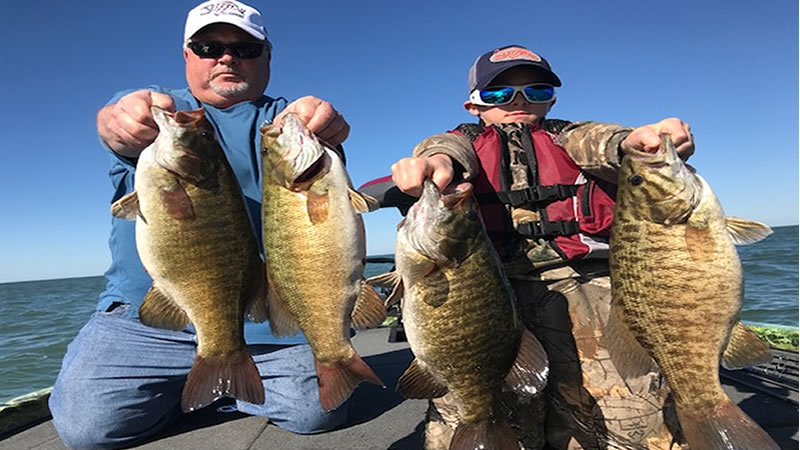
What counts as a trophy smallmouth bass? There is no universal weight that every angler, state agency, or tournament uses. On Lake Erie, however, a five-pound smallmouth is a serious trophy for most anglers, and a six-pound fish is exceptional. For perspective, the Pennsylvania Fish and Boat Commission currently lists the Pennsylvania state-record smallmouth at 8 pounds, 8 ounces.
Lake Erie is one of the best places in the country to chase heavy bronzebacks because it combines large expanses of rock, abundant forage, open-water structure, and enough seasonal variety to produce both numbers and size.
What Makes a Smallmouth “Trophy Class”?
Trophy status depends on the fishery. A three-pound smallmouth can be outstanding on some waters, while Great Lakes anglers may regularly encounter four-pound fish. On Lake Erie, many anglers begin thinking “trophy” around the five-pound mark because fish of that size are mature, powerful, and noticeably heavier than an average catch.
- 4 pounds: an excellent adult smallmouth.
- 5 pounds: trophy-class for most anglers.
- 6 pounds: exceptional and worthy of careful measurement and photos.
- 7+ pounds: rare, elite fish even on premier Great Lakes water.
Those are practical angler benchmarks, not legal or agency award thresholds. Always use current state-program rules if you are submitting a fish for an official award or record.
Why Lake Erie Grows Big Smallmouth
Big smallmouth need food, suitable habitat, and time. Lake Erie provides all three. Rocky reefs, shoals, gravel transitions, points, and offshore structure create feeding areas across a huge amount of water. The lake also supports abundant forage, including gobies and baitfish, allowing smallmouth to maintain the thick body condition Great Lakes anglers associate with “football” bronzebacks.
The Lake Erie fishing hub explains how this fishery changes across Pennsylvania, Ohio, New York, and Michigan. For Pennsylvania access, guides, and local information, use our Pennsylvania Lake Erie page.
Best Seasons for Trophy Lake Erie Smallmouth
Spring
Pre-spawn fish can be heavy and aggressive as they move toward warming water and staging structure. Regulations around spring bass and spawning areas vary by state and can change, so verify the rules for the water you are fishing before targeting shallow fish.
Early Summer
As fish leave protected shallow zones, transitional structure becomes important. Points, reef edges, rock-to-sand changes, and nearby depth breaks can hold quality smallmouth.
Mid- to Late Summer
Many large fish use deeper rock, humps, ledges, and offshore forage. This is when electronics, boat control, and finesse presentations become especially important. See our deep Lake Erie smallmouth guide.
Fall
Cooling water can concentrate bait and trigger heavy feeding before winter. Trophy fish may be caught shallow or deep depending on weather, forage, and basin conditions. Use the Lake Erie seasonal forecast for a month-by-month planning framework.
Best Presentations for Trophy Smallmouth
- Drop shot: excellent when large fish are holding on deeper rock or directly beneath the boat.
- Tubes: effective for crawling across rock and imitating bottom forage.
- Ned rigs: a high-percentage finesse option for pressured or neutral bass.
- Swimbaits: strong when fish are roaming or feeding on suspended bait.
- Jerkbaits: useful when bass are looking upward and willing to chase.
- Topwater: capable of drawing explosive strikes during low-light feeding windows.
For detailed setups, see the Lake Erie drop-shot guide and topwater smallmouth guide.
How to Target the Biggest Fish in a School
Large smallmouth often use the best part of a structure rather than distributing evenly. Pay attention to isolated rock, the first major depth break, a single boulder on an otherwise flat bottom, or the edge where hard bottom meets sand. When one quality fish bites, mark the exact cast, depth, and bottom feature before moving on.
Do not assume the largest fish are always deepest. Weather, forage, current, light, and seasonal stage can move trophy fish surprisingly shallow or suspend them off structure.
Use a Scale, Length Board, and Good Fish Handling
If you catch a personal-best smallmouth, have a scale and measuring board ready before the fish is landed. Support the fish horizontally, minimize air exposure, take the photo efficiently, and release it quickly when practicing catch-and-release. Big, old fish are valuable to both the fishery and the next angler.
Trophy Smallmouth FAQ
Is a 5-pound smallmouth a trophy?
For most anglers, yes. On Lake Erie, five-pound fish are realistic enough to target but still large enough to be memorable trophies.
How big is the Pennsylvania smallmouth record?
The Pennsylvania Fish and Boat Commission currently lists the state-record smallmouth bass at 8 pounds, 8 ounces.
What is the best Lake Erie trophy technique?
No single lure wins every day. Drop shots, tubes, Ned rigs, swimbaits, jerkbaits, and topwater all have important seasonal windows. Location and boat control usually matter more than owning one “magic” bait.
For the full system, start with our Lake Erie smallmouth strategy guide.
Official reference: Pennsylvania Fish and Boat Commission state-record fish.