
Published July 13, 2023 · Updated September 9, 2026
A drop shot rig for bass places the hook above the weight, keeping a soft-plastic bait off the bottom while the sinker maintains depth and contact. It is a precise finesse system for largemouth, smallmouth, and spotted bass, but it is not limited to deep, clear water. Anglers can fish it vertically, cast it across structure, or adapt it for shallow cover.
This page owns the setup and technique side of the topic: rod, reel, line, hook, weight, leader length, knots, and presentations. For bait profiles, sizes, and colors, use the separate guide to the best drop shot lures for bass.
Table of Contents
What Is a Drop Shot Rig?
The rig is simple: the hook is tied directly to the main line or leader, and a tag end extends below the hook to a sinker. When the weight rests on the bottom, the bait remains suspended at the height set by that tag end. The angler can move the bait while keeping it near one spot, which is useful when bass are pressured, inactive, or grouped tightly around cover.
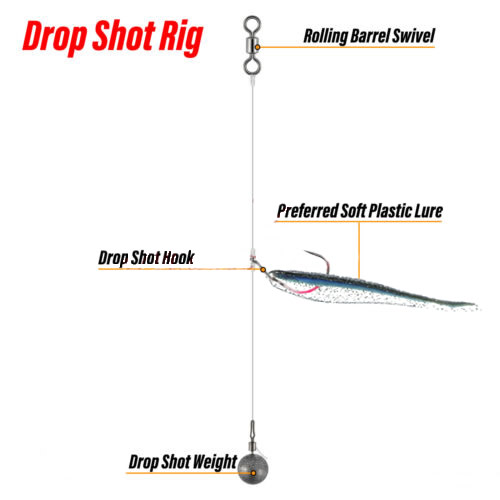
A drop shot belongs in the larger family of bass fishing rigs, but the weight-below-hook layout separates it from Texas, Carolina, and shaky-head presentations. It gives the bait freedom to move without forcing it to lie on the bottom.
Drop Shot Setup: Rod, Reel, Line, Hook and Weight
Rod and reel
A medium-light or medium spinning rod around 6 feet 10 inches to 7 feet 4 inches is a practical starting range. Choose a fast or extra-fast tip that transmits light bites but still bends enough to protect light line. A 2000- to 3000-size spinning reel balances most rods in this class and manages thin braid or fluorocarbon well.
Main line and leader
Many anglers use thin braided main line with a fluorocarbon leader because braid improves sensitivity and leader material is less visible in clear water. Straight fluorocarbon also works. Six- to 10-pound leader material covers many open-water situations; heavier line may be appropriate near vegetation, docks, or abrasive cover. The correct choice depends on water clarity, cover, fish size, and the hook being used.
Hook placement
For open water, a size 1 or 2 finesse hook is a common starting point for nose-hooked plastics. Match the hook to the bait instead of treating one size as universal. Around grass or brush, a light-wire offset hook can hold a Texas-rigged plastic with the point protected. The hook should stand out roughly perpendicular to the line with its point facing upward.
Weight shape and size
Start light enough to retain a natural presentation but heavy enough to feel the bottom. A 1/8- to 1/4-ounce weight handles many shallow or calm situations. Deeper water, current, wind, or a fast vertical drop may call for 3/8 ounce or more. Cylinder weights slip through vegetation and narrow gaps; round or teardrop weights provide strong bottom feedback on rock or firm substrate.
Leader length
The distance from hook to weight controls bait height. Eight to 14 inches is a versatile baseline, not a fixed rule. Shorten it when bass hug the bottom or visibility is poor. Lengthen it when fish suspend above cover, forage rides higher, or clear water allows bass to see farther. The Virginia Department of Wildlife Resources likewise recommends changing tag length for the desired depth.
How to Tie a Drop Shot Rig
- Tie the hook. Use a Palomar, double-uni variation, or another knot appropriate for the line and hook. Leave enough tag end to create the planned hook-to-weight distance.
- Orient the hook. Pass the tag end back through the hook eye from the point side. This helps the hook sit upright when the line is tightened.
- Attach the weight. Clip on a purpose-built drop shot weight or tie a sinker to the tag end. A clip-style weight can release if it wedges into cover, saving the rest of the rig.
- Add the bait. Nose-hook a finesse plastic for maximum movement in open water, or Texas-rig it when the hook point needs protection.
- Test the rig. Hold the line tight beside the boat or bank. Confirm that the hook faces up, the bait hangs naturally, and the weight maintains bottom contact.
The Palomar knot is a familiar starting point, while professional anglers sometimes prefer other knots for specific line and hook combinations. Experienced anglers test knot, weight, and leader choices rather than assuming one setup fits every condition.
How to Fish a Drop Shot Rig for Bass
Vertical presentation
Position the boat over fish, rock, brush, or a depth change located with sonar. Lower the rig until the weight touches bottom, remove excess slack, and hold the bait in place. Small rod-tip movements are enough. The goal is to animate the plastic without repeatedly lifting the sinker away from the target.
Cast and drag
Cast beyond a point, ledge, shell bed, or isolated cover and let the sinker settle. Move the weight a short distance, pause, and allow the bait to hover. This covers water while preserving the drop shot’s controlled presentation. Keep enough tension to detect a bite, but avoid pulling the rig continuously like a heavy Carolina rig.
Dead-stick and shake
When bass are inactive, hold the weight still and let current, boat movement, or the plastic’s buoyancy create subtle action. If that fails, shake the slack line lightly. Aggressive rod movement often makes the weight jump and turns a finesse presentation into a noisy one.
Shallow power shot
A heavier line, weedless hook, and compact weight can take the rig through grass, reeds, or dock edges. This version is sometimes called power-shotting. It keeps the bait above debris while giving the angler more control around cover. For a real location example, see the Lake Erie drop-shot smallmouth report.
How to Adjust the Rig for Conditions
- Clear, pressured water: use a lighter leader, natural bait, and restrained movement.
- Wind or current: increase weight until bottom contact is reliable, but stop before the presentation feels unnecessarily heavy.
- Fish tight to bottom: shorten the hook-to-weight distance.
- Suspended fish: lengthen the tag end or hold the rig at the marked depth rather than dropping below the fish.
- Rock: use a weight that communicates bottom composition and avoid dragging it into cracks.
- Grass or brush: choose a narrow weight and Texas-rig the plastic to reduce snags.
- Cold water: extend pauses and use less movement.
- Active fish: fish faster, make short pitches, and move to the next target after a brief presentation.
The rig works through all seasons. Summer is productive when bass group on deep structure, but a drop shot can also catch shallow spring fish, suspended fall bass, and winter fish that will not chase. The better rule is to follow fish position, not the calendar.
Common Drop Shot Mistakes
- Overworking the bait. The plastic can move while the sinker stays planted. Large rod sweeps often pull the presentation out of the strike zone.
- Using too much weight. Excess weight reduces finesse and can wedge more firmly into rock. Use only what conditions require.
- Ignoring hook orientation. A hook that lies sideways or points down produces poor presentation and hookup efficiency.
- Keeping one leader length. Bass position changes. Adjust the tag end when fish are higher or lower than the bait.
- Fishing below suspended bass. Bass often feed upward. Stop the rig at their level when electronics show fish off bottom.
- Setting the hook too hard. With light line and a small hook, reel down and sweep rather than making a violent hookset.
Drop Shot Rig FAQ
What is the best drop shot setup for bass?
A balanced starting setup is a medium-light spinning rod, 2000- to 3000-size reel, thin braid with a 6- to 10-pound fluorocarbon leader, size 1 or 2 finesse hook, and 1/8- to 1/4-ounce weight. Adjust each component for cover, depth, current, bait size, and fish size.
How far should the hook be above the weight?
Eight to 14 inches is a useful baseline. Shorten the distance for bottom-hugging bass or low visibility and lengthen it for suspended fish, taller cover, or clear water.
Should a swivel be used?
A swivel is optional. It can reduce line twist, but it adds another connection. Many anglers instead use braid-to-fluorocarbon with a compact leader knot and manage twist by rigging the bait straight.
Can a drop shot catch largemouth and smallmouth bass?
Yes. The same weight-below-hook principle works for both. Largemouth anglers often adapt it for vegetation and docks, while smallmouth anglers commonly use it around rock, points, and deeper structure. Review the smallmouth bass guide for species-specific habitat details.
Which lure should go on the hook?
Start with a straight-tail worm, minnow profile, small worm, or compact creature bait that matches the available forage. The lure page explains how to choose drop shot bait shapes, sizes, and colors without duplicating the rig instructions here.


I do not even know how I ended up here, but I thought this post was great. I don’t know who you are, but definitely you’re going to be a famous blogger if you aren’t already ;) Cheers!
Thanks!