
Sight fishing for bedding bass isn’t about finding a hungry fish; it’s about psychological warfare against a creature that doesn’t want to eat. If you’ve spent any time on the water during the spawn, you know the frustration of watching a massive trophy ignore your lure for hours. It’s a high-stakes game where one wrong move or a single shadow can spook the fish of a lifetime before you even make your first cast. You’re likely tired of fighting surface glare and watching bass swim circles around your bait without ever opening their mouths.
I understand that feeling because I’ve been there myself. This guide is your professional tactical playbook to mastering the spawn. I’ll teach you how to use stealth to your advantage, select polarized lenses that cut through the toughest glare, and observe how a fish responds to a lure near its nest without assuming a strike. We’ll dive into the specific gear setups and lure presentations that turn a standoff into a successful landing. By the time we’re done, you’ll have the visual skills and technical confidence to handle any bedding situation like a seasoned pro.
Key Takeaways
- Invest in high-quality polarized optics with copper or bronze lenses to cut through surface glare and spot fish before they spot you.
- Master the art of stealth by keeping the sun at your back and minimizing boat vibration to approach shallow nests undetected.
- Learn to trigger defensive strikes by presenting lures like lizards and craws that bass perceive as immediate threats to their offspring.
- Discover why sight fishing for bedding bass requires specialized gear, including heavy-action rods that provide the leverage needed to pull trophy fish from thick cover.
- Minimize handling and release fish promptly, while recognizing that nest return and continued guarding are not guaranteed.
The Art and Science of Sight Fishing for Bedding Bass
Sight fishing for bedding bass is the ultimate test of an angler’s patience and vision. It involves visually locating a fish on its spawning nest and presenting a lure to trigger a reaction strike. Unlike traditional fishing where you search for active feeders, this is a game of psychological pressure. You aren’t trying to convince the fish that your lure is a tasty snack; you’re convincing them it’s a threat that must be eliminated immediately. It’s a high-energy standoff that requires you to stay calm and focused while staring down a potential trophy.
During this period, the biological drive shifts entirely toward reproduction and protection. Understanding Largemouth bass spawning behavior is critical because it explains why a fish that won’t eat a real minnow will suddenly crush a plastic lizard. In most cases, you’ll see two fish on a bed. The smaller, hyper-aggressive one is the “buck” male. The large, often lethargic shadow nearby is the trophy female. While the buck is easy to catch, the female is the true prize that requires professional-grade tactics to fool. Remember, these fish are guarding territory, not looking for a meal.
Identifying the Spawning Phases
Success starts with knowing when to look. Bass move through specific stages before they lock onto a nest, and your approach must change accordingly.
- Pre-spawn staging: Fish hold on nearby drop-offs or deep grass edges, waiting for the right conditions.
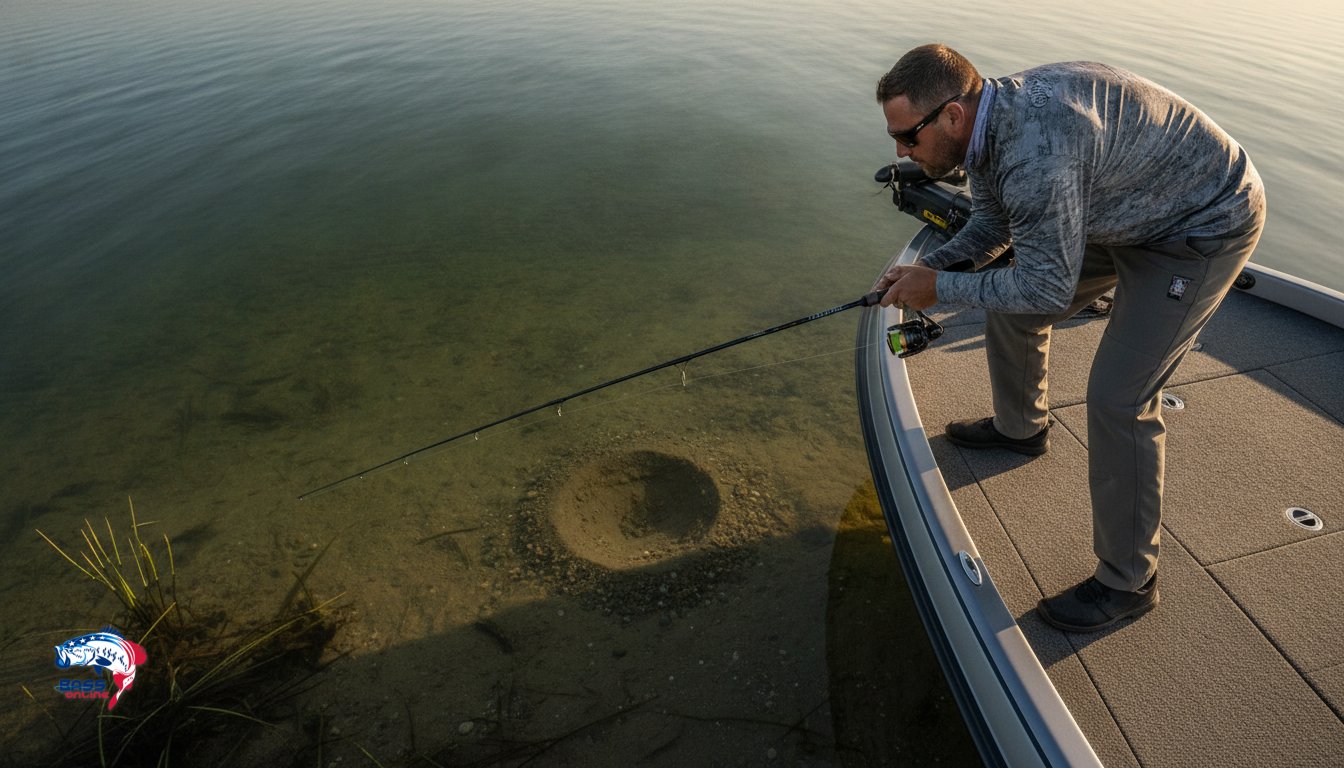
- Bedding behavior: The male fans out a circular “clean” spot on the lake bottom, removing silt and debris to expose hard sand or gravel.
- Water Temperature: Look for the action to heat up when water temps hit the 60 to 70-degree range.
Recognizing a fresh bed is key. A bright, light-colored patch against a darker bottom usually indicates an active nest where a bass is currently on guard. If the bed looks “dirty” or covered in silt, the fish have likely moved on.
Why Bass Protect the Bed
Bass don’t tolerate intruders near their eggs. Their instinctual drive is to kill or remove anything that might eat their offspring, such as bluegill, crawfish, or salamanders. This is where you find the “sweet spot.” Eggs may be distributed across suitable surfaces within a nest; there is no universal one-square-inch target. If your lure lands outside this zone, the bass might just watch it. If it lands exactly in the sweet spot, the bass will often snap at it instantly to move the threat. The male guards the eggs and fry after spawning. Females may be present during spawning, but should not be described as sharing the male’s extended nest-guarding role. See the UF/IFAS explanation of Florida bass reproduction and bed fishing. Mastering bass species behavior during this phase is what separates the weekend warriors from the pros.
Essential Gear: Seeing the Unseen
Vision is your greatest weapon when you’re on the hunt. You can have the perfect lure, but if you can’t see the fish or the bed, you’re just casting at shadows. Sight fishing for bedding bass is an equipment-intensive game where the right tools don’t just help; they’re the only reason you’re in the fight. Professional guides rely on a specific kit designed to eliminate environmental obstacles like surface glare and heavy cover. High-quality gear allows you to stay stealthy while maintaining the leverage needed to win a short-range brawl with a trophy fish.
The Role of Polarized Sunglasses
You wouldn’t go into a dark room without a flashlight, and you shouldn’t go sight fishing without premium optics. Lens polarization is a specialized filter that blocks horizontal light waves, effectively stripping away the blinding surface glare that prevents you from seeing into the water column. In 2026, lens technology has reached a point where specialized tints can make a bass “pop” against the bottom. For shallow water and nesting areas, copper or amber lenses are the gold standard because they increase contrast and depth perception. Grey lenses are great for bright, open water, but they don’t offer the same detail in the shallows. Premium polarized sunglasses typically range from $110 to over $300, and they’re worth every penny for the clarity they provide.
To get the best view, keep the sun at your back. This angle uses the light to illuminate the bed rather than reflecting it into your eyes. If you want to see how the pros handle these visual challenges, checking out Shaw Grigsby’s 5 Best Tips for Sight Fishing can give you a head start on your next outing. Our professional fishing guides use these visual tactics daily to put clients on fish that others simply swim right over.
Rod and Reel Setup for Precision
When you’re sight fishing for bedding bass, the battle is usually won or lost within twenty feet of the boat. You need a 7-foot to 7-foot 6-inch rod with medium-heavy to heavy power. This gives you the backbone to “hoist” a bass out of thick vegetation before it can wrap your line. A fast-action tip is essential for short-distance accuracy; it allows you to flick a lure exactly into the sweet spot of the nest without a massive, spooking splash. Pair this with a high-speed casting reel (7.1:1 ratio or higher). If a bass spits your lure or misses the strike, you need to burn that bait back and get it back on the bed instantly. Use 15 to 20-pound fluorocarbon line because it’s nearly invisible underwater and sinks quickly, keeping your lure pinned in the strike zone. If you’re ready to put this gear to the test, you can reach out to us to book a session with a mentor who can show you these setups in action.
Stealth and Boat Positioning Tactics
Sight fishing for bedding bass is a game of inches where your boat is a giant, vibrating intruder. You can have the best optics in the world, but if the bass feels your presence before you see the nest, the battle is over. Stealth isn’t just about being quiet; it’s about eliminating every physical signature you leave on the water. Sound travels five times faster in water than in air, and a single metal-on-metal “thud” from a dropped pair of pliers or a slamming locker lid can send a trophy female back to deep water in a heartbeat. Professional success depends on approaching the shallows like a predator.
Choose a viewing angle that reduces glare while keeping your shadow off the nest. Shadows extend away from the sun: with the sun behind you, your shadow can fall ahead toward the fish. Adjust your approach for the sun angle, wind and visibility, and avoid passing directly over the nest.
Approaching the Bed Without Spooking
Your trolling motor is your most useful tool and your biggest liability. Avoid “pulsing” the motor on high speeds, as the sudden surge of vibration is a clear warning sign to fish. Instead, keep the motor on a low, constant speed to glide into position. Watch the fish’s body language closely. If the bass remains “pinned” to the center of the bed with its fins moving rapidly, it’s locked in and aggressive. If it starts swimming in wide circles or hovers on the edge of the nest, you’re too close. If the fish leaves, back off immediately. A disturbed fish may return, but timing and behavior vary. If it leaves, reduce disturbance and move on rather than relying on a fixed return time.
Leveraging Shallow Water Anchors
In less than 10 feet of water, shallow water anchors like Power-Poles or Talons are game changers. Wind and current will constantly push your boat, forcing you to use the trolling motor to stay in place. This creates unnecessary noise and silt-disturbing prop wash. By silently pinning your boat to the bottom, you can focus entirely on the fish. Lock into a position that allows for a cross-wind cast, which helps prevent your line from drifting over the center of the nest. If you’re looking for a hands-on mentor to teach you these high-level maneuvers, our Bass Online guides specialize in the stealth tactics required to land pressured fish. Mastering this silent approach allows you to dissect a nest without the bass ever knowing you’re there.
Proven Lures and Retrieval Techniques to Trigger Strikes
When you’re sight fishing for bedding bass, you have to stop thinking like a chef and start thinking like a home invader. These fish aren’t looking for a snack; they’re looking to eliminate anything that threatens their eggs. Your lure needs to represent a natural predator that bass instinctively hate. Craws, lizards, and bluegill imitations are the top choices because they are notorious nest-robbers. If you drop a plastic lizard into the center of a nest, the bass doesn’t see a meal. It sees a threat that needs to be killed or carried away immediately.
Using scent is a pro move that many weekend anglers overlook. While scent won’t necessarily draw a bedding fish from a distance, it serves a vital purpose once the strike happens. A heavy application of craw or shad scent masks human odors and encourages the bass to hold onto the “intruder” for a few extra split seconds. In a game where strikes are often lightning-fast and defensive, those extra seconds give you the window you need to reel down and drive the hook home.
Choosing High-Visibility Baits
In most fishing scenarios, you want your lure to look as natural as possible. For sight fishing for bedding bass, that rule goes out the window. I recommend using high-visibility colors like white, bubblegum pink, or chartreuse. These bright colors aren’t for the fish; they’re for you. You need to see exactly where your lure is sitting on the bed. When a bass inhales a white lure, it disappears from view. That visual “disappearing act” is often your only signal to set the hook. Match your lure size to the nest; a smaller bed usually requires a more compact creature bait to avoid overwhelming the fish. You can find more deep dives into lure selection by visiting our guide on Mastering Bass Fishing.
The Irritation Retrieve: Making Them Mad
The “irritation retrieve” is a test of wills. Start by “dead-sticking” your lure. This means letting it sit perfectly still in the “sweet spot” of the nest for up to a minute. If that doesn’t work, start repetitive casting. Hit the exact same spot ten, twenty, or even thirty times in a row. You’re wearing down the fish’s patience until it finally snaps. Shake the lure in place without moving it out of the strike zone to simulate an egg-thief feeding on the nest. The exact moment to set the hook is when the lure completely disappears from sight and you see the bass’s head turn to move the intruder off the bed. If you want to see these defensive triggers in person, book a guided trip with us and let a pro coach you through the process.
Ethical Considerations and the Professional Edge
Sight fishing for bedding bass is an incredible way to target the biggest fish in the lake, but it comes with a heavy responsibility. You’re interacting with these fish during their most vulnerable life stage. As an angler, you aren’t just a participant; you’re the temporary guardian of that nest. Every second a bass is away from its bed, opportunistic predators like bluegill and sunfish are circling, waiting to raid the eggs. Professional ethics mean putting the health of the fishery above the glory of the photo. Careful handling reduces avoidable disturbance, but catching a nesting bass can still affect its brood.
Trophy females deserve extra care. These are the “big mamas” that carry the genetic legacy of the lake. During the spawn, they’re already under immense physical stress. Handling them with wet hands, supporting their weight properly, and getting them back into the water immediately is non-negotiable. Keep handling brief and release the fish promptly near the capture area; returning to a nest within a particular time is not assured. This proactive mindset is what keeps our favorite lakes productive year after year. It’s about respecting the resource as much as the sport.
Responsible Catch and Release
Time is the enemy. When you land a bedding bass, keep the celebration short. Minimize the time the fish spends out of the water. I never recommend putting a bedding bass in a livewell. Avoid transporting nesting fish away from the capture area. Research on nest-guarding males links some angling practices, including livewell confinement and displacement, with delayed return or abandonment. Keep handling brief and release the fish near where it was caught. You can learn more about the biology of these incredible creatures by checking out the Florida Bass Science report, which breaks down the strategy behind protecting our trophy species. Keep handling and air exposure brief and release the fish promptly. This does not guarantee a return to nest guarding. Research on nesting largemouth bass documents brood predation and nest abandonment following angling; outcomes vary with conditions.
Why a Professional Guide Shortens the Learning Curve
Mastering the visual skills needed for this sport takes years of time on the water. A professional guide acts as a mentor, helping you develop an “expert eye” to spot hidden beds that most anglers miss. A guide can help you observe fish behavior and decide when to adjust your presentation or move on, without assuming that a fish will strike. You’ll learn how to position the boat and select the right gear without the trial and error that often spooks the biggest fish in the lake. If you’re ready to level up your skills and experience the raw excitement of the spawn, Book your next trophy bass trip with Bass Online today. We provide the professional equipment and local knowledge to make your expedition a success while prioritizing the conservation of the species we love.
Master the Spawn and Land Your Trophy
Mastering sight fishing for bedding bass is about more than just seeing the fish; it’s about executing a tactical plan with absolute precision. You now have the playbook for using high-quality optics to cut through glare and positioning your boat to stay invisible. Remember that you’re triggering a defensive strike by invading the sweet spot of the nest with high-visibility lures. These field-tested techniques turn a frustrating standoff into an adrenaline-pumping victory while keeping the health of the fishery a top priority.
Success on the water comes down to experience and having a mentor who knows these waters inside and out. Since 1997, we’ve provided expert-led expeditions on the nation’s premier lakes. Our guides bring over 25 years of professional experience and specialized knowledge in targeting trophy largemouth and peacock bass. We handle the gear and the navigation so you can focus entirely on the catch of a lifetime. Ready to land a trophy? Book your professional bass fishing guide now! Grab your gear and get ready for an unforgettable day on the water.
Frequently Asked Questions
Is sight fishing for bedding bass considered ethical?
Ethical sight fishing is entirely possible when you prioritize the health of the fishery. Prompt release and minimal handling reduce time away from the nest, but do not guarantee that a male resumes guarding or that the brood remains unharmed. Bass seasons, harvest restrictions, and catch-and-release requirements differ by state and waterbody, and special regulations may apply during the spawn. Check the current local rules before fishing, and return bedding fish to the water promptly and carefully.
What lens color is best for sight fishing in stained water?
Copper or amber lenses are the top choice for stained water conditions. These tints increase contrast and help you distinguish the light-colored sand of a bass bed against a darker, siltier lake bottom. While grey lenses work well for open water, they don’t provide the depth perception needed to spot a trophy female holding in the shadows. High-quality polarized optics are essential for cutting through the surface glare that hides these shallow nests.
How do I know if a bass is actually on a bed?
A bass is on a bed if it stays “locked” into a specific circular patch of cleared bottom and refuses to leave as you approach. Bedding fish will hover directly over a central point or swim in tight, defensive circles around the nest. Failure to return within a few minutes does not reliably distinguish a cruising fish from a disturbed nesting fish. Observe behavior from a distance and avoid repeatedly pressuring a fish that leaves.
What do I do if the bass swims away when I cast?
Stay perfectly still and wait for the fish to return to its post. Spooked bass often circle back to their eggs once they realize the “intruder” isn’t an immediate threat. If the fish refuses to return, you might be too close or your boat shadow might be crossing the nest. Try repositioning your boat further away and making a longer, quieter cast with a lighter lure to avoid creating a splash.
Why do pro anglers use white lures for sight fishing?
Professional guides use white lures primarily for visual tracking rather than attracting the fish. When you are sight fishing for bedding bass, you need to see exactly when the lure enters the strike zone or disappears into the fish’s mouth. Since bedding strikes are often defensive “pick up and drop” moves, seeing that white plastic vanish is your best signal to set the hook before the bass can spit the intruder out.
How long should I try to catch a bedding bass before moving on?
Give a specific fish about 15 to 20 minutes of dedicated effort. If you haven’t seen a change in body language or an increase in aggression by then, the fish may not be ready to commit. Some trophy females take much longer to “fire up,” but overworking a single nest can cause excessive stress. It is often better to move on and check back later when the sun angle or wind conditions have changed.
Can I catch a trophy bass on a bed using live bait?
You can, but artificial lures are usually more effective for triggering the specific defensive strikes required during the spawn. Live bait like shiners can be difficult to keep exactly in the center of the nest. Soft plastic lizards or craws allow you to hover the threat directly over the eggs. This constant presence irritates the bass into a reaction strike that a moving live bait might not provoke as consistently.
What is the “sweet spot” on a bass nest?
Anglers use “sweet spot” to describe an area where a fish reacts to a presentation. It is not necessarily the exact center of the bed or proof that eggs are concentrated there. If your lure lands on the edge of the nest, the fish might just watch it or nudge it away with its nose. A fish may react to a lure near the nest, but a strike is not assured. Usually, an aggressive fish will choose to attack the intruder to protect its offspring.

Article by
Mr Bass
Todd Kersey, widely known as Mr. Bass by Field & Stream, is a professional angler, accomplished author, and dedicated philanthropist with a lifelong passion for bass fishing. Armed with a degree in Outdoor Travel, Mr. Bass has expertly combined his knowledge with his practical fishing experience to become one of the most respected names in bass fishing.
His deep understanding of bass habitats and fish behavior has earned him numerous accolades as an asset to the sport. Serving 8 years as FWC Stakeholder Chairperson. Leading and passed cutting-edge legislation, such as the Black Bass Management Plan, and successfully built, passed, and helped finance the Trophy Catch program.
As CEO, he is committed to giving back to the community through his philanthropic efforts. He supports a variety of causes, especially those centered around physical disabilities. Through his advocacy, his mentorship programs inspire anglers to engage in fishing stewardship, helping to raise more than $18 million dollars in donations. Mr. Bass continues to inspire anglers and outdoor enthusiasts alike with his commitment to the sport, industry, and the world around him.