

Published: January 6, 2023 | Updated: September 10, 2026
There is no single bass lure that wins in every lake and every hour. The right choice depends on three questions: where are the fish in the water column, what cover is around them, and how willing are they to chase? This guide organizes the main bass lure types around those decisions, so you can choose a useful presentation instead of buying another bait because its package looks convincing.
Largemouth bass commonly use vegetation, wood, and other structure as ambush cover, and adults feed on fish, crayfish, and frogs. Those habitat and diet facts explain why successful lures imitate several different prey types and must work at different depths. The U.S. Fish and Wildlife Service largemouth bass profile provides a helpful biological foundation.
Quick answer: the most useful bass lure categories
A compact tackle box can cover most situations with soft plastics, jigs, spinnerbaits or bladed jigs, crankbaits, jerkbaits, topwater lures, swimbaits, and spoons. Each category has a job. Soft plastics and jigs probe targets slowly. Crankbaits, spinnerbaits, and bladed jigs cover water. Jerkbaits suspend around fish. Frogs and other topwaters work above the surface. Swimbaits and spoons imitate baitfish through a wide depth range.
- Heavy vegetation: Texas-rigged plastics, frogs, compact jigs, and weedless swimbaits.
- Wood or rock: squarebill crankbaits, jigs, and spinnerbaits that can deflect past cover.
- Open water: jerkbaits, swimbaits, lipless crankbaits, and spoons.
- Inactive or pressured fish: smaller plastics, finesse jigs, and suspending jerkbaits.
- Actively feeding fish: topwater lures, spinnerbaits, bladed jigs, and fast-moving crankbaits.
Table of Contents
Choose a lure by depth, cover, and fish activity
Start with location, not color. If bass are buried in grass, a lure that cannot pass through vegetation is a poor choice even if its color is perfect. If fish are suspended over deep water, a bottom bait may spend most of the retrieve below them. Match the tool to the strike zone first, then refine profile, color, and speed.
- Surface: walking baits, poppers, buzzbaits, and hollow-body frogs.
- Shallow to mid-depth: spinnerbaits, bladed jigs, squarebill crankbaits, jerkbaits, and weightless plastics.
- Bottom: Texas rigs, Carolina rigs, Ned rigs, football jigs, and compact casting jigs.
- Vertical or deep: jigging spoons, drop-shot plastics, and weighted swimbaits.
When you need to locate active fish across a large flat or point, use the dedicated search-bait method. Once you find a productive area, slowing down with a jig or soft plastic often reveals fish that will not chase.
Soft plastics: the adaptable foundation
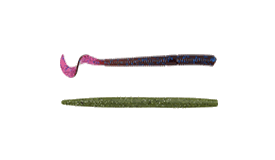
Soft plastics are useful because one bait can be rigged to fall, swim, crawl, or stay nearly still. A Texas rig slips through vegetation and brush. A weightless stick bait falls slowly beside docks or grass edges. A wacky rig creates action with very little forward movement. A drop shot keeps a small bait above the bottom, while a Carolina rig covers deeper flats.
Choose the rig before obsessing over the brand. A straight-tail worm on a light, exposed hook suits open water; the same bait may need a weedless hook and heavier line around cover. For detailed setup choices, see the Texas rig guide. Soft plastics also make a practical starting point for beginners because retrieve speed can be adjusted without changing the entire lure category.
Jigs: controlled bottom and cover presentations
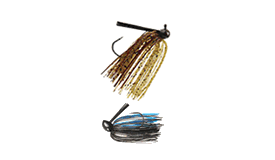
Jigs excel when bass relate closely to the bottom, docks, wood, grass edges, or isolated targets. A football head is designed for dragging across relatively open rock or hard bottom. A compact casting jig works around mixed cover. A swim jig is retrieved through grass and around shallow targets rather than crawled along the bottom.
The trailer changes the presentation. A subtle chunk or craw keeps the profile compact; a kicking trailer creates more movement and lift. Use enough weight to maintain contact and control, but not so much that every cast crashes into shallow cover. For dense vegetation, the site’s heavy-grass lure guide explains when a jig, frog, or pegged plastic is the more efficient option.
Spinnerbaits and bladed jigs: vibration in cover
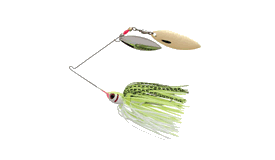
Spinnerbaits create flash and vibration while remaining relatively resistant to snags. They are useful along grass lines, beside laydowns, and over shallow cover, especially when wind or stained water reduces a bass’s ability to inspect the lure. Willow-style blades provide flash and less lift; rounder blades usually create more thump and can help keep the bait higher at slower speeds.
A bladed jig uses a vibrating blade directly in front of the jig head. It can cover similar water but has a tighter, more forceful vibration. Let conditions decide between them: a spinnerbait can roll over and around cover cleanly, while a bladed jig is excellent for ticking vegetation and then snapping free. Neither needs to be retrieved at one fixed speed. Contact, deflection, and sudden changes in cadence often matter more than a constant retrieve.
Crankbaits and jerkbaits: hard baits for the middle zone
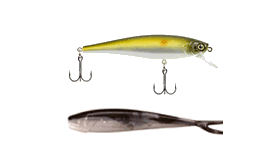
Crankbaits are depth tools. The bill shape, body buoyancy, line diameter, and retrieve determine where they run. Squarebills are built for shallow deflection around wood and rock. Lipless crankbaits sink and can be counted down or ripped through grass. Deeper-diving models reach ledges, points, and offshore cover.
Jerkbaits rely on a pull-pause cadence and an erratic baitfish profile. A suspending hard jerkbait can remain near a fish between movements, which is valuable in cool water or around pressured bass. Soft jerkbaits can be rigged weedless and worked through grass or beside cover. Pause length is not a universal formula: colder or less active fish may prefer more time, while feeding fish may respond to a faster cadence.
Clear water often favors natural or translucent patterns, but light, forage, depth, and wind all affect visibility. The clear-water lure guide explores those choices in greater detail.
Topwater lures: surface options for active bass
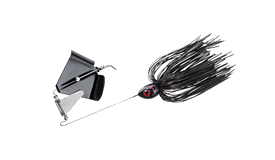
Topwater lures are most useful when bass are willing to feed upward. Walking baits cover open banks and flats. Poppers stay near a target longer. Buzzbaits move quickly through shallow water. Hollow-body frogs cross pads and matted vegetation where exposed treble hooks cannot travel cleanly.
Low light can improve a surface bite, but topwater fishing is not restricted to dawn. Shade, wind, schooling bait, cloud cover, and overhead vegetation can create surface opportunities throughout the day. After a strike, avoid setting the hook on sight alone; wait until you feel the fish load the rod. The full topwater lure guide covers presentation and tackle in more depth.
Swimbaits and spoons: baitfish profiles from shallow to deep
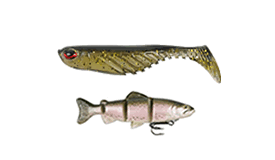
Swimbaits range from small paddle tails on light jig heads to large, jointed hard baits. Match their size to the local forage and the depth you need to reach. A weedless soft swimbait can move through grass; an exposed jig hook is better suited to open water. Larger swimbaits may draw fewer bites, but they can be effective when bass are focused on substantial prey. Learn the rigging and retrieve options in the soft-swimbait guide.
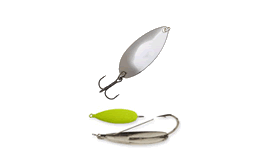
Spoons are less common in a basic bass box, yet they fill useful roles. A weedless spoon slides across vegetation, a casting spoon covers open water, and a jigging spoon reaches fish beneath a boat. Their flash and falling action can imitate injured baitfish, particularly when bass are grouped around deep forage.
How color, size, and retrieve change the presentation
Color is a visibility and contrast decision, not a rigid rule. Natural greens, browns, silvers, and translucent patterns often look convincing in clear water. Dark silhouettes or stronger contrast can be easier to track in stained water, shade, or at night. Bright accents may help fish locate a moving lure, but vibration, depth, and placement can matter more than a small color difference.
- Size: begin near the dominant forage size, then downsize for pressured fish or increase profile when bass are feeding on larger prey.
- Speed: retrieve fast enough to learn what fish will chase, then slow down when strikes are short or absent.
- Cadence: add pauses, deflections, or direction changes instead of repeating the same motion on every cast.
- Weight: choose enough weight to reach and control the strike zone while preserving the action you want.
- Sound: rattles and vibration can help in low visibility, while quieter baits may be better around heavily pressured fish.
Season affects bass location and activity, but calendar rules vary with latitude, weather, and the individual fishery. Use the seasonal bass-lure guide as a framework, then let water temperature, forage, and observed fish behavior refine the choice.
A practical bass lure system for one tackle box
A useful starter system is simpler than a wall of tackle-store options. Carry one moving bait for surface water, two for the middle zone, and two bottom-contact choices. Add replacements only when a lure solves a problem your current box cannot.
- Surface: one walking bait or buzzbait plus one hollow-body frog for vegetation.
- Middle: one spinnerbait or bladed jig and one crankbait or jerkbait.
- Bottom: a Texas-rig kit and one compact jig with two trailer styles.
- Open-water baitfish: one soft swimbait in a common forage color.
- Finesse backup: a small worm or Ned-style bait for difficult bites.
Keep notes on depth, cover, water clarity, lure, and retrieve after each trip. Patterns become clearer when the record says more than “caught one on green.” This method also prevents confidence from being confused with habit.
Common lure-selection mistakes
- Changing color before changing depth: a perfect color cannot help when the lure never reaches the fish.
- Buying duplicates without learning the category: several nearly identical baits do not replace practice with one.
- Ignoring hook condition: inspect points, split rings, knots, and line abrasion before the next cast.
- Using absolute seasonal rules: fish behavior responds to local conditions, not a national calendar.
- Forcing a favorite lure: confidence matters, but it should not overrule clear evidence about depth, cover, or activity.
- Skipping regulations: check the rules for the water you fish. Florida anglers can also review the FWC’s largemouth bass tips for cover-oriented techniques.
Frequently asked questions
What is the best all-around lure for bass?
A Texas-rigged soft plastic is one of the most adaptable choices because it can fish shallow or deep and move through many kinds of cover. If the goal is to find active bass quickly, a spinnerbait, bladed jig, or crankbait may be more efficient. The best all-around choice therefore depends on whether you are searching or working a known target.
Which lure should a beginner use first?
Start with a soft-plastic stick bait and a spinnerbait. The stick bait teaches line watching, fall rate, and target fishing. The spinnerbait teaches casting, depth control, and how cover contact triggers strikes. Together they cover slow and fast presentations without requiring a large tackle collection.
Do largemouth and smallmouth bass need different lures?
The categories overlap, but typical habitat changes the emphasis. Largemouth often relate to vegetation, wood, and shallow cover, while smallmouth frequently use rock, current, and open-water structure. Smaller tubes, finesse plastics, jerkbaits, and compact swimbaits are common smallmouth tools. See the dedicated smallmouth lure guide for species-specific adjustments.
When should I change lures?
Change when the current lure cannot reach the observed depth, move through the cover, or match the fish’s activity level. Before abandoning a useful category, test a different retrieve, weight, or profile. If several good casts through high-percentage water produce no contact, switch to a presentation that explores a different water column or speed.

Great website. Plenty of helpful info here. I’m sending it to some friends and also sharing in delicious. And obviously, thanks for your effort!
My wife and I fish for bass in smaller northern WI from our kayaks, some are no wake lakes with grasses, down tree’s and docks and Lilly pads. We really enjoyed some good fishing catching some nice bass and northern. These lakes are anywhere from 40 acres to 100 acres at most. We enjoy very low boat traffic if any most of the time it’s just us. So what can I do to improve my bass fishing in these beautiful quite lakes.
Experiment with different lures, most people also use the confidence lure and it provides the same old results. Especially as the seasons change and the weather. Try bigger baits, sometime it gets let bites, but bigger ones and always pay attention to the speed that you are fishing. In many cases can be more important than the lure itself! Good luck, and much success!
This is fricng awesome. Coming from a old veteran
Thank you
Glad you enjoyed it, and thank you for your service!
Thank you for your input. I use blade baits and lipless crankbaits. Also, square bill crankbaits in cold winter lakes.
All great baits, good luck to you!
Awesome, your service is wonderful, perfect!