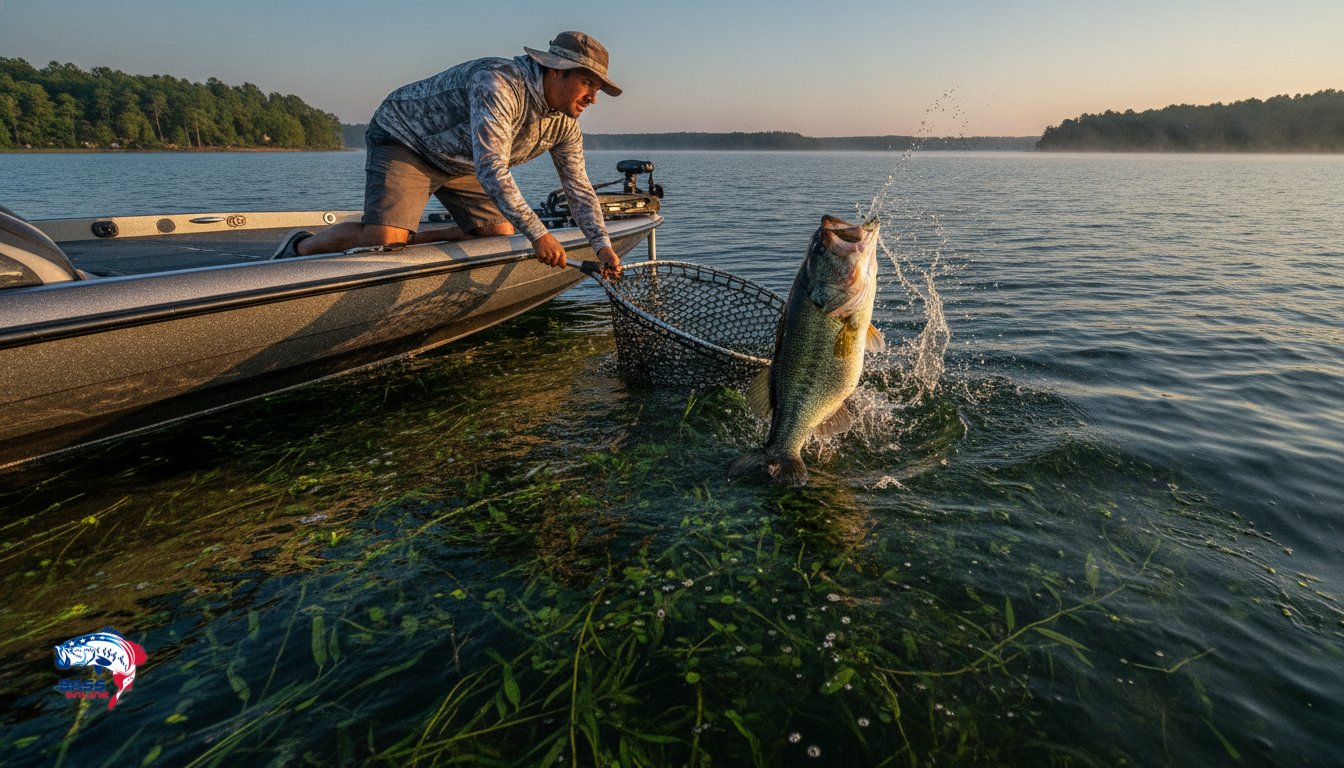

Most anglers see a massive field of thick hydrilla and see a lure graveyard, but for a trophy bass, it’s the ultimate high-oxygen kitchen. While others avoid the “slop” to save their gear, the pros know that the biggest largemouth in the lake are usually buried deep in that green mess. You’ve likely spent your afternoon pulling five pounds of salad off your hook for every one cast, wondering if there’s a better way to fish without losing your mind or your tackle.
It’s frustrating when you can’t tell a bite from a weed, but fishing submerged vegetation for largemouth doesn’t have to be a headache. I’m going to share the field-tested tactics our guides use every day on legendary waters like Lake Okeechobee and Lake Guntersville to pull giants out of the thickest cover. You’ll learn how to identify the most productive grass beds, pick the perfect lures for different vegetation types, and master the “rip and pause” technique that triggers violent strikes. We’re moving past generic tips to give you a pro-level blueprint for dominating the grass and landing the fish of a lifetime.
Key Takeaways
- Learn to identify “King” hydrilla and feather-like milfoil to pinpoint exactly where trophy bass set up their ambush lanes.
- Master the “tick and rip” retrieval method to trigger aggressive reaction strikes when fishing submerged vegetation for largemouth.
- Select specialized lures like lipless crankbaits and vibrating jigs designed to slice through thick grass without fouling.
- Understand the oxygen advantage of submerged beds and why they act as high-energy kitchens for bass during the summer heat.
- Discover how a professional guide can help you master the “feel” required to distinguish a subtle bite from a strand of grass.
Why Submerged Vegetation is a Largemouth Bass Goldmine
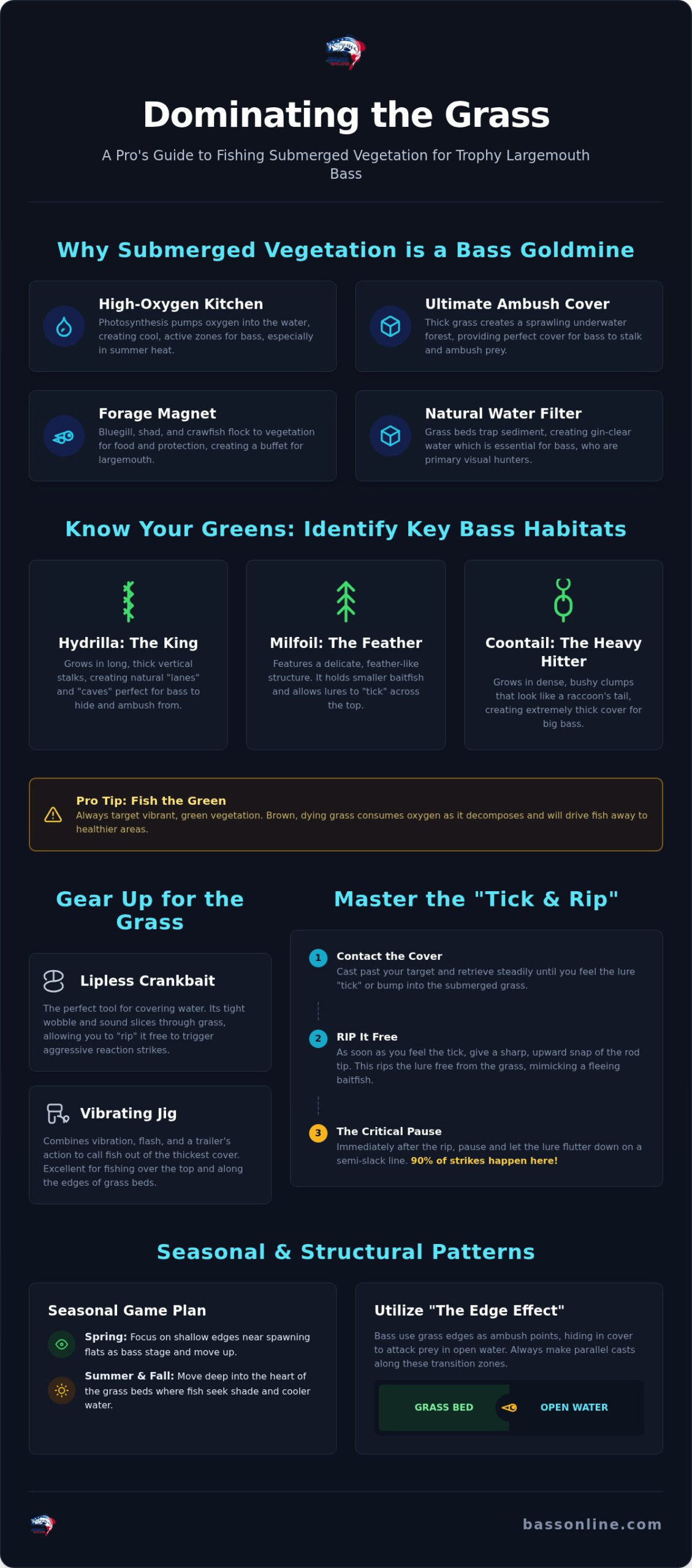
Submerged vegetation refers to aquatic plants that grow completely underwater without breaking the surface. Think of it as a sprawling underwater forest. When you’re fishing submerged vegetation for largemouth, you’re targeting the most productive habitat in the lake. These plants, often found in legendary spots like Lake Guntersville, provide everything a trophy bass needs to reach record-breaking sizes.
During the heat of a summer afternoon, these grass beds act like natural air conditioners. Through photosynthesis, they pump fresh oxygen into the water while creating “cool spots” that hold active fish when the rest of the lake turns sluggish. This oxygen advantage is a magnet for every species in the lake, making these beds the ultimate high-energy kitchen.
To better understand how bass relate to this underwater cover, watch this expert breakdown:
It isn’t just about the oxygen; it’s about the food. These beds are the foundation of the freshwater food chain. Bluegill, shad, and crawfish congregate in the submerged canopy for protection and easy meals. This concentration of forage draws in the largemouth bass, which use the thick cover to stalk their next meal without being seen.
The perimeter of these beds is where the most consistent action happens. Bass are opportunistic predators that prefer to work as little as possible for a meal. They utilize “The Edge Effect” by tucking into the shadows at the very edge of the grass, watching the open water for passing baitfish. This transition zone between the thick vegetation and the open lake is often the highest-percentage spot on any given day.
The Biological Connection Between Bass and Grass
Beyond providing cover, these plants are biological powerhouses. Submerged beds act as a natural filter, trapping suspended sediment and keeping the water gin-clear. This clarity is essential for bass, which rely heavily on their vision to hunt effectively. Thick grass also creates a sanctuary from intense UV rays. Even several feet underwater, dense vegetation provides shade, allowing bass to remain active during the brightest parts of the day. Submerged vegetation is the primary producer of trophy largemouth in freshwater because it offers a unique combination of high-octane oxygen, abundant forage, and superior ambush cover.
Seasonal Shifts in Submerged Cover
Understanding the health of the grass is vital for consistent success. You always want to look for “green” vegetation. Brown, dying grass consumes oxygen as it decomposes and usually drives fish away to healthier areas.
- Spring: Focus on the shallow edges near spawning flats. Bass use these as staging areas and protective corridors before moving onto the beds.
- Summer and Fall: As the sun gets higher, fishing submerged vegetation for largemouth requires moving deep into the heart of the hydrilla forest. This is when you need to get aggressive and pull fish out of the thickest shade.
Identifying the Best Grass: Hydrilla, Milfoil, and Coontail
Not all “weeds” are created equal. If you treat every green patch the same, you’re going to leave fish on the table. When you’re fishing submerged vegetation for largemouth, the specific plant species dictates where the bass sit and how you should present your lure. State wildlife agencies often highlight these areas in their official_habitat_description because they know that’s where the biomass is concentrated. You need to recognize these structures before you even make a cast.
Hydrilla is the undisputed king. It grows in long, vertical stalks that can reach from the bottom to near the surface. Because it grows in thick columns, it creates natural “lanes” and “caves” underneath the canopy. Bass love these ambush lanes because they can hide in the shadows and dart out at passing prey. Milfoil is different; it has a feather-like, delicate structure. It tends to hold smaller baitfish like young shad. Because it’s so soft, you can “tick” your lure across the tops without getting bogged down constantly.
Coontail is the heavy hitter’s choice. It grows in dense, bushy clumps that look like a raccoon’s tail. It doesn’t have a true root system, so it often forms thick, isolated mounds on the bottom. These clumps are where the biggest, “laziest” trophy bass live. They find a hole in the middle of a coontail bush and wait for food to come to them. Finally, don’t overlook Eelgrass or Peppergrass. These are thin, ribbon-like plants. Because they don’t mat up as tightly, they’re the perfect choice for moving baits like swimbaits or spinnerbaits that you want to burn through the cover.
How to Read Your Electronics for Submerged Beds
Your fish finder is your eyes underwater. When scanning, look for the “crown” of the grass—the very top of the bed where it starts to level off. You want to see a crisp line between the top of the vegetation and the open water above. Pay attention to the bottom signal too. A hard, yellow or red return under the grass is a goldmine. If the grass is growing out of soft silt, it’s often less productive. Use your side imaging to find “holes” or “pockets” within a solid field. These small openings are high-percentage targets where a big bass is likely waiting.
The “Green is Good” Rule
This is the most important rule in grass fishing: if it isn’t green, don’t fish it. Brittle, brown, or slimy vegetation is dying. As it rots, it sucks oxygen out of the water, and bass will vacate the area immediately. Use your lure to “sample” the grass. If you pull up a strand that’s vibrant and crisp, you’re in the right spot. You can learn about the forage like bluegill and crawfish that thrive in this healthy cover to better understand what your lure should mimic. If you want to see these grass beds in person and learn to read them like a pro, you can always reach out to our team to plan your next outing.
The Best Lures for Ripping and Picking Through Submerged Weeds
Matching Lure Weight to Grass Depth
Mastering the right weight is the “secret sauce” when fishing submerged vegetation for largemouth. A 1/2 oz lipless is great for “ticking” the tops of grass in shallow water, but if that grass is deeper, you’ll need a 3/4 oz to reach the strike zone and plow through the thicker sections. When using Texas rigs, always choose high-quality tungsten weights. Tungsten is smaller and denser than lead, which helps it slip through the canopy without hanging up. Using specialized largemouth bass fishing lures with weedless designs ensures you spend more time fishing and less time cleaning your hook.
Color Selection for Grass Environments
Color choice depends entirely on visibility and the local forage. In clear-water grass, “Chrome/Blue” reflects light and looks like a fleeing shad. In early spring milfoil, “Red/Craw” is a killer because it mimics the crawfish emerging from the mud. Use “Green Pumpkin” when you want your soft plastics to blend into the shadows of the coontail, or “White” when you need to stand out against a dark, muddy bottom. Always remember that bass in the grass are usually looking up, so choose a color that creates a strong silhouette against the surface.
Pro Retrieval Techniques: Triggering Reaction Strikes
Once you’ve got the right lure tied on, the real work begins. Fishing submerged vegetation for largemouth isn’t a passive game. You can’t just cast out and reel back. You’ve got to make that lure look like a panicked baitfish trying to escape a jungle. The way you move your rod tip determines whether a bass ignores your bait or tries to kill it.
The “Tick and Rip” is the gold standard. When your lipless crankbait or chatterbait hits the top of the grass, you’ll feel the vibration stop. Instead of just reeling harder, give the rod a sharp upward snap. This clears the hooks and creates a sudden burst of speed. The “Slow Roll” is the opposite. It’s a steady, rhythmic retrieve where you keep a swimbait just inches above the submerged tips. If the fish are finicky, try the “Dead Stick.” Cast a plastic worm into a pocket and let it settle. Sometimes the biggest fish just want to watch it sit still for ten seconds before they inhale it.
Success depends on keeping your bait clean. If your lure feels “heavy” or the vibration stops, you’ve likely picked up a single strand of grass. A fouled lure won’t catch fish. You have to learn the difference between the mushy weight of a weed and the hard “thump” of a bass. If you aren’t sure, snap it anyway. It’s better to clear a weed than to miss a trophy.
Mastering the Snap-Free Release
You need a rod with some backbone for this. A medium-heavy or heavy power rod allows you to “pop” the lure out of a snag with a single flick of the wrist. If your rod is too soft, it’ll just load up and pull the lure deeper into the grass. The strike almost always happens within one second of the lure breaking free. This is the moment of peak vulnerability. A common mistake is reeling too fast immediately after the rip. You have to give the lure a split second to “hunt” or fall naturally. That’s when the big ones commit.
Boat Positioning and Casting Angles
Your boat’s position is just as important as your cast. Always try to cast with the wind when you’re working large grass flats. It helps you maintain contact with your lure and makes it easier to feel those subtle grass “ticks.” Use the “Parallel Cast” to work the edges of a submerged line. Instead of throwing across the grass, cast along the length of the edge to keep your bait in the strike zone longer. You can find more advanced boat control tips on our blog to help you navigate these tricky environments. If you want to see these techniques in action with a pro, book a trip with our guides today and we’ll get you on the water.
Mastering the Grass with a Professional Guide
You can read every article on the internet and watch a hundred hours of video, but nothing replaces the sensory feedback of a real day on the water. Fishing submerged vegetation for largemouth is a game of inches and subtle vibrations. The hardest part for any angler to master is the “feel” of the grass. There’s a specific tension that happens when your lure is bogged down in hydrilla versus the sharp, electric “thump” of a trophy bass inhaling your bait in a dark pocket. A professional guide acts as your real-time translator, helping you decipher exactly what’s happening at the end of your line.
Our guides have spent decades on legendary grass lakes like Lake Okeechobee and Lake Guntersville. They’ve developed the muscle memory to distinguish between a lure ticking a submerged log, a strand of coontail, or a subtle strike from a lethargic summer bass. When you’re on a boat with a seasoned pro, you aren’t just catching fish; you’re absorbing years of localized knowledge in a single afternoon. We provide the high-end, heavy-action rods and specialized tackle needed to winch a monster out of the thickest cover, so you can focus entirely on perfecting your technique.
Shortcutting the Learning Curve
If you’re tired of spending your weekends cleaning weeds off your hooks instead of landing fish, a professional fishing guide is your ultimate shortcut. One day of hands-on instruction equals a year of trial and error on your own. We provide customized coaching based on the current seasonal patterns, whether the bass are staging on the spring edges or buried deep in the summer hydrilla forests. You can check out our fishing charter reviews to see how other anglers have transformed their grass-fishing skills and landed the biggest fish of their lives.
Ready to Land a Lunker?
Don’t let the thick stuff intimidate you. Submerged vegetation is where the giants live, and once you embrace the weeds, your catch rates will soar. Remember the “Rip and Pause” philosophy: let the grass be your friend, use it to trigger that reaction strike, and always keep your bait clean. It’s time to stop fishing around the edges and start targeting the heart of the cover where the real trophies hide. If you’re ready for an adventure that will change the way you look at a grass flat forever, Book Your Professional Bass Fishing Charter Today and let’s get to work.
Own the Underwater Forest
Success on the water comes down to confidence in the cover. You’ve learned that identifying healthy, green hydrilla and mastering the aggressive “tick and rip” technique are the keys to consistent bites. Fishing submerged vegetation for largemouth is a high-stakes game where the difference between a frustrating afternoon and a trophy catch is often just a matter of “feel.” It’s about knowing exactly when to snap that lure free and when to let it settle into the heart of a dense coontail clump.
If you’re ready to skip the trial and error, let our team show you the way. With over 25 years of professional guiding experience, our local experts know every grass bed on legendary waters across the country. We provide the top-tier tackle and tournament-ready boats needed to dominate the thickest vegetation. Book Your Professional Guided Bass Trip Now and let’s go pull a giant out of the grass together. The fish of a lifetime is waiting in the weeds, and we’ve got the gear to help you land it. Let’s get out there and make it happen!
Frequently Asked Questions
What is the best rod for fishing in submerged vegetation?
A 7’3″ or 7’6″ Medium-Heavy to Heavy power rod with a fast action is your best bet. You need that stiff backbone to snap your lure free and winch a heavy bass out of the stalks before it can bury itself. A soft rod will just bend and load up, leaving your lure stuck in the salad. This specific setup provides the leverage required for high-energy grass fishing.
How do I know if my lure is fouled with grass or if a fish is on?
A bite typically feels like a distinct, electric “thump” or a sudden weight that moves sideways. When you’re fishing submerged vegetation for largemouth, fouling feels “mushy” or like your lure’s vibration has simply died. If the lure feels heavy but doesn’t fight back, it’s usually grass. If you’re unsure, always swing hard; it’s better to clear a weed than miss a trophy catch.
Can I fish submerged grass with a spinning reel, or do I need a baitcaster?
You really need a baitcaster for this style of fishing. While spinning gear works for light grass edges, it lacks the raw torque and winching power needed to pull fish through dense hydrilla. Baitcasters also handle the heavy 50 to 65 pound braided line that is standard for this environment. Using a baitcasting reel ensures you have the control and power to manage aggressive reaction strikes.
What is the best line type for fishing in thick underwater weeds?
Braided line is the definitive choice for thick underwater weeds. It has zero stretch and a thin diameter that acts like a saw blade, cutting through plant stalks when a bass tries to bury itself. For clearer water or the outer edges of grass beds, a 15 to 20 pound fluorocarbon is a great alternative. Most pros stick with 50 pound braid to ensure they never lose a lunker.
Is topwater fishing effective over submerged vegetation?
Topwater fishing is incredibly effective over submerged vegetation, especially during the early morning or late evening. Hollow-body frogs and buzzbaits are designed to skitter across the surface just above the hidden canopy. Bass buried in the grass are constantly looking up for an easy meal. When they see a silhouette moving across the surface, they’ll blast through the weeds to intercept it with massive force.
Why do largemouth bass prefer hydrilla over other types of grass?
Hydrilla is the “King of Grass” because its vertical growth creates perfect ambush architecture. Unlike denser weeds that mat into a solid block, hydrilla grows in stalks that leave open “lanes” and “caves” underneath. This gives largemouth plenty of room to move and breathe while staying completely hidden in the shadows. It also produces massive amounts of oxygen, keeping fish active even when the summer heat turns up.
How do I find submerged vegetation if it does not reach the surface?
Your electronics are the best tool for finding grass that hasn’t topped out yet. Side imaging and down imaging will show clear “crowns” of vegetation rising off the bottom. If you don’t have high-end tech, use a heavy lipless crankbait to probe the depths. Cast across likely flats and wait to feel the lure “tick” the plants. Once you find that first strand, you’ve found the goldmine.
What should I do if my lure gets stuck deep in the coontail?
Avoid a slow, steady pull because that just wedges the hooks deeper into the bushy coontail. Instead, give your rod a sharp, violent pop to try and snap the lure free. If it stays stuck, keep your line tight and move the boat directly over the snag. Often, changing the angle of the pull is all it takes to slide the lure out of the dense vegetation without breaking your line.

Article by
Mr Bass
Todd Kersey, widely known as Mr. Bass by Field & Stream, is a professional angler, accomplished author, and dedicated philanthropist with a lifelong passion for bass fishing. Armed with a degree in Outdoor Travel, Mr. Bass has expertly combined his knowledge with his practical fishing experience to become one of the most respected names in bass fishing.
His deep understanding of bass habitats and fish behavior has earned him numerous accolades as an asset to the sport. Serving 8 years as FWC Stakeholder Chairperson. Leading and passed cutting-edge legislation, such as the Black Bass Management Plan, and successfully built, passed, and helped finance the Trophy Catch program.
As CEO, he is committed to giving back to the community through his philanthropic efforts. He supports a variety of causes, especially those centered around physical disabilities. Through his advocacy, his mentorship programs inspire anglers to engage in fishing stewardship, helping to raise more than $18 million dollars in donations. Mr. Bass continues to inspire anglers and outdoor enthusiasts alike with his commitment to the sport, industry, and the world around him.