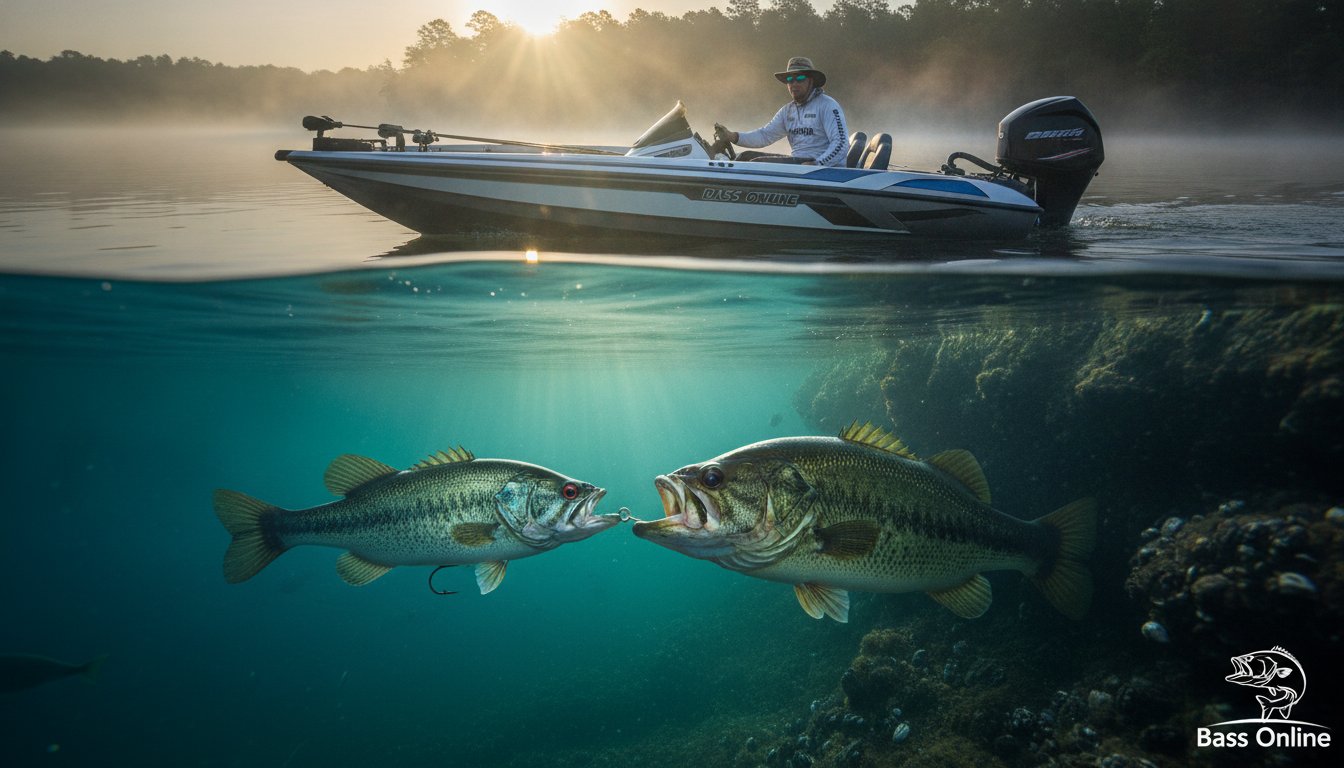

If you aren’t crashing an oversized plug into a rock pile twenty feet below the surface, you’re leaving the biggest bass of the summer on the table. Most anglers I talk to find the offshore game incredibly intimidating. It’s exhausting to throw those big baits all day, and it’s even more frustrating when your lure never seems to reach its advertised depth. I get it. Fishing “the desert” without a plan is a quick way to burn out. But deep cranking for largemouth bass isn’t just about winding a reel until your arm aches; it’s a precision system designed to provoke a violent reflex strike from schools that other fishermen simply can’t reach.
I’ve spent years refining this masterclass to help you stop guessing and start catching. You’re going to learn how to use modern electronics to find high-percentage offshore structures like humps, ridges, and creek channels. I’ll show you the exact “how” and “why” behind choosing the right line and rod to hit the 25-foot strike zone every single time. By the end of this guide, you’ll have the confidence to hunt for a new personal best during the hottest months of the year. Let’s dive into the technical details and gear setups that turn a tiring day into a legendary outing.
Key Takeaways
- Learn why monster largemouths abandon the shallows for the 15 to 25 foot strike zone and how to follow their migration using seasonal patterns.
- Discover the physics behind the long cast and why mastering deep cranking for largemouth bass requires more than just picking the right lure off the shelf.
- Identify high-percentage offshore structures like river channels and ledges using modern electronics to find the specific rock piles where trophy fish congregate.
- Master the Collision Principle to trigger aggressive reflex strikes by driving your crankbait directly into underwater timber and hard bottom transitions.
- Understand how a professional guided trip can shorten your learning curve by putting you on the water to practice complex electronics and retrieval techniques in real time.
Why Deep Cranking is the Ultimate Summer Slump Buster
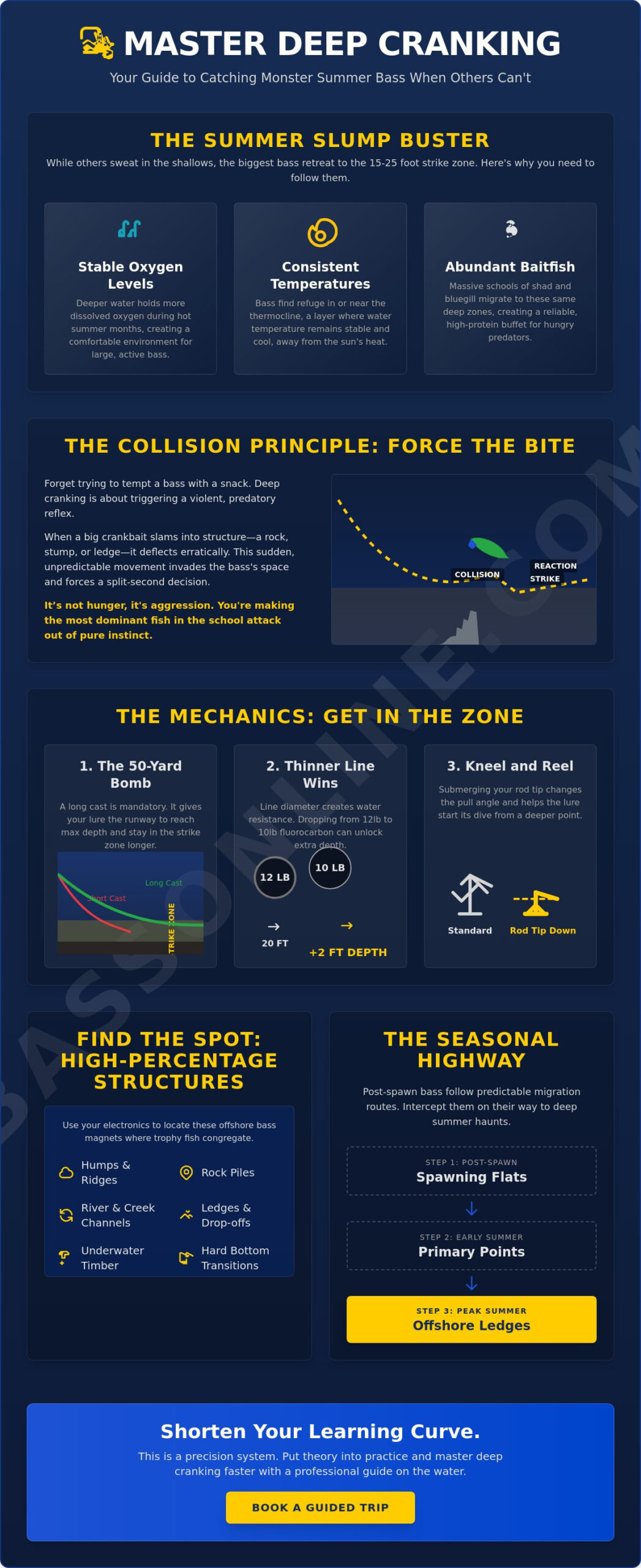
Deep cranking for largemouth bass is the ultimate way to beat the summer heat. While other guys are struggling in the hot shallows, the pros are out on the ledges. We define this technique as using oversized, deep-diving plugs to reach depths of 15 to 25 feet. Bass move to these offshore haunts for a few simple reasons:
- Stable oxygen levels found in deeper water columns.
- Access to the thermocline where temperatures remain consistent.
- Proximity to massive schools of migrating shad and bluegill.
It’s a high-speed game that requires commitment, but the payoff is worth every cast.
To see exactly how these baits behave underwater and why they trigger big fish, watch this helpful video:
Think of a crankbait as a threat rather than a meal. When you drag a jig or a worm, you’re hoping the bass wants a snack. With a crankbait, you’re forcing a reaction. It’s a high-octane collision course. When that bait deflects off a stump or a rock, it creates an erratic movement that the fish simply can’t ignore. This reaction strike is what makes deep cranking for largemouth bass so productive when the bite elsewhere has gone cold. You’re covering massive amounts of water, searching for the most aggressive fish in the school.
The Psychology of the Reaction Strike
Largemouths are apex predators, and they don’t like being bullied. When you rip a deep-diving plug through a school, you’re triggering an ancient predatory drive. It isn’t just about hunger; it’s about aggression and competition. In a school of twenty bass, the first one to reach the lure is usually the most dominant. This creates a chain reaction. Once the first bass bites, the rest of the school gets agitated and starts looking for their own target. This is why you can often catch five or six fish on consecutive casts. You’re invading their space and forcing them to make a split-second decision.
Seasonal Transitions: When to Go Deep
Most post-spawn fish follow a predictable path. As the water warms, fish migrate from the spawning flats to primary points and eventually to offshore ledges. Understanding Largemouth bass behavior helps you realize that these fish aren’t just wandering; they’re following specific underwater highways. Water clarity plays a huge role here. In clear water, fish might hold even deeper than 25 feet. If you’re looking for more details on these patterns, our Bass Fishing 101 resource covers the seasonal basics you need to master.
The Mechanics of Depth: Reaching the 20-Foot Strike Zone
Don’t believe every depth claim you see on a lure box. If a plug says it dives to 20 feet, that’s usually in a laboratory with a mile of line out. In the real world, deep cranking for largemouth bass is a constant battle against physics. To reach the strike zone, you have to master the 50-yard bomb. A long cast is mandatory because it gives the lure enough runway to reach its maximum depth and stay there. If your cast is short, the bait spends its entire life diving and then immediately climbing back to the surface. You want that lip grinding the bottom for the majority of the retrieve.
Line diameter is your biggest variable in the depth equation. Most anglers make the mistake of using line that is too heavy. Dropping from 12lb to 10lb fluorocarbon can actually gain you an extra two feet of depth because there is less water resistance on the thinner line. It’s a calculated risk, but in open water, that extra depth is often the only way to tickle the top of a deep brush pile.
The physical toll of this technique is real. Pulling these massive lures for eight hours can wear down even the toughest angler. This is where rod tip positioning becomes a secret weapon. I often use the kneeling and reeling technique, submerging the rod tip to start the dive from a deeper point. It adds depth and changes the pull angle, which can be the difference between a sniff and a strike. If you’re struggling to manage the fatigue or find the right depth, spending a day with our professional fishing guides will help you refine your form and save your shoulders.
Selecting the Right Deep-Diving Plug
Bill angle is your steering wheel. A steep angle dives fast but creates a lot of resistance. Silent baits are my go-to for pressured fish, while rattling models help bass find the lure in murky water. For colors, focus on high-contrast shades like chartreuse or citrus shad. Light fades fast at 20 feet, so a strong silhouette is more important than intricate scale patterns. You want something that stands out against the dark bottom.
The Gear System: Rods, Reels, and Line
You need a long, moderate-fast rod, preferably a glass or composite blend. The soft tip acts as a shock absorber, preventing the bass from throwing those small treble hooks during a surge. Pair it with a low-speed reel. A 5.4:1 or 6.3:1 gear ratio provides the cranking torque needed to pull big baits without burning out your wrist. This setup is essential when Finding offshore structure and staying on the bite all day. Stick with fluorocarbon line. It’s dense, sinks quickly, and stands up to the constant abrasion of the lake floor.
Reading the Bottom: Finding Offshore Structure That Holds Trophy Bass
Stop fishing the desert. I see too many anglers burning their arms out casting into empty water because they haven’t identified the “why” behind the location. Deep cranking for largemouth bass is only effective if you’re putting that lure in front of fish. The foundation of this game is the “Ledge” concept. We’re looking for river channels, sudden drop-offs, and submerged points that act as underwater highways. These fish want easy access to deep, cool water while remaining close to the buffet line of baitfish moving along the breaks.
The type of bottom you’re hitting is just as important as the depth. Bass have a massive preference for hard bottom transitions. I’m talking about gravel, rock, or clay. If you feel your bait digging into mushy silt, you’re in the wrong zip code. You want that crankbait to “hunt” and deflect off something solid. Mastering deep-cranking techniques for summer bass starts with finding these hard spots, especially shell beds, which are absolute goldmines for offshore schools.
Visualizing your “Cranking Lane” is the final piece of the puzzle. You don’t just park the boat and throw. You need to position yourself to pull the lure both up and down the break. Sometimes fish want that bait coming from the deep water and “climbing” the hill; other times, they want it diving off the cliff into the abyss. This is why our Lake Guntersville Fishing Trips are so popular during the summer months; the Tennessee River system is essentially one giant ledge-fishing classroom where boat positioning makes or breaks your day.
Structure vs. Cover: What are you hitting?
You need to differentiate between structure and cover. Structure is the floor itself—the humps and ridges. Cover is the “furniture” sitting on that floor, like submerged timber or brush piles. While structure holds the school, cover holds the biggest fish in that school. To target timber without snagging, use a lure with a wide bill that kicks the hooks away from the branches. It’s a high-risk, high-reward game that separates the pros from the weekend warriors.
Just as these underwater trees provide vital habitat, the trees on your property require expert care; for those in the San Antonio area, Lone Star Landscape & Tree Services offers professional solutions to keep your landscape thriving.
Interpreting Side Imaging and 2D Sonar
Modern sonar is your underwater eyes. On 2D sonar, a school of bass looks like thick arches or “spaghetti” stacked near the bottom, whereas baitfish appear as cloudy masses. Side imaging is where you find the “spot on the spot.” Look for a single stump or a small rock pile on a massive flat. Once you see it, drop a waypoint and establish a precise casting angle. If you don’t hit the target within a few feet, you won’t get the bite. It’s that specific.
The Trigger Factor: Retrieval Techniques and Cadence Control
Once your bait reaches that 20-foot ledge, the retrieve becomes a game of high-stakes billiards. If you’re just winding the handle at a steady pace, you’re missing half the bites. The “Collision” principle is the absolute heartbeat of deep cranking for largemouth bass. You want your lure to act like a frantic baitfish that’s constantly crashing into obstacles. That sudden change in direction when the lip hits a rock or a stump is what forces a bass to react. It’s a violent, erratic movement that screams “easy meal” to a predator waiting in the shadows.
I rely on two primary cadences to get the job done: the “Stop-and-Go” and the “Burn-and-Grind.” The Stop-and-Go is deadly for pressured fish. When you feel the lure hit an object, stop reeling for a split second. Because these plugs are buoyant, they’ll start to float upward. This “pause and rise” often triggers a strike from a bass that was following the bait but wasn’t quite ready to commit. On the other hand, the Burn-and-Grind is all about speed. You’re trying to create a panic response, moving the lure so fast that the fish doesn’t have time to inspect it. It’s a physical grind, but the rewards are often the biggest fish in the school.
Identifying the “Tick” is a skill that takes time to master. At 25 feet, a bite doesn’t always feel like a massive thump. Sometimes the line just goes slack, or you feel a slight change in the vibration. It’s a subtle “tick” that feels different from the rhythmic grinding of a rock. If the weight of the lure suddenly disappears or feels “mushy,” set the hook immediately. Ready to feel that first “tick” for yourself? Reach out to our team today to schedule a day on the water where we can practice these techniques in real time.
The Art of the Deflection
Deflection is the secret sauce. When your lure hits a piece of cover, it “hunts”—meaning it darts off to one side before tracking straight again. You should never stop reeling the moment you hit something; instead, keep the pressure on. Use your rod to “pull” the lure through the cover rather than just using the reel. This creates a unique vibration and ensures the bait stays in the strike zone longer. This erratic hunt is the most common trigger for a trophy bass.
Fighting and Landing Deep-Water Bass
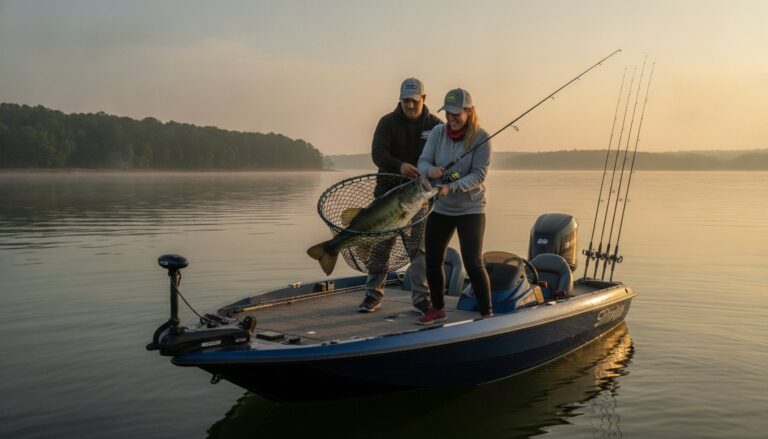
When you hook a fish in 20 feet of water, the fight is far from over. You have to manage the risk of barotrauma, which is when a fish’s swim bladder expands due to the rapid change in pressure as you pull it to the surface. To protect the fish, bring it up slowly and steadily. Never “horse” a crankbait fish. Because you’re using small treble hooks and a heavy lure, a bass can easily use the weight of the plug to shake itself free if you give it slack. Keep your rod tip low and let the moderate-action rod do the work of pinning the fish until it’s safely in the net.
Put the Theory into Practice with a Professional Bass Guide
Deep cranking for largemouth bass is a mental game as much as a physical one. You can read about “the grind” or “the tick” until you’re blue in the face, but nothing replaces the moment a ten-pounder tries to rip the rod out of your hands at twenty feet. It’s a confidence technique. If you don’t truly believe there’s a school of fish on that ledge, you won’t make the hundredth cast necessary to trigger them. That’s where a professional guide becomes your greatest asset. We don’t just show you where the fish are; we show you how to believe in the system.
When you step onto a boat with Bass Online, you’re bypassing the years of frustration that come with “fishing the desert.” We provide the heavy-duty, moderate-action glass rods and low-speed reels that make pulling these oversized plugs manageable. You’ll spend the day learning the nuances of offshore mapping and seeing firsthand what an active school looks like on high-definition side imaging. We’ll refine your casting angles and help you master the “Collision Principle” until it becomes second nature. A guided trip is a shortcut to mastery, turning a complex offshore strategy into a repeatable skill you can take to any lake in the country.
Our goal is to ensure you leave the water with more than just a photo of a trophy. We want you to understand the mechanics of the strike zone. You’ll learn how to:
- Interpret complex sonar data to separate “dead” structure from “active” schools.
- Adjust your boat positioning to account for wind and current on the ledges.
- Manage the physical fatigue of deep cranking through proper form and gear selection.
- Safely handle and release deep-water fish to ensure the health of the fishery.
Mastering the Ledges with an Expert
Every lake has its own rhythm. Whether you’re navigating the Tennessee River ledges or the submerged points of a Texas reservoir, our captains have the insider knowledge to put you on the “spot on the spot.” We’ve spent thousands of hours graphing these waters to find the shell beds and rock piles that hold the biggest fish in the system. To get a head start on understanding your target, check out our species guide to learn more about the largemouth you’ll be targeting on your next expedition.
Book Your Adventure Today
There’s no substitute for time on the water with a seasoned professional. If you’re ready to stop guessing and start catching, it’s time to book an experience of a lifetime. Our captains are results-driven and passionate about helping you land a new personal best using the most exciting techniques in the sport. Don’t let another summer pass you by in the shallows. Visit Bass Online Charters today to find a location near you and secure your spot on the ledge.
Crush the Offshore Game and Land Your Trophy
Success on the ledges isn’t a matter of luck; it’s a matter of system. By mastering the 50-yard bomb and understanding the collision principle, you’ve unlocked the most effective way to target trophy fish during the heat of summer. Remember that the right gear, from low-speed reels to thin-diameter fluorocarbon, is what keeps your bait in the 25-foot strike zone where the giants live. Mastering deep cranking for largemouth bass takes commitment, but the reward of a screaming drag and a new personal best is worth every ounce of effort.
You don’t have to tackle this learning curve alone. With over 25 years of professional guiding experience and top-rated captains across more than five states, our team is ready to put you on the fish. We provide all the professional gear and tackle you need to succeed. If you’re ready to leave the shallow water behind and experience the raw excitement of offshore fishing, it’s time to take the next step. Book Your Professional Bass Fishing Charter Today and let’s get to work. The big ones are waiting for you out there; I’ll see you on the water.
Frequently Asked Questions
What is the best line for deep cranking for largemouth bass?
10-to-12lb fluorocarbon is the gold standard for deep cranking for largemouth bass. Fluorocarbon is denser than water; it actually sinks, which helps pull your lure down to those 20-foot depths. Thinner diameter line also has less water resistance, allowing the bait to dive much deeper than it would on 15lb or 20lb test. I always choose a high-quality brand to ensure it can handle the constant abrasion of grinding against rocks and timber.
How do I make my crankbait dive deeper?
You can make your crankbait dive deeper by increasing your casting distance and lowering your rod tip. The longer the cast, the more time the lure has to stay at its maximum depth during the retrieve. I also recommend using the kneeling and reeling technique, where you submerge your rod tip in the water. This effectively starts your lure’s dive from a foot or two below the surface, giving you that extra edge to reach deep-water schools.
Can I use a regular baitcasting rod for deep diving crankbaits?
You shouldn’t use a stiff, fast-action regular rod for this technique. Deep-diving plugs create massive resistance, and you need a moderate-action glass or composite rod to absorb the vibration. A softer rod also prevents the fish from ripping the treble hooks out of its mouth during a violent surge. If you use a rod that’s too stiff, you’ll likely pull the bait away from the fish before they can fully engulf it.
When is the best time of year for deep cranking?
Summer and early fall are the absolute prime seasons for deep cranking for largemouth bass. Once the spawn ends and the water temperature rises, fish migrate toward offshore ledges and river channels to find cooler, oxygen-rich water. This pattern usually holds strong from June through September. During this window, bass congregate in large schools, making it possible to catch multiple trophy fish from a single offshore hump or point.
What is the difference between structure and cover in bass fishing?
Structure refers to the permanent physical layout of the lake floor, like humps, ridges, and creek channels. Cover is the furniture that sits on top of that structure, such as submerged trees, brush piles, or rock piles. I look for structure first to find the general area where bass stage, then I target specific pieces of cover to find the exact spot on the spot where the biggest fish are hiding.
How do I avoid getting snagged when deep cranking?
To avoid snags, maintain a steady retrieve and let the lure’s bill do the work. The large lip on a deep-diving crankbait acts as a shield, kicking the hooks away from branches or rocks when it makes contact. If you feel the bait hang up, don’t pull hard. Instead, give the line some slack; the buoyancy of the lure will often cause it to float backward and free itself from the obstruction.
What gear ratio is best for deep diving lures?
A low gear ratio between 5.4:1 and 6.3:1 is the best choice for deep-water lures. These reels provide the necessary torque to pull large, high-resistance baits without wearing out your arm by lunchtime. High-speed reels might seem faster, but they lack the winching power needed to grind a plug against the bottom. Using a slower reel also forces you to maintain the ideal cadence for triggering aggressive reaction strikes.
Do I need expensive electronics to find deep-water bass?
You don’t strictly need the most expensive units, but quality electronics are a massive advantage for finding offshore bass. Basic 2D sonar can show you depth and fish arches, but side imaging allows you to see the specific rock piles and shell beds that hold schools. Without some form of sonar, you’re essentially fishing the desert and hoping for a lucky collision, which is a very difficult way to find consistent success.

Article by
Mr Bass
Todd Kersey, widely known as Mr. Bass by Field & Stream, is a professional angler, accomplished author, and dedicated philanthropist with a lifelong passion for bass fishing. Armed with a degree in Outdoor travel, Mr. Bass has expertly combined his knowledge with his practical fishing experience to become one of the most respected names in the bass fishing, his deep understanding of bass habitats, and fish behavior has earned him numerous accolades as a asset of the sport. Serving 8 years as FWC Stakeholder Chairperson. Leading and passing cutting-edge legislation, such as the Black Bass Management plan, and successfully building, passing, and financing the Trophy Catch program. As CEO, he is committed to giving back to the community through his philanthropic efforts. He supports a variety of causes, especially those centered around physical disabilities. Through his advocacy, his mentorship programs inspire anglers to engage in fishing stewardship, helping to raise more than $ 18 million in donations. Mr. Bass continues to inspire anglers and outdoor enthusiasts alike with his commitment to the sport and the world around him.