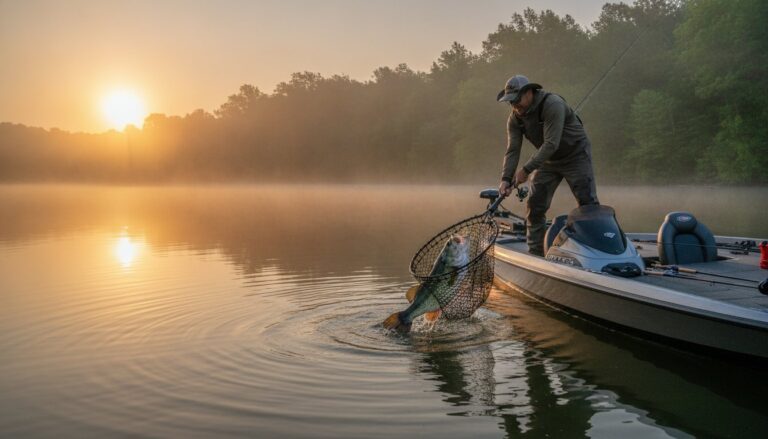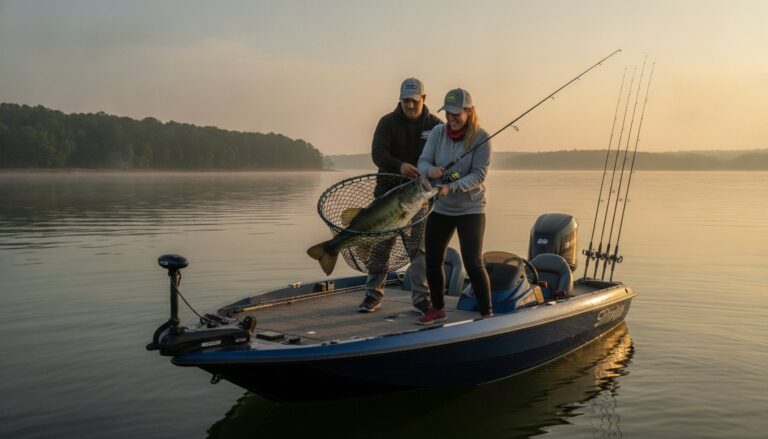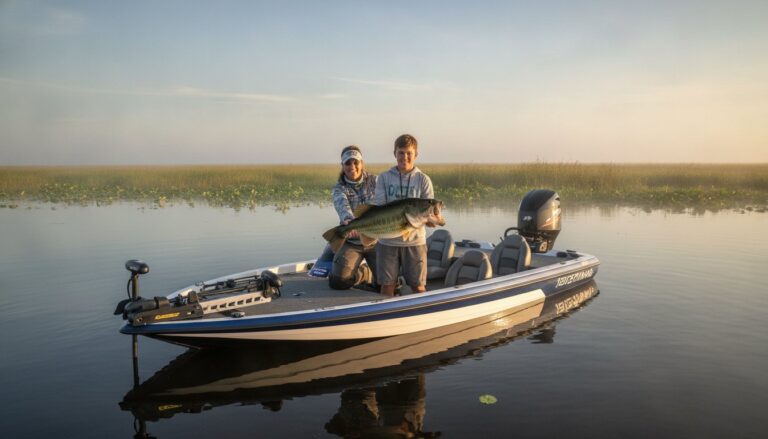
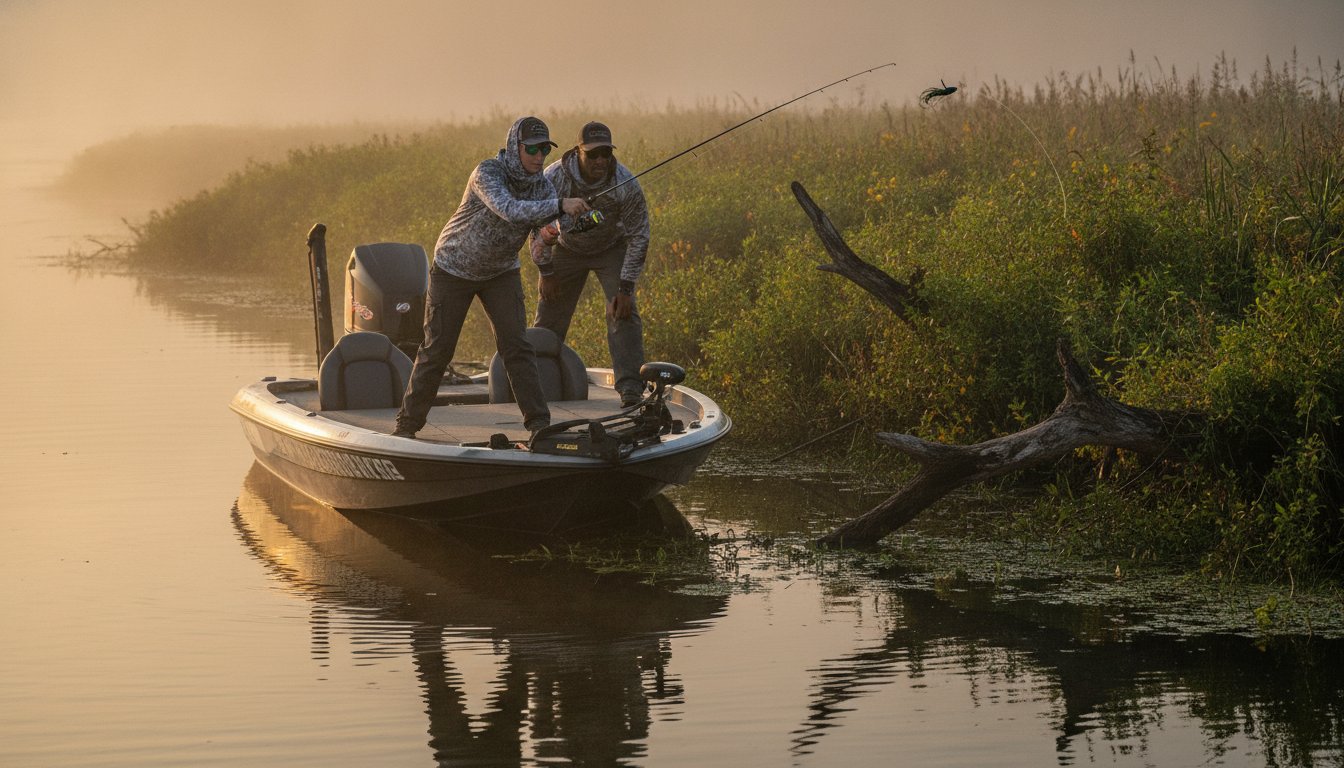

That impenetrable wall of matted grass isn’t a barrier; it’s actually the front door to the biggest bass of your life. It’s easy to feel hesitant when you’re staring down a gnarly laydown, especially if you’re tired of losing expensive lures or missing critical hooksets in the thick stuff. We’ve all been there, wondering if that heavy jig is actually going to come back out or if a trophy is just going to wrap your line and break off. You want the confidence to reach those hidden pockets without the constant fear of a snag.
This guide is built to change your game. I’ll help you master the surgical precision of flipping and pitching jigs for bass so you can confidently hunt trophy fish in cover other anglers are too afraid to touch. Whether you’re navigating dense, matted vegetation or intricate submerged timber, these field-tested techniques will put more weight in your livewell. We are diving deep into the technical side of things, from selecting the right jig head shapes for 2026 tournament standards to the specific rod mechanics that ensure a higher landing ratio for those heavy hitters.
Key Takeaways
- Learn the technical difference between the underhand pitch and the fixed-line flip to hit every tight window with surgical precision.
- Identify the three essential jig head shapes and how to adjust weed guard stiffness to maximize your hook-up ratio in heavy cover.
- Master the art of flipping and pitching jigs for bass to extract trophy-sized fish from the thickest grass and wood.
- Discover the “match the hatch” strategy for choosing trailers and colors based on water temperature and local crawfish or bluegill patterns.
- Develop the discipline to detect subtle bites and execute the professional slack-line hookset to pull giants into the boat.
Mastering the Basics: Why Flipping and Pitching Jigs are Essential for Big Bass
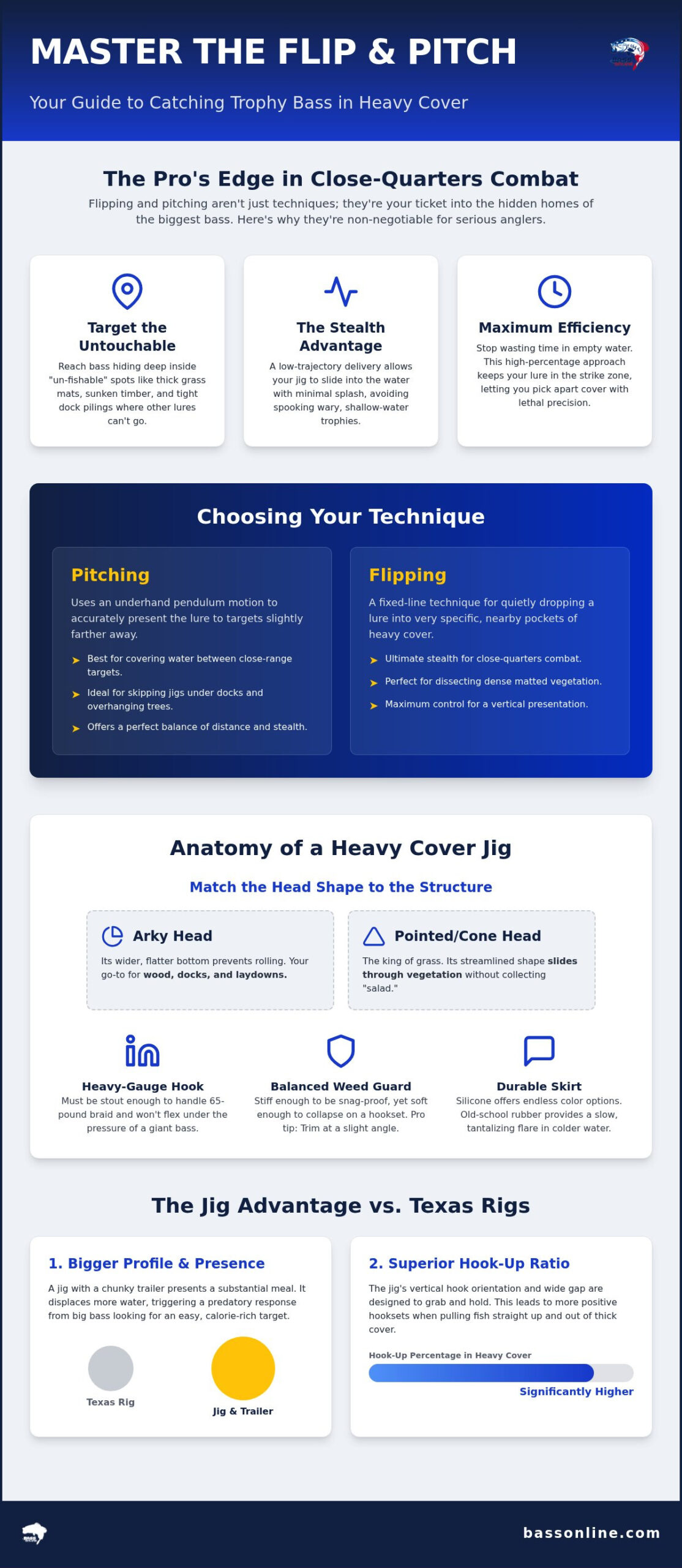
Think of flipping and pitching as the close-quarters combat of the fishing world. While most anglers are happy to launch a crankbait across an open flat, the real giants are usually tucked deep inside the “un-fishable” stuff. Flipping involves using a fixed length of line to quietly drop a jig into cover, while pitching uses an underhand pendulum motion to reach targets slightly further away. Both are specialized short-range techniques designed to put your lure where a standard overhead cast simply can’t go. If you want to pull a trophy out of a sunken cedar or a thick mat of hydrilla, these methods aren’t just options; they’re requirements.
Traditional casting is great for covering water, but it’s often too loud and too messy for shallow, pressured bass. When you’re flipping and pitching jigs for bass, you’re focusing on high-percentage targets like a single dock piling or a specific pocket in the reeds. This approach is incredibly efficient. Instead of wasting time winding a lure through twenty feet of empty water, you’re spending every second of your day in the strike zone. You can pick apart a hundred-yard stretch of bank in half the time it takes a casual caster, hitting every stump and laydown with lethal accuracy.
The Stealth Advantage in Shallow Water
The real magic happens when you master the silent entry. In shallow water, bass are hyper-aware of their surroundings; a heavy lure “plopping” into the water sounds like a dinner bell for some, but for a wary trophy, it’s a warning signal to leave. Low-trajectory deliveries keep your jig close to the surface, allowing it to slide into the water with barely a ripple. This stealth factor is what separates the weekend hobbyists from the pros who consistently bag limits in clear, skinny water. In the world of the five-foot pitch, surgical precision is the skill of dropping your lure into a tiny opening in the weeds with zero splash and total control.
Why Jigs Outperform Other Lures in the Slop
I often get asked why a jig is better than a standard Texas-rigged worm in heavy cover. While a Texas rig is a great tool, it doesn’t have the “bulk” factor that a jig offers. A jig with a chunky trailer creates a larger profile that displaces more water, triggering a predatory response from bass that want a substantial meal. The vertical orientation of a flipping jig’s hook also provides a much better hook-up ratio when you’re pulling a fish straight up out of the slop. For those just getting their feet wet with these concepts, I recommend checking out our Bass Fishing 101 resources to build a solid foundation before you start tackling the heaviest cover on the lake. The added weight and skirt movement of a jig make it the ultimate weapon for penetrating dense vegetation and staying in the face of a big fish until she bites.
Anatomy of a Heavy Cover Jig: Head Shapes, Weed Guards, and Hooks
A jig is more than just a piece of lead with a skirt; it’s a precision tool designed for specific combat conditions. When you are flipping and pitching jigs for bass, the anatomy of your lure determines whether you’re hauling in a trophy or snagging a cypress knee. Every component, from the angle of the eyelet to the stiffness of the weed guard, plays a critical role in how that lure behaves once it enters the water. You need gear that is rugged enough to withstand the abuse of heavy wood and grass while remaining delicate enough to trigger a bite from a pressured fish.
The hook is the heart of the jig. For heavy cover, you must use a stout, heavy-gauge wire hook that won’t flex or straighten under the pressure of a big bass and 65-pound braided line. Pair this with a weed guard that strikes a balance between protection and performance. A guard that is too stiff will prevent the hook from penetrating the fish’s mouth, while one that is too soft will leave you hung up on every branch. Many pros trim the weed guard at a slight angle to improve hook-setting efficiency without sacrificing snag resistance. Skirt material also matters; silicone is the standard for its vast color options, but old-school rubber skirts offer a unique, slow-pulsing flare that is deadly in cooler water.
Choosing the Right Head Shape for the Structure
The shape of the jig head dictates how the lure navigates cover. Pointed, cone-shaped heads are the kings of the grass because they slide through vegetation without collecting “salad.” If you’re fishing around wood, docks, or laydowns, the Arky head is your best bet. Its wider, flatter bottom prevents the jig from rolling over and wedging into crevices. Avoid using football heads in these situations; while they are great for dragging over rocks, their wide profile makes them a magnet for snags in thick brush or timber. If you’re unsure which setup to bring on your next trip, you can always consult with our local experts to get the right gear for the lake you’re hitting.
Weight Matters: From 1/4 oz to 1-1/2 oz
Weight selection is a game of efficiency and reaction. The general rule is to use the lightest weight possible that still allows you to reach the bottom and penetrate the cover effectively. A lighter jig has a more natural, slower fall, which is often necessary for finicky bass in clear water. However, don’t be afraid to go heavy to trigger a reaction bite. A fast-falling jig can surprise a bass into striking before it has time to inspect the lure. Heavy weights are essential for “punching” through thick surface mats to reach the bass lurking in the shadows beneath. Choosing the right weight ensures your jig stays vertical and in the strike zone longer.
Pitching vs. Flipping: Choosing the Right Technique for the Structure
Choosing between flipping and pitching isn’t about personal preference; it’s about the distance to your target and the density of the cover you’re attacking. If you’re 20 feet away from a dock piling, you’re pitching. If you’re right on top of a thick reed line in two feet of water, you’re flipping. Mastering flipping and pitching jigs for bass requires you to read the environment and select the tool that offers the most stealth. Pitching gives you range, while flipping provides unmatched speed and surgical precision for picking apart every square inch of a high-percentage spot.
Most anglers overlook the importance of boat positioning and wind management. If you’re fighting the trolling motor or the wind is pushing you into the cover, your accuracy will suffer. I always try to keep the boat upwind or use the wind to drift quietly along a grass edge. This allows for a more natural presentation and keeps your shadow off the fish. Proper boat control ensures you aren’t constantly making corrections, which lets you focus entirely on the feel of the jig. When the boat is stable, your pitches and flips will be much more consistent.
Mastering the Pitching Motion
The pitch is an underhand pendulum motion that is all about rhythm. Start with the jig in your hand, drop your rod tip, and use a smooth upward snap of the wrist to send the lure toward the target. Your thumb is your best friend here; you must use it to feather the spool, controlling the distance and ensuring the jig enters the water with a whisper rather than a splash. Lake Guntersville is a prime spot to practice this, as the endless grass edges provide the perfect laboratory for perfecting your mid-range accuracy. Once you find that rhythm, you’ll be able to hit a coffee cup from 20 feet away every single time.
The Art of the Traditional Flip
Traditional flipping is a dying art, but it’s still the fastest way to fish dense cover. You aren’t actually casting; you’re using a fixed length of line and your non-reeling hand to swing the jig into a pocket. By pulling line off the spool with your free hand, you can drop the jig vertically into the tightest windows imaginable. This technique is incredibly efficient for working through a dense reed line where bass are buried deep in the shadows. For more advanced heavy cover strategies, remember that speed is your advantage. You can hit five different pockets in the time it takes someone else to make one long cast, significantly increasing your chances of finding a trophy bass.
The Trailer and Color Strategy: Matching the Hatch in Dirty Water
Selecting the right trailer is where the science of flipping and pitching jigs for bass meets the art of the bite. It isn’t just about adding a bit of plastic; it’s about controlling the descent and the vibration of your lure. When the water is warm and bass are aggressive, you want a trailer that fights back. Conversely, when a cold front moves in or the water is frigid, you need a profile that stays relatively still. The bulk of your trailer acts like a parachute, slowing the jig’s fall to give lethargic bass more time to react. This is crucial when you’re targeting trophy fish that won’t chase a fast-moving meal.
Matching the hatch is your golden rule for consistent success. If the lake is crawling with crawfish, you want a trailer with pinchers that stand up in a defensive posture. If bluegill are the primary forage, a wider, flat-sided trailer mimics that panfish profile perfectly. Your color choice should always be dictated by water clarity. In clear water, natural tones like watermelon or brown are essential to avoid spooking wary fish. When you’re dealing with “chocolate milk” or heavily stained water, you need high-contrast colors that help the bass locate the lure through their lateral lines and limited vision.
Action vs. Profile: Picking the Best Trailer
Your trailer choice should change based on the mood of the fish and the density of the cover. Craw-style trailers with large flappers create maximum vibration, making them ideal for active fish in stained water. If you’re trying to slide your jig into the smallest cracks in a log jam, a Beaver-style trailer is the better choice because its streamlined shape doesn’t catch on every twig. In cold water, use a chunk-style trailer to provide a subtle, non-threatening profile that mimics a dormant crawfish. This minimal action is often the only way to get a bite when the water temperature drops below 55 degrees.
Color Patterns That Produce Nationally
You don’t need a thousand different colors to be successful, but you do need the right ones. Green Pumpkin is the undisputed heavyweight champion for clear to slightly stained water; it works on almost every lake in the country. When the visibility drops to less than a foot, Black and Blue becomes the king of the slop because it creates a massive silhouette that bass can easily track. Don’t forget about seasonal shifts, either. In the early spring, switching to trailers with orange or red hues can be a game-changer as crawfish emerge with those specific colors. If you want to see these strategies play out in real-time on the water, book your next guided bass fishing trip with us and we’ll show you exactly how to match the hatch for your local conditions.
Mastering the Hookset and Landing: How to Pull Giants from the Thick Stuff
You’ve selected the right head shape, matched the trailer to the forage, and executed a silent entry into the heart of a brush pile. Now comes the moment of truth. When flipping and pitching jigs for bass, the window between a bite and a lost fish is measured in milliseconds. Because you’re fishing in the thickest cover imaginable, you don’t have the luxury of a long, sweeping fight. You need the right equipment and a specific “winch” mentality to ensure that when a trophy strikes, she actually makes it into the boat.
Your gear must be up to the task of close-quarters combat. I recommend a rod between 7’3” and 7’11” with Heavy power. This length provides the leverage needed to pull a fish up and out of the cover, while the power ensures the rod won’t double over when you’re fighting both a bass and ten pounds of weeds. Pair this with a high-speed casting reel, ideally an 8.1:1 gear ratio or higher. You need to pick up line fast to stay ahead of a fish trying to bury itself deeper. For line choice, 50-65lb braid is the gold standard for matted grass, while 20-25lb fluorocarbon offers better abrasion resistance and stealth around jagged wood and boat docks.
Detecting the Jig Bite
The bite isn’t always a violent “thump.” In fact, the biggest bass often take the jig with a subtle “heavy” feel or a slight tick in the line. You have to watch your line where it enters the water; if it jumps, twitches, or starts moving sideways, set the hook immediately. Differentiating between a branch and a bass takes practice. A branch feels like a dead stop, while a bass usually has a slight “pulse” or a spongy sensation. Our professional guides often teach clients to “feel with their eyes” by focusing on the line’s behavior during the initial fall, which is when the majority of strikes occur.
The “Winch” Mentality: Landing the Fish
The biggest mistake anglers make is swinging on a slack line. When you feel that bite, you must reel down until you feel the weight of the fish before you swing. This “slack-line” hookset ensures you’re moving the fish, not just the line. Once the hook is set, do not stop reeling. You cannot let the bass turn its head or get its nose down into the roots. Keep the rod tip high and maintain constant, heavy pressure. If you’re ready to see how a pro handles these high-pressure moments, book a guided trip with our experts to master heavy cover fishing on the nation’s best trophy lakes. Remember, in the slop, you aren’t playing the fish; you’re winching it.
Dominate the Cover and Land Your Next Trophy
Mastering the art of flipping and pitching jigs for bass is about more than just a lucky cast; it’s about having the technical discipline to pick apart the thickest cover on the lake. You now have the blueprint for selecting the right head shapes, matching your trailers to the conditions, and executing that critical slack-line hookset. These skills turn intimidating vegetation into your most productive fishing grounds. It takes practice to stay calm when a giant thumps your jig in the heart of a brush pile, but you’re now equipped with the field-tested knowledge to win that fight.
If you want to fast-track your success, there’s no substitute for time on the water with a seasoned expert. Our team brings over 20 years of professional guiding experience to every trip, providing the local knowledge and specialized gear needed to conquer legendary waters. We handle the boat positioning and technical details so you can focus entirely on the strike. Master heavy cover tactics with a professional guide at Bass Online and see what it’s like to fish with the best in the business. Grab your heavy rod, trust your gear, and get out there. The biggest bass of the season is waiting in the slop.
Frequently Asked Questions
What is the best rod for flipping and pitching jigs?
A 7’6″ or 7’11” Heavy power rod with a fast action is my top pick. You need that extra length to provide the leverage required to pull a big bass vertically out of dense cover. The heavy backbone ensures the rod doesn’t fold when you’re winching a fish and ten pounds of grass. I prefer a rod that is balanced; it shouldn’t feel tip-heavy during a long day of repetitive pitching.
Should I use braid or fluorocarbon for pitching jigs?
I choose my line based on the specific structure I’m attacking. For thick vegetation and matted grass, 50 to 65-pound braid is essential because it cuts through stalks like a saw. If I’m pitching around wood, docks, or jagged rocks, I switch to 20 or 25-pound fluorocarbon. Fluorocarbon offers superior abrasion resistance against hard surfaces and provides a stealthier presentation in clear water where bass might be line-shy.
What is the difference between a flipping jig and a casting jig?
The primary difference is the head shape and hook strength. A flipping jig features a pointed or cone-shaped head designed to slide through vertical cover without snagging. It also sports a heavy-gauge hook built for heavy line. A casting jig typically has a rounder or oval head meant for dragging across open bottoms. Using a casting jig in the slop is a recipe for getting hung up on every single cast.
How do I choose the right jig weight for thick grass?
Start with the lightest jig that can still penetrate the canopy. If a 1/2 oz jig won’t break through the mat, step up to a 3/4 oz or a 1 oz model. In 2026, many pros are using 1.5 oz tungsten jigs for “punching” through the thickest Florida-style mats. The goal is to reach the bottom quickly without the jig getting hung up on the surface vegetation.
Can I use a regular baitcasting reel for flipping?
You certainly can, but it needs to be a high-performance model. I look for a reel with a high-speed gear ratio of at least 8.1:1 to pick up slack line instantly. A strong, smooth drag system is also a must for flipping and pitching jigs for bass in heavy cover. If your reel has a low gear ratio, you’ll struggle to keep the fish’s head up as it tries to dive.
Why am I missing hooksets on my flipping jig?
Missing hooksets usually happens because you’re swinging while there is still slack in your line. You must reel down until you feel the weight of the fish before you execute a vertical snap. Another common issue is a weed guard that is too stiff. I often trim my weed guard at a 45-degree angle to make it easier for the hook to penetrate the fish’s mouth without sacrificing its snag-resistance.
What is the best trailer for a flipping jig in cold water?
In cold water, less is definitely more. I reach for a “chunk” style trailer or a subtle beaver-style plastic that has very little action. Bass are lethargic when the temperature drops, so a high-vibration flapping trailer can actually spook them. A simple, compact profile mimics a dormant crawfish perfectly. This subtle presentation stays in the strike zone longer and gives finicky winter bass plenty of time to commit to the bite.
Is a 7-foot rod long enough for flipping?
A 7-foot rod is usually too short for this specialized work. While it works for general casting, you’ll find that you lack the reach and leverage needed for flipping and pitching jigs for bass effectively. I find that a longer rod, at least 7’6″, allows for a much quieter entry and gives you the tip speed required to drive a heavy-gauge hook home when a giant strikes deep in the timber.

Article by
Mr Bass
Todd Kersey, widely known as Mr. Bass by Field & Stream, is a professional angler, accomplished author, and dedicated philanthropist with a lifelong passion for bass fishing. Armed with a degree in Outdoor travel, Mr. Bass has expertly combined his knowledge with his practical fishing experience to become one of the most respected names in the bass fishing, his deep understanding of bass habitats, and fish behavior has earned him numerous accolades as a asset of the sport. Serving 8 years as FWC Stakeholder Chairperson. Leading and passing cutting-edge legislation, such as the Black Bass Management plan, and successfully building, passing, and financing the Trophy Catch program. As CEO, he is committed to giving back to the community through his philanthropic efforts. He supports a variety of causes, especially those centered around physical disabilities. Through his advocacy, his mentorship programs inspire anglers to engage in fishing stewardship, helping to raise more than $ 18 million in donations. Mr. Bass continues to inspire anglers and outdoor enthusiasts alike with his commitment to the sport and the world around him.