
If you think the Carolina rig is just a slow way to drag a plastic worm, you’re missing out on the most powerful underwater radar in your tackle box. This setup isn’t just a lure; it’s a tactical search-and-destroy tool that tells you exactly what’s happening on the lake floor. I know the frustration of fishing deep water. It’s easy to get discouraged when you’re constantly hung up on timber or missing those subtle, mushy bites because of a long leader. You want to feel every pebble and transition, not just hope for the best.
In this guide, I’ll teach you exactly how to fish a carolina rig for bass to turn those deep-water “dead zones” into your personal honey holes. We’re going to master the rigging secrets and retrieve techniques our professional guides use to find trophy fish on legendary waters like Lake Guntersville and Lake Erie. You’ll learn which baits to pair with your rig for 2026, how to avoid the “snag-and-snap” cycle, and the seasonal patterns that make this the most versatile year-round technique in your arsenal. Let’s get to work and put more weight in the boat.
Key Takeaways
- Learn why tungsten weights and glass beads are the pro choice for maximum sensitivity when feeling out bottom transitions and shell beds.
- Master the “drag and pause” rod technique to understand exactly how to fish a carolina rig for bass on deep-water structure.
- Discover the best seasonal targets, including pre-spawn staging points and deep summer ledges, where the C-Rig outperforms other setups.
- Understand the “horizontal suspension” advantage that gives your soft plastics a natural, weightless drift that wary bass can’t resist.
- See how professional guides use this rig as a high-speed search tool to locate schools of fish across massive reservoirs.
The Anatomy of a Carolina Rig: Why It Outperforms Other Setups
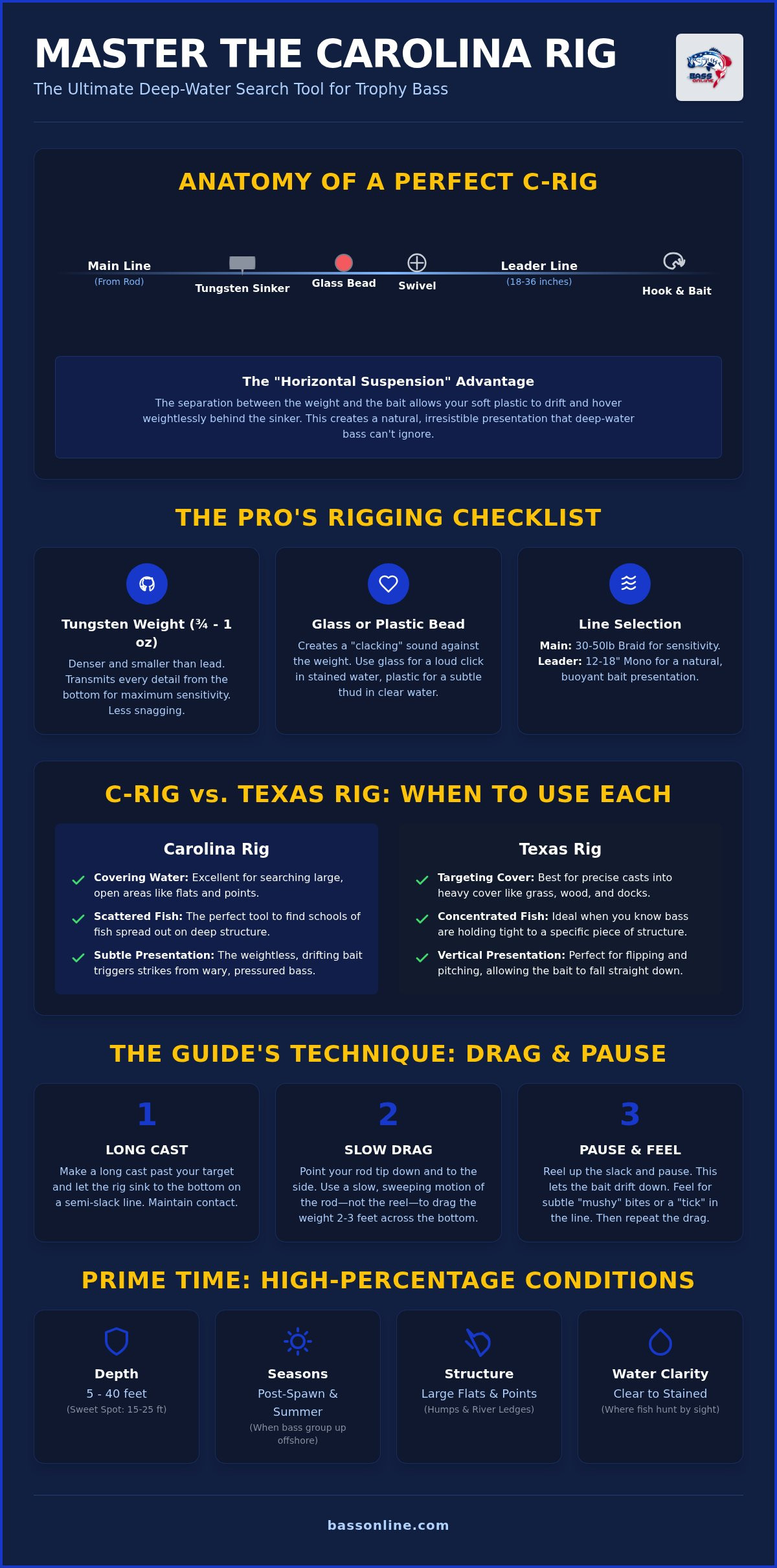
The Carolina rig is the heavy hitter of deep-water bass fishing. It’s a specialized bottom-contact system that uses a sliding weight, a plastic or glass bead, and a swivel to separate your sinker from your soft plastic lure. This gap is what makes it deadly. Unlike a Texas rig, which pins your bait to the floor and is designed for precision in thick cover, the C-rig is superior for covering massive flats and long points where bass are scattered. This separation allows for horizontal suspension. Your bait drifts naturally several feet behind the weight, mimicking a dying baitfish or a wandering craw without the unnatural drag of a heavy sinker.
This setup is the ultimate search tool. When you’re mastering how to fish a carolina rig for bass, you’ll realize it’s like having sonar in your fingertips. The heavy weight stays glued to the bottom, transmitting every vibration back to your rod. You’ll feel the difference between a hard rock pile, a soft mud flat, or a patch of submerged grass. It lets you map out high-percentage structure faster than almost any other technique, making it an essential skill for any serious angler.
The ‘Bass and Chain’ Mechanics
The sliding weight isn’t just for reaching depth; it’s a dinner bell. As you drag the rig, the weight clacks against the bead, creating a high-pitched sound that draws bass in from a distance. Bass are often attracted to the commotion of the weight passing through their territory. They’ll move in to investigate the noise and the puff of silt on the bottom. Then, a few seconds later, your bait drifts into their strike zone. This delay triggers a powerful reactionary strike because the fish thinks it’s an easy meal following the disturbance. Once the weight stops, the bait “free-lines,” slowly sinking or hovering in a way that looks completely natural and unattached to any line.
When to Reach for the C-Rig
I reach for this rig when the sun is high and the fish move deep. It’s a staple for anyone learning how to fish a carolina rig for bass because it keeps your bait in the strike zone longer than a traditional jig. Our professional fishing guides rely on this setup to target largemouth bass and smallmouth on offshore humps and ledges when the bite turns tough. It’s most effective under the following conditions:
- Water Clarity: Clear to stained water where fish can see the bait’s natural drift.
- Depth: Anywhere from 5 to 40 feet, though it shines in the 15 to 25-foot range.
- Seasons: Most effective during post-spawn and summer when bass school up on offshore structure.
- Structure: Large flats, points, river channel swings, and deep humps.
Whether you’re fishing a massive reservoir or a deep natural lake, the Carolina rig provides the feedback you need to find the fish and the presentation required to catch them.
Rigging for Success: The Ultimate Component Checklist
Mastering how to fish a carolina rig for bass requires more than just a random collection of tackle. It’s a system where every piece serves a specific purpose. Pro guides exclusively use tungsten weights because they’re denser and smaller than lead, providing a compact profile that doesn’t snag as easily. More importantly, tungsten transmits the “feel” of the bottom with incredible clarity. Using a high-quality tungsten weight is crucial for Carolina rig fishing for bass because it transmits every vibration from the lake floor directly to your hands.
Don’t overlook the “clacker” effect created by your bead. A glass bead paired with tungsten creates a sharp, loud “click” that mimics the sound of a crawfish shell. If the fish are finicky or the water is ultra-clear, switching to a plastic bead provides a more subtle thud. You’ll also need a premium ball-bearing swivel to act as the gatekeeper between your main line and leader. This prevents the massive line twist that occurs when your soft plastic spins during the retrieve. For your business end, match a 3/0 to 5/0 offset wide gap hook to the thickness of your bait to ensure you have enough bite to penetrate a big bass’s jaw.
Line Selection: Main Line vs. Leader
Your main line needs to be the workhorse of the operation. Most pros opt for 30 to 50lb braided line for its zero-stretch properties and maximum sensitivity, though 15 to 20lb fluorocarbon is a great choice if you’re fishing around abrasive rocks. For the leader, monofilament is a secret weapon when you want your bait to float up and stay buoyant. If you need the bait to stay closer to the bottom or want it to be invisible in gin-clear water, fluorocarbon is the way to go. You determine your leader length by the height of the bottom vegetation so your bait stays visible above the grass. If you’re unsure about your local setup, you can always reach out to our team for a quick gear check.
Rod and Reel: The Heavy Artillery
You can’t bring a knife to a gunfight when you’re learning how to fish a carolina rig for bass. A long rod, typically 7’3″ to 7’6″ with medium-heavy to heavy power, is non-negotiable. You need that extra length to sweep up the slack of a long leader during a hookset. Pair this with a high-speed casting reel featuring a 7.1:1 gear ratio or higher. When a bass eats your bait and swims toward the boat, you have to pick up line fast to maintain tension. Look for a rod with a slightly soft tip; it allows the weight to navigate over rocks without getting wedged in every crack, keeping your presentation moving smoothly through the strike zone.
How to Fish a Carolina Rig: Step-by-Step Presentation
Once you’ve got your gear dialed in, it’s time to execute. When I’m teaching clients how to fish a carolina rig for bass, the first thing I tell them is to cast past the target. If you’re targeting a deep ledge or a specific rock pile on Lake Guntersville, you want that rig to settle on the bottom well before it reaches the “juice.” This allows the weight and bait to separate and track naturally through the strike zone without spooking the fish with a heavy splash directly overhead.
The retrieve is a game of patience and rod control. Never use your reel to move the rig. Instead, point your rod tip at the weight and slowly drag it sideways or upward, moving the sinker about 2 to 3 feet at a time. This keeps the weight in constant contact with the floor. After each drag, use the “reel-down” technique. As you move your rod back toward the bait, reel in the slack just enough to keep a slight bow in the line. You need to stay in contact with that weight at all times to feel the bottom composition.
When a bass strikes, don’t use a vertical “snap” set like you would with a jig or a Texas rig. Because of that long leader, there’s a significant amount of slack and line stretch to overcome. I always use a wide, sideways sweep set. When you feel that pressure, reel quickly until the line is tight, then sweep the rod firmly to the side. This long, powerful motion ensures the hook penetrates even with several feet of leader between your weight and the fish.
Decoding the Feedback: Rocks, Grass, or Bass?
Learning to interpret what the rod is telling you is the secret to high catch rates. A rock feels like a distinct, hard “thud” or a sharp “clink” against the tungsten. Submerged grass feels like a heavy, mushy pull that lacks a heartbeat. A bass bite is different. Sometimes it’s a sharp “tick-tick,” but often the rig just feels “heavy” or like you’ve suddenly lost contact with the weight because the fish is swimming toward you. Line watching is a critical secondary bite indicator. If your line jumps or starts tracking sideways, swing immediately.
Varying the Retrieve Speed
Don’t get stuck in one rhythm all day. I use a “Power Drag” when I’m searching for active schools on Lake Erie, moving the rig quickly to cover a large flat. If the bite is tough or I’m on a pressured community hole, I switch to a “Finesse Twitch,” barely moving the weight and letting the bait hover in place. Sometimes, a long pause of up to 10 seconds is the only way to get a lethargic bass to commit. Let the bait sink naturally during these pauses and wait for that heavy sensation before moving it again.
Strategic Situations: Seasonal Patterns and High-Percentage Structure
Most anglers think the C-rig is strictly a summer tool. They’re wrong. Knowing how to fish a carolina rig for bass across every season is what separates the trophy hunters from the rest of the pack. In the pre-spawn, I use this rig to intercept big females on secondary points and staging areas as they move toward the shallows. When the heat of summer arrives, it becomes the dominant choice for picking apart deep ledges, humps, and river channel swings where current breaks hold massive schools of active fish.
As the water cools in the fall, bass follow baitfish into the back of creeks and across large flats. A C-rig allows you to cover these expansive areas quickly to find where the shad are congregating. In the winter, it’s all about the slow drag. With the 2026 year-round catch-and-release seasons now active in states like Minnesota, you can target deep wintering holes and bluff walls throughout the coldest months. The key is slowing your retrieve to a crawl to trigger those lethargic, cold-water strikes.
Targeting the Right Structure
You aren’t just dragging in the dark. You’re looking for specific bottom features that hold fish. Hard bottom transitions, where sand or mud meets gravel and rock, are absolute gold mines. Bass love the edge where the floor composition changes. I also look for isolated cover, like a lone stump or a small rock pile in the middle of a barren flat. On massive reservoirs, shell beds are a pro guide’s favorite target. These crunchy, hard patches on Lake Guntersville act like magnets for crawfish and the bass that eat them.
Bait Selection for the C-Rig
Your choice of plastic should match the bass’s mood and the water conditions. For aggressive summer bass, creature baits are my go-to because they displace a lot of water and create a large profile. If I’m fishing high-pressure days or cold water, I switch to a straight-tail worm for a subtle, finesse look. And don’t forget the classic lizard. It’s an “old school” choice that remains one of the most effective trophy bass producers ever made. Ready to test these seasonal strategies on the water? Book your next guided trip with us today and let’s hunt some trophies.
Mastering how to fish a carolina rig for bass means understanding these movements. Whether you’re dragging over a shell bed or a deep winter bluff, this rig gives you the feedback needed to stay in the strike zone.
The Guide’s Secret: Why Professional Charters Rely on the C-Rig
Professional guides are paid for results, not just for a boat ride. That’s why the Carolina rig is a staple on almost every boat in our fleet. When we need to locate a school of fish quickly on a massive reservoir, we don’t guess. We use the C-rig as a high-speed search tool. Learning how to fish a carolina rig for bass allows our professional fishing guides to “read” the bottom better than any electronics can. It tells us where the hard spots are, where the shell beds begin, and exactly where the bass are staging.
This rig is also the ultimate equalizer for our clients. It’s incredibly client-friendly because it takes the guesswork out of “feeling” the bottom. Even a beginner can feel the distinct thud of a rock or the drag of a brush pile. This immediate success builds the confidence needed for trophy bass hunting. When you know you’re in the right spot, you fish better. It’s that simple.
Lessons from the Back of the Boat
The most common mistake our guides see is the “panic set.” When an angler feels that first tick, they often snap the rod tip straight up. In the back of the boat, we see this lead to missed fish every single day. The fix is simple: reel down until you feel the weight of the fish, then sweep the rod sideways in one smooth motion. This long pull overcomes the slack of the leader and buries the hook in the roof of the mouth.
We also use real-time sonar to adjust our leader length on the fly. If we see fish suspended slightly off the bottom on our LiveScope, we’ll immediately switch to a longer, 4-foot monofilament leader to keep the bait in their line of sight. If they’re tight to the rocks, we’ll cut it down to 18 inches. This level of adaptability is why this rig works when every other presentation fails. It’s about being precise with the “how” and “where” of your presentation.
Your Next Step to Mastering Bass
Mastering how to fish a carolina rig for bass is your ticket to consistent success, no matter the season or the water conditions. It’s a versatile, year-round tool that belongs in every serious angler’s arsenal. Before your next outing, run through this final checklist to ensure you’re rigged for a trophy:
- Confidence: Trust the feedback you feel through the rod and stay focused on the drag.
- Adaptability: Don’t be afraid to change your leader length or bait style based on what the fish are telling you.
- Patience: Let the bait do the work during the pauses; that’s when most strikes happen.
- Execution: Remember the sweep set to ensure you don’t lose that fish of a lifetime.
There’s no substitute for time on the water with an expert. Book your professional bass fishing trip today and let our guides show you these field-tested strategies in person. We’ll get you on the fish and give you the skills to catch them long after the trip is over.
Take Your Deep-Water Game to the Next Level
Mastering the Carolina rig is about more than just dragging a weight; it’s about developing an intimate connection with the lake floor. You’ve learned how the right tungsten components transmit vital data to your fingertips and why the sideways sweep set is the only way to pin a deep-water giant. These aren’t just theories. They’re the same field-tested tactics we use every day to put our clients on fish when the bite gets tough.
Whether you’re scanning a shell bed in Alabama or picking apart a deep ledge in Pennsylvania, you now have the blueprint for how to fish a carolina rig for bass like a seasoned pro. We’ve spent over 25 years guiding on the most iconic bass lakes in the US, and we’re ready to share that expertise with you. Our instructional approach is designed to build your skills while putting you on the fish of a lifetime. It’s time to put these lessons into practice and see the results for yourself.
Ready to land a trophy? Book your guided bass fishing trip now! The big ones are waiting for you in the deep. Let’s go get ’em.
Frequently Asked Questions
What is the best leader length for a Carolina rig?
A leader between 18 and 36 inches is the sweet spot for most water conditions. I’ll shorten the leader to about 12 inches when I’m fishing around thick brush or jagged rocks to keep the bait from drifting into snags. If the water is gin-clear or the bass are suspended a few feet off the bottom, stretching that leader out to 4 feet can be the secret to getting a bite.
Can I fish a Carolina rig on a spinning rod?
You can definitely use a spinning rod, but you’ll need to downsize your entire setup. I recommend using a 1/4 or 3/8 ounce weight to avoid overstressing the rod tip. This finesse version of the rig is a deadly tool for clear water smallmouth on Lake Erie when the fish are spooky and won’t commit to a heavy power presentation.
What is the difference between a Texas rig and a Carolina rig?
The main difference is the distance between your weight and your lure. On a Texas rig, the weight is pinned right against the bait, making it perfect for precision casting into thick weeds. A Carolina rig separates the weight from the bait with a leader. This allows the lure to drift and hover naturally, which is why it’s the superior choice for covering massive offshore flats.
Why do I keep getting hung up with my Carolina rig?
Constant snags usually happen because you’re using a weight that’s too heavy for the cover or you’re letting too much slack in your line. Use a slender, bullet-shaped tungsten weight to glide over rocks rather than a round egg sinker. Make sure you’re dragging the rig with your rod tip to the side; this keeps the weight moving smoothly across the surface of the structure.
What weight should I use for a Carolina rig in 20 feet of water?
A 3/4 ounce to 1 ounce tungsten weight is the standard for 20 feet of water. You need that extra mass to maintain a “pinned” feel on the bottom, especially if there’s any wind or current. Using a heavy weight is a core part of learning how to fish a carolina rig for bass because it ensures you’re actually feeling the structure rather than just guessing.
Is monofilament or fluorocarbon better for a Carolina rig leader?
It depends entirely on where the fish are holding in the water column. Monofilament is buoyant, so it’s my first choice when I want the bait to float up and stay above the silt or low-lying grass. Fluorocarbon is denser and sinks, making it the better option when you want your bait hugging the bottom or when you need total invisibility in clear water.
What are the best baits to use on a Carolina rig?
Soft plastic lizards and creature baits are the gold standard because their legs and tails create action even when the rig is sitting still. If the bite is tough, I’ll switch to a 6-inch straight-tail worm. The key is to use a bait that has enough salt or air pockets to move naturally as it follows the weight through the strike zone.
How do I know if a bass has bitten my Carolina rig?
Most bites feel like a sudden “heavy” sensation or a distinct “thump-thump” transmitted through the line. Sometimes the fish will inhale the bait and swim toward the boat, making your line go completely slack. If the rig suddenly feels weightless or you see your line tracking sideways, reel in the slack immediately and prepare for a powerful sweep set.

Article by
Mr Bass
Todd Kersey, widely known as Mr. Bass by Field & Stream, is a professional angler, accomplished author, and dedicated philanthropist with a lifelong passion for bass fishing. Armed with a degree in Outdoor travel, Mr. Bass has expertly combined his knowledge with his practical fishing experience to become one of the most respected names in the bass fishing, his deep understanding of bass habitats, and fish behavior has earned him numerous accolades as a asset of the sport. Serving 8 years as FWC Stakeholder Chairperson. Leading and passing cutting-edge legislation, such as the Black Bass Management plan, and successfully building, passing, and financing the Trophy Catch program. As CEO, he is committed to giving back to the community through his philanthropic efforts. He supports a variety of causes, especially those centered around physical disabilities. Through his advocacy, his mentorship programs inspire anglers to engage in fishing stewardship, helping to raise more than $ 18 million in donations. Mr. Bass continues to inspire anglers and outdoor enthusiasts alike with his commitment to the sport and the world around him.