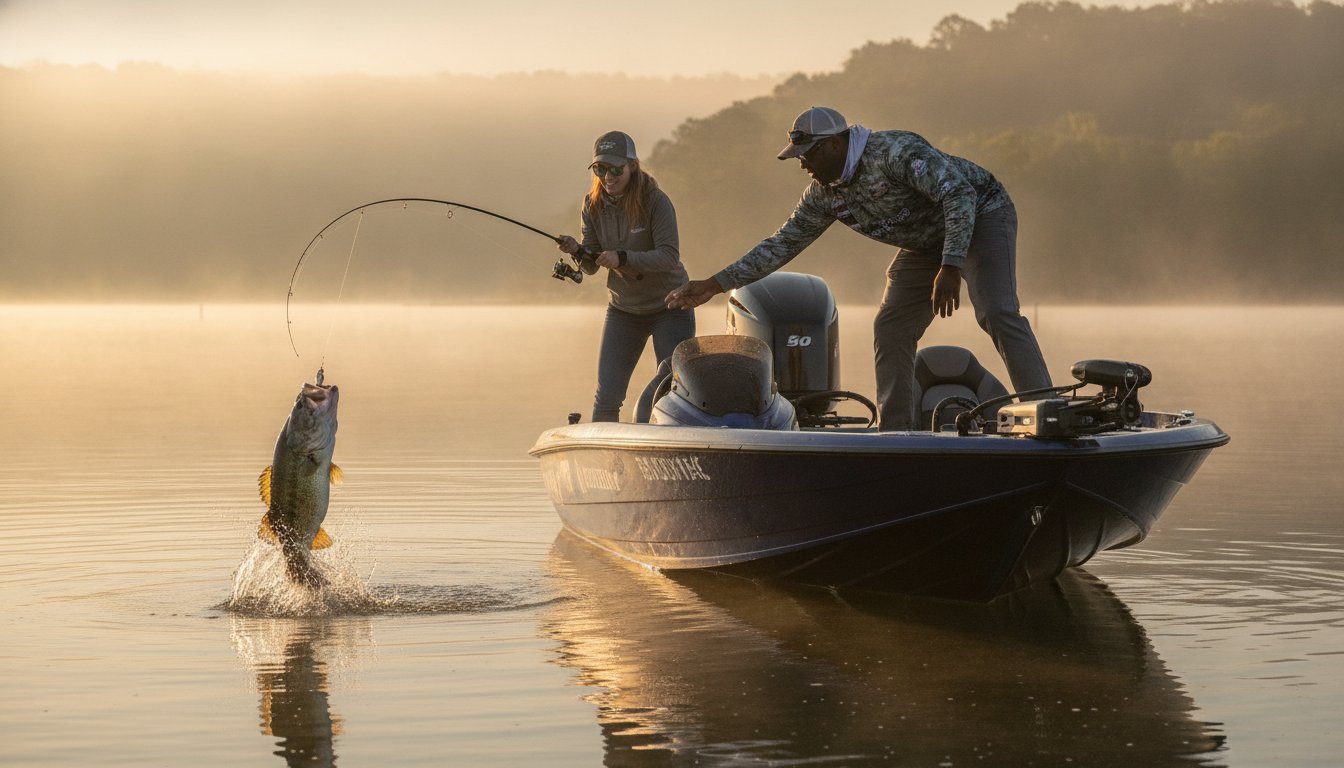

What if I told you that the most crowded “dead” water on the lake is actually holding the biggest trophy of your life? We have all felt that sting of fishing a perfect spot on a busy Saturday, only to realize the bass have seen every lure in the catalog. Even when applying advanced bass fishing techniques, it is frustrating to watch a school of giants on your Garmin LiveScope Plus or Humminbird MEGA Live 2 ignore your best casts. You know the fish are there, but they have become masters at dodging the standard rotation of baits.
I am here to help you flip the script. In this guide, I will share the exact strategies that professional guides use to trigger strikes when the pressure is at an all-time high. You are going to learn how to read water like a seasoned pro and master the “urchin” style soft plastic presentations that are dominating the 2026 season. We will break down the psychology of spooked fish and give you versatile rigs that work when the standard lures stop performing. By the time we are done, you will have the confidence to out-fish the crowds and turn a quiet day into a highlight reel.
Key Takeaways
- Learn how to trigger aggressive reaction strikes from “conditioned” fish that have learned to recognize and avoid common lure vibrations.
- Discover advanced bass fishing techniques for targeting the 70% of big bass that spend their time suspended in deep water or heavy timber.
- Master the mechanics of the Tokyo Rig to skip and punch through the thickest matted vegetation that most weekend anglers completely avoid.
- Move beyond the bank and follow post-spawn migrations to offshore ledges by using oversized swimbaits as high-efficiency search tools.
- Understand how spending time on the water with a professional guide can help you execute these elite tactics in real-world conditions.
The Psychology of Pressure: Why Traditional Bass Tactics Fail
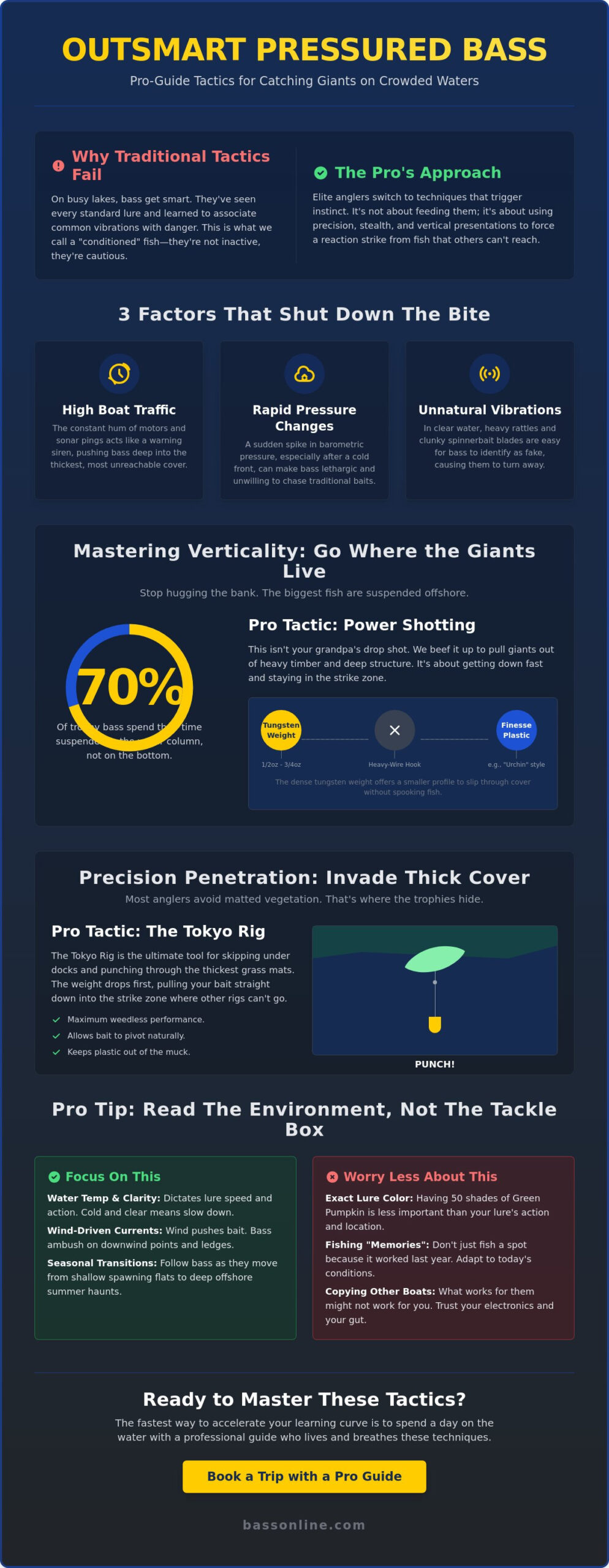
I’ve spent thousands of hours on the water, and there is one thing that separates the weekend warriors from the pros: understanding the mental state of the fish. Most anglers think that if they aren’t getting bites, the fish just aren’t there. That’s rarely the case. In modern bass fishing, the fish are usually right where they should be, but they have become completely numb to traditional presentations. Advanced bass fishing techniques focus on triggering “reaction strikes” from these non-active fish. This means moving away from trying to feed the bass and instead forcing them to snap at a lure out of pure instinct.
Factors that frequently shut down a bite include:
- High-frequency boat traffic near spawning flats and primary points.
- Rapidly rising barometric pressure immediately following a cold front.
- Excessive lure noise and “unnatural” vibrations in clear water conditions.
The Conditioned Bass Phenomenon
Catch-and-release is the backbone of our sport, but it has a side effect: smarter fish. A trophy bass that has been caught three times is a lot more cautious than a juvenile. Conditioned bass are fish that have learned to associate specific lure profiles and repetitive vibrations with danger. In high-traffic areas, I often switch to “silent” presentations. Weightless soft plastics or lures without internal rattles can sneak into a strike zone without triggering an internal alarm. It’s about being a ghost on the water.
Environmental Triggers vs. Lure Color
Don’t get obsessed with having fifty different shades of green pumpkin. In my experience, water temperature and clarity dictate lure speed and action far more than the exact color of your bait. Cold water requires a slower, more deliberate crawl, while warm water allows for high-speed burning. You also need to look at wind-driven currents. Wind pushes baitfish, and smart bass will position themselves on the downwind side of points or submerged ledges to ambush them. Understanding bass species behavior while applying advanced bass fishing techniques is the first step toward true mastery. If you can predict where the current will push the food, you’ll know exactly where the giants are waiting.
Mastering Verticality: Tactics for Suspended and Deep-Water Bass
If you are only fishing the bottom, you are missing out on the majority of the lake’s population. It is a well-known secret among professional guides that roughly 70% of trophy bass spend their time suspended in the water column rather than hugging the floor. These fish are often the most difficult to catch because they aren’t relating to obvious structure. To target them, you have to embrace advanced bass fishing techniques that prioritize vertical precision. When you explore these deeper patterns, you’ll find that mastering the vertical game requires a specialized approach to your gear and electronics.
One of my favorite evolutions in this space is “power shotting.” We all know the traditional drop shot, but when I am fishing heavy timber, I beef everything up. I use a 1/2-ounce or 3/4-ounce tungsten weight and a heavy-wire hook to pull giants out of the thick stuff. Tungsten is vital here. Its high density allows for a much smaller profile than lead, which means your weight can slip through branches and reach the strike zone without spooking wary fish. If you want to refine your approach, following expert bass fishing tips on weight selection can make the difference between a snag and a personal best.
The “Moping” Technique for Suspended Fish
Moping, often called Damiki rigging, has become a powerhouse technique thanks to Forward Facing Sonar (FFS). This involves using a specialized jig head and a 3- to 4-inch fluke-style bait. The goal is to drop the bait directly over a fish you see on your screen and hover it exactly 12 inches above its head. Bass are designed to look up. By keeping the lure just out of reach, you trigger their competitive nature. The most advanced move you can make here is actually doing nothing. Don’t shake the rod tip. A dead-still presentation in the face of a suspended bass often forces a violent reaction strike that a moving bait won’t get.
Deep Cranking the Thermocline
During the heat of the summer, you need to understand the thermocline, which is the layer of water where the temperature changes rapidly. Bass rarely dip below this line because oxygen levels drop off significantly. I look for where the thermocline intersects with deep ledges or humps. To get these fish to bite, I use deep-diving cranks that are rated for 20 feet or more. The trick is to choose a lure that dives slightly deeper than the bottom so it “digs” into the silt. This creates a debris cloud that mimics a fleeing baitfish. I always use a long, 7-foot-11-inch glass rod for this. The soft action allows the fish to fully inhale the bait and prevents the hooks from tearing out during a heavy fight. If you’re struggling to find these deep-water honey holes, feel free to reach out to our team to get the latest report on where the schools are holding.
Precision Penetration: Skipping and Punching Heavy Cover
When the sun is high and the boat traffic is heavy, the biggest bass on the lake don’t just disappear. They move into the “neglected” cover—the thickest, nastiest vegetation that most anglers are too intimidated to touch. While the crowds are beating the banks with spinnerbaits, professional fishing guides are often deep in the jungle, pulling trophies out of matted grass and under low-hanging docks. Success here isn’t about luck; it is about using advanced bass fishing techniques that prioritize precision over volume. You have to put the lure where nobody else can.
One of the most effective tools for this is the Tokyo Rig. Unlike a standard Texas rig, the Tokyo Rig features a wire dropper that keeps the weight below the bait. This creates a more vertical, streamlined profile that punches through matted grass without the bait getting snagged on the surface. When you’re in the thick of it, your line choice is non-negotiable. Fluorocarbon is a liability here because it can nick or snap when rubbed against abrasive stalks. I always switch to 65lb braid. It cuts through vegetation like a saw, giving you the leverage needed to haul a big fish out before it can bury itself in the roots.
To find the right spot in a massive grass mat, look for “blow holes” or areas where different types of vegetation meet. These spots usually have higher oxygen levels and offer the perfect ambush point. If the mat looks like a solid carpet, you’re looking for the subtle depressions or small openings where a bass can breathe and see its prey.
The Art of the Backhand Skip
Skipping a jig 15 feet under a boat dock or a cypress limb is a game-changer. For maximum distance, I prefer a flat-sided jig over a round head; it acts like a skipping stone on the water’s surface. To execute the backhand skip, start with a low-trajectory sidearm or backhand motion. The goal is to hit the water about two feet in front of your target. A common mistake is putting too much thumb on the spool. Instead, tune your baitcaster’s tension knob so the lure falls slowly, and keep your thumb light. This prevents the dreaded professional overrun while allowing the jig to maintain its momentum deep into the shadows.
Punching the Jungle
Punching requires heavy-duty gear: a 7-foot-11-inch extra-heavy rod, a 1.5oz to 2oz tungsten weight, and a stout flipping hook. When your weight breaks through the mat, pay attention immediately. We call it the “reaction drop” because the first two seconds of the fall are the only ones that matter. The bass sees a sudden intrusion and snaps out of instinct. If you hook a 10-pounder in the middle of that jungle, don’t give it an inch. Keep your rod tip high and use the trolling motor to move toward the fish. These advanced bass fishing techniques are designed to win the fight in the first five seconds, which is often all the time you’ll get.
Advanced Seasonal Transitions: Moving Beyond the Bank
When the spring spawn ends, most anglers hit a wall. They continue to beat the banks while the biggest fish in the lake begin their migration toward deeper, cooler water. This “mid-summer slump” is where advanced bass fishing techniques become the difference between a skunk and a limit. To stay on the bite, you have to understand the spatial logic of how bass move. They aren’t just wandering; they are following specific underwater highways toward offshore ledges and humps where the oxygen levels and food sources are more stable. This movement is driven by metabolic shifts that dictate how much energy a trophy fish is willing to spend to catch a meal. You can dive deeper into the Florida Bass science to understand why these temperature changes trigger such massive migrations.
To find these offshore schools, I rely on oversized swimbaits in the 7- to 10-inch range. These aren’t just lures; they are high-efficiency search baits. A large swimbait creates a massive profile that draws fish out of cover, even if they don’t commit to the strike. I use them to “map” the school’s location. Once I see a few followers or get a hesitant nip, I switch to finesse rigs to pick the school apart. Another pro secret is targeting “Bluegill Beds.” During the summer, bluegill spawn in shallow, sandy pockets. Giant bass will often patrol the outer edges of these beds, waiting for an easy meal. If you can find the beds, the trophies are usually just a cast away in the nearby deeper water.
Ledge Fishing Secrets
Ledge fishing is the ultimate test of your electronics. I use side imaging to scan for “hard spots,” which are usually shell beds or rock piles on an otherwise muddy bottom. These hard spots are magnets for crawfish and baitfish. Once I find a school, I use the “strolling” technique. This involves letting out a massive amount of line while the boat is moving to get my crankbait deeper than its rated depth, keeping it in the strike zone for the entire length of the ledge. On river-fed lakes, timing is everything. Current is king. Bass will often only bite when the “Power Generation” is active and water is moving through the dam. If the current stops, the bite usually dies with it.
Night Fishing for Pressured Giants
On lakes with heavy weekend pressure, the biggest bass often become strictly nocturnal. They wait for the sun to go down and the boat traffic to clear before they move into the shallows to feed. For night fishing, I keep my lure colors simple. Black and blue are the only colors you need because they provide the strongest silhouette against the moonlit sky. Navigation is the biggest challenge here. Always keep your GPS running and move at half-speed when traveling between offshore spots. If you want to see how these nocturnal patterns play out in person, I recommend you book a guided trip to learn the lake’s night-time secrets safely.
The Pro’s Edge: Accelerating Your Learning Curve
Mastering the advanced bass fishing techniques we have discussed requires more than just high-end gear; it demands “time on the water.” You can own the most expensive electronics on the market, but nothing replaces the intuition gained from thousands of casts in varying conditions. It is the fundamental difference between simply “fishing” and truly “hunting” for trophy bass. When you transition into a hunting mindset, you stop casting blindly at every stump. Instead, you start dissecting the environment with surgical precision, understanding the “why” behind every reaction strike and every seasonal shift.
Why Hire a Professional Guide?
The fastest way to skip the frustration and jump straight to the results is to spend a day with a seasoned expert. Professional guides spend upwards of 300 days a year tracking fish movements and fine-tuning their equipment. This is not just about catching fish; it is about “Live Instruction.” Having a pro correct your casting angle or your retrieval mechanics on the fly provides an immediate boost to your skill set. You can read about punching a mat all day, but seeing a guide execute it in the middle of a grass mat on Lake Okeechobee or Lake Guntersville gives you a mental blueprint you cannot get anywhere else. If you want to see the impact of this firsthand, check out our fishing charter reviews to see how other anglers have leveled up their game.
To get the most out of your charter, you need to ask the right questions. Don’t just ask “what lure is that?” Instead, ask “why did you choose that specific weight for this current?” or “what are you seeing on the sonar that made us stop at this specific spot?” Extracting this high-level knowledge is what turns a fun trip into a career-changing educational experience. It allows you to take advanced bass fishing techniques and apply them to your home waters with total confidence.
Booking Your Next Expedition
The best way to master these elite strategies is to apply them in the field on some of the most productive waters in the country. Whether you want to tackle the heavy mats of the Florida Everglades or the deep ledges of the St. Lawrence River, there is no substitute for real-world experience. I encourage you to explore iconic lakes across our network to find the perfect proving ground for your new skills. Don’t just read about advanced tactics; experience them on the water by booking your next guided bass fishing trip with us today.
Take Command of the Water
Mastering the water in 2026 isn’t just about having the latest sonar; it’s about shifting your mindset from a casual angler to a strategic hunter. We have explored how to trigger reaction strikes from conditioned fish, the precision needed to punch through the thickest mats, and the logic behind offshore seasonal migrations. These advanced bass fishing techniques are the tools you need to stop guessing and start catching, especially when the weekend crowds make the bite feel impossible. You now have the blueprint to target the suspended giants and neglected cover that others simply overlook.
If you’re ready to see these tactics in action, there’s no better way than learning from the best. With over 25 years of professional guiding experience, our team provides access to the top 1% of freshwater fishing hotspots. You’ll receive direct instruction from local captains who live on the water and know exactly where the trophies are hiding. Don’t let another trip end in frustration. Book Your Professional Bass Fishing Charter with Bass Online Today! We’ll get you on the fish and help you build the confidence to dominate any lake you visit. See you on the water!
Frequently Asked Questions
What is the most effective advanced rig for pressured bass?
The Tokyo Rig is currently one of the most effective advanced bass fishing techniques for pressured water because it offers a unique, vertical presentation that bass haven’t grown accustomed to yet. It keeps your bait just off the bottom and allows for a much more natural movement than a standard Texas rig. I find it especially useful when fish are being picky in high-traffic areas and need to see something different to trigger a strike.
How does Forward Facing Sonar change the way I should fish?
Forward Facing Sonar (FFS) turns fishing into a real-time game of cat and mouse by allowing you to see how a fish reacts to your lure before it strikes. Instead of casting blindly at a stump, you can adjust your retrieve speed or jigging motion based on the fish’s immediate body language. It’s a game-changer for targeting suspended fish that don’t relate to traditional bottom structure, letting you stay in the strike zone longer.
Is fluorocarbon or braid better for advanced bass techniques?
You should choose your line based on the specific environment, but 65lb braid is the king of heavy cover while fluorocarbon is essential for clear water finesse. Braid gives you the raw power to saw through thick vegetation during a fight without snapping. Fluorocarbon offers the invisibility and sensitivity needed to fool smart, “conditioned” bass in open water where they have plenty of time to inspect your lure.
What is “punching” and when should I use it?
Punching is a technique where you use a heavy tungsten weight, usually 1.5 to 2 ounces, to crash a lure through thick mats of floating vegetation. You should use it when high sun or heavy boat traffic pushes trophy bass deep into the “jungle” for shade and security. It’s often the only way to reach fish that other anglers simply can’t get to, providing a vertical drop that triggers instinctual reaction strikes.
How do I find bass that are suspended in open water?
Finding suspended bass requires using your electronics to locate schools of baitfish or identifying where a ledge intersects with the lake’s thermocline. These fish often hold at a specific depth where oxygen and temperature are optimal, regardless of what the bottom looks like. Once you find that magic depth on your sonar, use vertical presentations to keep your bait right in their faces until they can’t resist.
Can I use advanced techniques from the shoreline?
Absolutely, you can apply advanced bass fishing techniques like backhand skipping or using “micro” finesse baits from the bank with great success. Skipping a jig under low-hanging limbs or boat docks that other bank anglers ignore can put you on fish that rarely see a lure. It’s all about precision and reaching the spots that require a bit more technical skill to fish, giving you an edge over the weekend crowds.
Why do professional anglers use tungsten weights instead of lead?
Professional anglers prefer tungsten because it is much denser than lead, allowing for a smaller lure profile that is less likely to spook wary fish. The harder material also transmits vibrations much better, which means you can feel every pebble or subtle strike through your rod. It’s a small investment that provides a massive advantage when you’re hunting for a trophy in pressured waters where every detail counts.

Article by
Mr Bass
Todd Kersey, widely known as Mr. Bass by Field & Stream, is a professional angler, accomplished author, and dedicated philanthropist with a lifelong passion for bass fishing. Armed with a degree in Outdoor travel, Mr. Bass has expertly combined his knowledge with his practical fishing experience to become one of the most respected names in the bass fishing, his deep understanding of bass habitats, and fish behavior has earned him numerous accolades as a asset of the sport. Serving 8 years as FWC Stakeholder Chairperson. Leading and passing cutting-edge legislation, such as the Black Bass Management plan, and successfully building, passing, and financing the Trophy Catch program. As CEO, he is committed to giving back to the community through his philanthropic efforts. He supports a variety of causes, especially those centered around physical disabilities. Through his advocacy, his mentorship programs inspire anglers to engage in fishing stewardship, helping to raise more than $ 18 million in donations. Mr. Bass continues to inspire anglers and outdoor enthusiasts alike with his commitment to the sport and the world around him.