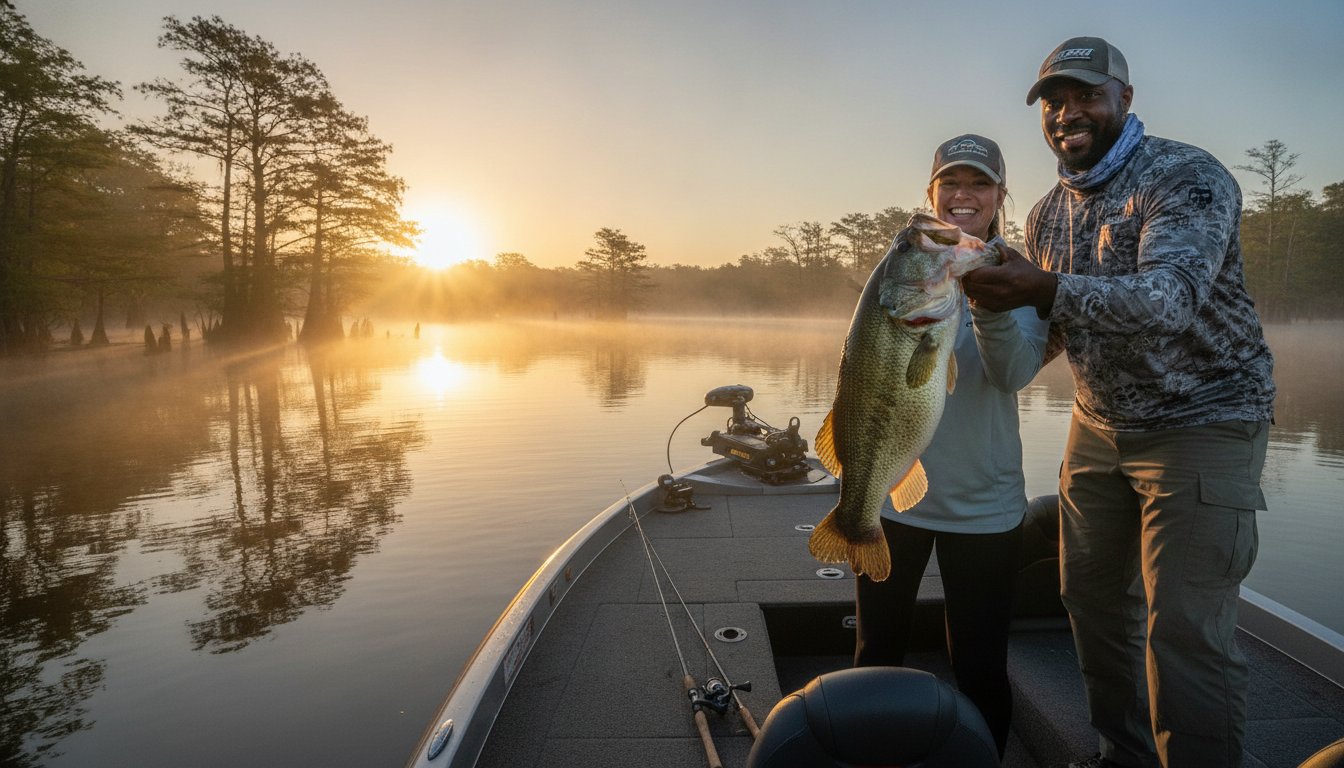

If you are staring at a glass-calm lake and wondering why am i not catching largemouth bass, the problem isn’t your luck. It is simply that you haven’t finished your diagnosis. We have all felt that sting of returning to the dock empty-handed while other anglers are bragging about their haul. It is frustrating to spend your hard-earned time and money on the water only to feel more confused by conflicting gear advice than when you started.
I’m here to stop that cycle right now. This guide pulls back the curtain on the exact diagnostic process our professional guides use to turn a “skunked” morning into a trophy-filled afternoon. You’ll learn how to read shifting 2026 water conditions and gain total confidence in your lure selection, whether you’re throwing a Berkley PowerBait Chop Block or a finesse Z-Man Fuzzy TRD. We will break down the “why” behind bass behavior and seasonal patterns so you can stop guessing. By the time you finish reading, you will have the field-tested steps needed to land at least one solid fish on every single outing.
Key Takeaways
- Stop wasting time in “dead water” by using the 90/10 rule to find areas where oxygen, temperature, and forage actually hold fish.
- Solve the mystery of why am i not catching largemouth bass by slowing down your retrieve and knowing when to challenge the “match the hatch” rule.
- Decode environmental triggers like barometric pressure and post-front bluebird skies to predict exactly where bass go when the bite gets tough.
- Tighten up your technical game with stealthier approaches and fluorocarbon line to fool wary fish that have seen every lure in the book.
- Discover how a guided trip serves as a diagnostic masterclass, teaching you the subtle “feel” of a strike that you can’t learn from a screen.
Location Diagnostics: Are You Fishing in “Dead Water”?
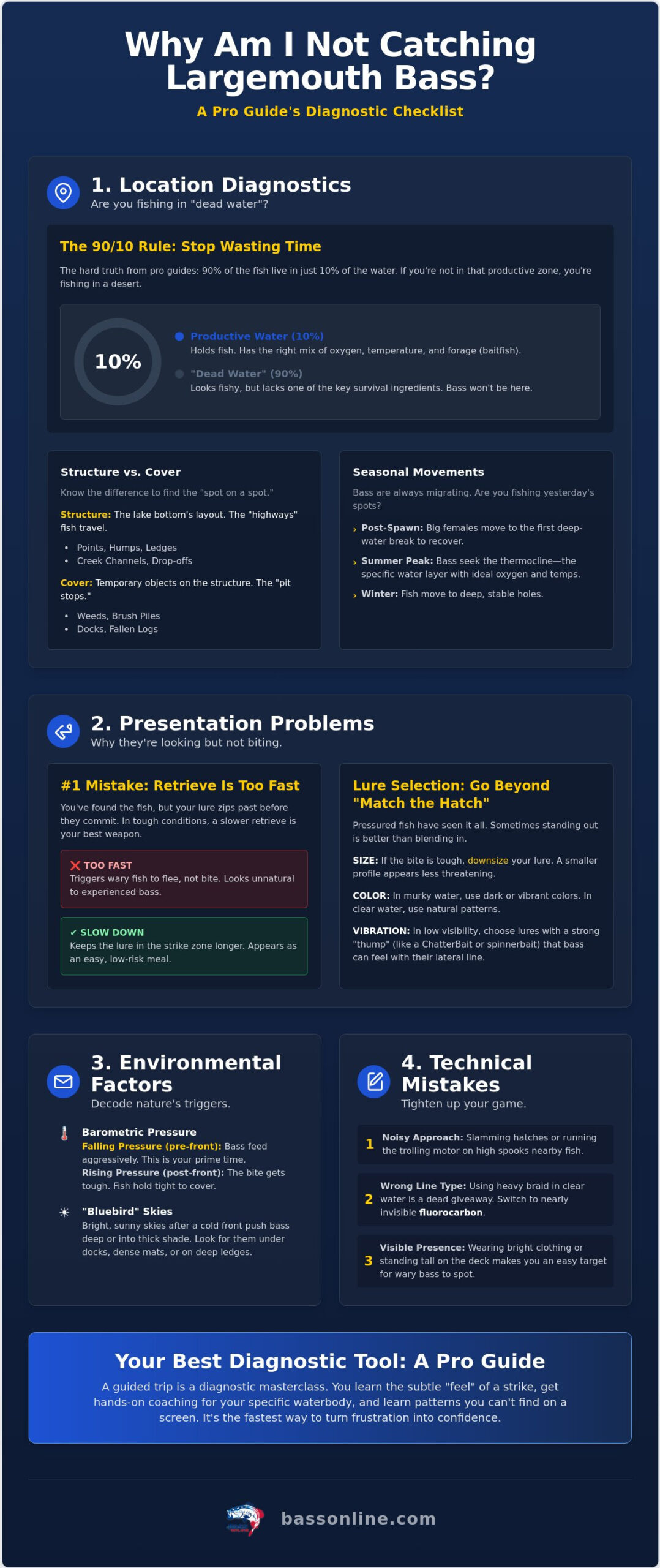
Most anglers pull up to a bank that looks perfect and start casting. They see green grass, they see a fallen log, and they assume the fish are there. Here is the hard truth: 90% of the fish live in just 10% of the water. If you aren’t in that 10%, you are fishing in “dead water.” This is the most common reason you find yourself asking why am i not catching largemouth bass today even though you caught them in this exact spot last month.
Dead water looks fishy on the surface but lacks the essentials. It might be a beautiful weed bed that has lost its oxygen due to decay, or a dock where the water temperature has spiked too high for comfort. Understanding Largemouth bass biology is the first step to realizing that these fish are driven by survival. They need the right mix of oxygen, temperature, and forage. If one of those is missing, the bass are gone, no matter how good the cover looks.
To better understand this concept, watch this helpful video:
Seasonal Movements: Tracking the Bass Migration
Bass are on a constant march. In early 2026, we have seen fish move from deep wintering holes to shallow spawning flats earlier than usual in many regions. If you are still pounding the flats when the “post-spawn funk” hits, you’re wasting your time. After spawning, big females move to the first deep-water break to recover. During the peak of summer, they seek the thermocline. This is the specific layer of water with the best oxygen and temperature. If your lure is running below that line, you are fishing in a desert where no bass can breathe.
Structure vs. Cover: Knowing the Difference
I tell the anglers on our guided fishing trips that structure and cover are two different things. Structure is the permanent layout of the lake bottom, like points, humps, and ledges. Think of structure as the highway system fish use to travel. Cover is the temporary stuff, like weeds, brush piles, or docks. These are the pit stops. To find the “spot on a spot,” you need to find where two types of cover intersect on a major piece of structure. A single stump sitting on a secondary point is a high-percentage target. A massive field of grass with no depth change is often low-value water that holds very few trophy fish. Use your electronics to find those offshore humps that shore anglers miss. Those hidden spots often hold the biggest schools of the year.
Presentation Problems: Why They Are Looking But Not Biting
You have eliminated the “dead water” we talked about in the previous section. You are on the right structure. You even see fish on your electronics. Yet, your lure comes back untouched every single time. This is the moment when most anglers get frustrated and wonder why am i not catching largemouth bass despite being in the right area. The truth is that finding them is only half the battle. Presentation is what closes the deal. Bass are highly efficient ambush predators, but they are also incredibly discerning when it comes to how a meal moves through their strike zone.
Many people focus strictly on the “Match the Hatch” rule, but that can be a fallacy in pressured waters. If every angler on the lake is throwing a four inch silver shad imitation, the bass eventually learn that “silver and fast” equals a hook. Sometimes, standing out is better than blending in. By understanding bass habitat and feeding patterns, you can decide whether to mimic the local forage or trigger a reaction strike with something completely different. In 2026, with over 57 million anglers hitting the water, bass have become highly conditioned. They know what a standard crankbait sounds like. If a horizontal retrieve isn’t working, try a vertical approach by jigging directly over the fish to change the angle of attack.
Lure Selection: Size, Color, and Vibration
Size and color matter more than most realize. If the bite is tough, downsize. A smaller profile often tricks a wary fish into thinking it is an easy, low-risk snack. Follow the golden rule of water clarity: dark day, dark lure; bright day, bright lure. In murky water, vibration is king. You need a lure with a heavy “thump” that fish can find using their lateral lines before they ever see it. If you are struggling to find the right combination for your local lake, reach out to our expert team for personalized advice on what is currently working.
The Art of the Pause: Letting the Lure Do the Work
This is the biggest secret in a pro guide’s arsenal. Most amateur anglers retrieve their lures far too quickly. They wind and wind, never giving the fish a chance to commit. Speed kills your chances. The strike almost always happens when the lure stops moving. Whether you are using a jerkbait or a soft plastic, the pause is when the bass decides to kill. Try “dead-sticking,” which means letting your bait sit perfectly still on the bottom for ten to fifteen seconds. It feels like forever, but it is often the only way to trigger a lethargic trophy when you are asking why am i not catching largemouth bass.
Environmental Factors: Reading the Water Science
You’ve narrowed down the location and refined your lure action, but the fish still aren’t biting. This is where most anglers give up, but it is actually where the real science begins. Barometric pressure is the silent killer of many fishing trips. When you find yourself asking why am i not catching largemouth bass, look at your barometer. A rapidly rising pressure usually means a cold front is moving in, and that sends bass into a metabolic lockdown. Their swim bladders are sensitive to these shifts, making them feel uncomfortable and less likely to chase a meal.
Professional guides don’t just hope for good weather; they read it. Wind, for example, is your best friend. While casual anglers complain about the waves, pros look for wind-blown banks where forage like shad and crawfish get pushed into a tight zone. This creates “mud lines” where clear water meets murky water. Bass use these lines as perfect ambush points. Temperature also plays a massive role. Once water temps drop below 45 degrees or spike above 85, bass become metabolically inactive. They aren’t gone; they just aren’t eating as often. You have to adjust your expectations and your tactics to match their slower internal clock.
The Cold Front Survival Guide
When a cold front hits and those bluebird skies appear, the strike zone shrinks. A bass that would have chased a spinnerbait ten feet yesterday won’t move two inches today. You have to hit them on the nose. This is the time to switch to bottom-bouncing baits like a heavy jig or a Texas rig. You need to punch through the thickest cover you can find. The fish are still there, but they are tucked deep into the shadows of docks or buried in the heart of hydrilla mats to avoid the high-pressure light. Precision casting becomes the difference between a skunk and a trophy.
Solunar Cycles and Light Penetration
Light penetration is the ultimate clock for a largemouth. The “Golden Hour” at dawn and dusk provides the low-light conditions where bass have the visual advantage over their prey. If you are struggling during the midday lull, look for shadows. A single overhanging tree or a bridge piling creates a sanctuary. As for moon phases, our decades of experience on waters like Lake Erie and Lake Guntersville prove that while the full moon can trigger a spawn, the “major” and “minor” solunar periods are what actually dictate the daily feeding windows. If you aren’t timing your best spots with these windows, you’re missing the peak bite of the day.
The Technical Diagnostic: 5 Mistakes You’re Making Right Now
Sometimes the reason why am i not catching largemouth bass isn’t about the lake or the weather; it’s about your technical execution. We have already audited your location and your lure choice, but now it is time for a personal gear and behavior check. These are the small, often overlooked errors that separate the weekend warriors from the pros who consistently put trophy fish in the boat. Bass are survivalists, and they didn’t get big by being stupid. If you are making these five mistakes, you are essentially ringing a dinner bell that says “danger” instead of “food.”
- Stealth: If you can see the fish, they have likely already seen you. Bass are incredibly sensitive to vibration and visual cues.
- Line Visibility: In 2026, with pressured waters being the norm, switching to high-quality fluorocarbon is non-negotiable. It disappears under water and provides the sensitivity you need to feel those “mushy” bites.
- Casting Accuracy: If you aren’t putting your lure in the “junk,” which includes the thickest grass and the darkest part of the dock, you aren’t in the fish. Bass don’t hang out in the open where it is easy to cast.
- Scent: Unnatural deterrents like sunscreen, gasoline, or tobacco on your hands can transfer to your lure and kill the bite instantly.
- Noise: Dropping a pliers on the deck or slamming a locker lid sends a shockwave through the water that can shut down a shallow-water bite for an hour.
Stealth and Boat Positioning
Your trolling motor is either a dinner bell or a fire alarm depending on how you use it. Constant, high-speed adjustments in shallow water will spook a trophy before you even reach for your rod. I always tell my clients to manage their shadow too. If the sun is at your back and your shadow falls over a stump, you have just announced your arrival. Practice long-distance casting to stay outside their “alert zone.” By staying back and casting into the target area from a distance, you avoid the boat-shyness that keeps big bass from committing.
The “One More Cast” Trap
Don’t fall in love with a spot that isn’t producing. I use the 15-minute rule: if I’ve rotated through my power fishing baits like crankbaits and then slowed down with a finesse rig without a sniff, it’s time to move. Angler pressure is the cumulative effect of human activity on a specific area that typically takes about 24 hours of zero activity to fully reset. You need to know when to leave a “good looking” spot to find a “productive” one. If you want to see these techniques in action and cut your learning curve in half, book a session with our pro team today and let’s get you on the fish.
Level Up: Why a Pro Guide is Your Best Diagnostic Tool
You have audited your location, refined your lures, and checked the weather. If you are still staring at a quiet rod and asking why am i not catching largemouth bass, it is time to bring in the ultimate diagnostic tool. A professional guide doesn’t just put you on fish; we teach you the “why” and the “how” behind every strike. This is the final step in moving from a frustrated angler to a consistent producer. We provide the real-time feedback that a YouTube video or a blog post simply cannot offer.
There is a specific “feel” to a trophy bass bite that takes years to master. Sometimes it is a slight weightlessness in the line; other times it is a faint “tick” that feels like a bluegill pecking at your worm. Our guides stand right beside you to coach your hook sets and refine your casting accuracy. On massive bodies of water like Lake Okeechobee or Lake Guntersville, finding fish is a daunting task. We have the advantage of being on the water 200+ days a year, giving us access to “secret” offshore humps and seasonal transitions that don’t appear on any map. We take the guesswork out of the equation so you can focus on the fight.
Shortening the Learning Curve
A single day spent on one of our Guided Fishing Trips is worth an entire year of trial and error on your own. You will learn to use high-end electronics effectively, moving past the basic settings to actually identifying fish behavior and thermoclines in real-time. We show you how to read the latest 2026 sonar tech so you can stop fishing over empty water. Browse our professional fishing guides to find a local expert who can turn your frustration into a masterclass in bass biology.
Book Your Success Story
We customize every expedition to match your specific skill level. Whether you are a novice looking to land your first solid fish or a seasoned angler hunting for a double-digit trophy, we have the territory and the expertise to make it happen. Explore top bass fishing lakes across the country and pick your next destination. Stop guessing, stop the frustration of returning home empty-handed, and start catching. We have been leading the industry since 1997, and we are ready to put that experience to work for you today.
Master the Water and Land Your Next Trophy
Stop guessing and start catching. You now have the diagnostic blueprint to stop asking why am i not catching largemouth bass and start solving the real problems on the water. Success comes down to ditching “dead water” through the 90/10 rule and mastering the art of the pause to trigger those stubborn strikes. Every cast is an opportunity to apply these field-tested lessons in stealth, environment, and presentation. These small adjustments are what separate a frustrating day at the dock from a legendary haul.
Our team has over 25 years of professional guiding experience and thousands of 5-star reviews from successful anglers across the country. We bring expert local knowledge to every major US bass lake, ensuring you aren’t just fishing, but catching. It’s time to take your skills to the next level and leave the embarrassment of an empty livewell behind. Book a Pro Guide and End the Skunk Streak Today! We will put you on the trophy of a lifetime and give you the confidence to own the water on every single outing. See you out there!
Frequently Asked Questions
Why do bass stop biting all of a sudden?
Bass usually stop biting due to sudden environmental shifts like a spike in barometric pressure or a change in wind direction. These predators are incredibly sensitive to their surroundings. A quick shift can send them into a “neutral” mood where they tuck deep into heavy cover to feel secure. When this happens, they aren’t gone; they just require a much slower, more precise presentation to trigger a strike.
What is the best time of day to catch largemouth bass?
Low-light periods at dawn and dusk are typically the most productive windows for active feeding. These “Golden Hours” give bass a massive visual advantage over their prey, allowing them to ambush baitfish more effectively. However, don’t sleep on the midday sun during a cold front. Sometimes that extra bit of warmth in shallow water is exactly what it takes to trigger a brief, aggressive feeding window.
Does the color of my lure really matter?
Lure color is vital because it dictates how well a fish can see your bait in different water clarities. Use dark colors like black or blue in murky water to create a high-contrast silhouette that fish can track. In clear water, stick to natural, translucent shades like watermelon or pumpkin seed. Matching the light conditions helps prevent wary, pressured bass from spotting the ruse before they commit to the strike.
Can I catch bass from the shore as well as from a boat?
You can absolutely land trophy bass from the bank if you focus on high-percentage structure like rip-rap, points, and overhanging trees. Shore anglers actually have a stealth advantage because they don’t have trolling motor vibration or hull slap. The secret is to stay mobile. Don’t stay in one spot for an hour; keep moving until you find where the active 10% of fish are holding.
What is the best lure for when bass are not biting?
When the bite gets tough and you are wondering why am i not catching largemouth bass, reach for a finesse bait like a Ned Rig or a small soft plastic. Downsizing your profile and slowing your retrieve to a crawl is the best way to trick a lethargic fish. These subtle presentations look like an easy, low-energy meal that even a pressured bass finds difficult to pass up.
How does water temperature affect bass fishing?
Water temperature is the primary driver of a bass’s metabolic rate and where they live in the water column. In cold water, their systems slow down, and they move to deeper, more stable areas. As temps rise into the 70s, their activity peaks. However, when it gets too hot, they seek oxygen-rich zones like thick vegetation or moving current. Knowing these thresholds helps you predict their next move.
Why am I getting bites but not hooking the fish?
You are likely dealing with “short strikes” where the fish is only nipping at the tail of the lure. This often happens when bass are non-committal due to high pressure or clear water. Try downsizing your bait or switching to a different hook style to ensure better penetration. Sometimes, simply waiting a half-second longer before setting the hook gives the fish enough time to fully inhale the bait.
Does barometric pressure really affect fishing?
Barometric pressure is one of the most powerful factors in fish behavior. A falling barometer usually triggers a feeding frenzy right before a storm hits. On the flip side, a high-pressure system with bright blue skies often shuts the bite down. Understanding these atmospheric shifts is a huge part of solving the mystery of why am i not catching largemouth bass on days that otherwise look perfect.

Article by
Mr Bass
Todd Kersey, widely known as Mr. Bass by Field & Stream, is a professional angler, accomplished author, and dedicated philanthropist with a lifelong passion for bass fishing. Armed with a degree in Outdoor travel, Mr. Bass has expertly combined his knowledge with his practical fishing experience to become one of the most respected names in the bass fishing, his deep understanding of bass habitats, and fish behavior has earned him numerous accolades as a asset of the sport. Serving 8 years as FWC Stakeholder Chairperson. Leading and passing cutting-edge legislation, such as the Black Bass Management plan, and successfully building, passing, and financing the Trophy Catch program. As CEO, he is committed to giving back to the community through his philanthropic efforts. He supports a variety of causes, especially those centered around physical disabilities. Through his advocacy, his mentorship programs inspire anglers to engage in fishing stewardship, helping to raise more than $ 18 million in donations. Mr. Bass continues to inspire anglers and outdoor enthusiasts alike with his commitment to the sport and the world around him.