
What if the thousands of dollars spent on the latest electronics and high-end tackle are actually the reason you aren’t catching fish? It’s a common trap to think a bigger boat or a “smart reel” guarantees a trophy, but the reality is much simpler. If you’re tired of coming home with an empty livewell, you’re likely falling into some common beginner bass fishing mistakes to avoid that have nothing to do with your budget. I’ve guided thousands of trips on legendary waters like Lake Okeechobee and Lake Toho, and I’ve seen these same tactical errors stop great days in their tracks.
I know how frustrating it feels to watch a monster bass snap your line or to stare at a massive lake without a clue where to cast. You want to feel confident in your gear and consistent in your catch every time you launch the boat. This guide is designed to eliminate those headaches by providing field-tested pro insights that work on any body of water in 2026. We will break down exactly how to choose the right lure for the conditions, how to tie knots that won’t fail, and how to read bass behavior like a seasoned pro. By the time you’re done reading, you’ll have the tactical edge needed to turn a slow day into a legendary one.
Key Takeaways
- Learn why simplifying your tackle box and avoiding the “confidence lure” trap will actually help you land more fish.
- Master retrieve speeds and the power of the “pause” to trigger strikes from bass that are currently ignoring your lures.
- Identify high-percentage spots like wind-blown banks while learning the beginner bass fishing mistakes to avoid when scanning a large body of water.
- Protect your catch rate by mastering the basics of hook maintenance and proper spool management to prevent lost fish at the boat.
- Discover how a single day with a professional guide can replace a year of frustrating trial and error on the water.
Stop the Gear Overload: The #1 Mistake Beginners Make
I see it at the boat ramp every morning: an angler struggling with four overstuffed tackle bags and six mismatched rods. This gear overload is one of the most common beginner bass fishing mistakes to avoid because it creates choice paralysis. When you’re constantly digging through plastic trays for a “magic” lure color, you aren’t focusing on where the fish actually live. Modern bass fishing is about efficiency, not inventory.
In 2026, the pros are moving toward a minimalist approach. You don’t need a boat full of gear to be successful; you just need a few reliable setups that cover the entire water column. Sticking to a streamlined kit keeps your mind on the water instead of your gear bag, allowing you to react faster when the bite changes. If you want to catch more fish this year, you need to strip back the clutter and focus on the high-percentage plays.
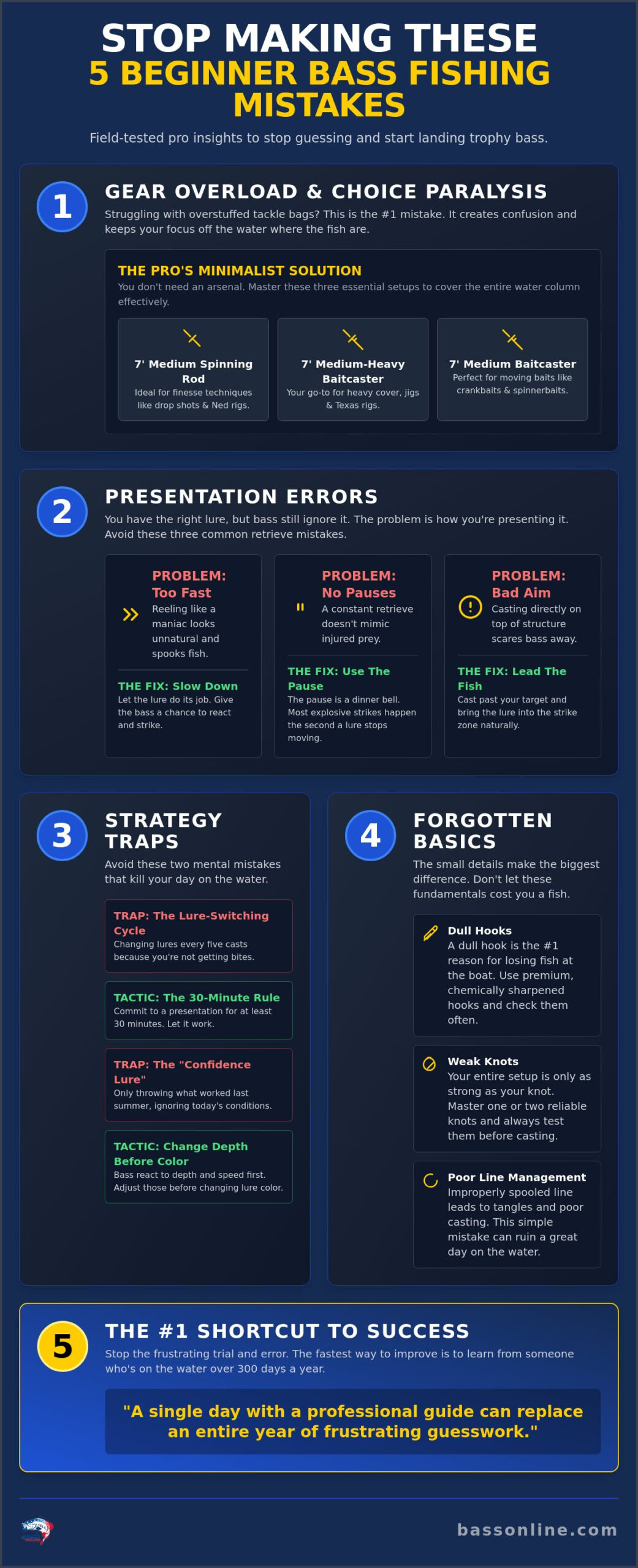
To help you visualize how to avoid these common gear traps, check out this breakdown of essential mistakes:
The Lure-Switching Cycle of Doom
One of the fastest ways to ruin a day is by switching lures every five minutes. If you don’t get a bite on your first ten casts, don’t immediately reach for a different color. I tell my clients to follow the 30-minute rule: give a specific presentation at least a half-hour of focused effort before moving on. However, don’t fall into the “Confidence Lure” trap either. Sticking to a soft plastic worm just because it worked last summer can blind you to what the fish want today. While the history of bass fishing shows us that lure technology has exploded, the fish still react primarily to depth and speed. If you aren’t catching anything, change your depth in the water column before you change your lure’s shade of green.
Investing in Quality Over Quantity
It’s tempting to buy five cheap rod-and-reel combos for the price of one professional setup, but that’s a mistake that will cost you trophy fish. A high-quality, sensitive rod allows you to feel the subtle “tick” of a bass picking up a worm, something a bargain rod simply can’t do. You should also prioritize your terminal tackle. Spend the extra money on premium tungsten weights and chemically sharpened hooks. Balanced tackle is the specific ratio of rod power to line test that ensures your lure moves naturally while providing the leverage needed to set the hook. Investing in a single, professional-grade combo is the best way to bypass the most common beginner bass fishing mistakes to avoid.
For a solid 2026 minimalist approach, I recommend starting with these three essential setups:
- 7′ Medium Spinning Rod: Perfect for finesse techniques like drop shots or Ned rigs.
- 7′ Medium-Heavy Baitcasting Rod: Your go-to for jigs, Texas rigs, and heavy cover.
- 7′ Medium Baitcasting Rod: The ideal choice for moving baits like crankbaits and spinnerbaits.
Presentation Errors: Why Bass Are Ignoring Your Lures
You can have the most expensive lure in the world, but if you move it like a robot, the bass won’t care. One of the biggest beginner bass fishing mistakes to avoid is reeling like a maniac. Most anglers get excited and retrieve their lure far too quickly. This doesn’t look like a natural meal; it looks like a piece of plastic flying through the water. Slow down. Let the lure work for you and give the fish a chance to catch up.
The “Pause” is your best friend on the water. Most explosive strikes happen the second a lure stops moving. When a baitfish is injured, it doesn’t swim in a straight line at high speeds. It flutters, stops, and sinks. That moment of stillness is a dinner bell for a hungry predator. If you aren’t pausing your retrieve, you’re leaving fish behind. Similarly, stop casting directly on top of the fish’s head. You want to lead the fish by casting past your target and bringing the lure into their strike zone quietly. Bombing a heavy jig right on a stump usually just scares the resident bass away.
Depth is the final piece of the presentation puzzle. I often see beginners throwing topwater plugs over 20 feet of water in the middle of a bright afternoon. Unless those fish are actively busting bait on the surface, they aren’t coming up that far to eat. Understanding seasonal bass behavior helps you realize that fish move deep when the sun is high or the water is cold. Matching your lure to where the fish are actually sitting, not where you wish they were, is a major step in correcting the beginner bass fishing mistakes to avoid.
Largemouth vs. Peacock Bass: Different Striking Zones
If you’re targeting Largemouth, think slow and erratic. These fish are ambush predators that love to sit near heavy cover and wait for an easy meal to drift by. Peacock Bass are a different animal entirely. They are aggressive, fast, and often require a retrieve speed that would make a Largemouth dizzy. You need a fast, violent retrieve to trigger a Peacock’s competitive nature. Make sure to tighten your drag for Peacocks; they hit with a force that can snap light line instantly. If you’re struggling to find that rhythm, reaching out for professional advice can help you dial in the right speed for your specific target species.
The ‘Straight Retrieve’ Trap
Avoid the “straight retrieve” at all costs. Instead, use your rod tip to add life to the lure. A simple “twitch-twitch-pause” cadence mimics a dying baitfish perfectly. This erratic movement creates vibrations that bass feel through their lateral line, drawing them in from a distance. When the hit finally comes, don’t swing too early. Wait until you actually feel the weight of the fish on the line before setting the hook. A common beginner mistake is “swinging at the splash” and pulling the lure right out of the fish’s mouth before they’ve actually grabbed it.
Reading the Water: Why Your Location Strategy is Failing
You have the right rod and you’ve slowed down your retrieve, but you’re still staring at a quiet depth finder. This happens because most anglers hunt for “pretty” water instead of productive water. I’ve watched countless people pull up to a picturesque, lily-pad-filled cove and spend three hours catching nothing but a sunburn. This is the “Dead Zone” trap. Just because a spot looks like a postcard doesn’t mean it’s actually holding fish. One of the most critical beginner bass fishing mistakes to avoid is staying in one place just because it looks fishy. If the water is stagnant and you don’t see any baitfish activity, you’re fishing in a desert.
Wind is another factor that separates the pros from the amateurs. While beginners usually hunt for calm, glass-like water to make casting easier, I’m looking for the wind-blown bank. Wind pushes plankton and baitfish into specific shorelines, which naturally draws in the predators. It also breaks up surface tension, making bass less wary of your presence. If you can handle a little chop on the water, you’ll find that the wind is often your best guide to a trophy catch. Similarly, pay attention to your shadow. Bass are incredibly sensitive to light changes. If you stand on the bank with the sun at your back, your shadow hits the water before your lure, triggering an immediate flight response from any nearby fish. Keep your profile low and stay stealthy to avoid common beginner mistakes that spook the big ones.
Seasonal Patterns for 2026
In 2026, we are seeing more extreme temperature shifts, making the “Oxygen Factor” more important than ever. During the heat of a summer day, bass will abandon shallow coves for deeper water or areas with current. Moving water stays cooler and holds more oxygen, which keeps the fish active. In the spring, look for those shallow transition zones where the sun hits the water first. If you want a deeper dive into how these patterns shift throughout the year, check out our guide on Bass Fishing 101.
The 90/10 Rule of Fishing
The 90/10 rule is simple: 90% of the fish live in 10% of the water. To find that 10%, you have to look for structure and cover. Structure is the “house”—the actual landform like a point, a drop-off, or a submerged hump. Cover is the “furniture”—the weeds, docks, or fallen trees sitting on that structure. Bass love to sit where the two meet. Use your eyes to spot transition zones, such as where a sandy bottom turns into rock or where a weed line ends. These edges are high-traffic highways for bass, and focusing your efforts there will immediately increase your consistency.
The Forgotten Basics: Knots, Hooks, and Stealth
You can find the perfect spot and use the right lure, but if your terminal tackle fails, the fish of a lifetime is gone in a second. Many anglers focus so much on the “where” that they forget the “how” of basic gear maintenance. This lack of attention to detail leads to some of the most frustrating beginner bass fishing mistakes to avoid. I’ve seen countless trophy bass lost halfway to the boat simply because a hook was dull or a knot was rushed. Precision in the small things is what separates the weekend warriors from the pros.
Stealth is your secret weapon, yet it’s often the first thing beginners ignore. Sound travels much faster and further underwater than it does in the air. Dropping a pair of pliers on the metal deck of a boat or slamming a locker lid can send shockwaves that spook every bass within fifty yards. Similarly, line management is a major hurdle. Line memory and tangles often occur because you’ve overfilled your spool. If your line is jumping off the reel in loops, you’ve put too much on. Leave about an eighth of an inch of the spool lip visible to keep your casts smooth and bird-nest free.
Choosing the wrong line type for your environment is another tactical error. Monofilament is great for topwater because it floats, but its stretch makes it a poor choice for deep-water jigging. Braided line has zero stretch and incredible strength for heavy cover, but its high visibility can scare fish in clear water. Match your line to the conditions to ensure you have the best chance of a solid hookset.
Knot Integrity and Line Management
You don’t need to know fifty different knots to catch bass. The Palomar knot is widely considered the strongest and easiest knot for beginners to master. It works perfectly with braid, mono, and fluorocarbon. However, even the best knot won’t save you if your line is damaged. Check for “nicks” or rough spots in your line after every fish or after pulling your lure through heavy brush or rocks. Line burn occurs when friction generates heat as you pull a knot tight, and you can prevent this by lubricating the line with water or saliva before cinching it down.
Hook Maintenance and Selection
The “Dull Hook” disaster is a silent killer of catch rates. Use the “Thumbnail Test” to check your sharpness: if the hook point doesn’t immediately dig into your nail with light pressure, it’s too dull. Sharpen it or swap it out. Matching your hook size to your bait size is equally important; a hook that is too large will kill the action of a small plastic worm, while one that is too small won’t have enough gap to clear the plastic and find the fish’s jaw. Use weedless hooks when fishing around grass or timber, but stick to open trebles for crankbaits in open water to maximize your hookup ratio. If you’re tired of losing the big ones to gear failure, book a trip with us to master these technical details in person.
Think Like a Pro: The Ultimate Shortcut to Success
You can read every blog post and watch every YouTube video available, but nothing beats time on the water with a seasoned captain. If you’re serious about your progress, hiring professional fishing guides is the single most effective way to bypass the steep learning curve of this sport. The fastest way to eliminate all the beginner bass fishing mistakes to avoid is to watch a pro in action. You aren’t just paying for a boat ride; you’re paying for decades of trial, error, and refined local knowledge that you can’t get from a smartphone app.
A single eight-hour trip can replace a full year of struggling on your own. During a guided session, you’ll see exactly how a pro positions the boat, how they manage their line in the wind, and how they adjust their strategy the second the bite slows down. This is the “Guided Learning” curve in action. To maximize your experience, don’t just sit back and reel in fish. Ask your captain why they chose a specific point, what they’re seeing on their electronics, and how they’re manipulating the lure. This shifts your mindset from “catching,” which is often luck-based, to “fishing,” which is a calculated, strategic process.
The Value of Local Expertise
Professional guides spend thousands of hours on the water every year, allowing them to track daily fish migrations that no algorithm can predict. They know exactly how a cold front in 2026 will push Peacock Bass into deeper canals or how a rising tide affects Largemouth in the Everglades. Beyond location, you’ll get to use professional-grade gear, which is crucial for learning the “feel” of a true strike versus a snag. Many of our clients have completely transformed their approach after just one outing. You can see these success stories for yourself by checking out our Bass Online reviews, where anglers of all levels share how they finally cracked the code on trophy bass.
Your Next Step: Booking Your First Charter
When you prepare for your first professional trip, keep it simple. Pack high-quality polarized sunglasses, plenty of sun protection, and a camera to document your catch. Most importantly, bring an open mind and a set of realistic goals. Don’t just focus on the number of fish; focus on mastering one specific technique, like skipping a jig under a dock or perfecting your hookset. Every pro was once a beginner who made the same mistakes you’re making now. Fishing is a lifelong journey, so enjoy the process and embrace the challenge. Once you start thinking like an expert, the trophies will follow naturally. We’ll see you on the water!
Take Command of the Water Today
Success on the water isn’t about owning the flashiest electronics or a boat full of tackle. It’s about refining your tactics and truly understanding how fish move. By simplifying your gear, mastering the “pause” in your retrieve, and hunting for high-percentage structure, you’ve already solved the most common beginner bass fishing mistakes to avoid. Every trophy catch starts with these field-tested basics: a sharp hook, a solid knot, and a stealthy approach. These habits are what transform a frustrating day into a legendary outing.
If you’re ready to stop guessing and start landing more fish, we’re here to lead the way. Bass Online brings over 25 years of professional guiding experience to every trip. Our expert captains specialize in trophy Largemouth and Peacock Bass, providing nationwide access to the most iconic freshwater lakes in the country. Don’t waste another season on trial and error when you can learn from the best in the business. Book a Professional Bass Fishing Guide and Skip the Learning Curve!
The water is calling, and that next big strike is just one cast away. Grab your gear and get out there.
Frequently Asked Questions
What is the most common mistake beginners make when lure fishing?
The most common lure fishing mistake is using a constant, robotic retrieve speed without any variation. Bass are opportunistic predators that react to erratic movements and vulnerable pauses. If you don’t vary your speed, you miss the “reaction strike” that triggers big fish to bite. Adding a simple twitch and a three-second pause can significantly increase your catch rate.
Why do I keep losing bass right before I get them to the boat?
You’re likely losing fish because your hooks are dull or you’re allowing the line to go slack during the fight. Always use the “thumbnail test” to ensure your hook points are razor sharp. Keep your rod tip up and maintain constant pressure as the fish nears the boat. If the bass jumps, lower your rod tip slightly to prevent the lure from being thrown.
How often should I change my fishing line to avoid break-offs?
You should change monofilament and fluorocarbon lines at least once every season because they develop “memory” and weaken from UV exposure. Braided line is much tougher and can last two or three years if you flip it on the spool. Always check the last few feet of your line for nicks or abrasions after every catch to avoid unnecessary break-offs.
Is it better to fish fast or slow when you’re just starting out?
Slowing down is almost always the better choice for beginners because it keeps your lure in the strike zone longer. Fast fishing requires precise casting and a deep understanding of bass positioning to be effective. By slowing down with a Texas-rigged worm or a Ned rig, you give the fish more time to find and commit to your bait.
What color lure should I use in murky vs. clear water?
Use dark colors like black and blue or high-contrast chartreuse in murky water to create a strong silhouette. In clear water, stick to natural, translucent colors like watermelon or pumpkin seed that mimic the local forage. Matching your lure color to the water clarity is a simple way to correct common beginner bass fishing mistakes to avoid.
Do I really need an expensive rod and reel to catch big bass?
You don’t need a thousand-dollar setup to catch trophy bass, but a quality medium-heavy rod is a worthwhile investment for any angler. Higher-grade graphite offers better sensitivity, letting you feel the subtle “thump” of a bite before the fish has a chance to spit the hook. Focus on a balanced combo that feels comfortable in your hand rather than just buying the cheapest gear available.
How can I tell if a spot has bass without a fish finder?
Look for visible signs of life like jumping baitfish, diving birds, or swirls near the surface of the water. Bass are rarely far from their food source. If you see dragonflies hovering over lily pads or bluegill schooling near a dock, there’s a high probability that a predator is lurking nearby. Focus your casts on these transition zones where cover meets deeper water.
What should I do if I’m not getting any bites for over an hour?
If the bite goes cold for an hour, it’s time to change your location or your depth immediately. Don’t fall into the trap of staying in a “pretty” spot that isn’t producing results. Move to a different structure type or try a lure that works a different part of the water column. Addressing these beginner bass fishing mistakes to avoid keeps you mobile and increases your odds of finding active fish.

Article by
Mr Bass
Todd Kersey, widely known as Mr. Bass by Field & Stream, is a professional angler, accomplished author, and dedicated philanthropist with a lifelong passion for bass fishing. Armed with a degree in Outdoor travel, Mr. Bass has expertly combined his knowledge with his practical fishing experience to become one of the most respected names in the bass fishing, his deep understanding of bass habitats, and fish behavior has earned him numerous accolades as a asset of the sport. Serving 8 years as FWC Stakeholder Chairperson. Leading and passing cutting-edge legislation, such as the Black Bass Management plan, and successfully building, passing, and financing the Trophy Catch program. As CEO, he is committed to giving back to the community through his philanthropic efforts. He supports a variety of causes, especially those centered around physical disabilities. Through his advocacy, his mentorship programs inspire anglers to engage in fishing stewardship, helping to raise more than $ 18 million in donations. Mr. Bass continues to inspire anglers and outdoor enthusiasts alike with his commitment to the sport and the world around him.