













Other Names: Chondrostei – beaver fish, blackfish, cottonfish, cypress trout, freshwater dogfish, grinnel, grindle, mud pike, mudfish, Choupique, and swamp trout
Bowfin Amia calva
The bowfin fish (Amia calva) has coexisted with dinosaurs and continues to thrive in the backwaters of eastern North America. It is a voracious and slimy creature that has a mouth full of sharp teeth.
Other common names for the amia calva fish are beaver fish, blackfish, cottonfish, cypress trout, freshwater dogfish, grinnel, grindle, mud pike, mudfish, Choupique, and swamp trout. Choupique is a Cajun-French name originating from the Choctaw word for bowfin. Many people believe their nickname “mudfish” refers to their taste, but it actually refers to the particular places they live.
It’s an unrecognized freshwater species that has existed since primordial times. It is part of the Amiidae family and is the only living representative of the order Amiiformes, which is traced back to Jurassic times. Bowfin fish are often referred to as a “living fossil.”
Fossils indicate that Amiidae members were once widespread in both saltwater and freshwater, ranging across North and South America, Asia, Europe, and Africa. Today, their range is mostly in the eastern United States and southern Canada. They are abundant in the Mississippi River drainage basins, the Great Lakes, and various waterways in the Eastern coastline of the Gulf of Mexico.
The bowfin fish species is known for putting up an intense fight for anglers; it is considered a game fish by many.
Appearance
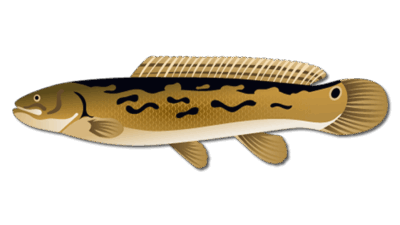
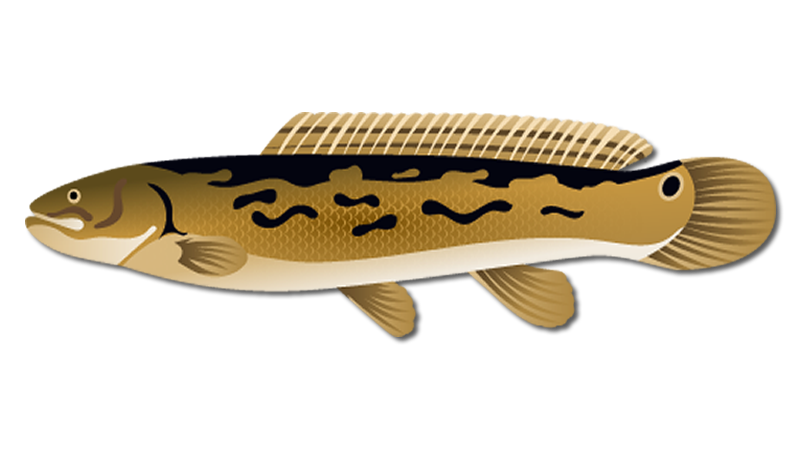
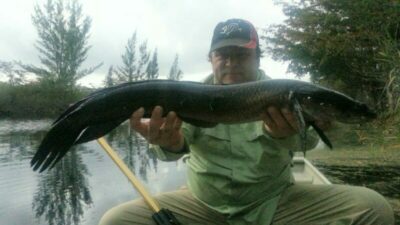
The bowfin is a bony sport fish with a long, cylindrical body and a long dorsal fin that extends over half the length of its back. The bowfin fish has a rounded tail fin with a black spot on the upper base. The dogfish has a large mouth and an olive-green body color that fades to a lighter hue on the belly. Females can reach 30 inches in length, and males average a length of 18 to 24 inches. Bowfin average 1 to 5 pounds but can reach up to 19 pounds in size.
Air-Breathing Fish
Similar to gars, bowfins are bimodal breathers who gulp air and water to breathe. Their gills enable them to extract oxygen from the water for air-breathing by exchanging gases. Bowfin has a gas bladder that maintains buoyancy, enabling them to breathe air from small pneumatic ducts connected from the foregut to the gas bladder. Most other fish use their gas bladders only for buoyancy.
Locating Bowfin Game Fish
The bowfin fish are found in North America’s sluggish waters from the Great Lakes down to the Gulf.
This air-breathing fish species thrives in tidal systems and rivers. However, they do not like the current. If you target them in these areas, you must follow the flow to create a roadmap to where the water is not flowing at all or very little.
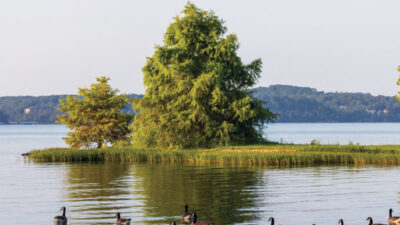
Bowfins can thrive in amazingly clear rivers and lakes, to the nastiest and muckiest swamps. Irrespective of the aesthetics of their board, the waters all share the common trait of heavy vegetation.
Their preferred habitat is abundant in vegetated sloughs, lowland lakes and rivers, swamps, and backwaters.
Bowfins require heavy salad to spawn, and they also love ambushing and hunting in weeds and grass. You are hardly going to find them in open water. Deeper waters seem to be appealing to these fish. If you find a vegetated area that is quite sufficient, be it on a backwater or bog in a pristine setting, you should focus on a dense channel cutting through the swamp or the area closest to the main river.
Their availability speaks volumes about the health of the underwater ecosystem. It is a fact that bowfins only live in areas where the water is healthy, which is similar to American Surgeons.
Eating Habits
These fish are voracious predators regarded as trash fish by many anglers because they prey on the more desirable game fish. They feed on many fish, insects, crustaceans, amphibians, small rodents, and larvae. An adult one is mainly piscivorous, but it also eats a wide range of dead or live animals if it can. This trash fish helps prevent the overpopulation of forage fish and stunting game fish.
It has a reputation among anglers as a nuisance that negatively impacts the local game fish population by eating the young game fish and their prey. However, science has shown otherwise. Bowfins are predators that will eat any prey most abundant in the area, such as shad, minnows, game fish, or crustaceans. Young bowfins will feed on insect larvae and small crustaceans until they reach a juvenile stage, when they switch to a fish-based diet.
Bowfin fish are ambush predators that lurk in the shallows at night, hunting for prey. It can survive for a long time without feeding.
Spawning
The male bowfin creates a nest in shallow vegetated waters. The nest is made by biting off roots, creating a vegetation clearing for the eggs. Two females often spawn in the same nest and may spawn in multiple nests in the spring. Spawning usually occurs at night. The males guard the nests and introduce air to the eggs—the eggs hatch in about 8 to 10 days.
After the eggs hatch, the young bowfin attaches to small vegetation’s small roots by an adhesive organ, similar to pikes—the male bowfin guards both the incubating eggs and fry remaining in the nest. The males guard the young, which travel in schools, until they reach approximately 3 to 4 inches in length. Spawning for these fish usually occurs in weedy shallows between April and June in Florida.
Fishing for Bowfins
These fish are notoriously strong fighters, earning the nickname ‘junkyard dog’ from many anglers. A bowfin can grab your bait and then take off like a jet, looking for the closest weedy cover to swallow it. Anglers should let the fish run for about 5-10 seconds after setting the hook. Anglers should prepare for a battle after hooking a bowfin; these fish will turn, twist, and jump once you hook them.
Based on the bowfin’s mood, you will have to agitate a little to get them to bite. If you dangle the bait loudly right in front, it will help entice a bite.
Bowfins have muscular bodies, sharp teeth, and powerful jaws. So, landing your catch might prove to be a challenge. So, ensure you carry a good pair of fishhook removers and a fish gripper. Like northern pike and muskie, bowfin has sharp razor teeth that can smoothly slice through a braided line. This means a steel leader is a must. Bowfins have tough skulls and jaws.
To penetrate their lips, you need a sharp, strong hook with a long shank. Be sure to sharpen your hooks before you target a bowfin.
Techniques
The local experts prefer a heavy steelhead rig or a lighter stout crankbait rig to handle these bowfin fishes’ strength. The crucial factor when catching these firm sport fish is the line. The power of fluorocarbon makes this the best choice, especially for spinning setups. A moderate-test braided line is an excellent option for baitcasting rigs. A 17 to 35-pound test is generally a good option for these grunty game fish.
The top baits for bowfin fishing are nightcrawlers, minnows, salamanders, frogs, chatter baits, and stinkbait. Other good options for catching include crayfish and other crustaceans. A shiny spinner with bait on the hook is often productive in the murky brackish waters.
Edibility
Several anglers consider them trash fish and not good enough for table fare, but they can be quite tasty if prepared properly. Most of the time, anglers go after this fish only for sport, as it is not the most popular fish to eat. Bowfin fish might not be known as the river’s tastiest fish, but it can be prepared enough to justify serving it at the dinner table.
Bowfin Record
The longest bow fin that has ever been caught measures 34.3 inches in length. The largest caught by an angler in South Carolina weighed 21 pounds.
Bowfin vs. Snakehead
Snakeheads are native to Asia and Africa. They closely resemble bowfin fish and are often mistaken for each other. Both are invasive species; however, they are entirely unrelated.
Snakehead
- No bony plates between the lower jawbones
- Enlarged scales on the head
- Anal fin is as long as the dorsal one
- Pelvic fins are much closer to the head
- Some species have an eyespot
Bowfin
- Bony plates between the lower jawbones
- No scales on the head like Bullhead Catfish
- The anal fin is short, similar to a Grass Carp
- The long dorsal fin extends from the middle of its back
- Pelvic fins are in the center of the body
- The base of the tail has a black spot but only in the males
Cooking Bowfin
The key to preparing and eating this is to use it when it is fresh. Ideally, you would like to cook and eat within just a few hours of catching it. The primary reason is that the flesh starts to become mushy and deteriorate when left for too long. Also, it doesn’t withstand freezing well.
Bowfin fish is best suited for frying or breaded dishes. With this, you will be able to make great deep-fried fish patties.
This fish features a fine bone structure, making it easier to fillet with the aid of a fillet knife. Cut down the fillets but avoid the gut to prevent any unusual taste.
Ensure that you dip the fish in saltwater before frying it to draw out the blood and the muddy taste.