
Pacolet River, Chauga River, Tennessee River
The Redeye or Coosa bass is an elongated, slender fish with a largemouth that extends slightly behind the eye’s rear margin. The dorsal fin usually contains ten spines and twelve rays. The space between the two is only slightly spaced or notched.
The anal fin usually contains ten rays and three spines. The lateral line has from 65 to 75 scales. Scales above the lateral line on the Redeye bass number twelve. This bass also has a slight tooth patch on the tongue.
The Redeye back and sides are generally olive to brown with darker brown mottling. Many say that it is similar to the largemouth bass or the smallmouth bass, depending on the part of the country you live in.
Adult Shoal bass have several horizontal rows of dark spots on the lower sides and venters. Breeding males have a light bluish-green color on the lower head and throat of the fish. On juvenile bass, the sides of the body usually have ten dark blotches that do not join to a lateral stripe.
The lower and upper margins of the caudal fin are edged in white, a valuable feature for separating redeye bass, smallmouth bass, largemouth bass, spotted bass, and stripers from other bass.
Habitat and Biology of Micropterus Coosae
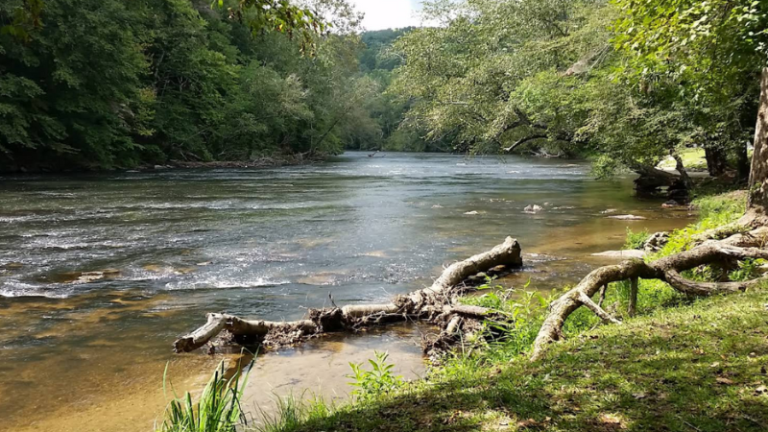
The Redeye inhabits small to medium-sized upland streams and rarely large rivers and impoundments. It is often found in water willow or other aquatic vegetation, near a submerged stump or boulder, or along an undercut bank.
Juvenile redeye bass occur in shallow runs and riffles over sand and gravel substrates. Spawning occurs from April to June, and they will eventually grow 14 to 17″ in length as an Adult. Diet includes aquatic and terrestrial insects, crayfish, and small fish.
ETYMOLOGY: Micropterus means small fin. Coosae means Coosa River.
Common Names: Shoal bass
Commonly known as Coosa bass, shoal bass, Flint River smallmouth, Chipola bass, Redeye bass, and even thought of as largemouth bass or smallmouth bass by some anglers.
Redeye Description, not a smallmouth bass
The red color of its eyes and the dorsal fin easily separate this species from other bass. Suwannee and shoal bass have red eyes but generally have less red on the fins and upper and lower margins.
Redeye bass is generally brownish to light bluish-green, with vertical bars and soft centers along its sides. Redeye or Coosa bass are bronze-olive above, with dark olive mottling, and yellow-white to blue below.
This fish has a prominent dark spot on the gill cover and caudal fin.
Redeye scales on the base portion of the soft-rayed dorsal fins, clearly connected first and second dorsal fins, and an upper jaw bone that does not extend beyond the eyes. As well generally noticed as a more sender fish.
Redeye Bass: Range and Location
Redeye bass is present in the Coosa, Cahaba, and Tallapoosa Rivers. Known for its excellent fishing qualities, the Coosa provides the perfect habitat for the redeye bass.
The Coosa River Basin initiative was conceived at the confluences of Rome’s Etowah and Oostanaula rivers. It consisted of 600 km of the Coosa River to the Mobile River and Florida Bay in the Gulf of Mexico, along the Apalachicola River.
Reported sightings in South Carolina, but mainly from Rome, Georgia; the Coosa winds toward Weiss Dam in Center, Alabama. It merged with Tallapoosa and combined to form the Alabama River.
It’s not likely you will find them in areas like Stockton Ca or San Fransico.
Redeye Bass Habitat
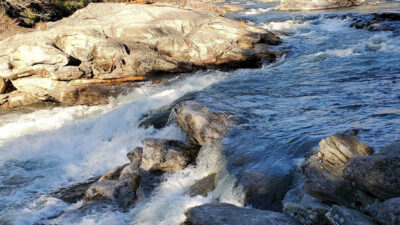
Likely to be found in rocky runs, pools of creeks, and small to medium rivers close to main-channel habitat. They are seldom found in natural lakes, ponds, or impoundments.
These fish prefer a water temperature of about 65 degrees. Shoal bass in the Chipola River is closely associated with rock shoals and is uncommon in other habitats.
Redeye Spawning
The Redeye Bass starts to spawn from April through May, with some spawning continuing into July. Nevertheless, spring comes and goes. When water temperatures have increased above 68 degrees Fahrenheit, it may occur.
They prefer to lay nests in sheltered places, such as a gravel-filled pool in the deep waters. In some cases, the canals or coves provide an ideal habitat for these fish. Males at high spawning periods may display blue tinges around their heads, necks, and throats.
Like the largemouth bass, the Redeye bass spawn starts with the male preparing the nest and guarding the eggs and fry.
How to identify Redeye Bass?
The most exciting characteristic of these bass is their red eyes. However, large and smallmouth bass with red eyes exist, so they can’t be classified under Micropters Coosa, a scientific term describing Redeye Bass and Coosa Bass.
It’s essential to note that they are often mistaken for other fish. Their short and slender fish body features several horizontal rows of dark spots, ranging from darker bronze to olive green, with pale bellies.
The complete lateral line is darker, with vertical stripes or blotches that fade as time passes. The gill covers have darkened spots and a unique anal fin. In addition, they have darker brown mottling on the brown-white belly areas, and a lighter brown-white hue is unique again on the upper and lower edges.
Age and Growth
The growth rate of redeye bass is slow compared to other black bass species. Growth is fast in the first year but decreases as the fish ages. Shoal bass grow much quicker than redeye bass.
Sporting Quality
It is a good game fish and a scrappy fighter that is often difficult to catch. They like to eat crayfish, minnows, as well as small spinners, and a wide variety of small surface lures. Some have to reach more than eight pounds.
Eating Quality
Good. It has white, flaky meat and tends to be drier than a largemouth.
World Record
Eight pounds, 3 ounces, caught in the Flint River, Georgia, in 1977. This fish was a shoal bass.
Florida Record
A fish weighing 7 pounds, 13-1/4 ounces, was caught in the Apalachicola River in 1989; however, the identification is controversial.
How do you catch redeye bass?
Fishing for Redeye bass fish is fun, but the fights are tough. Its popularity has also been increasing with sportfishing. Fish instinctively love to ambush their prey.
They cover the ground and break the current to conceal before spotting. By taking some time to see the river, it is easier to know the hiding place or the attack.
If approaching an area that looks like an isolated location, look down. If a fish sees some of that mud or debris falling out, they are likely spooky. In addition, the fish usually look down the shoreline for food anyway.
Tell me the best bait to use
Differentiating Redeye bass from others is essential; they have small body sizes and feed on the same smaller food. Common food items for these are crayfish, tiny fish, nightcrawlers, leaf and redworms, and numerous insects found at the surface of rivers and streams.
Natural bait, such as worms or minnows, can be effective for these fish, although artificial options, like spoons and worm lures, are equally effective. Start with a 4-inch finesse. Of course, flies with fly rods are also a common means of obtaining the Redeye or Striped bass.
Although fewer rivers are accessible for Redeye, catching them is usually easier when using slow trolling techniques.
WHERE CAN YOU FISH FOR THIS BASS?
The Redeye bass is found in the state of Florida, specifically in the Panhandle region.
The home to a large proportion of the Redeye is in Alabama!
Georgia is home to the majority of Coosa bass, particularly on the Flint River.