
What if your favorite summer honey hole isn’t actually fished out, but simply the starting line of a high-speed chase you’re currently losing? It’s a common frustration for every angler when those reliable deep-water ledge fish vanish overnight as the air turns crisp. You’ve likely felt the sting of a “dead” lake during the confusing fall turnover, watching your electronics go blank while the baitfish begin their massive migration toward the backs of creeks. It feels like the fish have disappeared, but in reality, they’ve just changed the rules of the game.
I’m here to help you crack the code on 2026 fall bass fishing patterns so you can stop guessing and start intercepting. You’ll learn how to predictably locate bass on their way to shallow water and understand the “why” behind their baitfish-driven movements. We’ll dive into the specific tactical roadmap you need, from selecting the right lures like the new Z-Man Fuzzy TRD to utilizing tech like the Lunkerhunt Black B.L.B. FFS Minnow. Get ready to turn the most confusing season of the year into your most successful expedition yet.
Key Takeaways
- Identify the three primary triggers—light, temperature, and bait—that signal the start of the massive autumn transition from deep water to the shallows.
- Master the fall bass fishing patterns by identifying the “baitfish highway” and tracking forage movement from the main lake into creek arms.
- Locate high-percentage “rest stops” like secondary points where migrating bass pause to feast on their way to the backs of pockets.
- Discover why faster retrieves and topwater explosions are the most effective ways to trigger aggressive reaction strikes as the water cools.
- Understand why daily on-water intelligence is critical for staying on the bite when weather fronts cause patterns to shift overnight.
What is the Fall Bass Fishing Transition?
The fall transition isn’t just a slight change in the weather; it’s a total biological reset for every fish in the lake. For months, you’ve likely been targeting bass in their deep-water summer haunts, but those days are over. As the season shifts, bass abandon their predictable ledges and deep brush piles to begin a massive migration toward shallow-water feeding grounds. This isn’t a random stroll. It’s a calculated, high-energy move driven by the need to gorge themselves before winter. Understanding Bass fishing during this period means realizing that the old summer rules no longer apply. The fish are now nomadic, aggressive, and laser-focused on one thing: baitfish.
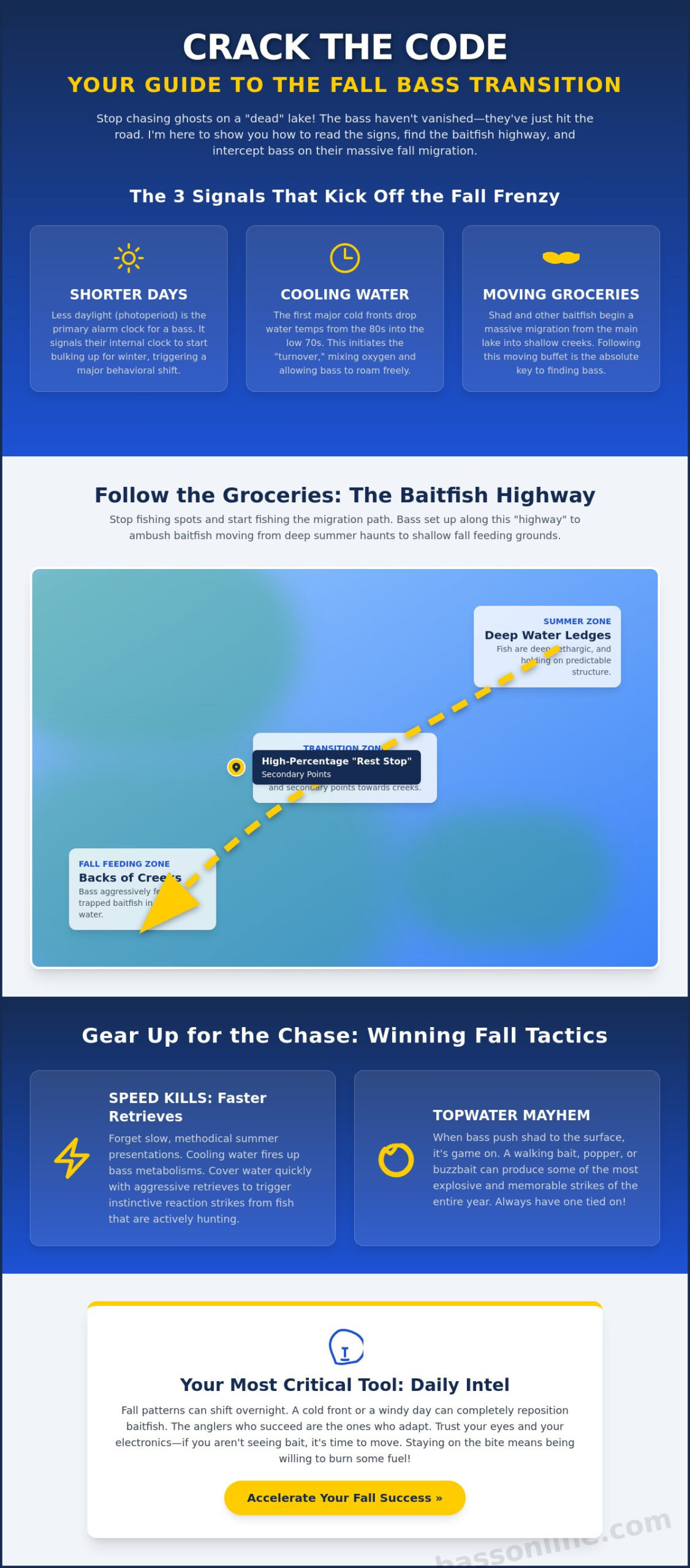
To visualize how these movements play out on the water, check out this tactical breakdown of a high-percentage fall pattern:
This period creates a unique urgency on the water. Bass enter a literal feeding frenzy, and if you aren’t in the right spot, you’ll be casting at empty water. They are preparing for a period of dormancy, so their metabolism kicks into high gear. If you want to stay consistent, you have to stop thinking about where the fish were and start predicting where they are going. Mastering these shifting fall bass fishing patterns is the only way to keep your rod bent when the mercury starts to dip.
The Biological Triggers of Autumn
Bass don’t have calendars, but they are incredibly sensitive to photoperiodism, which is the shortening of daylight hours. This reduction in light signals their internal clock that the growing season is ending. When the first major cold front slams into the region, it does more than just chill the air. It triggers the “turnover” process, where cooling surface water sinks and mixes oxygen throughout the lake. This allows fish to move freely through depths they avoided all summer. Because of this, “matching the hatch” becomes a survival necessity. If the shad are moving, the bass are right behind them. You can learn more about how different bass species react to these changes to better time your trips.
Phase 1: The Early Fall Shift
Many anglers get frustrated during the “early fall lull.” This happens when the summer bite dies but the shallow-water explosion hasn’t fully arrived. The key is to target the first major breaklines and secondary points that lead out of deep water. These are the staging areas where fish pause before committing to the creek arms. The Early Fall Transition occurs when water temperatures drop from the 80s into the low 70s. During this phase, fall bass fishing patterns revolve around intercepting these fish as they transition from being stationary to being hunters on the move.
Decoding the Baitfish Highway
Finding bass in the fall is 90% about finding the groceries. Think of your lake as a complex map of highways where the baitfish are the commuters. During October and November, shad and sunfish begin a massive exodus from the main lake basin into the protected creek arms and shallow pockets. This isn’t a random stroll; it’s a biological drive for warmer water and nutrients. Bass know this schedule better than anyone. They set up along these “highways” to intercept the moving buffet. If you can’t find the bait, you’re fishing in a desert. Mastering these fall bass fishing patterns requires you to stop looking for permanent “spots” and start looking for the migration path. Visualize the main creek channel as the interstate, while the secondary points and flats are the off-ramps where the action happens.
In most reservoirs, the baitfish migration is the primary engine driving fish behavior. Bass use these schools of forage as a moving buffet line, following them deeper into the creeks as the water temperature drops. If you aren’t seeing life on your electronics or bait flipping on the surface, it’s time to crank up the big motor and move. Tracking this movement is the fastest way to put a trophy in the boat. If you want to see how the pros stay on top of these shifting schools, booking one of our professional fishing guides is the best way to see the highway in action.
Following the Shad Migration
In shad-dominated systems, bass turn into open-water marauders. You’ll often find “wolf packs” of aggressive bass roaming the mouths of major creeks, just waiting for a school of shad to pass by. This is where your electronics become your most powerful tool. Look for “bait balls”—dense, cloud-like clusters of forage—rather than individual fish arches. If the bait is high in the water column, the bass are active and ready to strike. Pay close attention to the wind. A steady breeze pushes microscopic nutrients into specific pockets, and the shad follow those nutrients. Where the shad go, the bass are sure to follow.
The Sunfish Factor in Weedy Lakes
Not every lake is a shad factory. In weedy, natural lakes, bluegill and sunfish are the primary targets. Unlike shad, these fish don’t make long-distance runs to the backs of creeks. They stay in the vegetation as long as possible. As the water cools and the grass starts to die, sunfish are forced to move to the “inside edge” of the remaining healthy weeds. Bass will tuck into these pockets of green grass, waiting for a bluegill to make a mistake. Because sunfish are less nomadic, bass in these systems stay shallow much longer than their reservoir cousins. You can find more tactical advice on identifying these forage types in our outdoor blog.
Strategic Stopping Points: Where to Intercept Bass
Think of the baitfish highway we discussed as a long road trip. Bass don’t swim the entire distance from the main lake to the back of a creek in one single burst. They are opportunistic predators, and they use specific “rest stops” to pause, ambush forage, and rest. If you want to master fall bass fishing patterns, you have to stop fishing the empty stretches of the highway and start targeting these high-traffic intersections. Intercepting a school at a stopping point is the difference between a frustrating day and a limit that pushes the scales. Whether you are fishing the grass of Lake Guntersville or the rocky points of the North, these structural milestones remain the same.
The most effective stopping points are secondary points, channel swings, and isolated cover. A secondary point is any point located inside the mouth of a creek rather than on the main lake. These act as the primary “off-ramps” for migrating fish. Channel swings are another gold mine; this is where the creek channel makes a hard turn and brushes up against a shallow flat. Bass love these because they provide an immediate escape route to deep water while keeping them inches away from a shallow buffet. Finally, never overlook isolated cover. In a sea of mud or empty water, a single stump, a lone rock, or a discarded tire can hold an entire school of aggressive bass.
Secondary Points and Pockets
The first secondary point inside a creek mouth is usually the most consistent producer in early to mid-autumn. As the bait moves in, the bass set up shop right here to greet them. I always prioritize the “windward” side of these points. When the wind blows directly against a point, it creates a “pinch point” where baitfish are trapped against the structure, making them easy pickings. If you see birds diving or fish breaking on the surface near these points, don’t overthink it. Get a bait in there immediately. You can read our fishing charter reviews to see how often these specific structures produce trophy fish for our clients during the transition.
Hard Bottom vs. Soft Bottom
As water temperatures drop, bass develop a strong preference for hard bottom compositions like rock, gravel, or shell beds. Rock holds heat better than mud, and it provides a better habitat for crawfish and small sunfish. I use a heavy jig or a Carolina rig to “feel” the bottom. If my rod tip is vibrating over something crunchy, I know I’m in the strike zone. Man-made rock, often called rip-rap, is a legendary fall target. It lines bridges and causeways, acting as a massive heat sink that keeps the local water just a few degrees warmer, which is often all it takes to trigger a bite.
- Rock and Gravel: Look for transition lines where mud turns to stone.
- Shell Beds: These are often found on the edges of flats near channel swings.
- Rip-Rap: Target these areas during the afternoon when the sun has had time to warm the stones.
The Best Fall Bass Lures and Tactics
When the water starts to cool, your first instinct might be to slow down. That is a mistake. The “Speed Rule” is the most important concept to master right now. As bass enter their feeding frenzy, they are looking for a meal that is trying to get away. Faster retrieves often work better because they trigger a reaction strike, forcing the fish to commit before the lure zips past. If you retrieve too slowly, you give them too much time to inspect your bait and realize it isn’t the real thing. To stay ahead of shifting fall bass fishing patterns, you need to keep your lures moving and cover as much water as possible.
Nothing beats the adrenaline of a topwater explosion in the fall. Buzzbaits and walking baits are my go-to tools for covering massive flats and shallow pockets early in the morning or on overcast days. These lures create a surface disturbance that mimics a wounded shad, which is an irresistible dinner bell for a roaming bass. As the sun gets higher, I transition to crankbaits. The key here is “matching the hatch” by selecting a lure that matches the size of the current shad in your lake. Early in the fall, small profile baits work best, but as the season progresses into November, you should upsize your offerings to match the growing forage.
Once the water temperatures hit the 50s, it is time for the jerkbait transition. This is when you finally start to incorporate pauses into your retrieve. A suspending jerkbait mimics a dying baitfish that can no longer swim against the cooling current. If you want to see a full breakdown of the gear we use on the water, check out our guide on the best bass lures every angler should own to ensure your tackle box is ready for the transition.
Power Fishing the Shallows
Searching for fall bass fishing patterns across a massive flat requires extreme efficiency. A lipless crankbait is the number one tool for this job. You can cast it a mile and “burn” it back to find where the active schools are holding. If you are fishing a lake with dying vegetation, try burning a spinnerbait right through the tops of the grass. The vibration and flash of the blades will pull bass out of the cover even when they aren’t actively chasing. If you are ready to put these power tactics to the test, book a guided trip and let us show you how to pick apart the shallows like a pro.
Finesse Tactics for Post-Front Days
Not every day in the fall is a feeding frenzy. When a major cold front stalls the bite, the fish will often tuck into the thickest part of the cover and refuse to chase. This is when I reach for a Ned Rig or a Drop Shot. These finesse tactics allow you to keep a bait in the strike zone longer, enticing a “pity strike” from a lethargic bass. White and silver are the dominant fall colors because they accurately mirror the reflective scales and pale underbellies of migrating shad.
- Ned Rig: Use this on hard-bottom secondary points when the wind dies down.
- Drop Shot: Perfect for targeting bass that have moved slightly deeper off a channel swing.
- Thick Cover: If the fish won’t come out, you have to go in after them with a weighted plastic.
Why a Guided Trip Accelerates Your Fall Success
The biggest challenge with autumn fishing is that the lake changes faster than your social media feed. A heavy rain or a sudden 20-degree temperature drop can shift the entire baitfish highway three miles up the creek overnight. For most anglers, this means spending your limited weekend time searching instead of catching. This is exactly where professional fishing guides make the difference. We live on these waters. By the time you launch your boat, we’ve already spent the last five days tracking how the local fall bass fishing patterns are evolving. We don’t guess where the fish are; we know where they moved this morning.
Investing in a guided trip isn’t just about a single day of success. It’s a high-intensity masterclass in seasonal behavior. You’ll see firsthand how we interpret electronics to separate a ball of shad from a school of active predators. On legendary waters like Lake Guntersville, understanding the specific “rest stops” on the grass lines is the only way to stay consistent. A guide provides the real-time intelligence you need to bypass the learning curve and get straight to the action. You’ll learn the “why” behind every move, giving you a tactical advantage you can use on your home lake.
Experience Iconic Bass Waters
The thrill of a fall transition is best experienced on the nation’s premier fisheries. Imagine the chaos of a topwater bite on Lake Okeechobee, where giant largemouth ambush forage in the heavy vegetation. If you prefer the rod-bending power of smallmouth, our Lake Erie fishing trips offer world-class action as bronzebacks school up on rocky reefs before the winter freeze. These iconic locations have unique personalities in the fall. Having a local expert at the helm ensures you’re fishing the highest-percentage spots from the first cast to the last.
Mastering New Techniques with a Pro
Beyond just catching fish, you’ll walk away with a refined tactical toolkit. We’ll show you how to dial in your electronics to find those elusive “pinch points” and “channel swings” we discussed earlier. You’ll learn the nuances of lure presentation, like the exact speed needed to trigger a reaction strike or the subtle rod twitches that make a jerkbait look like a dying shad. It’s about building the confidence to tackle any water, any time. We’ll help you hone your casting accuracy and lure selection under expert supervision. Ready to see what you’ve been missing? Book Your Fall Bass Fishing Adventure Today and let’s go hunt some giants.
Master the Migration and Land More Giants
You now have the tactical roadmap to dominate the water as temperatures drop. Success in the autumn transition isn’t about luck; it’s about staying mobile on the baitfish highway and intercepting bass at those high-traffic secondary points. By applying the “speed rule” with aggressive reaction baits and keeping a close eye on your electronics for massive bait balls, you can turn a confusing seasonal shift into your most productive time of year. These fall bass fishing patterns are predictable once you understand the biological drive behind the movement.
Don’t let the shifting conditions leave you guessing while the bite of a lifetime is happening just around the next creek bend. With over 25 years of professional guiding experience and top-rated local experts across 15+ states, we specialize in tracking trophy largemouth and peacock bass daily. We’ve spent decades patterns these migrations so you can spend your time casting instead of searching. We have the local knowledge and the equipment to ensure your next expedition is a massive success.
Book Your Professional Fall Bass Charter Now and let’s go hunt some giants together. The water is cooling down, but the action is just getting started. I’ll see you on the lake!
Frequently Asked Questions
What is the best water temperature for fall bass fishing?
The absolute best water temperature for fall bass fishing usually sits between 55 and 70 degrees. This range kicks the fish’s metabolism into high gear and signals that it is time to gorge on baitfish before winter. Once the water drops below 50 degrees, the bite often transitions from aggressive reaction strikes to more calculated finesse tactics as the fish’s activity levels begin to slow down.
Do bass move shallow or deep in the fall?
Bass move primarily toward shallow water in the fall as they follow migrating schools of shad and sunfish into the creeks. While they start the season in deep summer haunts, they use secondary points and creek channels as highways to push into the backs of pockets. You will find the most active fish in water less than 10 feet deep during the peak of the autumn transition.
What are the best lure colors for fall bass?
White and silver are the most effective colors because they accurately mimic the natural flash of shad and other migrating baitfish. If you are fishing in exceptionally clear water, stick to translucent patterns to avoid spooking wary fish. In lakes dominated by bluegill, switching to greens and oranges can trigger strikes as bass target sunfish hiding along the edges of dying grass lines.
How does a cold front affect fall bass patterns?
A major cold front can temporarily stall fall bass fishing patterns by making fish lethargic and causing them to tuck tight into cover. Instead of roaming the open flats to hunt, bass will bury themselves in the thickest brush or the deepest parts of a dock. You will need to slow down your presentation and use finesse baits like a Ned Rig to get these pressured fish to commit.
What is the ‘fall turnover’ and how does it affect fishing?
Fall turnover is the process where cooling surface water becomes denser, sinks, and mixes with the deeper, stagnant layers of the lake. This can temporarily make fishing difficult because it lowers oxygen levels and clouds the water with bottom debris and decaying organic matter. If you hit a lake during turnover, look for the clearest water available or move to a different creek arm that hasn’t turned over yet.
Can you catch trophy bass in the fall?
You can absolutely catch trophy bass in the fall because the biggest fish in the lake are feeding most aggressively to prepare for winter. They need to pack on weight to survive the coming dormancy, so they are more willing to attack large lures than they were in the heat of summer. Targeting “pinch points” on the baitfish highway is a proven way to cross paths with a massive largemouth.
What is the best time of day to fish for bass in the autumn?
Mid-morning to late afternoon is often the most productive window as the sun has time to warm the shallow flats and active cover. Unlike summer, where the pre-dawn and dusk periods are critical, the slightly warmer water of a sunny autumn afternoon can actually trigger a massive feeding frenzy. This makes fall bass fishing patterns much more accessible for anglers who prefer to fish during the middle of the day.

Article by
Mr Bass
Todd Kersey, widely known as Mr. Bass by Field & Stream, is a professional angler, accomplished author, and dedicated philanthropist with a lifelong passion for bass fishing. Armed with a degree in Outdoor travel, Mr. Bass has expertly combined his knowledge with his practical fishing experience to become one of the most respected names in the bass fishing, his deep understanding of bass habitats, and fish behavior has earned him numerous accolades as a asset of the sport. Serving 8 years as FWC Stakeholder Chairperson. Leading and passing cutting-edge legislation, such as the Black Bass Management plan, and successfully building, passing, and financing the Trophy Catch program. As CEO, he is committed to giving back to the community through his philanthropic efforts. He supports a variety of causes, especially those centered around physical disabilities. Through his advocacy, his mentorship programs inspire anglers to engage in fishing stewardship, helping to raise more than $ 18 million in donations. Mr. Bass continues to inspire anglers and outdoor enthusiasts alike with his commitment to the sport and the world around him.