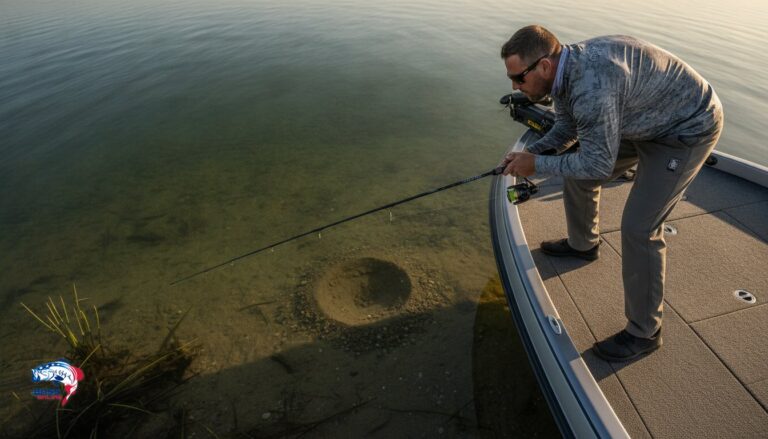
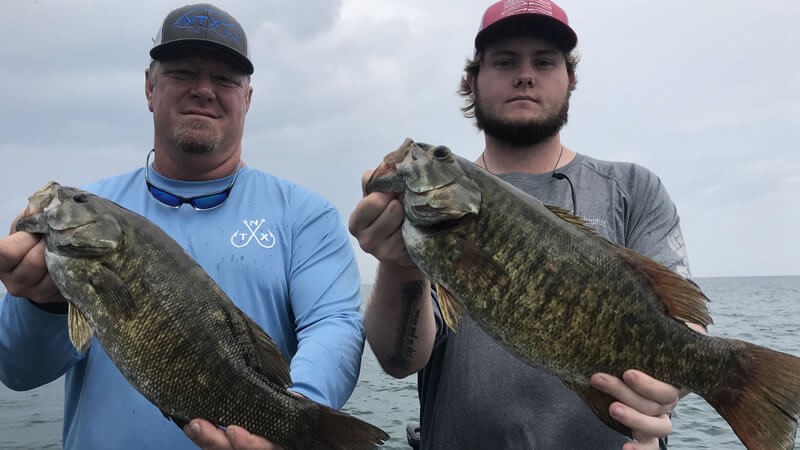

Deep-water smallmouth fishing is one of the most important Lake Erie skills once summer pushes bronzebacks away from shallow spring areas. The challenge is not simply fishing “deep.” It is finding the right hard-bottom structure, bait, depth change, and boat angle inside a lake that can make an otherwise perfect-looking area feel empty.
How Deep Do Lake Erie Smallmouth Go?
There is no fixed depth. Smallmouth move with water temperature, forage, wind, light, seasonal stage, and basin conditions. In summer, productive fish can be found from moderate-depth rock to much deeper offshore structure. A better question than “what depth?” is: where are rock, bait, and a useful depth transition meeting today?
Best Deep-Water Structure
- isolated boulders on otherwise uniform bottom;
- reef edges and offshore shoals;
- rock-to-sand or gravel transitions;
- humps with a sharp side or defined crown;
- points extending into deeper water;
- ledges, breaks, and small depressions holding bait.
Do not overlook tiny features. One rock pile can hold more quality smallmouth than hundreds of yards of featureless bottom.
Use Electronics to Find Fish, Not Just Depth
Traditional sonar is useful for seeing depth, bottom hardness, and fish directly beneath the boat. Side imaging helps scan a wide area for isolated rock and schools. Forward-facing sonar can show whether fish are tight to bottom, suspended, or following a bait.
The most useful habit is to mark the exact structure where a quality fish bites, then repeat the same depth and bottom feature elsewhere. Electronics become powerful when they help you build a pattern rather than simply stare at a screen.
Boat Control Is the Difference Between Seeing Fish and Catching Them
Lake Erie wind can move the boat faster than a finesse bait can stay in the strike zone. Position the boat so your lure travels naturally across the structure. When fishing vertically, use enough weight to maintain bottom contact. When casting, account for wind bow in the line and the boat’s drift before choosing your casting angle.
Best Deep Smallmouth Presentations
Drop shot
A drop shot keeps the bait just above bottom and lets the sinker maintain contact with rock. It is one of the best options for fish shown directly beneath or near the boat. See our Lake Erie drop-shot guide.
Tube jig
Tubes imitate bottom forage and can be dragged, snapped, or allowed to glide down a break. Adjust weight until the bait reaches bottom without becoming an anchor.
Ned rig
A compact Ned rig is effective when fish are pressured or neutral. Its strength is simplicity: maintain contact, move slowly, and let the bait remain available.
Swimbait
Small swimbaits work when fish are off bottom or actively feeding on baitfish. Count the lure down and retrieve it through the depth where sonar shows fish.
How to Find the Productive Depth Faster
- Start with a seasonal depth range rather than one exact number.
- Scan for hard bottom and bait.
- Fish the highest-percentage feature first.
- When a quality fish bites, record depth, bottom type, lure, and boat angle.
- Run the pattern on similar structure instead of randomly changing spots.
Deep Water vs. Shallow Water
Deep fishing should not become a rule that prevents you from checking shallow water. Wind, cloud cover, bait movement, and seasonal shifts can pull quality fish shallower. The best anglers use depth as a pattern to test, not a fact to defend.
For the complete seasonal framework, see Lake Erie fishing forecast and best times. For broader tactics, see Lake Erie smallmouth bass fishing strategies.
Deep Lake Erie Smallmouth FAQ
Do I need forward-facing sonar?
No. Traditional sonar, side imaging, careful mapping, and disciplined boat positioning can all produce fish. Forward-facing sonar can shorten the search, but it does not replace understanding structure.
What is the best deep-water bait?
A drop shot is an excellent starting point because it is easy to control at depth. Tubes, Ned rigs, and swimbaits become equally important depending on fish position and activity.
Where should Pennsylvania anglers start?
Use the Pennsylvania Lake Erie guide for local access and trip planning, then use electronics to locate the day’s productive rock and depth.
Plan the bigger fishery: Use the Lake Erie fishing hub to compare Pennsylvania, Ohio, New York and Michigan before choosing where to target deep-water smallmouth.