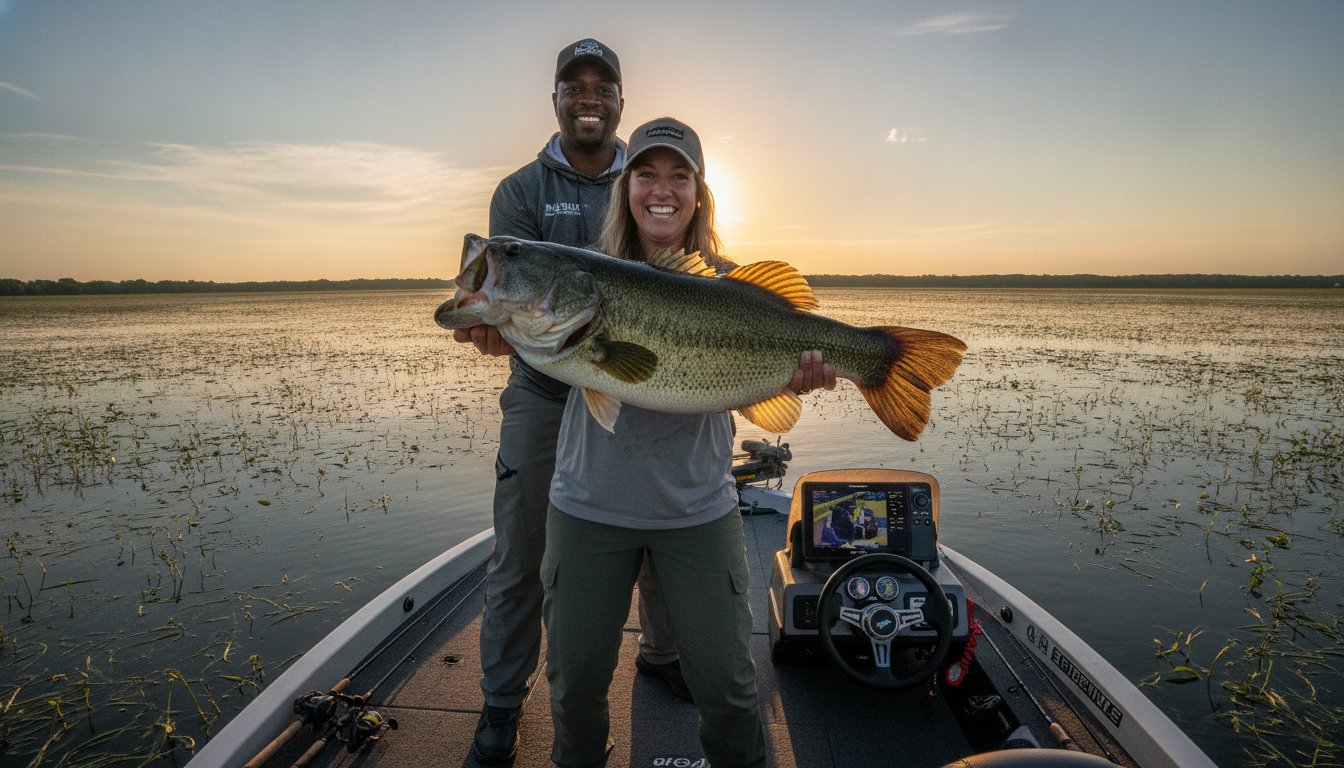

You don’t just “go fishing” in prime trophy bass waters; you go hunting for a prehistoric giant that can snap 20-pound fluorocarbon like sewing thread. It’s a bold claim, but anyone who’s experienced the raw power of trophy bass fishing knows it’s the truth. Most anglers show up to vast, challenging fisheries and feel immediately defeated by expansive waters and thick walls of aquatic vegetation. It’s frustrating to watch the clock tick down while you struggle to find a clear path through the cover or miss the narrow window when these true giants actually feed.
Bass Online has spent years on these challenging waters, and we can tell you that success isn’t about luck. It’s about understanding the “why” behind the bite. This comprehensive guide provides a masterclass on landing a double-digit largemouth by teaching you the exact seasonal movements and secret spots required for success in 2026. We’ll explore how to read the incredible grass health reported across top fisheries, how to time your casts with optimal water flow patterns, and which heavy-hitting lures actually trigger these trophy-sized bass. By the end of this report, you’ll have a professional plan to tackle any trophy bass fishery with total confidence.
Key Takeaways
- Identify the high-percentage windows for double-digit bass by mastering the seasonal shifts from shallow pre-spawn grass to deep summer river ledges.
- Learn to decode the massive 69,000-acre reservoir by breaking it down into manageable sections, from the deep bluffs near the dam to the lush mid-lake flats.
- Gain a tactical edge in trophy bass fishing lake guntersville by matching your lure vibration and retrieve style to the specific density of milfoil and hydrilla.
- Discover how to use Tennessee Valley Authority (TVA) current generation to your advantage, turning “dead” water into a feeding frenzy for giant largemouth.
- Understand how the “Guide’s Eye” helps you instantly evaluate water clarity and grass health, saving you days of trial and error on the water.
Why Lake Guntersville Remains a Trophy Bass Factory in 2026
Guntersville isn’t just a body of water; it’s a high-output engine for growing monsters. Spanning a massive 75-mile stretch of the Tennessee River, this reservoir provides 69,000 acres of prime habitat that most lakes simply can’t match. To understand why trophy bass fishing lake guntersville is so legendary, you have to look at the “Guntersville Effect.” This refers to the perfect combination of shallow-water nutrients and river-fed oxygen. You can dig deeper into the Guntersville Lake history and facts to see how the Tennessee Valley Authority (TVA) shaped this environment into the world-class fishery it is today.
While many lakes consider a five-pounder the catch of a lifetime, an 8-pound largemouth is the standard benchmark for a true trophy here. The sheer volume of fish in this class is staggering. In February 2026, tournament results proved this health, with the Bassmaster Elite winner hauling in over 88 pounds across four days. This level of productivity doesn’t happen by accident. It’s the result of a managed ecosystem where current and cover collide to create a predator’s paradise.
To better understand this concept, watch this helpful video:
The TVA plays a critical role by controlling the heartbeat of the lake. When they pull water through the dam, it creates a current that acts as a dinner bell for big bass. This moving water oxygenates the depths and positions fish predictably on river ledges. Combine this with the lake’s legendary vegetation, specifically the thick mats of Milfoil and Hydrilla, and you have a nursery that protects young fish while providing an ambush point for giants. Reports from July 2026 confirm that grass health is currently at an all-time high, making the vegetation bite more explosive than ever.
The Science of the Giant: Genetics and Growth
The growth rates on Guntersville are fueled by a massive forage base of shad and bluegill that thrive on nutrient-rich runoff. Because the lake averages only 15 feet in depth, sunlight reaches the bottom across vast areas, promoting year-round feeding and rapid growth. The Trophy Window represents that precise intersection where a bass’s slowing metabolism in cool water meets the peak availability of high-protein forage.
Pressure vs. Productivity: The 2026 Outlook
Even with heavy tournament pressure, the 10-pound-plus class remains strong due to a deeply ingrained catch-and-release culture among local anglers and guides. Modern conservation efforts and strict 15-inch size limits ensure that 2026 is a prime year for anyone hunting a personal best. If you’re new to the hunt, check out Bass Fishing 101 for foundational concepts that will help you understand the gear needed to handle these heavy Alabama hitters.
Seasonal Movements: Timing Your Trophy Bass Hunt
Success on a massive river system like this requires more than just a lucky lure. You’ve got to understand how water temperature and current dictate where these giants live. For a deep dive into the lake’s biology and primary targets, Alabama’s official Lake Guntersville fishing guide provides excellent data on the habitat these fish prefer. Mastering these seasonal shifts is the only way to find consistent success with trophy bass fishing lake guntersville throughout the calendar year.
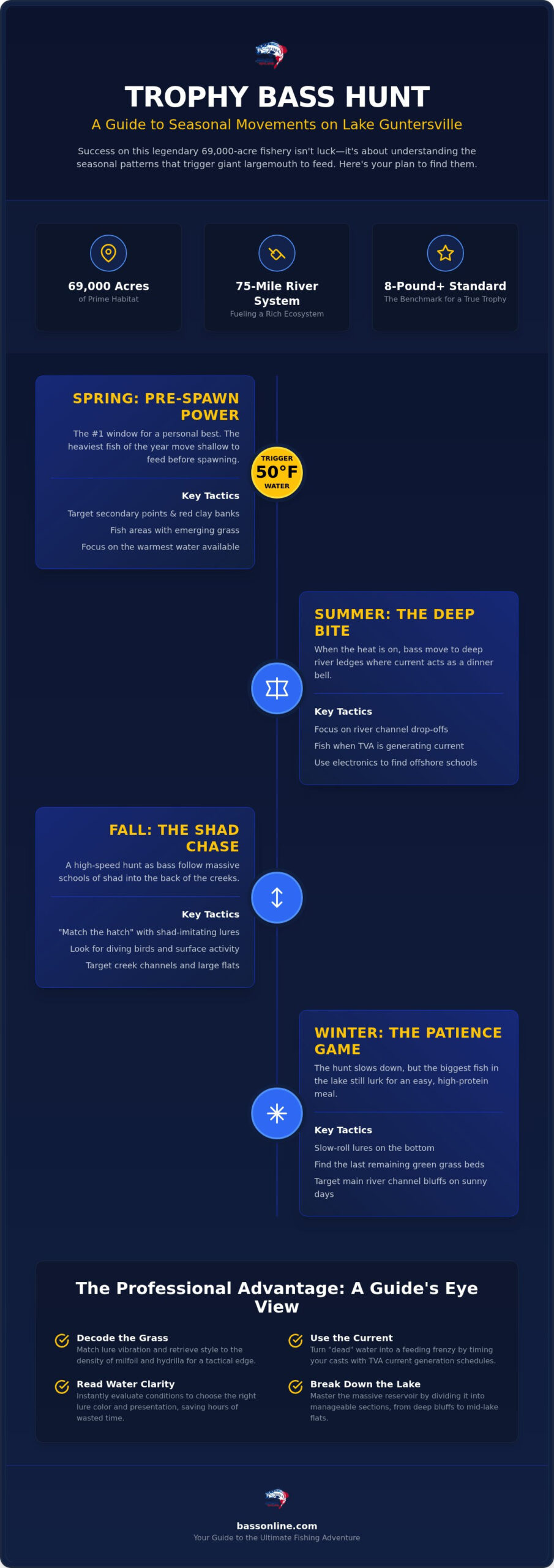
The calendar year breaks down into four distinct phases. Spring is the undisputed window for a personal best when the heaviest fish move shallow. Summer shifts the focus to the deep river channel where current is king. Fall is a high-speed chase as bass follow massive schools of shad into the back of the creeks. Winter is for the patient angler, slow-rolling lures along the edges of dying grass where the biggest fish in the lake still lurk for an easy meal.
Pre-Spawn: The Quest for a Double-Digit Bass
When the water hits the 50-degree mark, the giants start their march toward the banks. I target secondary points and those famous red clay banks first. These areas absorb sunlight and warm up faster than the surrounding water, drawing in sun-seeking females. Focus your efforts on staging areas in 8 to 12 feet of water. Use high-vibration search baits like a lipless crankbait to cover water quickly. Once you find a school, slow down with a heavy jig to trigger the biggest fish in the group.
Summer Ledges: Playing the Current
By June, the heat pushes fish out to the main river ledges. This is a high-stakes game where you must check the TVA dam release schedules. If the water isn’t moving, the bite is usually dead. Position your boat in the deep water and cast up onto the humps, dragging your bait back with the flow. Use your electronics to find “hard bottom” spots like shell beds or rock piles. These show up much brighter on side-imaging than silted areas and are exactly where trophies stack up to ambush baitfish. If you’re struggling to locate these offshore schools, you can connect with a local expert to dial in your coordinates.
Regardless of the season, the key is to stay mobile. These fish move based on forage and oxygen. If you aren’t seeing bait on your sonar or feeling the current against your hull, it’s time to fire up the big motor. Finding the right “bite window” often means being in the right spot when the TVA starts pulling water, turning a slow day into a legendary one in minutes.
Trophy Tackle: Lures that Trigger Guntersville Giants
To land a double-digit fish on this lake, you can’t just throw whatever is on sale at the local shop. You need a specific arsenal known as the “Big Three”: frogs, swimbaits, and oversized crankbaits. The Alabama Department of Conservation and Natural Resources highlights the massive impact of the lake’s vegetation on fish behavior; that’s why matching your lure’s vibration to the density of the hydrilla beds is critical. If your bait doesn’t feel right as it ticks the grass, the fish won’t commit. In 2026, the most successful anglers are integrating Forward-Facing Sonar (FFS) to hunt specific fish, but they still rely on traditional blind casting to cover the massive grass flats where trophies hide.
Matching the hatch matters more on Guntersville than perhaps any other Southern reservoir. These bass are educated and see thousands of lures a year. To fool them, your presentation must be flawless. Whether you’re fishing the deep ledges or the shallow mats, your gear needs to be heavy-duty. We’re talking 65-pound braid for the slop and 20-pound fluorocarbon for the deep stuff. If you come under-gunned, a Guntersville giant will break your heart and your line in the same second.
Topwater Explosions: The Frog Game
Nothing beats a topwater blow-up in the thick stuff. When choosing your weapon, use a walking frog for dense, matted vegetation to create a subtle “push” that bass can track. If you find holes in the grass or scattered milfoil, switch to a popping frog to create the surface disturbance needed to draw them out. The most important lesson I can teach you is the “Guntersville Pause.” When a giant chokes that frog, wait just one full second before you set the hook to ensure the fish has turned its head. You need a heavy-action rod with enough backbone to maintain unyielding tension so the bass can’t bury its head into the thick hydrilla stalks.
Deep Cranking and Swimbait Tactics
When the fish move to the ledges, deep cranking is the way to go. The goal is to select a diving depth that allows your lure to just “tick” the top of the submerged grass. If you’re constantly fouled with weeds, you’re fishing too deep; if you aren’t touching the grass, you’re too shallow. Stick with legendary colors like “Sexy Shad” or “Chartreuse Blue” to mimic the local gizzard shad. For the truly wary monsters, the 2026 trend is the “Glide Bait.” These large, single-jointed swimbaits provide a massive profile that mimics a dying shad, offering a big meal that a ten-pounder simply can’t pass up. If you want to see these tactics in action, consider booking one of our professional fishing guides to flatten your learning curve.
Staring at a 75-mile stretch of water is enough to make any angler second-guess their plan. With 69,000 acres to explore, you can’t just fish “the lake.” You have to pick a section and master it. The Lower End, stretching from the dam up to Seibold, is dominated by steep bluffs and massive main-river ledges. This is the place to be during the heat of summer when the current is moving. Conversely, the Upper River from Roseberry toward Nickajack feels more like a traditional river. You’ll find more wood cover and current-driven eddies there.
Choosing where to launch depends heavily on the wind and water temperature. If a strong North wind is blowing, the Lower End can become a washing machine. In those conditions, I head to the Upper River or the protected creeks. For most anglers pursuing trophy bass fishing lake guntersville, the Mid-Lake section between Goose Pond and Sauty is the primary target. This area holds the most consistent grass beds and massive flats that keep giants shallow for longer periods.
The “Goose Pond” Area: A Trophy Hunter’s Paradise
Goose Pond is arguably the most famous name on the lake for a reason. It’s a 10-pounder factory. The key here is the complex “ditch” systems. These are natural depressions or old creek channels that act as underwater highways. Bass use these deeper lanes to move from the main river onto the vast, shallow grass flats to feed. If you can find where a ditch intersects a thick hydrilla line, you’ve found a gold mine. To see these spots firsthand, check out our Lake Guntersville Fishing Trips where we put you right in the heart of the action.
Seibold and Town Creek: Consistent Producers
Seibold and Town Creek offer a different tactical advantage. These areas are defined by creek mouth transitions where the water depth changes rapidly. I look for the “Gravel Bar” secrets. These are small patches of hard bottom surrounded by soft mud. Bass love to congregate on these hard spots to spawn or ambush shad. These creeks also serve as a perfect “safety net.” When the main lake is too rough to fish comfortably, these protected areas still offer a legitimate shot at a giant without the back-breaking waves. Ready to skip the guesswork and head straight to the honey holes? Contact us to schedule your expedition.
The Professional Advantage: Why a Guide is Essential
Guntersville is a beast of a lake. Even the most seasoned anglers can feel defeated after eight hours of casting into 69,000 acres of water without a single heavy thud on the line. Hiring a professional isn’t just about getting a boat ride; it’s about eliminating a learning curve that usually takes years to master. When you’re targeting trophy bass fishing lake guntersville, a guide acts as a tactical shortcut. We’ve already spent the weeks prior tracking the movement of schools and monitoring the TVA current schedules so you don’t have to.
The most valuable asset a professional brings is the “Guide’s Eye.” This is the ability to look at a mat of grass and instantly know if it’s healthy, oxygen-rich hydrilla or dying “snot” moss that fish avoid. We read water clarity at a glance, knowing exactly how a two-inch change in visibility should alter your lure color. Beyond the fishing, safety is a massive factor on the Tennessee River. Navigating through heavy barge traffic and avoiding the legendary stump fields in the mid-lake flats requires local knowledge that keeps your trip focused on the fish rather than a damaged lower unit.
Learning the “Why” Behind the Bite
My goal isn’t just to net your fish; it’s to mentor you on the mechanics of the hunt. During a trip, we break down seasonal patterns that you can take back to your home waters. You’ll see how we use tournament-ready boats and pro-grade electronics to pinpoint giants in real-time. Whether you’re a beginner wanting to learn the basics of a baitcaster or a tournament pro looking to refine your forward-facing sonar skills, the experience is tailored to your goals. You can check out our Alabama Fishing Guides profiles to find an expert who matches your preferred style.
Booking Your 2026 Guntersville Expedition
If you’re planning a trip for the 2026 season, timing is everything. The pre-spawn window in March and the aggressive fall grass bite in October are the most requested dates. These slots fill up fast, so booking in advance is the only way to ensure you’re on the water when the biggest fish are moving. For your day on the lake, keep it simple. Pack high-quality sunscreen, a pair of polarized glasses to see through the surface glare, and a hunger for a personal best. Recent August 2026 reports show guide trips producing 30 to 40 bass per outing, proving the lake is in peak condition. Ready to land the fish of a lifetime? Contact our Lake Guntersville experts today.
Claim Your Personal Best on the Big G in 2026
Landing a giant on Alabama’s most famous reservoir is a rite of passage for any serious angler. Success in the 2026 season requires more than just a boat and a rod; it demands a deep understanding of how the TVA current moves fish and how to pick apart thick hydrilla with precision. By mastering seasonal shifts and focusing on high-percentage areas like the Goose Pond ditches, you put the odds in your favor for the catch of a lifetime. Experience the raw power of trophy bass fishing lake guntersville with a team that knows these 69,000 acres inside and out.
We provide everything you need for a legendary expedition, from top-rated professional equipment and tournament-ready boats to expert local guides with decades of experience on these waters. We have a proven track record of putting clients on 8lb to 10lb+ Alabama giants, and we’re ready to do the same for you. Don’t leave your bucket-list trip to chance. Book Your Lake Guntersville Trophy Hunt Now and let’s get to work. The water is right, the grass is healthy, and those monsters are waiting for your lure. I’ll see you on the water!
Frequently Asked Questions
What is the best time of year for trophy bass fishing on Lake Guntersville?
The best window for catching the heaviest fish of your life is the pre-spawn period from February through April. During these months, females are at their maximum weight before spawning. If you prefer high-volume action, the summer ledge bite from June to August is incredible when the TVA is moving water. Both seasons offer world-class opportunities for trophy bass fishing lake guntersville.
Do I need a special license to fish Lake Guntersville in 2026?
Yes, every angler over age 16 needs a valid Alabama freshwater fishing license. For the 2026-2027 season, a resident annual license is $17.00. Non-residents can choose between a 7-day trip license for $37.00 or an annual pass for $66.25. It’s best to purchase these online through the state’s official portal before your trip to save time at the boat ramp.
How much does a professional bass fishing guide cost on Guntersville?
While rates vary based on trip duration and the number of anglers, industry standards on Guntersville typically range from $400 for a half-day to over $700 for a full eight-hour expedition. These rates generally cover fuel, expert instruction, and the use of professional-grade tackle. For our specific trip options and current availability, we recommend checking our booking page directly to see which package fits your needs.
Can a beginner catch a trophy bass on Lake Guntersville?
Absolutely, a beginner has a legitimate shot at a double-digit bass when fishing with a professional. We handle the complex tasks like navigating the 69,000-acre lake and identifying active grass beds. This allows you to focus entirely on your casting and hooksets. Many of our most memorable trophy catches come from novice anglers who followed their guide’s instructions to the letter during a specific bite window.
What are the most effective lures for Lake Guntersville bass?
The “Big Three” on Guntersville are hollow-body frogs, large swimbaits, and deep-diving crankbaits. In 2026, we’re seeing massive success by matching lure vibration to the density of the hydrilla. Use frogs in the thick mats and switch to a “Sexy Shad” colored crankbait when fishing the river ledges. These lures are specifically designed to trigger the aggressive predatory instincts of Alabama’s legendary largemouth giants.
Is Lake Guntersville better for largemouth or smallmouth bass?
Lake Guntersville is world-famous as a largemouth bass factory, though smallmouth are definitely present. Largemouth thrive in the lake’s massive hydrilla and milfoil beds, which make up the bulk of the habitat. While you might occasionally hook a “brown fish” near the dam or in high-current river sections, the primary target for anyone seeking a trophy is the heavy-bodied largemouth that dominates this reservoir.
What happens if the weather is bad on my scheduled guided trip?
Safety is our absolute priority on the Tennessee River. If conditions like lightning, extreme winds, or heavy fog make fishing dangerous, we’ll work with you to reschedule your trip for the next available opening. We monitor weather patterns and TVA release schedules closely leading up to your launch. Our goal is to ensure you have a productive, enjoyable day on the water rather than fighting unsafe elements.
How do I prepare for a full-day guided fishing charter?
Start by packing essential personal items like high-quality polarized sunglasses, sunscreen, and a waterproof rain jacket. We provide the tournament-ready boats and pro-grade tackle, but you’re welcome to bring a favorite rod if you prefer. Don’t forget plenty of water and snacks to keep your energy up for an eight-hour hunt. Most importantly, bring a positive attitude and be ready to learn new tactics from your mentor.

Article by
Mr Bass
Todd Kersey, widely known as Mr. Bass by Field & Stream, is a professional angler, accomplished author, and dedicated philanthropist with a lifelong passion for bass fishing. Armed with a degree in Outdoor Travel, Mr. Bass has expertly combined his knowledge with his practical fishing experience to become one of the most respected names in bass fishing.
His deep understanding of bass habitats and fish behavior has earned him numerous accolades as an asset to the sport. Serving 8 years as FWC Stakeholder Chairperson. Leading and passed cutting-edge legislation, such as the Black Bass Management Plan, and successfully built, passed, and helped finance the Trophy Catch program.
As CEO, he is committed to giving back to the community through his philanthropic efforts. He supports a variety of causes, especially those centered around physical disabilities. Through his advocacy, his mentorship programs inspire anglers to engage in fishing stewardship, helping to raise more than $18 million dollars in donations. Mr. Bass continues to inspire anglers and outdoor enthusiasts alike with his commitment to the sport, industry, and the world around him.