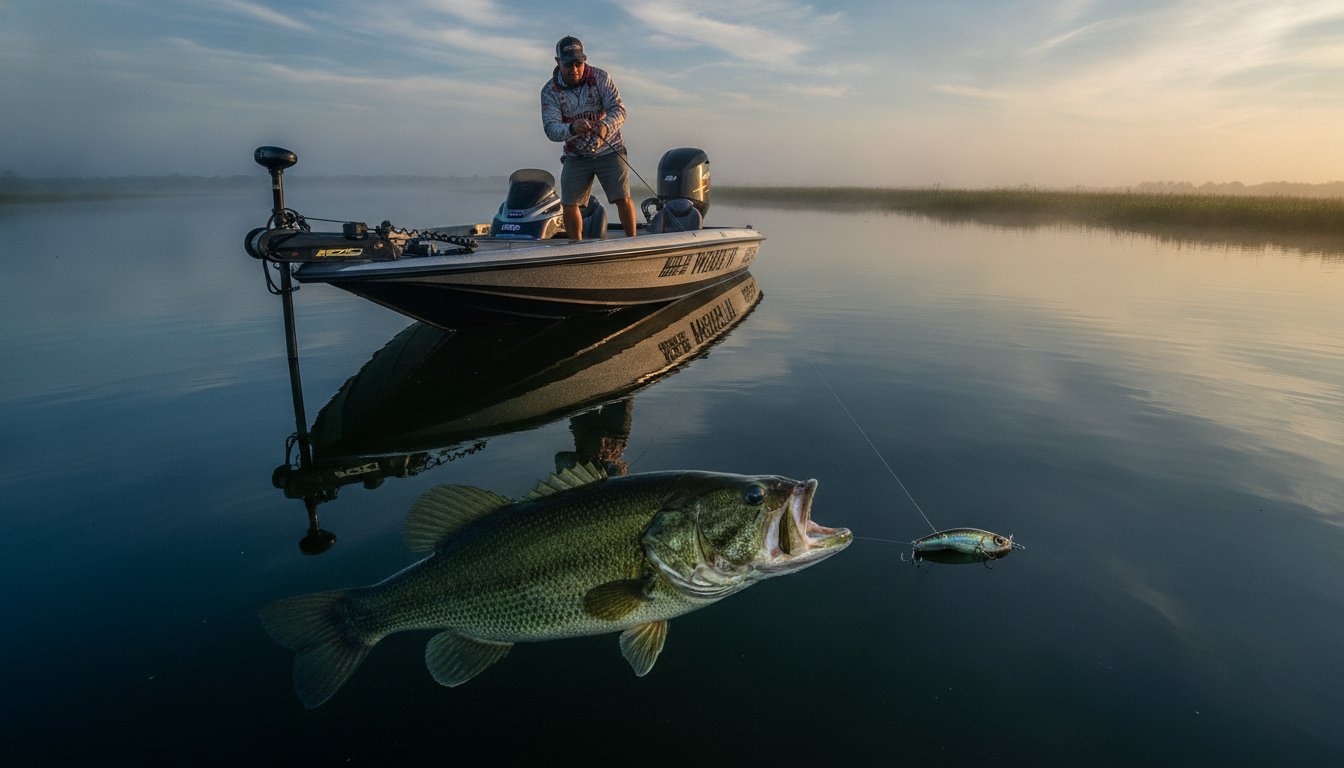

What if the secret to catching more trophy bass wasn’t how you move your lure, but how you let it sit? Most anglers think they’ve mastered the basics, but using advanced jerkbait techniques for bass requires a shift in mindset from simply making it move to making it look perfectly vulnerable. It’s about understanding the mental game of the pause and manipulating the physics of your line to mimic a dying baitfish’s final moments.
There is nothing more aggravating than watching a massive bass track your bait for thirty feet only to flare its gills and swim away because something looked slightly off. You know the fish are there and active, but they just won’t pull the trigger when it counts. We’ve all been there, and it’s usually a sign that your presentation is missing that professional edge that separates a good day from a legendary one.
This guide will turn those followers into fighters by teaching you the subtle art of the pause and the technical gear tweaks used by the pros. We’ll break down how to adjust your lure’s buoyancy for different water temperatures, why your line choice dictates your depth, and the specific cadences that force a predatory response even in the most pressured waters.
Key Takeaways
- Understand the dead-stick philosophy to master the pause, which is the most critical moment for triggering a big bass to strike.
- Master the slack line rip to give your lure a 180-degree turn-around action, a hallmark of advanced jerkbait techniques for bass.
- Fine-tune your presentation by adjusting line density and using lead tape to achieve the perfect suspension depth in any water temperature.
- Use wind and water clarity to your advantage by matching your lure’s profile and color to the specific conditions on the lake.
- Learn why spending a day on the water with a professional guide provides the real-time feedback needed to perfect these complex cadences.
The Psychology of the Strike: Why Advanced Jerkbait Techniques Work
I’ve seen it a thousand times. A trophy bass follows a lure, eyes locked on, but stays just inches away. It’s a standoff. To win, you have to understand that jerkbaits are psychological tools. They are visual-only lures that exploit a predator’s hardwired instinct to cull the weak. When we talk about advanced jerkbait techniques for bass, we’re talking about mastering the art of the ‘dying’ presentation.
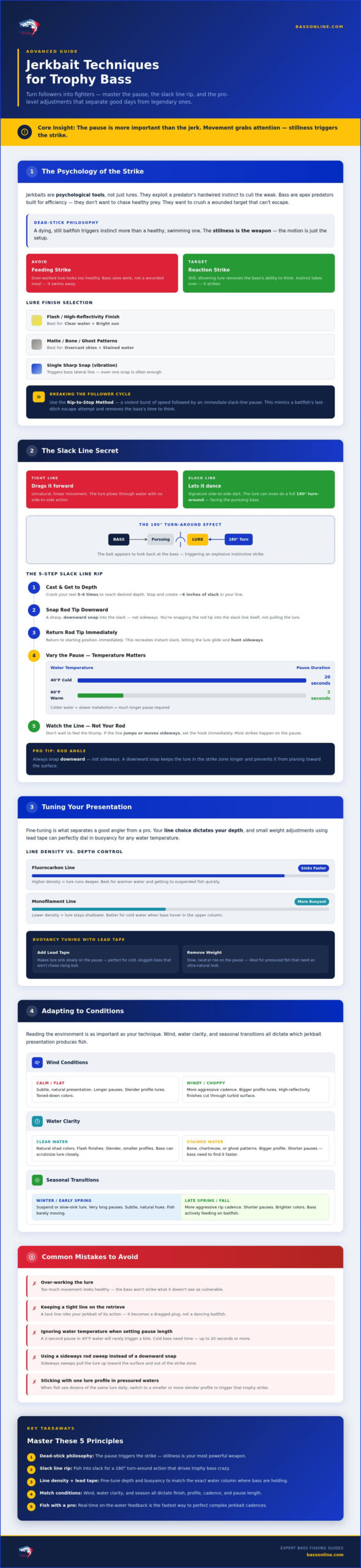
The core of this strategy is the dead-stick philosophy. It’s a tough pill to swallow for high-energy anglers, but the pause is actually more important than the jerk. The movement grabs their attention, but the stillness creates the strike. You’re trying to provoke a reaction strike, not a feeding strike. Understanding largemouth bass science helps you realize that bass are apex predators designed for efficiency. They don’t want to chase healthy prey; they want to crush a wounded target that can’t escape.
Mimicking the Dying Quiver
Bass rely on their lateral line to feel vibrations, but the final kill is all visual. Your job is to create an erratic, shivering movement that looks like a shad’s final moments. The biggest mistake I see anglers make is over-working the lure. If you jerk it too much, it looks too healthy. It looks like work for the bass.
- Flash: High-reflectivity finishes are killers in clear water and bright sun.
- Matte: Use bone or ‘ghost’ patterns when the sky is gray or the water is stained.
- Vibration: A single, sharp snap is often enough to get their lateral line firing.
Breaking the ‘Follower’ Cycle
Nothing is more frustrating than a ‘looker’ that won’t bite. To turn those followers into hook-ups, you have to remove their ability to think. I use the rip-to-stop method. It’s a sudden, violent burst of speed followed by an immediate, slack-line pause. This mimics a baitfish’s last-ditch effort to flee. When applying advanced jerkbait techniques for bass, the profile of your lure matters just as much as the action. If the bass are seeing dozens of standard lures every day, switching to a slightly smaller or more slender profile can be the key to triggering that trophy strike.
Mastering the Slack Line Rip: Precision Cadence for Trophy Bass
If you want to unlock the full potential of advanced jerkbait techniques for bass, you have to embrace the slack. Most anglers are taught to keep a tight line to feel the bite, but a tight line is the enemy of a jerkbait. When you pull a lure on a taut line, you’re dragging it forward. When you snap it on a slack line, you’re allowing it to dance. This Slack Line Secret is what gives the lure its signature side-to-side darting action.
By jerking into slack, you allow the lure to glide freely after the initial burst of energy. This often results in a 180-degree turn-around where the bait actually looks back at the pursuing bass. It’s a move that drives trophy fish absolutely crazy. To achieve this, your rod tip positioning is vital. I always recommend a downward snap rather than a sideways sweep. Snapping downward keeps the lure in the strike zone longer and prevents it from planing toward the surface. If you need a refresher on the basics of rod control, check out our guide on Bass Fishing 101.
The 5-Step Slack Line Rip
Mastering this rhythm takes practice, but it’s the fastest way to increase your hook-up ratio. Follow these steps on your next outing:
- Step 1: Cast out and crank your reel five to six times to get the lure to its desired depth. Once there, stop and create about 6 inches of slack in your line.
- Step 2: Snap your rod tip downward sharply. You aren’t trying to move the lure; you’re snapping the rod tip into the slack line itself.
- Step 3: Immediately return the rod tip to its starting position. This creates instant slack again, allowing the lure to glide and hunt sideways.
- Step 4: Vary your pause. In 40-degree water, you might wait 20 seconds. In 60-degree water, a 2-second pause is often plenty.
- Step 5: Watch your line. Don’t wait to feel the thump in the rod. If the line jumps or starts to move sideways, set the hook.
Advanced Cadence Variations
Once you’ve mastered the basic rip, it’s time to get creative. The Double-Snap mimics a panicked baitfish trying to escape a predator. It involves two quick downward snaps followed by a long pause. For deeper fish in the summer, I use a Slow-Roll Rip. This involves a slow steady retrieve with occasional soft twitches to keep the bait deep and moving. While a rhythmic cadence works for active fish, a chaotic, random pattern is often better for pressured bass that have seen every trick in the book. If you’re struggling to find the right beat, you can talk to one of our pros to see these cadences performed in person.
Tuning Your Presentation: Line Choice and Water Column Control
Professional anglers don’t just take a lure out of the box and start casting. They tune it. One of the most overlooked aspects of advanced jerkbait techniques for bass is how your line choice and hardware affect the bait’s suspension. Fluorocarbon is denser than water and sinks; this helps pull the bait deeper during the pause. Monofilament is more buoyant and can keep a bait from diving too deep. Even the weight of split rings and hook sizes matter. A heavier hook can turn a suspending lure into a slow-sinker, which might be exactly what you need. For more deep dives into lure modification, I always recommend checking the Bass Online blog.
Managing Buoyancy with Line Diameter
Line diameter is your most effective tool for controlling depth. If you’re fishing 10 feet of water and need that lure to get down, 8lb fluorocarbon is the choice. The thinner diameter cuts through the water with less resistance, allowing for a wider, more aggressive darting action. On the flip side, 12lb to 15lb line acts as a brake. The thicker line has more drag, keeping the lure shallower and slowing down its forward momentum. This is a pro secret for fishing over submerged grass without snagging.
Always perform a ‘suspension test’ at the side of the boat. Drop your lure in the water and watch it for ten seconds. Does it sit level? Does the nose dip? If it rises like a cork, you’ve got work to do. The goal is to match the lure’s behavior to the specific temperature and density of the water you’re fishing that day.
Aftermarket Hook and Weight Tuning
Sometimes the factory settings just don’t cut it. In colder water, bass often ‘slap’ at the bait rather than inhaling it. Swapping to light-wire trebles can turn those slaps into solid hook-ups because they penetrate with much less force. If the water is warm, it’s less dense, meaning your lure will naturally want to float more. You can fix this with lead tape hacks like adding Suspend Dots to the belly or wrapping lead wire around the hook shanks.
- Slow Sink: Best for when bass are holding deep near structure or when you want to mimic a dying baitfish falling through the column.
- Slow Rise: Perfect for fishing over the tops of submerged timber where you need the lure to back out of a snag during the pause.
- Perfectly Level: The gold standard for neutral fish in crystal clear water where they have all day to inspect the bait.
By adding weight to the front hook, you can achieve a ‘nose-down’ posture. This mimics a baitfish feeding on the bottom, a visual cue that often triggers an aggressive response from big largemouth.
Adapting to the Conditions: Wind, Clarity, and Seasonal Transitions
Many anglers put their jerkbaits away once the water warms up or the wind starts howling. That’s a huge mistake. Real proficiency in advanced jerkbait techniques for bass means knowing how to use the environment to your advantage. Wind isn’t an obstacle; it’s a cloaking device. Surface chop breaks up the lure’s silhouette, making it harder for bass to identify it as a piece of plastic. In crystal clear water, this is often the only way to get a trophy fish to commit because it masks the hooks and the line.
Clarity dictates your color palette. In gin-clear water, transparent ‘ghost’ patterns are king. They let light pass through the body, mimicking the translucency of a real shad. But when the water turns stained, you need solid colors like bone or the classic ‘clown’ pattern to provide a silhouette they can track. If you’re targeting offshore structure, don’t be afraid to reach for deep-diving +1 or +2 variants. These baits can reach depths of 12 feet or more, putting your presentation right in the face of bass holding on deep ledges or brush piles.
Fishing the Windblown Shoreline
Boat positioning is everything when the wind picks up. I always try to cast with the wind. This gives me maximum distance and helps the lure dive deeper because there’s less line bow to fight. Look for the ‘mud line’ where clear water meets stained water pushed by the wind. Bass love to sit on the clear side and ambush baitfish passing through the murky water. You can even let the wind’s current drift the lure during long pauses. This creates a natural, sweeping motion that looks incredibly realistic to a trailing predator.
Summer and High-Sun Strategies
The summer jerkbait is probably the most underutilized tool in the box. While most people are throwing worms, I’m targeting deep weed edges and submerged timber. Bass seek shade under high-sun conditions, and a jerkbait ripped over their heads can trigger a violent reaction strike. It’s about speed and placement during these months.
- The High-Speed Burn: Instead of long pauses, use aggressive, rapid-fire rips with almost zero rest. This forces a split-second decision from the fish.
- Targeting Shade: Focus on the dark side of bridge pilings or the deep edges of lily pads where bass hide from the sun.
- Low-Light Windows: Dawn and dusk remain prime time. The fish are shallower and much more willing to chase a fast-moving target.
Perfecting these environmental adjustments is what separates the weekend warriors from the pros. If you want to see how we handle these conditions in real time, you should book a guided trip with our expert team to learn these tactics on the water.
Mastering the Rip with a Pro: Take Your Skills to the Water
You’ve read the theory and you’ve seen the diagrams. But there’s a world of difference between understanding advanced jerkbait techniques for bass on a screen and executing them in the middle of a windblown lake. Even the most detailed YouTube tutorials can’t tell you if your rod tip is three inches too high or if your pause is just a second too short. That’s where a professional guide becomes your greatest asset. We provide the real-time feedback that turns a frustrating day of ‘followers’ into a career-best day of hook-ups.
When you’re out on the water with us, we don’t just tell you what to do; we show you why it works. We’ll watch your line, listen to the snap of your rod, and help you find that perfect rhythm that triggers a predatory response. It’s about developing the muscle memory that stays with you long after the trip is over. Once you feel that specific ‘thump’ on a slack line, everything we’ve discussed about physics and psychology finally makes sense.
Why Experience Matters
Since 1997, Bass Online has been leading the industry by putting anglers on trophy fish across the country’s most iconic waters. We’ve spent over 25 years refining these presentations through every possible weather condition and seasonal shift. When you step onto one of our boats, you skip the steep learning curve. We can often dial in your cadence in the first 30 minutes, ensuring you’re fishing with maximum efficiency for the rest of the day. Whether you’re targeting massive largemouth on Lake Guntersville or chasing aggressive smallmouth on Lake Erie, our seasoned experts live the jerkbait life every single day.
Ready to Land a Trophy?
There is nothing quite like the rush of a slack-line strike. You see the line jump, you set the hook, and you feel that heavy, pulsing weight on the other end. That’s the moment the technique clicks. Our guided fishing trips are designed to build that level of confidence. We handle the technical gear setup, from choosing the right line diameter to tuning your lure’s buoyancy, so you can focus entirely on the strike. If you have an angler in your life who wants to level up, we also offer gift certificates that provide an insider journey led by the best in the business.
The jerkbait is a tool of extreme patience and surgical precision. It’s a mental game as much as a physical one. Once you master the cadence and the ‘why’ behind every rip, it becomes a weapon you’ll never want to leave at the dock. Book your advanced bass fishing session with our expert guides today!
Dominate the Water with Your New Skills
Mastering the art of the pause and perfecting your slack line management are the biggest hurdles to overcome. Once you stop dragging the lure and start snapping it into slack, you’ll see a massive difference in how trophy fish respond. Remember to tune your gear for the specific water column you’re targeting. Whether it’s swapping hooks or adjusting line diameter, these small tweaks create a perfectly level suspension that bass can’t resist.
Applying these advanced jerkbait techniques for bass takes time and patience, but the results are worth every cast. Since 1997, our local experts have specialized in targeting trophy Largemouth and Peacock Bass across the country. We provide professional gear and strategy instruction on every outing to ensure you leave the dock with more than just a memory. Ready to master advanced jerkbait techniques? Contact our pro guides today! We’ll see you on the water for your next big adventure.
Frequently Asked Questions
How long should I actually pause my jerkbait between rips?
Water temperature dictates your pause time. In cold water below 50 degrees, you might need to wait 10 to 20 seconds for a strike. As the water warms up into the 60s, shorten that window to just 1 or 2 seconds. The key is letting the fish tell you what they want. If you’re seeing followers but no bites, try doubling your pause time.
Can I use a jerkbait in muddy or stained water?
You can definitely catch fish in stained water, but you have to adjust your colors. Switch from transparent patterns to solid, high-contrast colors like bone, gold, or chartreuse. Use more aggressive snaps to help the bass locate the lure through their lateral line. The extra vibration and a bold silhouette make the bait much easier to track in low-visibility conditions.
What is the best rod setup for advanced jerkbait fishing?
A 6-foot 6-inch to 6-foot 10-inch medium-action rod with a fast tip is the perfect tool. The shorter length allows you to snap the rod tip straight down without hitting the water or the boat. You want a rod with enough “give” in the mid-section to keep those small treble hooks from pulling out when a trophy bass makes a hard run.
Do I need a specific type of line for suspending jerkbaits?
Fluorocarbon is the gold standard for advanced jerkbait techniques for bass because it sinks and helps the lure reach its maximum depth. Use 10lb test for a good balance of strength and depth. If you need the bait to dive deeper, drop down to 8lb line. Thicker 15lb line is better for shallow-water presentations where you want to keep the lure above submerged grass.
Why are bass following my jerkbait but not committing to the strike?
Followers usually mean your cadence is too rhythmic or your lure doesn’t look vulnerable enough. Try a “rip-to-stop” method where you give a violent snap followed by an immediate dead-stop on a completely slack line. This sudden change in physics often forces a bass to make a split-second decision to strike before the “prey” has a chance to escape again.
Is it better to use a floating, sinking, or suspending jerkbait?
Suspending models are the most effective because they stay perfectly still in the strike zone during the pause. Floating models work well for working over the top of thick vegetation, while sinking models are specialized for heavy current. For most advanced jerkbait techniques for bass, a neutral-buoyancy suspending bait provides the most realistic and versatile presentation for trophy fish.
What size jerkbait is most effective for trophy largemouth bass?
A 110mm profile, which is about 4.5 inches, is the industry standard for targeting big fish. This size perfectly mimics common forage like shad, alewives, or herring. If you’re fishing in high-pressure areas or the local baitfish are particularly small, downsizing to a 90mm lure can often trigger bites when the larger profile is getting ignored by wary bass.

Article by
Mr Bass
Todd Kersey, widely known as Mr. Bass by Field & Stream, is a professional angler, accomplished author, and dedicated philanthropist with a lifelong passion for bass fishing. Armed with a degree in Outdoor Travel, Mr. Bass has expertly combined his knowledge with his practical fishing experience to become one of the most respected names in bass fishing.
His deep understanding of bass habitats and fish behavior has earned him numerous accolades as an asset to the sport. Serving 8 years as FWC Stakeholder Chairperson. Leading and passed cutting-edge legislation, such as the Black Bass Management Plan, and successfully built, passed, and helped finance the Trophy Catch program.
As CEO, he is committed to giving back to the community through his philanthropic efforts. He supports a variety of causes, especially those centered around physical disabilities. Through his advocacy, his mentorship programs inspire anglers to engage in fishing stewardship, helping to raise more than $18 million dollars in donations. Mr. Bass continues to inspire anglers and outdoor enthusiasts alike with his commitment to the sport, industry, and the world around him.