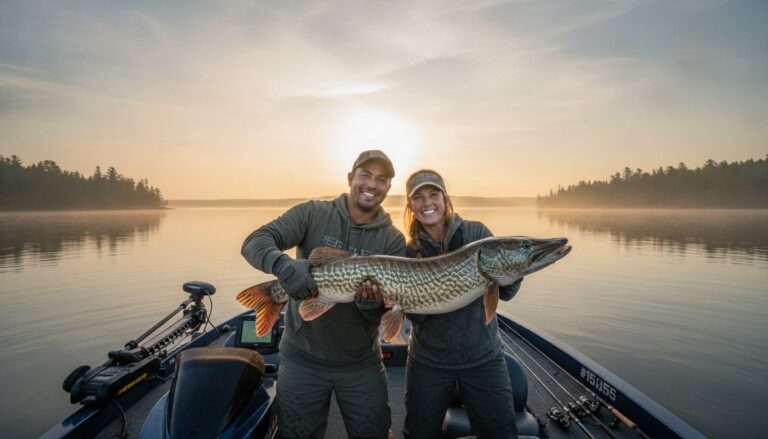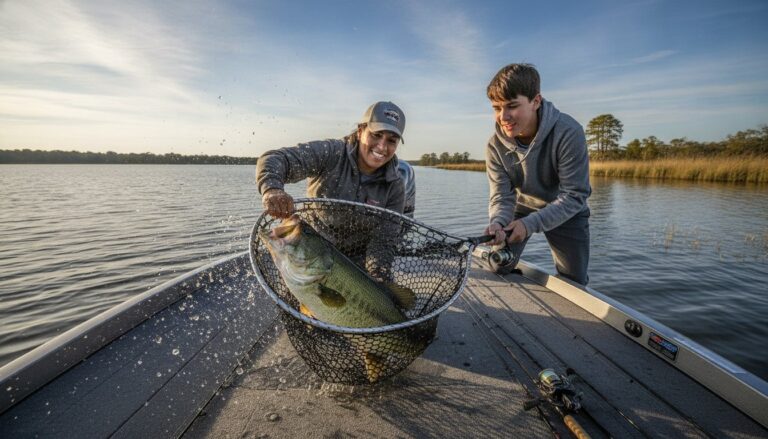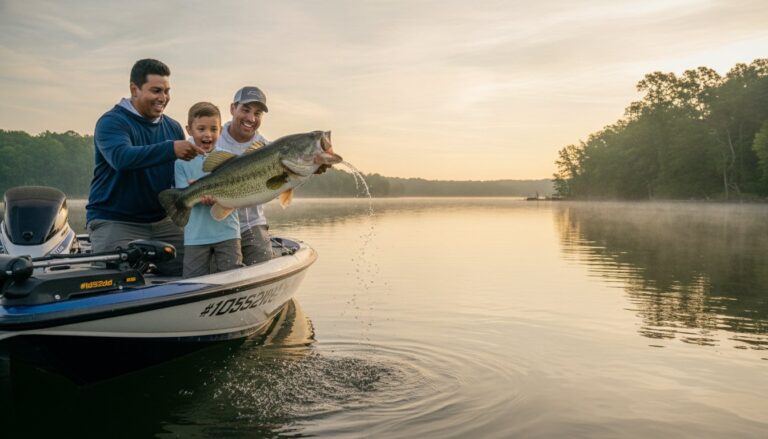
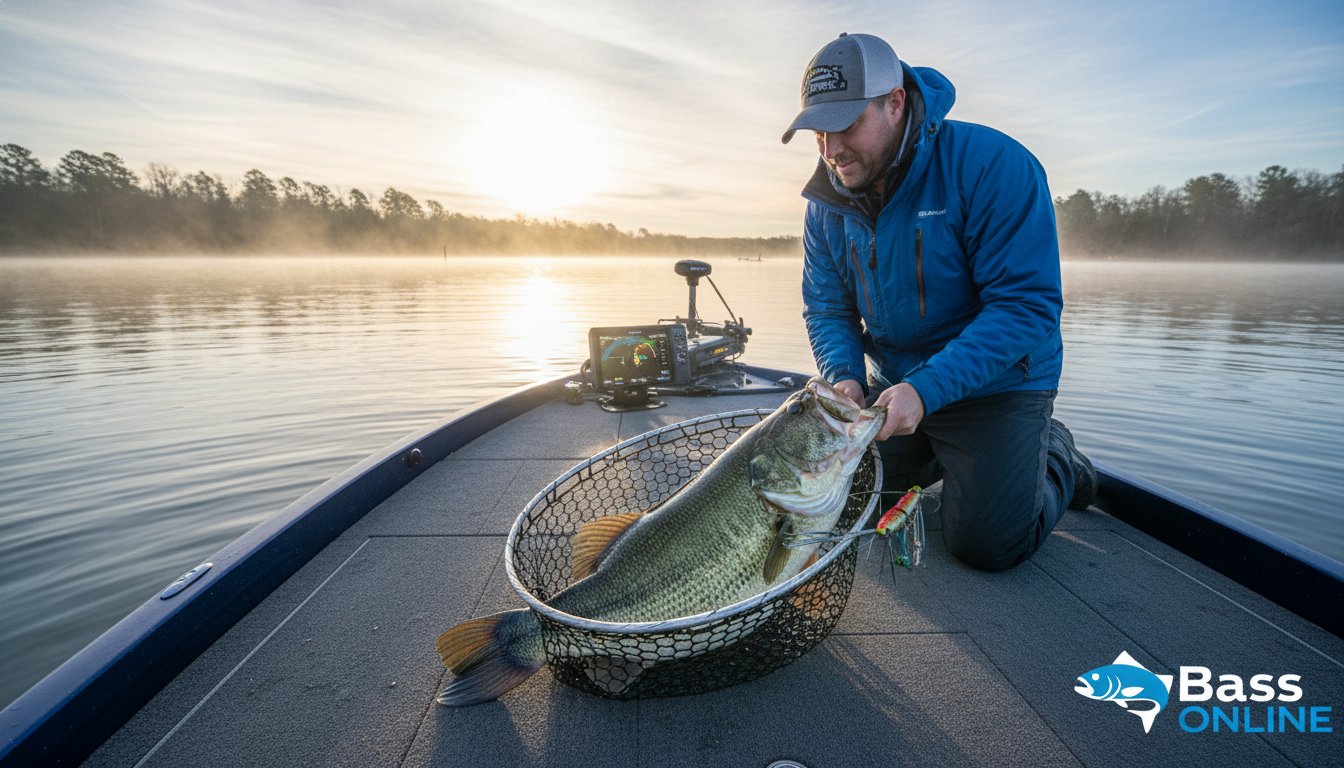

What if I told you that catching a double-digit trophy in forty-degree water has less to do with luck and everything to do with a simple math equation? Most anglers dread winter bass fishing because the lush vegetation they relied on all summer has turned into a lure-snagging brown mush. It’s incredibly frustrating to shiver in the cold wind while your electronics show a ghost town, especially when you’re stuck guessing between shallow flats and deep channels. I’ve been there, and I know the sting of a fishless, freezing day.
You don’t have to settle for a cold boat and an empty livewell. I’m going to show you how to master the metabolic math of cold-water bass and identify the exact thermal highways where these giants are stacking up right now. We’ll dive into the specific wintering holes that hold fish when the vegetation dies back, the high-stakes art of the long-pause jerkbait retrieve, and why the A-rig remains the undisputed king of the 2026 winter season. Get ready to turn the toughest months of the year into your most successful outings yet.
Key Takeaways
- Learn how the “39-degree rule” dictates exactly where trophy bass suspend when the Alabama winter sets in.
- Discover the top thermal highways for winter bass fishing Lake Guntersville, including why the upper river triggers earlier pre-spawn activity.
- Master the “dead-stick” retrieve and learn to detect the subtle, mushy bites that replace aggressive summer thumps.
- Get the pro breakdown on why the suspending jerkbait and the Alabama Rig are your most lethal weapons for mimicking lethargic shad.
- Understand how using professional-grade electronics can save you hours of shivering by instantly pinpointing deep wintering holes.
Table of Contents
-
The Science of the Winter Strike: Understanding Lake Guntersville Bass
-
Top Winter Lures for Guntersville: Jerkbaits, A-Rigs, and Jigs
The Science of the Winter Strike: Understanding Lake Guntersville Bass
To conquer winter bass fishing on Lake Guntersville, you have to stop thinking like a human and start thinking like an ectotherm. Bass don’t have the luxury of internal heat; their entire world is dictated by the temperature of the Tennessee River. As the mercury drops, their biological systems shift into a low-power mode. This isn’t just "laziness." It is a calculated survival strategy where every tail beat must be worth the energy spent. If you understand this biological math, you’ll stop casting aimlessly and start targeting the high-percentage windows that produce trophy fish.
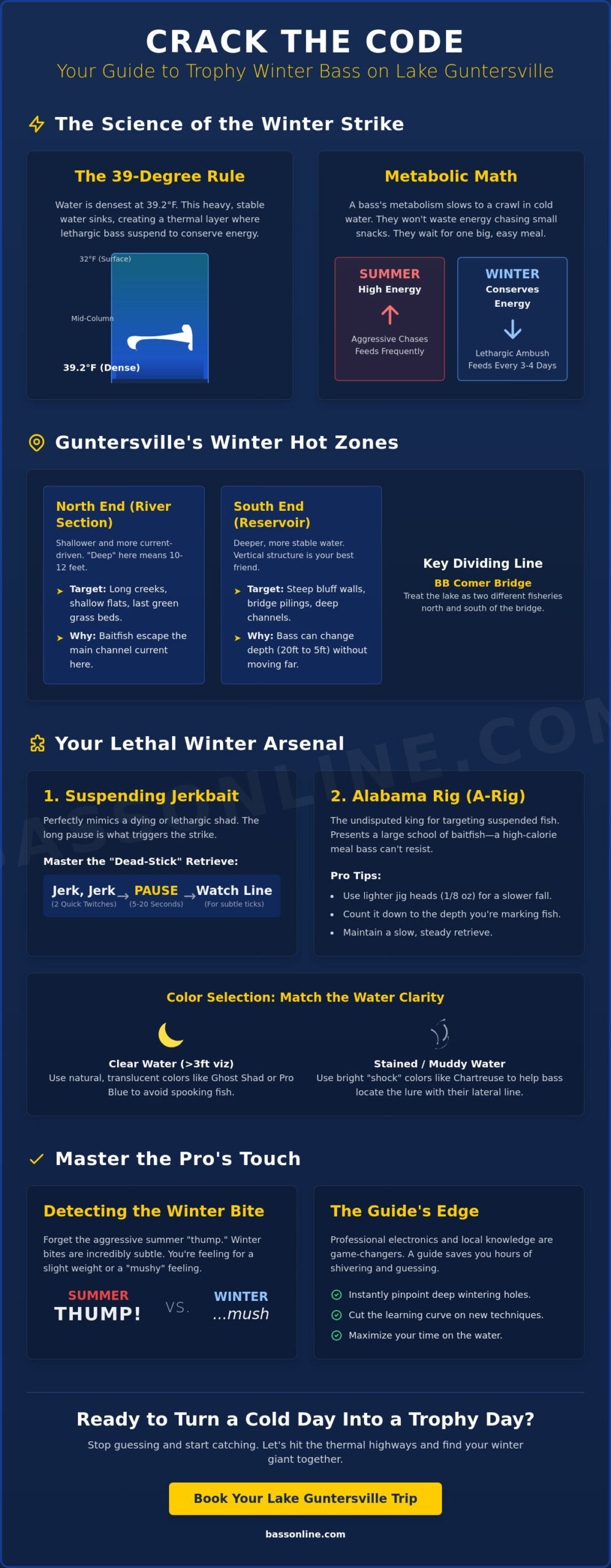
The "39-degree rule" is a secret weapon for cold-water experts. Water reaches its maximum density at approximately 39.2 degrees Fahrenheit. In the deep channels of Lake Guntersville, this "heavy" water sinks, creating a stable thermal layer. Bass often suspend right in this dense pocket because it requires less effort to maintain their position. They aren’t always hugging the bottom; sometimes they are hovering in the middle of the water column, waiting for a lethargic shad to drift by. During these stretches, a bass might only feed once every three to four days. Your job is to be there for that hunger strike or, more likely, to trigger a defensive reaction strike by invading their personal space so aggressively that they have to snap at your lure.
Metabolic Suppression and Caloric Budget
When the water turns icy, a bass’s heart rate slows to a crawl, and digestion takes significantly longer. Metabolic suppression is the biological slowdown to conserve winter energy. Because their "engine" is idling, a five-pounder isn’t going to burn 500 calories chasing a school of tiny minnows. They want one big, easy meal that pays the bills for the rest of the week. This is why many of our Alabama fishing trips in the winter focus on larger profile baits moved at a snail’s pace. You have to make the caloric reward look high, and the physical effort look low.
Water Clarity and the Lateral Line
As the famous Guntersville grass dies back and settles on the bottom, the water often clears up beautifully. While better visibility sounds great, it makes the fish more cautious. Bass rely heavily on their lateral line, a row of sensory organs that detect minute vibrations and pressure changes in the water. In clear winter conditions, they use this "sixth sense" to verify what they see. I recommend using natural, translucent colors like ghost shad or pro blue in high-vis water. Save the "shock" colors, like chartreuse, for the rare days when winter rains leave a muddy stain to the creek mouths.
-
Natural Colors: Use when visibility exceeds three feet to avoid spooking wary fish.
-
Shock Colors: Best for stained water or low-light, overcast winter mornings.
-
Vibration: Critical for helping bass "home in" on your lure through their lateral line.
Guntersville’s Winter Map: Finding the Thermal Highways
To master winter bass fishing on Lake Guntersville, you have to understand that this lake is essentially two different fisheries divided by the BB Comer Bridge. Up North, the Tennessee River is narrower and shallower. Down South, it opens into a massive, deep reservoir. The "thermal highways" are the paths bass take between their deep wintering holes and the shallow areas where they might feed on a sunny afternoon. Finding these routes is the difference between a record-breaking day and a long, cold boat ride.
Verticality is your best friend in January and February. Look for a structure that allows a bass to change its depth without traveling long distances. Steep bluff walls and bridge pilings are absolute gold. A trophy bass can move from 20 feet to 5 feet just by swimming up the side of a rock face. This saves the fish valuable calories while keeping them close to potential meals. If you’re struggling to read these transitions on your sonar, booking one of our Lake Guntersville fishing trips can cut your learning curve in half and put you right on the schools.
The North End: Shallow Water Tactics
In the upper section of the river, "deep" is a relative term. While a South-end angler might look for 30 feet, North-end fish consider 10 to 12 feet their winter sanctuary. These fish stay in these mid-depth ranges because the river current keeps the water oxygenated and moving. You’ll want to target the long creeks and shallow flats where baitfish congregate to escape the main channel flow. Look for the last remaining patches of green milfoil or hydrilla. As noted on Outdoor Alabama, these aquatic plants are the lifeblood of the lake’s habitat. Even a small patch of green grass in 8 feet of water can support a massive school because it produces oxygen and absorbs heat more effectively than the surrounding dead vegetation.
The South End: Deep Water and Staging Drops
Once you pass the bridge and head toward the dam, the game changes completely. Here, wintering holes are often 20 to 25 feet deep on staging drops near the main river channel. On the coldest days, pro-grade electronics often reveal massive schools suspended over 45-foot basins. These fish are often waiting for the afternoon sun to bake the rip-rap and rock along the shore. Rock holds heat much longer than mud or sand. If the sun has been out for at least three hours, those southern rocky banks can be three to four degrees warmer than the open water. That small temperature spike is often enough to trigger a flurry of activity from big largemouths looking for an easy meal.
-
North End Tip: Focus on 10-12 foot depths near creek mouths.
-
South End Tip: Target 20-25-foot staging drops and sun-warmed riprap.
-
Vertical Structure: Always prioritize bluffs and pilings for suspending fish.
Top Winter Lures for Guntersville: Jerkbaits, A-Rigs, and Jigs
When you’re prepping for winter bass fishing at Lake Guntersville, your lure choice is about quality over quantity. You’re hunting for that one massive bite from a lethargic giant. On Alabama’s largest lake, the largemouth is the undisputed king, and they get very picky when the water turns cold. You need tools that mimic dying shad or trigger an instinctive snap. My big three for the winter are suspending jerkbaits, the legendary Alabama Rig, and finesse jigs.
Mastering the Jerkbait Pause
The jerkbait is the undisputed heavyweight champion of winter. But here’s the catch: most guys work it too fast. In forty-degree water, the "Count to 10" rule is your law. After you snap the bait down to its depth, you wait. You wait until you think you’ve waited too long, then you wait five more seconds. That pause is when the magic happens. The bass is staring it down, weighing the caloric cost. If you’re new to this game, check out our guide on Bass Fishing 101 to master the basics before hitting the Tennessee River. Stick with colors like "Guntersville Shad" or "Clear Ayu" to match the high-visibility water we see once the grass settles.
The Alabama Rig: A Guntersville Staple
You can’t talk about winter bass fishing Lake Guntersville without mentioning the Alabama Rig, or A-Rig. This setup utilizes a central head with multiple wire arms to mimic a small, vulnerable school of shad. By rigging three to five small swimbaits together, you create a "baitball" effect that is irresistible to a hungry bass. The A-rig triggers a competitive feeding response in schools, making a bass strike out of the fear that another fish will get the meal first. To handle this heavy setup, you’ll need a dedicated 7-foot 10-inch heavy-action rod and at least 20-pound fluorocarbon line. It’s a workout to throw, but the results speak for themselves when the water is icy.
Finesse Jigs and Blade Baits
When the fish are glued to the bottom or tucked into the last remaining green grass, a finesse jig is my go-to. I prefer small profile "hair jigs" or compact silicone jigs in brown or purple. These mimic the crawfish that remain active even in the cold. If the fish are completely dormant and won’t look at a slow-moving bait, I’ll switch to a blade bait. The high-frequency vibration of a metal blade can "wake up" a bass and force a reaction strike when nothing else works. It’s a high-energy tool for a low-energy environment.
-
Jerkbaits: Best for suspending fish over deep grass or points.
-
A-Rigs: Ideal for targeting schools of bass following shad in open water.
-
Jigs: The primary choice for bottom-dwelling bass on rocky bluffs.
-
Blade Baits: Use these to trigger reaction strikes from inactive fish.
Slowing Down for Success: Professional Retrieve Techniques
Success in winter bass fishing Lake Guntersville isn’t about how many casts you make. It’s about the quality of the retrieve. Some folks suggest covering as much water as possible to find active fish, but that is a major mistake in the dead of January. When the water temperature is hovering near 40 degrees, the fish are glued to specific structure. If your lure flies past them too fast, they won’t even blink. You have to park your bait in their face and leave it there until they can’t stand it anymore. This requires a level of patience that many weekend anglers struggle to maintain.
Mental discipline is your greatest asset on the Tennessee River during the cold months. You have to accept the reality that you might only get five bites all day. If you lose focus during a three-hour lull, you’ll be out of position or too slow to react when that ten-pounder finally inhales your jig. I treat every single cast like it’s the one that will break my personal record. That mindset keeps your hands ready and your eyes locked on your line, which is exactly where the battle is won or lost in the winter.
The Art of the Dead-Stick
The "dead-stick" method is the hardest skill for an aggressive angler to learn, but it’s the most lethal tool in my boat. To do this correctly, cast your jig or Ned rig onto a deep ledge or a sun-warmed rock and let it sit perfectly still. I often wait 30 to 45 seconds before even thinking about moving it. I like to use the wind to my advantage here. A slight breeze creates a tiny ripple on your fishing line, which translates into a natural, microscopic quiver on your lure. This mimics a dying shad perfectly without you ever turning the reel handle. Overworking the bait is the fastest way to get ignored by a trophy bass trying to conserve its caloric budget.
Detecting the Winter Bite
You won’t feel a violent summer "thump" right now. A winter strike usually feels like your lure just got heavy or "mushy." It’s almost like you’ve snagged a wet leaf or a piece of dead grass. This is why I insist on using high-quality fluorocarbon line. It has virtually no stretch and transmits those subtle weight changes directly to your hands. If your line feels even slightly different, set the hook. Swinging is free, and on this lake, that "mushy" feeling is often a giant largemouth. If you want to see exactly how we detect these subtle strikes in real-time, join us for one of our Lake Guntersville Fishing Trips. We’ll get the right gear in your hands and show you the "why" behind every hookset.
-
Watch Your Line: Sometimes the only sign of a bite is a slight jump or sideways movement in your slack line.
-
Fluorocarbon is Key: Use 12-15lb test for sensitivity and to help your lures sink into the strike zone.
-
Stay Warm: It’s hard to feel a mushy bite if your fingers are numb. Invest in good gloves.
If you’re ready to test your grit and hunt for a winter monster with the pros, reach out to book your winter adventure today.
Why a Guided Winter Charter Beats Hitting the Bank Alone
Winter is the season of extremes on the Tennessee River. While the potential for a career-best trophy is at its peak, the margin for error is razor-thin. You can spend eight hours shivering in the wind and never once cross paths with a school of bass. This is where the advantage of a professional guide becomes undeniable. We don’t just provide a boat; we provide a sophisticated tactical advantage that combines high-end technology with decades of on-the-water intuition.
Our boats are equipped with pro-grade electronics that let us to see exactly how fish respond to the "39-degree rule" we discussed earlier. Instead of guessing whether the bass are suspended or hugging the bottom, we can see them in real time. Beyond the tech, a professional logbook is our secret weapon. I know exactly where the schools were yesterday, last week, and three years ago under identical weather patterns. This historical data allows us to bypass "dead" water and go straight to the most productive wintering holes on the lake.
Safety is another critical factor that often goes overlooked. Navigating winter fog and the heavy currents of the Tennessee River can be dangerous for those unfamiliar with the terrain. A seasoned captain understands the nuances of the river’s flow and how to keep the boat stable in biting winds. We handle the navigation and the gear, so your only job is to stay focused on the next bite.
Shortcutting the Learning Curve
One day spent with a pro can save you three seasons of trial-and-error frustration. We provide hands-on coaching to help you master the "mushy" bite detection and the precise cadence of a winter jerkbait retrieve. You’ll gain access to localized knowledge and specific spots that simply aren’t found on public maps. By learning from our Fishing Guides , you’ll walk away with a deeper understanding of how to read the water and adapt your strategy to any cold-weather scenario.
Book Your Guntersville Winter Adventure
If you’re hunting for a true 10-pound trophy, winter bass fishing Lake Guntersville offers your best statistical chance of success. These fish are at their heaviest weights of the year, and the crowds are at their thinnest. Our team brings a national reputation for excellence and deep local roots to every trip, ensuring you’re in the most capable hands in the industry. Don’t let the cold keep you off the water when the biggest fish of your life are waiting just below the surface. Book your Lake Guntersville winter bass fishing charter today!
-
Pro Electronics: Pinpoint suspended schools instantly.
-
Expert Coaching: Learn the subtle art of cold-water retrieves.
-
Safety First: Navigate fog and currents with a local authority.
-
Trophy Potential: Target the lake’s biggest bass during their peak weight.
Conquer the Cold and Land Your Trophy
You now have the biological blueprint and the tactical map needed to turn a freezing day into a career-defining outing. We’ve broken down the metabolic science behind the winter strike and identified the specific thermal highways that hold the lake’s biggest residents. By mastering the slow-cadence retrieve and picking the right wintering holes, you’re already miles ahead of the competition. Winter bass fishing Lake Guntersville demands patience, but the reward for your discipline is the heaviest largemouth of your life.
Don’t let the technical details or the Alabama chill keep you at the dock. With over 25 years of guiding experience on this river, our professional captains specialize in these exact winter patterns. We provide the top-tier electronics and essential safety gear to ensure your trip is both successful and secure. Ready to land a winter trophy? Contact our expert Lake Guntersville guides today! The giants are waiting for you in the deep; let’s go get them.
Frequently Asked Questions
What is the best water temperature for winter bass fishing on Lake Guntersville?
The best water temperature for a winter feeding frenzy is usually between 48 and 52 degrees. While you can certainly land giants in forty-degree water, that slight rise toward the fifty-degree mark often triggers a metabolic switch that makes bass hunt more aggressively. I always look for these subtle temperature spikes on sunny afternoons, especially in areas where northern winds are blocked by high bluffs or timber.
Do bass stay in the grass during the winter on Guntersville?
Bass will absolutely stay in the grass as long as it remains green and continues to produce oxygen. While much of the lake’s milfoil and hydrilla dies back and turns brown, any remaining green patches act as heat magnets and oxygen factories. These isolated clumps are high-priority targets for winter bass fishing Lake Guntersville because they concentrate both baitfish and predators into small, predictable strike zones.
What is the most effective winter lure for a beginner on the lake?
A 1/2-ounce lipless crankbait is the most effective tool for beginners because it is simple to cast and covers a lot of water. You don’t need a complex retrieve to be successful; just a steady, slow crawl with occasional "rips" to clear any dead grass will trigger big strikes. This lure allows a novice to clearly feel the vibration, making it obvious when a bass has inhaled the bait.
Is the North or South end of Lake Guntersville better in December?
The South end is typically more consistent in December because the deeper water provides a more stable thermal environment for the fish. While the North end can produce massive bags, it is much more susceptible to rapid temperature drops and muddy runoff from winter rains. The South end’s deep staging drops and rocky bluffs offer reliable wintering holes where schools of largemouth congregate for months at a time.
How long should I pause my jerkbait when the water is under 45 degrees?
You should pause your jerkbait for 10 to 20 seconds when water temperatures dip below 45 degrees. It feels like an eternity when you’re standing on the deck, but that stationary target is what convinces a cold, sluggish bass to commit. Most anglers fail because they get impatient and move the bait before the bass has time to close the gap. If you aren’t getting bit, try extending the pause even longer.
Can you catch bass on Lake Guntersville when there is ice in the creeks?
You can definitely catch bass even when ice is forming in the back of the shallow creeks. These extreme cold fronts often push fish out of the backwaters and onto the first major drop-off or secondary point. I look for the edge of the ice or the clearest water nearby. These fish will be tightly schooled and are highly susceptible to a vertical presentation like a metal blade bait or a heavy jig.
What color Alabama Rig works best in Guntersville’s winter water?
Natural shad patterns like pearl white or silver flash are the undisputed champions for winter bass fishing Lake Guntersville. Since the water often clears up significantly after the grass dies, you want a lure that mimics the translucent look of a cold, dying shad. If the water has a slight stain, I might swap the center swimbait for something with a chartreuse tail to provide a better focal point for the strike.
Is it better to fish the morning or afternoon on Guntersville in winter?
The afternoon is almost always better in the winter because the sun has had time to warm the shallows and rock faces. Even a two-degree increase in water temperature can be the "on" switch for a school of dormant bass. I usually start my guided trips a bit later during the winter months to take advantage of that peak thermal window between 1:00 PM and 4:00 PM.

Article by
Mr Bass
Todd Kersey, widely known as Mr. Bass by Field & Stream, is a professional angler, accomplished author, and dedicated philanthropist with a lifelong passion for bass fishing. Armed with a degree in Outdoor travel, Mr. Bass has expertly combined his knowledge with his practical fishing experience to become one of the most respected names in the bass fishing, his deep understanding of bass habitats, and fish behavior has earned him numerous accolades as a asset of the sport. Serving 8 years as FWC Stakeholder Chairperson. Leading and passing cutting-edge legislation, such as the Black Bass Management plan, and successfully building, passing, and financing the Trophy Catch program. As CEO, he is committed to giving back to the community through his philanthropic efforts. He supports a variety of causes, especially those centered around physical disabilities. Through his advocacy, his mentorship programs inspire anglers to engage in fishing stewardship, helping to raise more than $ 18 million in donations. Mr. Bass continues to inspire anglers and outdoor enthusiasts alike with his commitment to the sport and the world around him.