
White perch and white bass are both members of the temperate bass family, Moronidae, but they are different species with different markings, body shapes, habitats, and fishing behavior.
The easiest field clue is the side pattern: white bass usually show several horizontal stripes, while white perch are generally more uniformly silver or gray and do not show the same bold horizontal striping. Because young fish can look similar, use several features together instead of relying on color alone.
Quick Answer: White Perch vs White Bass
| Feature | White Perch | White Bass |
|---|---|---|
| Scientific name | Morone americana | Morone chrysops |
| Family | Moronidae | Moronidae |
| Side markings | Usually uniform silver/gray without bold horizontal stripes | Several dark horizontal streaks or stripes |
| Body shape | Body deepest ahead of the first dorsal fin | Body deepest beneath the first dorsal fin |
| Typical habitat | Fresh, brackish, estuarine and some coastal waters | Freshwater lakes, reservoirs and rivers |
| Feeding style | Opportunistic; eats invertebrates, crustaceans and fish | Open-water predator that often follows shad and other baitfish |
What Is a White Perch?
White perch are Morone americana. Despite the common name “perch,” they are not true perch; they belong to the same temperate-bass family as striped bass and white bass.
MassWildlife describes white perch as relatively deep-bodied, spiny-rayed fish with two dorsal fins that are slightly connected. Their color can range from silver to gray or olive depending on the water, and the body is generally uniform rather than strongly striped.
White perch can tolerate a wide range of salinity. Native and established populations occur in coastal bays, estuaries, rivers, lakes, and reservoirs. In some regions they move into fresher water during spring spawning runs.
Learn more from the Massachusetts Division of Fisheries and Wildlife white perch profile and Maryland DNR fish facts.
What Is a White Bass?
White bass are Morone chrysops, a freshwater temperate bass found across much of North America. They commonly live in lakes, reservoirs, and rivers and often form schools that follow baitfish in open water.
White bass typically show several dark horizontal streaks along their silver sides. The U.S. Fish & Wildlife Service lists a common length of about 12.5 inches, although larger fish occur.
They are especially well known for spring movements into tributaries and rocky spawning areas. Outside the spawning period, anglers often locate them by watching for bait schools, birds, surface activity, or electronics.
For more white-bass identification help, see our White Bass vs Striped Bass guide.
How to Tell White Perch and White Bass Apart
1. Look at the Side Markings
White bass normally show horizontal dark streaks or stripes. Missouri Department of Conservation describes several horizontal olive-gray streaks along the sides.
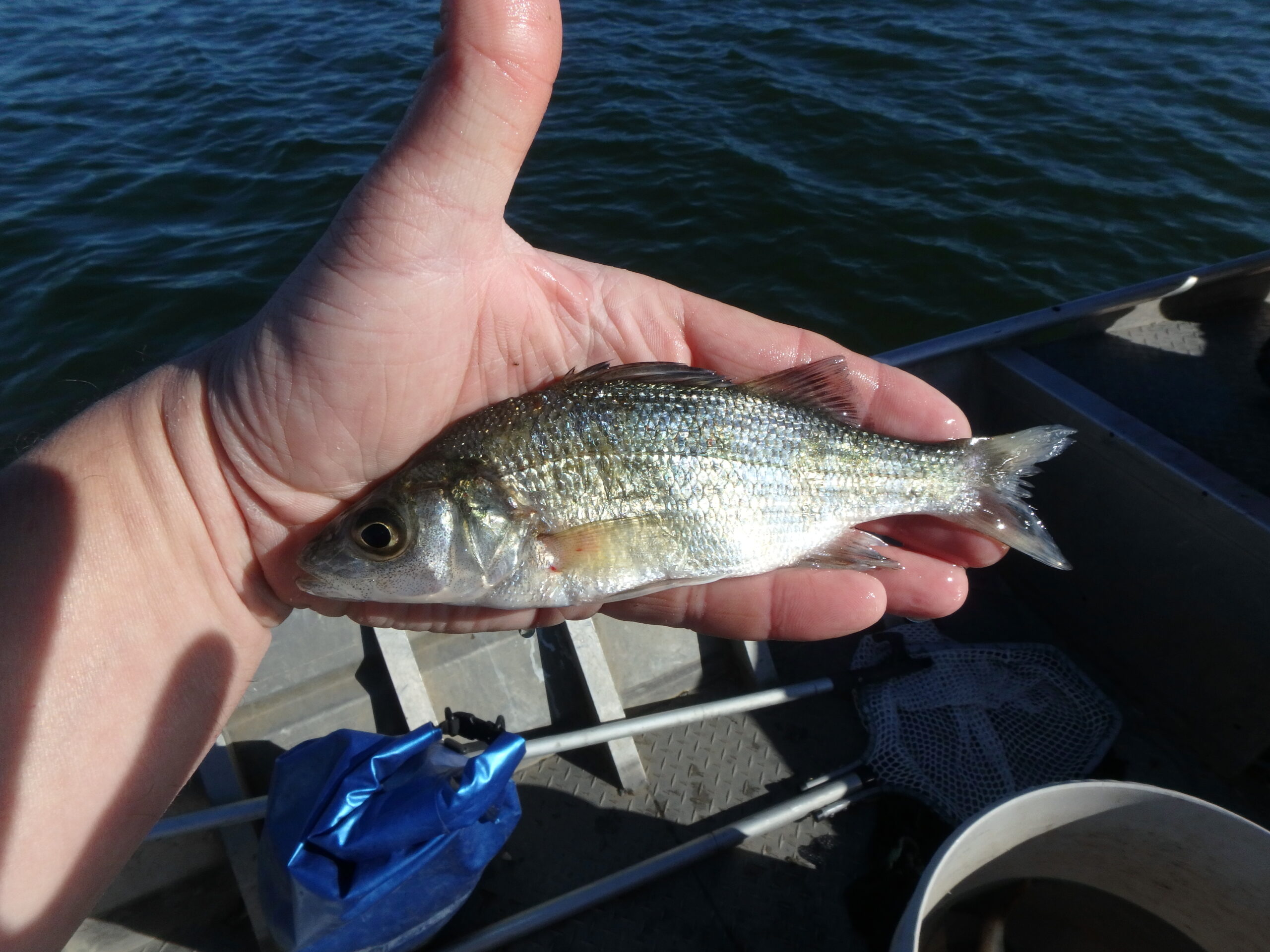
White perch usually look more uniformly silver, gray, or olive. MassWildlife notes that they generally lack stripes, spots, or other strong markings. Individual fish can vary with water color and condition, so use markings as one clue rather than the only clue.
2. Compare the Body Shape
The USGS white perch species profile distinguishes their body proportions: white perch are deepest ahead of the first, spiny dorsal fin; white bass are deepest beneath it. Use this alongside side markings.
Body proportions are easier to use when you can compare several fish from the same waterbody.
3. Check the Dorsal Fins
White bass have distinct spiny and soft dorsal sections. The notch or connection between dorsal sections can be difficult to judge on a folded fin or photograph. Do not make that feature your only identification test; compare markings and body proportions with a state fisheries identification guide.
4. Use Size as a Supporting Clue
White perch are commonly smaller, often encountered in the 7- to 10-inch range in many fisheries, although larger fish occur. White bass commonly average around 12 inches and can grow substantially larger.
Size alone is not enough for identification because young white bass and large white perch can overlap.
Habitat Differences
White perch are highly adaptable and can live in fresh, brackish, and estuarine water. Their native range is tied strongly to Atlantic coastal systems, although populations have become established far inland in some regions.
White bass are primarily freshwater fish. They are commonly associated with reservoirs, lakes, large rivers, and open-water baitfish schools.
If you are fishing an estuary or tidal river, white perch may be the more likely target. In a large inland reservoir with schooling shad, white bass are more typical.
Feeding and Fishing Behavior
White perch are opportunistic feeders. Depending on location and size, they eat aquatic insects, crustaceans, fish eggs, and small fish.
White bass become strongly piscivorous as they grow and often feed on shad and other small baitfish. Their schooling behavior can create fast action when a group pushes forage toward the surface.
White Perch Tactics
- Use small jigs, minnows, worms, or other small natural baits where legal.
- Fish around docks, bridges, channel edges, tidal creeks, or deeper holes depending on the waterbody.
- Use light tackle so smaller fish remain sporting.
- Check local regulations because limits vary by state and fishery.
White Bass Tactics
- Watch for baitfish schools and surface-feeding activity.
- Use small spoons, jigs, crankbaits, swimbaits, or other shad-imitating lures.
- During spring, focus on tributaries, current seams, rocky shoals, and migration routes where legal.
- Use electronics to stay with moving schools in lakes and reservoirs.
Do White Perch and White Bass Hybridize?
Hybrids between white perch and white bass have been documented. The U.S. Geological Survey species profile records hybridization in the Great Lakes region.
That is one more reason visual identification should use multiple features. If a fish does not match normal field traits, local fisheries biologists or agency identification resources are better references than a single photo or color pattern.
Do not confuse these fish with hybrid striped bass, often called wipers. For that comparison, see our Hybrid Striped Bass vs Striped Bass guide and Hybrid Striped Bass species page.
White Perch vs White Bass: Which One Are You Catching?
Start with the side markings and habitat. A uniformly silver, deep-bodied fish from an estuary or coastal-connected system may be a white perch. A silvery freshwater fish with several horizontal streaks that is schooling around baitfish is more likely a white bass.
Then confirm the identification with body shape and fin structure. When in doubt, check a state fisheries field guide before harvesting the fish.
Featured photo: White perch, U.S. Fish and Wildlife Service, public domain, via Wikimedia Commons.