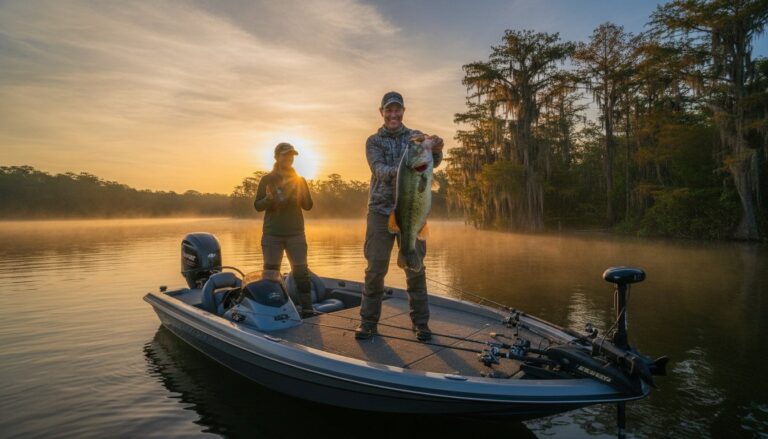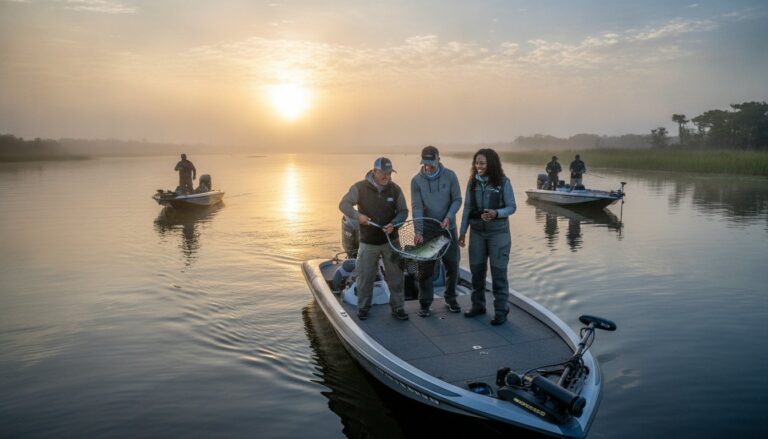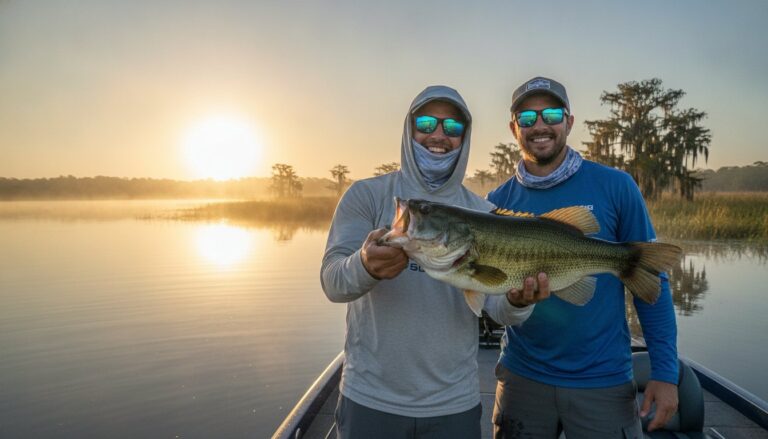
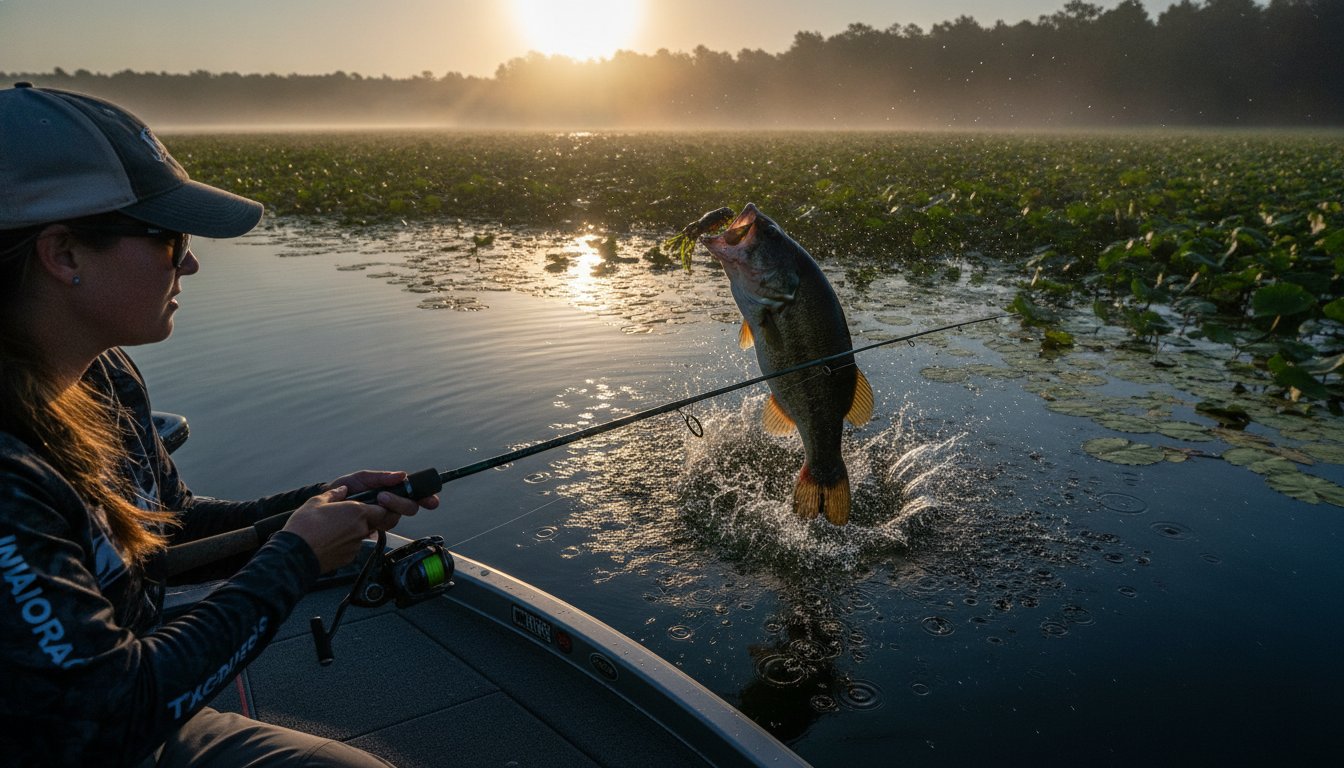

Most anglers lose their biggest bass of the year because they’re simply too fast on the trigger. When a six-pounder explodes through a thick mat of lily pads, your natural instinct is to rip the rod back instantly, but that’s actually the fastest way to pull the lure right out of the fish’s mouth. Learning how to master topwater frog fishing requires more than just a good cast; it demands the discipline to stay calm when the water turns into a washing machine. We’ve all felt the sting of a missed strike or the frustration of getting pinned in thick hydrilla because our line or rod wasn’t up to the task.
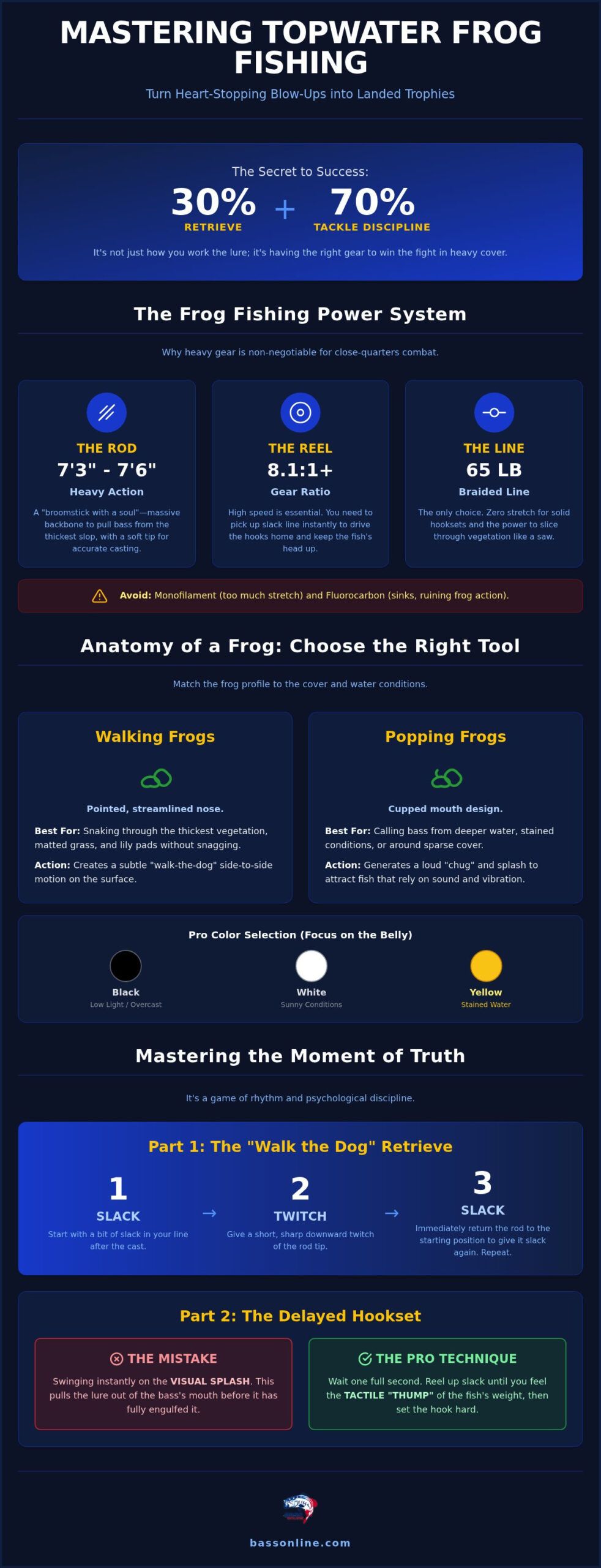
With over 20 years of guiding experience on a diverse array of challenging bass waters across the country, Bass Online knows that frog fishing success is 30% retrieve and 70% tackle discipline. This guide will show you how to turn those heart-stopping blow-ups into landed trophy bass. You’ll learn exactly which hollow-body frogs to tie on for specific cover, how to execute a perfect walk the dog retrieve, and the secret to the legendary delayed hookset. We’re going to dial in your gear and timing so you can stop missing fish and start hauling them out of the heaviest cover on the lake.
Key Takeaways
- Switch from monofilament to 65lb braided line to ensure you have the raw power needed to winch big bass out of the heaviest slop.
- Learn how to master topwater frog fishing by perfecting the slack-twitch-slack rhythm of the “walk the dog” retrieve to trigger aggressive strikes.
- Understand when to choose a popping frog over a walking frog to create the right level of surface disturbance for specific water clarity and cover.
- Build the psychological discipline to use a delayed hookset, waiting for the tactile “thump” rather than swinging on the initial splash.
- Identify high-percentage seasonal targets like post-spawn fry-guarding males and midday summer mats to keep your frog in the strike zone year-round.
The Frog Fishing Power System: Why Heavy Gear is Non-Negotiable
Frog fishing isn’t a finesse game; it’s close-quarters combat. If you want to learn how to master topwater frog fishing, you have to stop thinking about lures and start thinking about gear synergy. A hollow-body frog is a specialized topwater fishing lure designed to go where other baits can’t, but the lure is only as good as the system pulling it. I’ve spent years guiding on Lake Guntersville, and the biggest mistake I see is anglers bringing “all-purpose” tackle to a heavy-cover fight. You aren’t just fighting a bass. You’re fighting ten pounds of matted hydrilla and lily pad stems. If your gear isn’t up to the task, the fish wins every single time.
Reel speed is your best friend in the slop. You need a high-speed casting reel with at least an 8.1:1 gear ratio. When a trophy bass blows up on your frog, it often swims toward the boat or tries to bury itself deep in the vegetation. A slow reel won’t pick up the slack fast enough to get a solid hookset. You need to move a lot of line with every turn of the handle to keep that fish’s head up and moving toward the net. If that bass gets its head down, the fight is usually over before it starts.
The Braided Line Advantage
Monofilament and fluorocarbon have no place in this style of fishing. Monofilament stretches like a rubber band, which kills your hookset at the end of a long cast. Fluorocarbon sinks, which pulls the nose of your frog down and ruins its action. Braided line is the only option. It has zero stretch, meaning every bit of force from your hookset goes directly into the fish. More importantly, heavy braid acts like a saw blade. When a bass wraps you around a lily pad stem, 65lb braid will often slice right through the vegetation, allowing you to winch the fish out. While 50lb test is the absolute minimum, 65lb is the professional standard for the thickest mats.
Choosing Your Frog Rod
You need a “broomstick” with a soul. I recommend a heavy action rod between 7 feet 3 inches and 7 feet 6 inches. This length provides the leverage needed to haul a giant out of the weeds while still being short enough for accurate casting. The key is finding a rod with a massive backbone but a slightly soft tip. That soft tip allows the rod to “load” during the cast, which is essential for launching a light frog long distances. Once the hook is set, the stiff backbone takes over. You need that raw pulling power to move a five-pounder plus a five-pound clump of grass without the rod doubling over and losing control of the fish.
Anatomy of a Frog: Choosing the Right Tool for the Cover
Picking the right frog isn’t about finding the prettiest paint job on the shelf. It’s about how that body collapses and how the hooks are positioned for the strike. If you want to know how to master topwater frog fishing, you need to apply situational logic to your lure selection. On a lake like Lake Toho, you might face heavy mats one hour and sparse reeds the next. You need a specific tool for each environment to maintain a high hook-up ratio.
The most critical component of any frog is the hook. You need wide-gap, heavy-wire hooks that won’t flex under the pressure of a heavy-action rod. As we discussed in the power system section, your gear is only as strong as its weakest link. A cheap, thin hook will straighten out the moment you try to haul a trophy bass through twenty pounds of hydrilla. Look for frogs where the hook points sit flush against the body to remain weedless, but collapse easily when bit. You need a tool for each.
Walking vs. Popping Profiles
Walking frogs, like the SPRO Bronzeye Frog, feature a pointed, streamlined nose. This design is the gold standard for snaking through thick vegetation and heavy slop without snagging. Use these when you need to “walk the dog” over matted grass. Popping frogs, such as the Booyah Poppin’ Pad Crasher, have a cupped mouth. These are tools for calling bass out of deeper grass or making noise in stained water. The splash and chug of a popping frog can trigger strikes from fish that can’t see the lure through the surface film. For color, keep it simple. Focus on the belly. Use black for low light or overcast days, white for sunny conditions, and yellow for stained water.
Modifying Your Lures Like a Pro
Most pros don’t fish a frog straight out of the box. Small tweaks make a massive difference in how many fish you actually land. Trimming the rubber legs is the first step. I usually trim one side about half an inch shorter than the other. This creates an uneven resistance that makes it much easier to walk the frog in tight spaces. If you’re fishing heavy midday mats, consider adding internal rattles to help the bass locate the lure through the weeds.
The most important modification is the hook angle. Take a pair of pliers and bend the hook points slightly upward and outward, about 1/8th of an inch. This exposes the points just enough to grab the fish’s mouth more effectively without making the lure constantly snag on the grass. If you’re struggling to get the right action, spending a day with a professional guide can show you exactly how these modifications change the game in real-time.
The Master’s Retrieve: Walking the Dog in the Slop
Once you’ve dialed in your gear and tied on the right lure, the next step in learning how to master topwater frog fishing is perfecting the retrieve. Most beginners make the mistake of overworking the bait. They keep it moving constantly, thinking they need to cover as much water as possible. While speed has its place, the real magic happens in the rhythm. The “walk the dog” cadence is a slack-twitch-slack motion. You aren’t pulling the frog with a tight line. Instead, you’re snapping the rod tip against a slightly slack line to make the frog’s nose pivot left and right. This side-to-side dance mimics a wounded baitfish or a panicked amphibian, and it’s irresistible to a predator lurking below.
One of the biggest secrets to success is what I call the “Power of the Pause.” In my 20 years of guiding, I’ve seen that nearly 50% of strikes occur when the frog is completely stationary. This is the “dead stick” technique. When you reach a hole in the moss or the edge of a shade line, stop the frog. Let the ripples settle. A bass will often track a moving frog for yards, waiting for it to pause before committing to a massive blow-up. If you keep the bait moving, you might actually pull it away from a fish that was just about to strike.
In heavy mats, you also need to use the “thump.” Bass can’t always see the frog through several inches of vegetation, but they can feel the vibration. By giving the rod a sharper twitch, you make the frog’s body displace the mat, sending a signal down into the water column. It’s like a dinner bell for big bass buried deep in the grass. This vibration helps the fish zero in on the target before they ever see the lure.
Retrieval Rhythms for Success
Your rhythm should change based on the sun and the fish’s mood. During the low-light hours of early morning, go with an aggressive walk. Bass are active and looking for a fight. As the sun gets higher and fish retreat into the thickest shade, slow down. Use a slow twitch with long pauses to tempt midday bass that are buried deep in heavy cover. If you aren’t getting bit, vary your speed. Sometimes they want a fast, frantic chug; other times, they want a frog that barely moves. Let the fish tell you what cadence they want on that specific day.
Reading the Vegetation
Not all grass is created equal. The most productive spots are often seams where two different types of vegetation meet, like where hydrilla touches a lily pad field. These are natural travel corridors for bass. When working lily pads, keep your rod tip high to avoid snagging the stems on the retrieve. The absolute best ambush point is the edge of a mat. Big bass love to sit right on the perimeter, looking up at the open water. When your frog reaches that edge, get ready. This is where the most explosive strikes happen on lakes like Lake Toho or Lake Guntersville.
The Moment of Truth: Mastering the Delayed Hookset
The blow-up is the most heart-pounding moment in freshwater sports, but it is also where most anglers fail. If you want to learn how to master topwater frog fishing, you have to conquer your own adrenaline. When a six-pounder crashes through a mat, your brain screams at you to set the hook immediately. If you swing on the splash, you will likely watch your frog fly back at the boat. To land these fish, you must prioritize tactile feedback over visual chaos. You don’t swing when you see the splash; you swing when the frog disappears and you feel the weight of the fish on your line.
The “One-Two Count” is the psychological discipline required for success. After the strike, wait two full seconds before reacting. This delay allows the bass to fully inhale the hollow-body lure, turn its head, and dive back toward the cover. This movement is what actually positions the hooks for a successful penetration. Once you feel that heavy “thump” or tension on the line, it is time to deliver the mail. A vertical power set toward the 12 o’clock position is essential. Swinging to the side often results in the hooks catching the edge of the mouth or pulling the frog out entirely. A vertical set drives those heavy-wire hooks into the hard roof of the bass’s mouth.
Why We Miss: The Science of the Strike
Understanding the “why” behind missed fish will help your confidence. A hollow-body frog is designed to collapse when a bass bites down, exposing the hooks. If the bass hasn’t fully compressed the body, the hooks remain shielded. Swinging for the fences is necessary because you are trying to drive thick hooks through a plastic body and into a bony jaw. If a fish short-strikes and misses the lure, do not reel in immediately. Let the frog sit still for a few seconds. Often, that same bass will circle back to finish the job on a “wounded” target.
Step-by-Step Hookset Execution
- Step 1: The blow-up occurs. Immediately lower your rod tip toward the fish to give it some slack.
- Step 2: Reel in the remaining slack quickly until you feel the physical weight of the bass.
- Step 3: Deliver a violent, upward hookset using your legs and core for maximum leverage.
- Step 4: Keep the fish’s head up. If you let it bury into the grass, your chances of landing it drop by half.
Mastering this timing takes practice, but it is the difference between a story about “the one that got away” and a trophy photo. If you want to see these techniques in action on the water, contact our expert guide team today to schedule a trip on one of the country’s premier bass lakes.
Situational Strategy: Where to Throw a Frog Year-Round
Many anglers think frog fishing is strictly a summer midday activity, but that’s a narrow view. If you want to know how to master topwater frog fishing, you have to follow the seasonal movements of the bass. As long as the water temperature stays above 60 degrees Fahrenheit, a frog is a viable weapon in your arsenal. In early spring, look for the very first signs of lily pad growth in shallow, back-water pockets. These young pads provide the first bits of overhead cover for post-spawn males guarding fry. These fish are incredibly protective; they will annihilate anything that disturbs the surface near their nursery.
When the summer heat hits, the frog becomes a primary tool for finding midday giants buried under thick mats. While many anglers choose mat punching with heavy weights, a frog offers a more stealthy alternative that triggers aggressive surface strikes. In the autumn transition, the game changes again. Bass begin following baitfish into the backs of creeks and pockets. Focus on any remaining green vegetation or shade lines along steep banks. This is the fall feed-up, where bass pack on weight before the winter, making them much more willing to chase a moving target.
Advanced Seasonal Patterns
Timing the frog window is about reading the environment. In the fall, the bite can actually improve as the vegetation begins to die back, creating clear lanes for the bass to see your lure. However, you should put the frog away if the water temperature drops below 58 degrees or if the water becomes excessively muddy. Bass need a certain level of visibility and metabolic activity to commit to a topwater strike. See our bass fishing 101 guide for more tips on reading these seasonal shifts and identifying prime water conditions.
Level Up with a Professional Guide
Reading about techniques is a great start, but there’s no substitute for time on the water with an expert. Seeing a pro work a frog on Lake Guntersville is the fastest way to learn. You’ll get real-world coaching on retrieve cadence and that critical delayed hookset timing in heavy cover. A guide can show you exactly how to master topwater frog fishing by identifying the subtle sweet spots in a mat that most anglers overlook. Ready for an explosive day? Contact our expert guides to book your trip today!
Dominate the Slop and Land Your Next Trophy
Mastering the frog isn’t just about witnessing the bite; it’s about the discipline to wait for the weight and the raw power to pull giants from the slop. You now have the blueprint for the gear, the cadence, and the timing needed to succeed. Whether you’re walking a frog through summer mats or targeting post-spawn pockets, these small adjustments to your tackle and technique will dramatically improve your hook-up ratio. It’s time to stop missing blow-ups and start filling the livewell.
Learning how to master topwater frog fishing is a journey that changes how you look at every lily pad and hydrilla mat you see. Remember to trust your 65lb braid and never swing on the splash. If you’re ready to see these field-tested techniques in action on the country’s premier lakes, our team is ready to lead the way. We bring over 20 years of professional guiding experience and provide exclusive access to the best trophy bass lakes in the US using strategies refined by local tournament pros.
Book Your Pro-Guided Bass Fishing Adventure Now and experience the thrill of an explosive topwater strike for yourself. We’ll see you on the water!
Frequently Asked Questions
What is the best color frog for bass fishing?
Focus on the belly color because that’s the only part the bass actually sees from below. Use a black belly for low light, early morning, or overcast days to create a high-contrast silhouette against the sky. On bright, sunny days, switch to a white or natural belly. If you’re fishing stained water, a yellow or chartreuse belly provides the extra visibility needed to trigger a strike.
Do I really need 65lb braid for frog fishing?
Yes, 65lb braid is the professional standard for fishing heavy cover. You need the zero stretch properties to drive heavy-wire hooks into a bony jaw and the raw strength to pull a bass through thick vegetation. While you can get away with 50lb in sparse weeds, 65lb braid acts like a saw blade to cut through lily pad stems and hydrilla.
Can you fish a topwater frog in open water?
You can absolutely fish a topwater frog in open water, especially around isolated cover like a single stump or dock piling. Popping frogs are particularly effective here because they create more surface disturbance to call fish in from a distance. It is a great way to learn how to master topwater frog fishing without the added pressure of navigating thick mats.
How long should I wait to set the hook on a frog?
Wait approximately two seconds after the blow-up before you set the hook. This “one-two count” gives the bass time to fully inhale the lure and turn its head. If you swing the moment you see the splash, you’ll likely pull the frog away. Learning this patience is a critical step for anyone trying to understand how to master topwater frog fishing successfully.
What do I do if a bass misses my frog?
If a bass misses your frog, let it sit perfectly still for several seconds. Often, the fish will circle back to finish off what it thinks is a wounded meal. If it doesn’t strike again after a few twitches, quickly reel in and cast a soft plastic weightless worm into the same spot. That follow-up cast often catches the fish while it’s still aggressive.
Should I trim the legs on my hollow body frog?
Trimming the legs is a pro move that makes the frog much easier to walk side-to-side. Cut about an inch off the rubber strands, and consider trimming one side slightly shorter than the other. This creates an uneven resistance in the water that helps the lure pivot with much less effort. It also prevents fish from nipping at the legs without hitting the hooks.
What is the best rod length for frog fishing?
The ideal rod length for frog fishing is between 7 feet 3 inches and 7 feet 6 inches. This range gives you the leverage to haul big fish out of heavy cover while remaining short enough for accurate casting. You need a heavy action rod with a stiff backbone to ensure those thick hooks penetrate the jaw on every single strike you get.
Is frog fishing effective in the winter?
Frog fishing is rarely effective in the winter because bass become lethargic in cold water. You generally want to wait until water temperatures reach at least 60 degrees before reaching for a frog. Once the spring sun warms those shallow flats and the first pads start to emerge, the frog bite will turn on as bass move into the shallows to feed.

Article by
Mr Bass
Todd Kersey, widely known as Mr. Bass by Field & Stream, is a professional angler, accomplished author, and dedicated philanthropist with a lifelong passion for bass fishing. Armed with a degree in Outdoor travel, Mr. Bass has expertly combined his knowledge with his practical fishing experience to become one of the most respected names in the bass fishing, his deep understanding of bass habitats, and fish behavior has earned him numerous accolades as a asset of the sport. Serving 8 years as FWC Stakeholder Chairperson. Leading and passing cutting-edge legislation, such as the Black Bass Management plan, and successfully building, passing, and financing the Trophy Catch program. As CEO, he is committed to giving back to the community through his philanthropic efforts. He supports a variety of causes, especially those centered around physical disabilities. Through his advocacy, his mentorship programs inspire anglers to engage in fishing stewardship, helping to raise more than $ 18 million in donations. Mr. Bass continues to inspire anglers and outdoor enthusiasts alike with his commitment to the sport and the world around him.