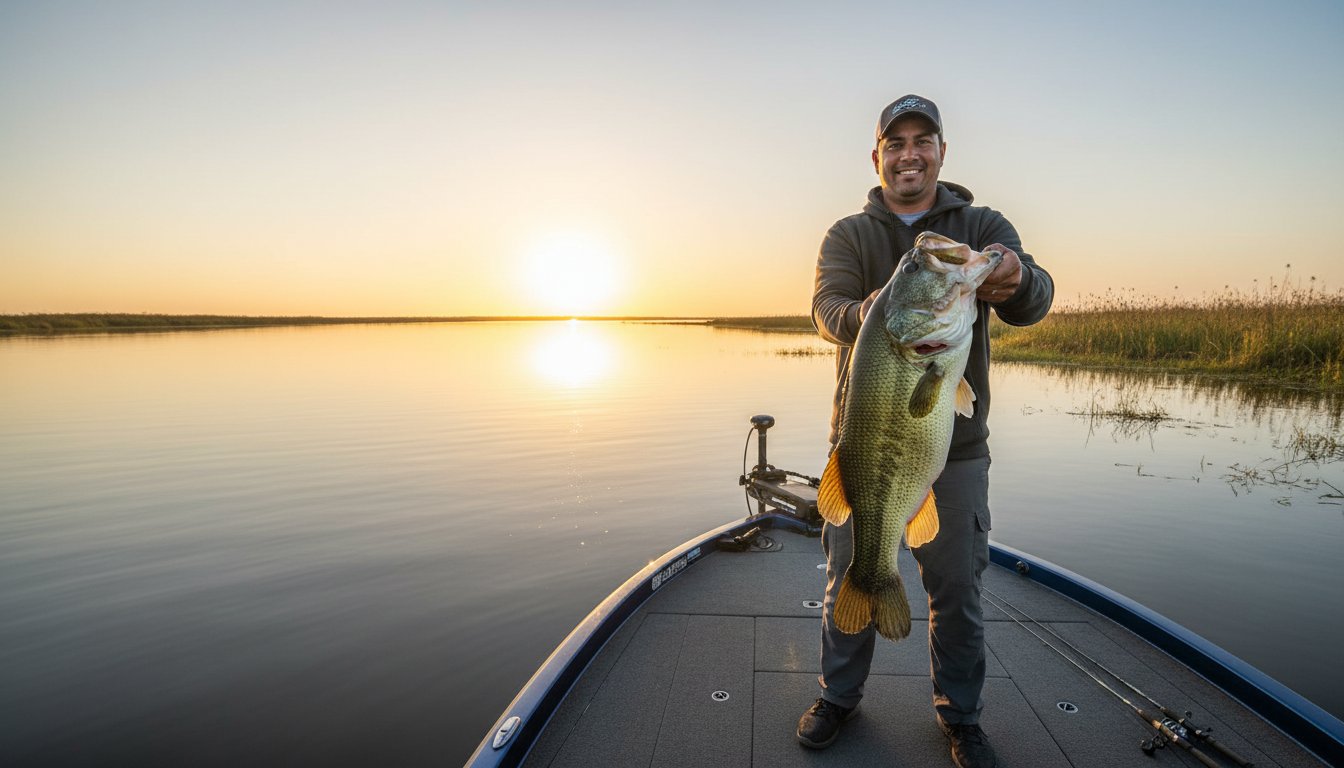

You can fish a thousand lakes in your lifetime, but you haven’t truly lived until you’ve stared down a double-digit hawg in the heart of the Big O. It’s no secret that looking at 450,000 acres of water can feel like trying to find a needle in a haystack. Many anglers arrive at the ramp and feel completely lost before they even drop the trolling motor. If you’ve felt overwhelmed by the sheer scale of lake okeechobee bass fishing, you aren’t alone.
I agree that the size is intimidating, and the shifting water levels can make navigation feel like a high-stakes guessing game. That’s why I’ve put together this field-tested guide to help you master the secrets of Florida’s most legendary fishery. You’ll learn how to identify the exact reed lines and peppergrass patches that hold trophy fish throughout the 2026 season.
We’re going to break down the primary zones of the lake, settle the debate between pro-level lures and live bait, and pinpoint the best month to land that 10-pounder you’ve been dreaming about. Let’s get to work and turn that confusion into a successful expedition.
Key Takeaways
-
Understand why vegetation is the ultimate structure on the Big O and how to identify the specific grass types that hold trophy largemouth.
-
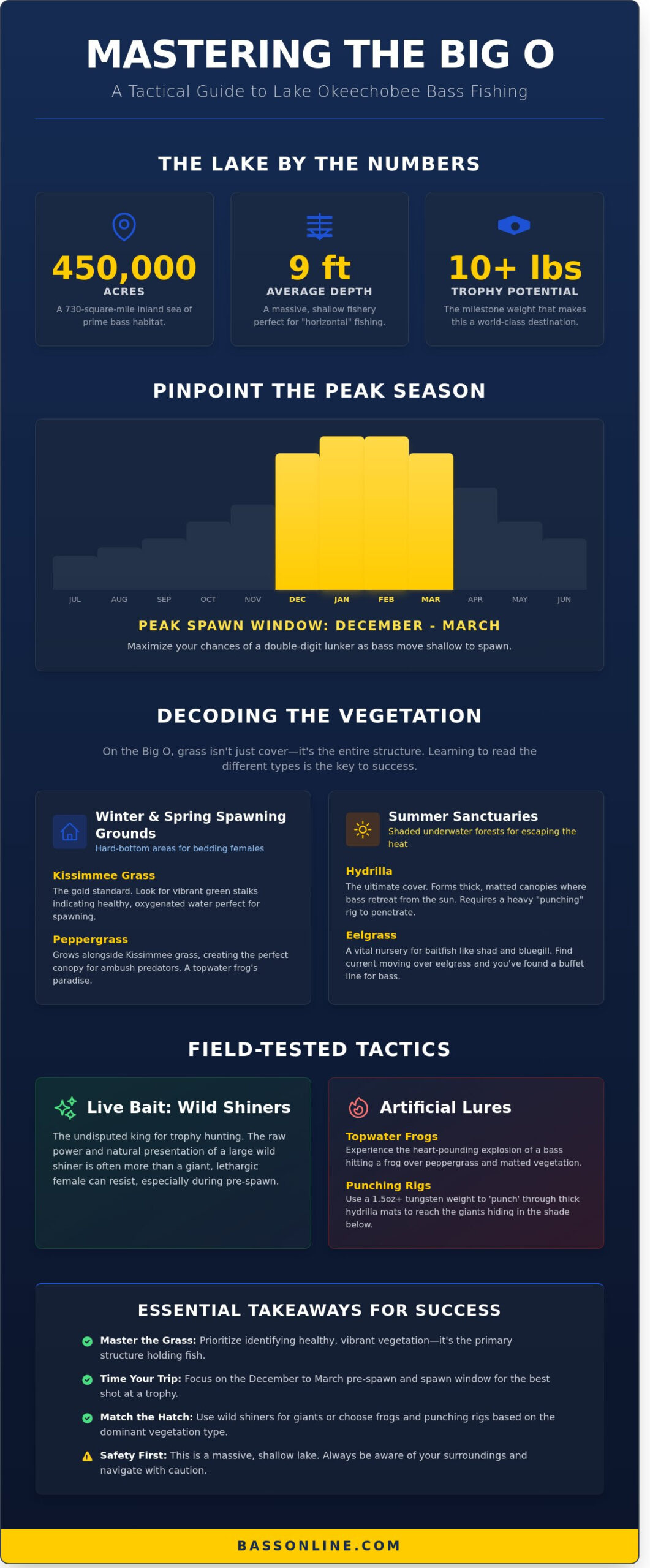
Pinpoint the "Peak Season" window from December to March to maximize your chances of landing a double-digit lunker during the spawn.
-
Master the field-tested tactics for lake okeechobee bass fishing, from the raw power of wild shiners to the heart-pounding thrill of topwater frog explosions.
-
Learn the essential safety secrets for navigating 730 square miles of shallow-water hazards to ensure your expedition is both successful and secure.
Table of Contents
-
The Legendary Big O: Why Lake Okeechobee Bass Fishing is World-Class
-
Decoding the Vegetation: Understanding the Structure of a Grass Lake
-
Tactics for Success: Lures, Live Bait, and Reading the Water
-
Booking Your Expedition: Why a Professional Guide is Essential
The Legendary Big O: Why Lake Okeechobee Bass Fishing is World-Class
Welcome to the "Bass Capital of the World." This isn’t just a lake; it’s a massive, 730-square-mile inland sea that dominates the South Florida landscape. When we talk about Lake Okeechobee, we’re talking about the heartbeat of the Florida Everglades. It’s a raw, prehistoric world where the grass is thick, the gators are plentiful, and the bass grow to legendary proportions. This unique shallow-water ecology allows for a year-round growing season, meaning there’s never a bad time to hunt for a giant.
The vastness of this ecosystem is truly best appreciated from above; for those inspired by the freedom of the Florida skies, you can learn more about 2FLY Airborne, a premier flight training academy.
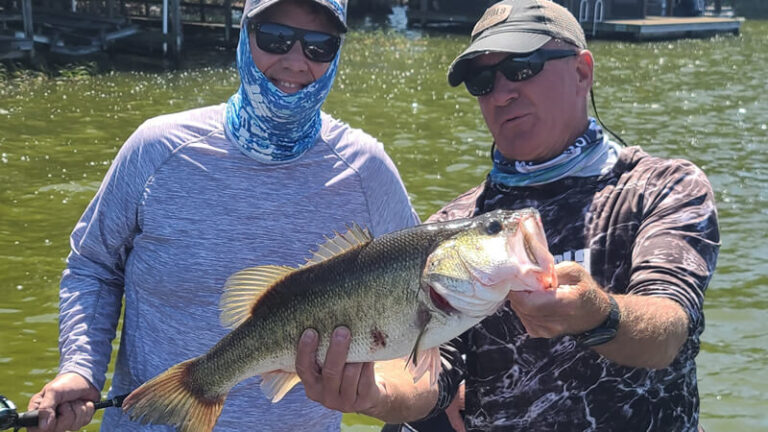
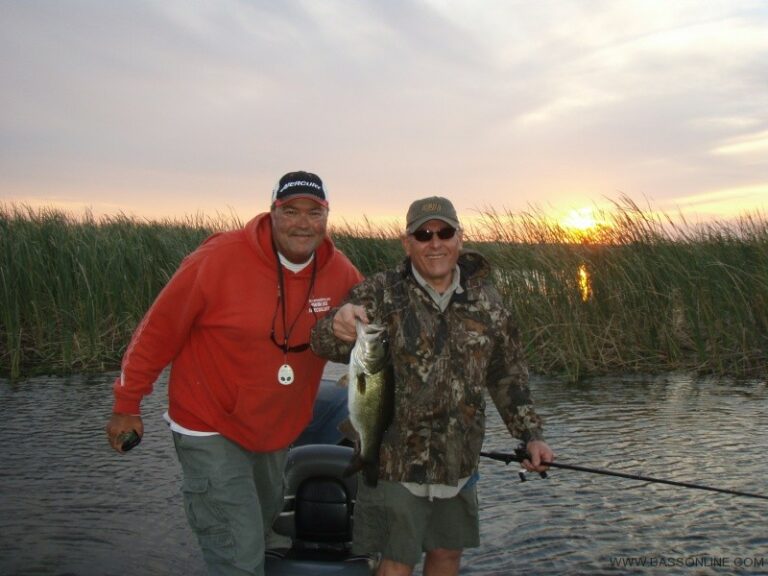
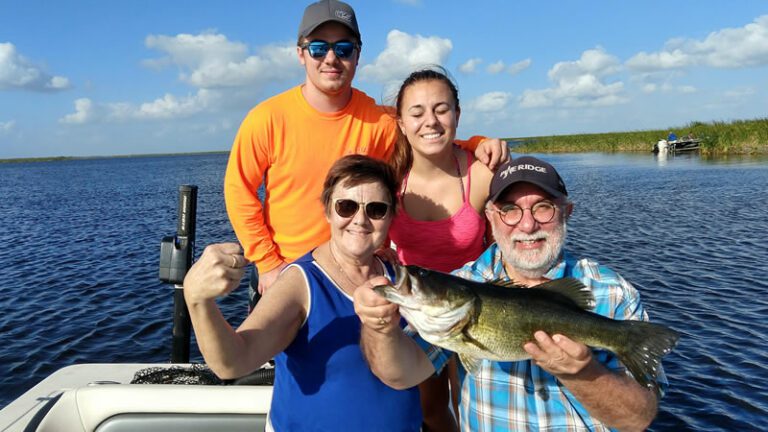
Anglers travel from every corner of the globe for one reason: to catch a Florida-strain bucketmouth that can tip the scales over 10 pounds. This ecosystem consistently produces more double-digit hawgs than almost any other waterway in the United States. The setup is purely "horizontal," meaning the fish use the vast vegetation for cover rather than deep-water ledges. It’s an adrenaline-fueled style of fishing where a massive strike can happen in just two feet of water at any moment.
To better understand this concept, watch this helpful video:
The Scale of the Opportunity
This massive water body covers over 450,000 acres of prime habitat. Because the average depth is only 9 feet, the entire lake acts as one giant hunting ground for predators. We focus on specific fishing zones like the North Shore, Monkey Box, and Clewiston to stay on the bite. While lake okeechobee bass fishing is the main draw, the lake also supports massive populations of Crappie (Speck) and Bluegill. Check our outdoor blog for current bite reports and seasonal movements.
Trophy Potential and Expectations
On most lakes, a 5-pounder is a trophy. Here, that’s just a solid starter. We define a true trophy as an 8-pound lunker, but the 10-pound milestone is what brings people back year after year. Bass Online has documented thousands of successful trips over the last 20 years, proving this lake is a factory for giants. Known as the "Big O" for its massive 450,000-acre surface area and surprisingly shallow 9-foot average depth, this lake offers a world-class horizontal fishing experience found nowhere else on earth.
Decoding the Vegetation: Understanding the Structure of a Grass Lake
Forget everything you know about fishing deep reservoir ledges or rocky points. On the Big O, the grass is the structure. If you want to master lake okeechobee bass fishing, you have to learn to read the garden. Vegetation dictates where bass eat, sleep, and spawn. These plants provide the primary oxygen source in the shallow, stained water and offer the perfect ambush cover for a hungry largemouth. Without grass, the bass simply won’t stay in an area.
Identifying healthy grass is the first skill every local pro masters. You want to see vibrant green stalks and clear water filtering through the stems. If the grass looks brown, feels slimy, or smells like rotting eggs, move on. Dying vegetation consumes oxygen instead of producing it, which drives fish away. In 2026, weed management has shifted toward more mechanical harvesting. You’ll find that bass are repositioning around these freshly cut "highways" in the marsh. Always check the latest updates from the Florida Fish and Wildlife Conservation Commission to see which areas are currently under management to avoid dead water.
Kissimmee Grass and Peppergrass
Kissimmee grass is the gold standard for finding trophy bass during the winter and spring spawn. It grows in hard-bottom areas, which is exactly what a big female needs to bed down. Look for "mixed bags" where peppergrass grows nearby. Peppergrass is thinner and often tops out just below the surface. This combination creates a perfect canopy. When you see the morning sun hitting a patch of peppergrass, get your topwater frogs or walk-the-dog baits ready. The edges of these grass lines act as a dinner rail for aggressive post-spawn hawgs.
Hydrilla and Eelgrass: The Underwater Forests
Hydrilla is the ultimate summer sanctuary. This submerged plant grows in thick, vertical columns that create massive underwater forests. When the Florida sun cranks the temperature up, schools of bass retreat into the shade of these mats. This is where the "punching" technique shines. You’ll need a 1.5-ounce tungsten weight and a heavy-duty flipping stick to break through the surface crust to reach the giants hiding in the cool pockets below. Eelgrass is equally vital; it serves as a nursery for shad and bluegill. Find a patch of eelgrass with a little current moving over it, and you’ve found a gold mine.
Reeds and Cattails: The Perimeter Protectors
Reeds and cattails form the lake’s outer defense. These sturdy plants are excellent wind breaks. On a breezy day, the calm water behind a thick reed line can be 5 degrees warmer and significantly clearer. If the wind is howling, the "Rim Canal" strategy becomes your best friend. This deep-water trench provides a secondary structure when the main lake gets too rough to fish. For more tips on navigating these conditions, check out our latest reports on the BassOnline outdoor blog. Understanding how water levels affect these reed lines is critical for any lake okeechobee bass fishing expedition in 2026. Use these vertical stalks as ambush points by pitching jigs right into the tightest pockets of the root systems.
The Takeaway: Success on Lake Okeechobee depends on your ability to distinguish between life-giving green vegetation and oxygen-depleted brown muck. Focus on "edges" where two types of grass meet to find the most active schools.
Seasonal Rhythms: The Best Time for Lake Okeechobee Bass
You can land a trophy any day of the year on the Big O, but understanding seasonal shifts is what separates a lucky day from a legendary one. For anglers hunting a double-digit hawg, the calendar is your most important piece of gear. The lake changes its personality with the water temperature, shifting fish from deep hydrilla edges to the heart of the shallow hayfields.
December through March represents the absolute peak of lake okeechobee bass fishing. This is when the biggest females in the system move toward the vegetation to prepare for the spawn. We see the highest concentration of 8 to 12 pound fish during these four months. If you want your best shot at a personal best, this is your window. The air is comfortable, the fish are heavy, and the bite is aggressive.
The Spawning Cycle (Winter & Spring)
Bass here respond to the moon like clockwork. During the three days surrounding the full and new moons in January and February, massive waves of fish push into the shallows to lock onto beds. Focus your efforts on the north end near Okeechobee City; the sprawling marshes of Kings Bar and Government Cut offer the ideal hard-bottom spawning habitat these lunkers crave. When a cold front drops water temperatures by 5 degrees in a single night, Okeechobee bass often retreat into the thickest hydrilla mats, requiring heavy punching weights to reach their strike zone.
Summer and Fall Patterns
Summer in Florida is intense, but the bite doesn’t stop. You just have to be an early bird to beat the heat. From June through August, the first two hours of daylight are your critical window for a topwater explosion. We focus on moving water during the rainy season. Target the current near the S-351 or S-354 locks because oxygenated water keeps the fish active even when the main lake surface temperature hits 90 degrees.
Fall is our favorite "sleeper" season for lake okeechobee bass fishing. As the water cools in October and November, shad migrate in massive schools toward the mouth of the Kissimmee River. You’ll find high-volume catches and zero competition from the winter crowds. It’s common to land 30 to 40 fish in a single afternoon using swimbaits or lipless cranks to mimic the moving baitfish. For more detailed updates on current lake levels and bait migrations, check out our latest reports on the BassOnline blog.
-
Winter: Focus on wild shiners in the reeds for trophy-sized females.
-
Spring: Sight fish the clear pockets in the "Monkey Box" or "Moonshine Bay."
-
Summer: Use frogs and swim jigs over thick grass mats before 9:00 AM.
-
Fall: Follow the birds to find schooling bass chasing shad in open water.
Takeaway: While winter offers the best chance at a double-digit trophy, the fall transition provides the highest volume of fish with the least amount of pressure. Match your tactics to the water temperature, and you’ll find success in any season.
Tactics for Success: Lures, Live Bait, and Reading the Water
Success on the "Big O" isn’t about luck; it’s about strategy and understanding the thick vegetation that defines this ecosystem. You have to know how a 10-pounder thinks when she’s buried deep in the hydrilla. Reading the water is your first step. Look for "nervous water" where baitfish like shad or shiners are flickering near the surface. If you see a patch of pads shaking or birds diving in a specific pocket, get your bait in there immediately. These are the tell-tale signs of a feeding frenzy.
The Power of Wild Golden Shiners
Wild golden shiners are the undisputed gold standard for landing a trophy. Don’t confuse these with hatchery-raised bait; wild shiners have the natural survival instincts that trigger a bass’s predatory drive. They swim harder and dive deeper into the cover. Our pro guides use two primary methods for shiner fishing. First, we use float placement, usually 18 to 24 inches above the bait, to keep the shiner from burying itself too deep in the grass. Second, we use "free-lining" in open pockets, allowing the bait to swim naturally to find the lunkers. You can learn more about this approach in our guide on Live Bait vs. Artificial Lures: The Florida Debate.
Essential Artificial Lure Selection
If you prefer the grind of artificials, your "Big O" starter kit must include lipless crankbaits, swim jigs, and soft plastics. The "Speed Worm" is perhaps the most versatile lure on the lake. You can buzz it across the surface like a toad or swim it through submerged grass. When the sun gets high, and the fish move under the thickest mats, we switch to "punching." This technique uses a 1.5 to 2-ounce tungsten weight to penetrate the canopy, putting a beaver-style plastic right in front of a hawg’s face. Stick to these proven colors for Lake Okeechobee bass fishing:
-
Junebug: The absolute go-to for stained water.
-
Black/Blue: Perfect for low-light conditions or heavy shade.
-
Watermelon: Best for those rare days of high water clarity.
Gear and Equipment Essentials
You cannot bring light tackle to this lake and expect to win. You need heavy-duty gear to pull a massive fish out of the abrasive sawgrass. I recommend a 7’6” Medium-Heavy to Extra-Heavy rod paired with a high-speed reel. A 7.1:1 or 8.1:1 gear ratio is vital for picking up slack quickly after a strike. For line, 50 to 65lb braid is the industry standard here. Fluorocarbon often snaps when rubbed against the sharp edges of the reeds, but braid cuts through the vegetation like a saw, giving you the leverage needed to land a legend. Mastering these gear choices is what separates a good day of lake okeechobee bass fishing from a record-breaking one.
Ready to test your skills against a Florida trophy? Book your professional Lake Okeechobee guide today and experience the thrill of the strike!
Booking Your Expedition: Why a Professional Guide is Essential
Lake Okeechobee is a massive inland sea covering 730 square miles. For the uninitiated, this waterbody is as dangerous as it is beautiful. The average depth is only nine feet, meaning a slight shift in wind or a wrong turn outside a channel can put your boat on a limestone reef or buried in a thick hydrilla mat. You don’t want to spend your vacation waiting for a tow boat. Hiring a professional guide ensures you navigate the complex trail system safely while staying on the hottest bite.
Trying to figure out lake okeechobee bass fishing on your own can take a decade of trial and error. A professional guide compresses those 10 years of learning into a single 8-hour day. We track water levels, temperature shifts, and vegetation growth daily. When you step onto the boat, you’re tapping into a real-time database of where the trophy hawgs are staging. Our "No Fish, No Pay" policy isn’t just a gimmick; it’s a guarantee of our commitment to your success. If you don’t catch a bass, you don’t pay the guide fee. We put our skin in the game because we’re confident in our ability to produce results.
Logistics matter when tackling the Big O. You need to choose a base camp that fits your style. Clewiston is the legendary "Bass Capital" on the south shore, providing quick access to the Shoal and Uncle Joe’s Cut. Belle Glade offers a quieter entry point to the grass islands of the southeast. If you’re coming from the north, Okeechobee City serves as the gateway to the Kissimmee River mouth and Government Cut. Each location offers a unique flavor of lake okeechobee bass fishing, and we can pick you up at the ramp closest to your lodging.
What to Expect on a Bass Online Charter
We offer half-day (4 hours), super-half (6 hours), and full-day (8 hours) expeditions. Every trip includes a tournament-ready bass boat equipped with the latest electronics and high-end tackle. You’ll use professional-grade rods and reels, so you don’t have to worry about gear failure when a double-digit lunker hits. Safety is our baseline. Every boat is stocked with modern life jackets, and our guides are experts at monitoring Florida’s rapid weather changes to keep you out of harm’s way.
-
Full-Day Trips: Best for those hunting a personal best, allowing time to rotate through multiple honey holes.
-
Half-Day Trips: Perfect for a quick morning burn or an evening topwater session.
-
What’s Included: Ice, water, fuel, and all necessary lures or terminal tackle.
Planning Your Trip Logistics
Before you arrive at the dock, you must secure your Florida Freshwater Fishing License. You can grab one instantly through the Fish|Hunt FL app or the GoOutdoorsFlorida website. For lodging, the region offers everything from the luxury of local resorts to the rugged charm of historic fish camps. Many of our clients prefer staying at Roland Martin’s Marina in Clewiston or the Pier II Resort in Okeechobee City for their proximity to the water.
Ready to haul in a giant? Don’t leave your trip to chance. Book Your Lake Okeechobee Trophy Bass Adventure Today!
Takeaway: A professional guide eliminates the guesswork and safety risks of the Big O, turning a potentially frustrating day into a world-class fishing experience with guaranteed results.
Claim Your Trophy on the Big O
You’ve got the map, the tactics, and the seasonal breakdown to conquer the Big O. Success on this legendary lake comes down to two things: reading the grass and timing the bite. Whether you’re flipping heavy mats in the summer heat or slow-rolling a swimbait during the winter spawn, understanding how these fish move through the vegetation is your ticket to a lunker. Lake okeechobee bass fishing isn’t just about throwing a lure; it’s about connecting with a world-class ecosystem that rewards patience and local knowledge.
Don’t leave your bucket-list trip to chance. We’ve spent over 25 years refining our techniques as the highest-rated bass fishing service in Florida. Our team knows every hidden hole and grass line from Clewiston to Okeechobee City. We’re so confident in our local expertise that we offer a No Fish, No Pay Guarantee. If you don’t catch fish, you don’t pay. It’s that simple. Grab your gear and let’s go find that double-digit hawg you’ve been dreaming about.
Book Your Legendary Lake Okeechobee Bass Trip Now!
Frequently Asked Questions
What is the best month for bass fishing on Lake Okeechobee?
The peak window for trophy lake okeechobee bass fishing runs from January through March when the big females move into the shallows to spawn. During these 90 days, you have the highest statistical probability of landing a double digit hawg. While you can catch fish year round, the winter and early spring months offer the most consistent action for anglers chasing a legendary personal best.
Do I need a fishing license for Lake Okeechobee?
You must have a valid Florida freshwater fishing license if you are between the ages of 16 and 64. You can purchase these easily through the Florida Fish and Wildlife Conservation Commission website or at local tackle shops. A 3 day non resident license currently costs about 17 dollars plus administrative fees. Don’t risk a fine; get your permit before we hit the water to hunt for lunkers.
Is Lake Okeechobee dangerous to navigate for beginners?
Navigating the Big O is notoriously tricky because the average depth is only 9 feet. Submerged stumps and rock piles can destroy a lower unit in seconds if you stray from the marked channels. Beginners should stick to the rim canal or follow a proven GPS trail. If the wind kicks up over 15 miles per hour, the lake turns into a washing machine, making it dangerous for smaller vessels.
What is the "No Fish, No Pay" policy?
Our "No Fish, No Pay" policy is a rock solid guarantee that ensures you get results on every single outing. If your party doesn’t land a fish during your scheduled charter, you don’t owe us a dime for the guide’s time. We have maintained a 99 percent success rate over the last 20 years because we know exactly where the hawgs hide. It is our way of proving we are the premier service.
Where is the best place to launch a boat on Lake Okeechobee?
Roland Martin Marina in Clewiston is the premier choice for southern access, while Scott Driver Park in the city of Okeechobee serves the north end perfectly. These two locations provide high-quality ramps and easy access to legendary spots like the Monkey Box or the Shoal. We often move our boats between 5 main access points to ensure we launch as close to the active bite as possible.
How much does a guided bass fishing trip cost?
Charter costs vary based on the duration of the trip and the number of anglers in your party. Professional guides on the lake typically offer 4-hour, 6-hour, and 8-hour packages to fit your specific schedule. Since fuel prices and seasonal demand fluctuate, check our live booking calendar for the most accurate daily rates. This ensures you get the best value for a world class lake okeechobee bass fishing experience.
Can I catch species other than largemouth bass on Lake Okeechobee?
You can target massive numbers of crappie, locally known as specks, especially from November through February. Bluegill and shellcracker also provide incredible light tackle action during the summer months. It is common for anglers to land 50 or more panfish in a single afternoon. If you want a break from chasing trophy bass, these species offer a fast-paced alternative that is fantastic for young anglers.
What should I bring on my Lake Okeechobee fishing charter?
Pack high-quality polarized sunglasses to cut through the surface glare and see the grass lines where lunkers hide. You also need SPF 50 sunscreen and a wide-brimmed hat to handle the intense Florida sun. We provide all the top-tier rods, reels, and tackle you will need for the day. Just bring your own snacks, drinks, and a positive attitude for a day of chasing legendary Florida hawgs.