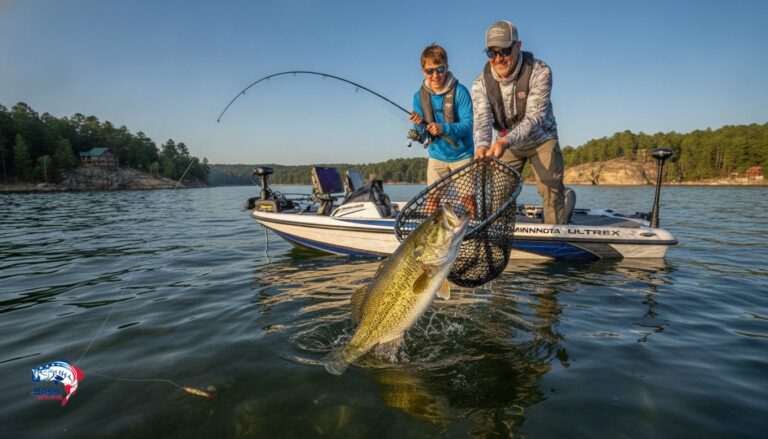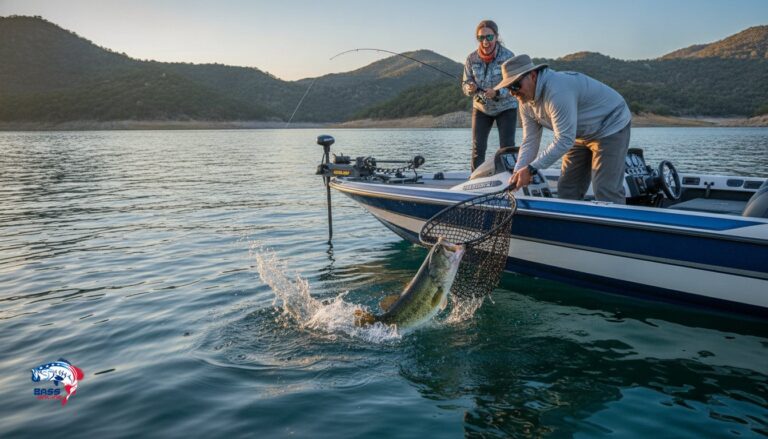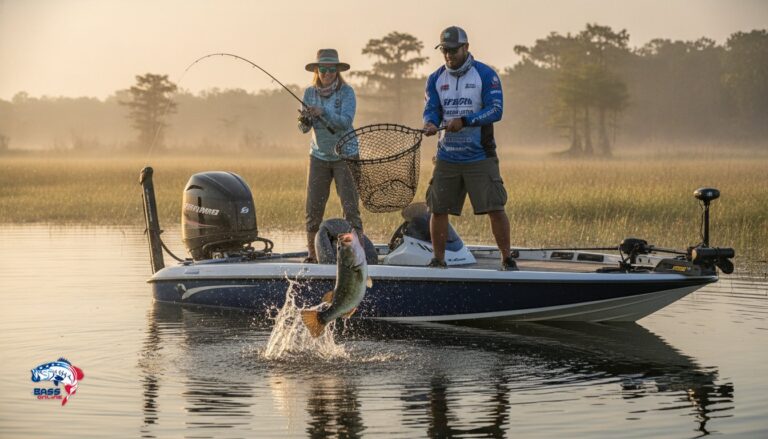
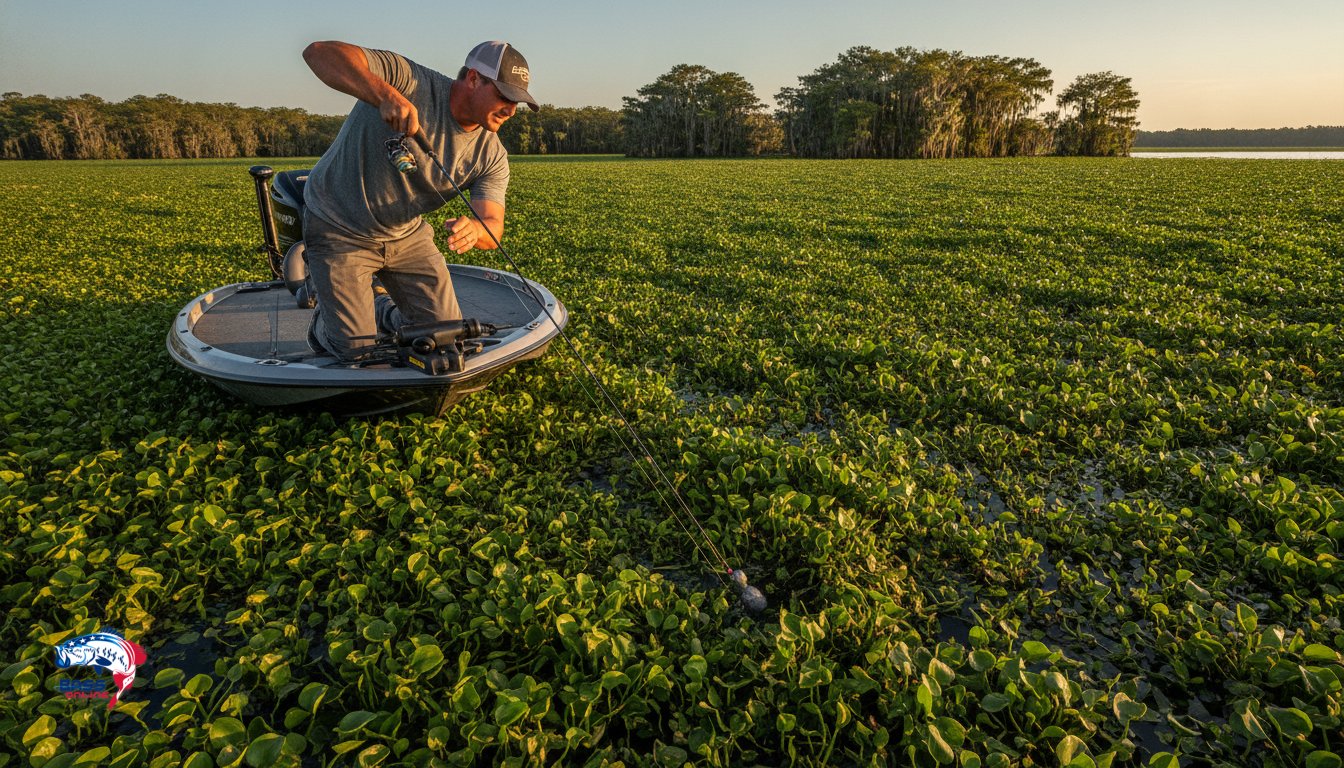

That impenetrable wall of green vegetation isn’t an obstacle; it’s the ultimate big-bass fortress. I know how frustrating it is to watch your favorite lure sit uselessly on top of a thick salad bowl while you know a trophy is lurking just inches below. It’s maddening to rip hooks out of heavy cover or struggle with gear that just isn’t up to the task. This guide will show you exactly how to fish grass mats for bass using the punching technique, a field-tested method our pro guides use to pull giants out of the thickest canopy. You’re going to master the art of the vertical drop and learn why heavy weights are your best friend in the summer heat.
We’ll dive into the specialized heavy-duty tackle you need, how to identify which mats are actually holding fish, and the specific search and destroy tactics that turn a daunting weed bed into your personal honey hole. By the time we’re done, you’ll have the confidence to tackle the heaviest cover on the water and land the fish of a lifetime. It’s time to stop fishing around the edges and start going where the big ones live.
Key Takeaways
- Understand the “Canopy Effect” and how living vegetation creates oxygen-rich sanctuaries that attract trophy bass during the summer heat.
- Assemble the right gear, focusing on a 7’11” extra-heavy rod and a high-speed reel to gain immediate control over a hooked fish.
- Learn the “flip and lift” technique and how to fish grass mats for bass by ensuring your lure achieves a perfect vertical entry through the mat.
- Use the “Iceberg Rule” to find mats with deep water underneath and target mixed vegetation areas for the best chance at a strike.
- Perfect your hookset with a vertical “hammer-down” motion and learn to winch fish to the surface quickly to avoid getting buried in the slop.
Why Bass Live Under Heavy Grass Mats
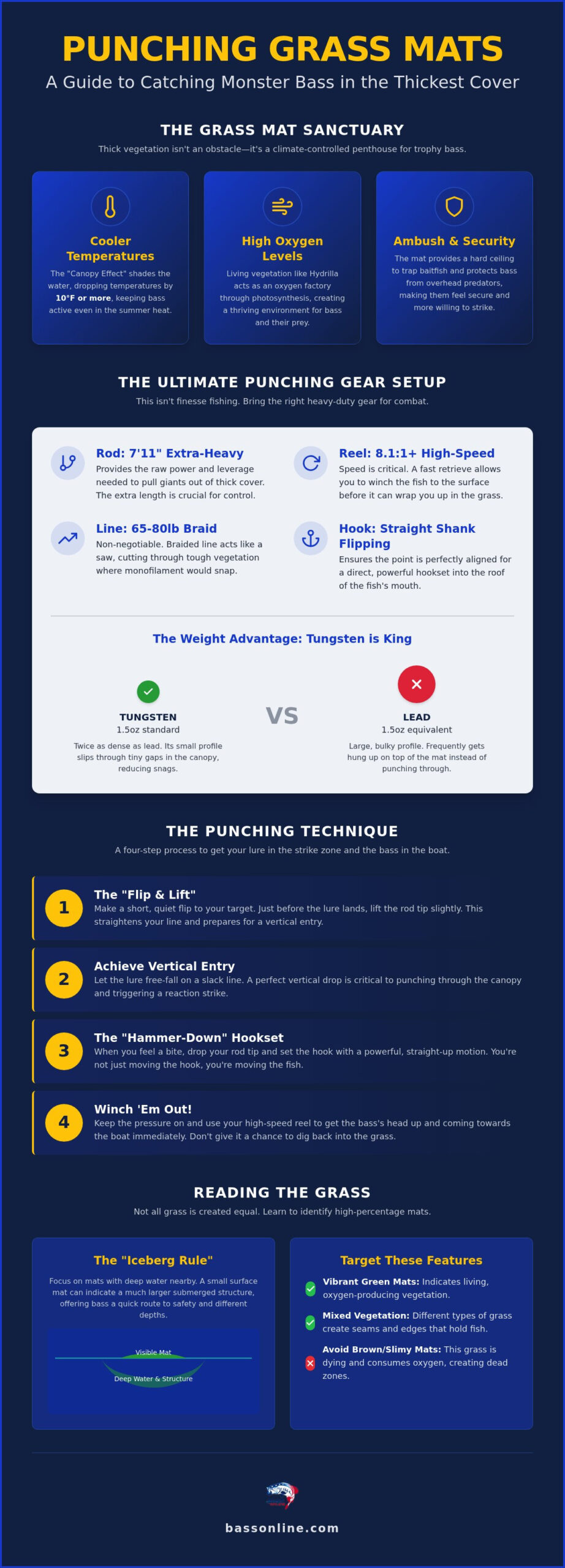
To truly master how to fish grass mats for bass, you have to think like a predator looking for a home. Matted vegetation is a biological sanctuary for trophy largemouth, offering a perfect mix of climate control, high oxygen, and easy meals. While the rest of the lake might be struggling with the summer heat, the bass under the slop are living in a climate-controlled penthouse.
The “Canopy Effect” is the primary draw for these fish. When the summer sun beats down on open water, surface temperatures can soar into the 90s, making fish sluggish and uncomfortable. Under a thick mat, those temperatures can drop by 10 degrees or more. This shade creates a localized cool zone that keeps Largemouth bass active and aggressive even in the middle of a July afternoon.
Living vegetation like Hydrilla or Milfoil acts as an oxygen factory. Through photosynthesis, these plants pump dissolved oxygen directly into the water column. In many lakes, deep water becomes stagnant and oxygen-depleted during the hottest months. The slop stays fresh, providing a high-oxygen environment that supports both the bass and the baitfish they hunt. This thick roof also serves as the ultimate ambush point. Bass use the underside of the mat as a hard ceiling, pinning bluegill or shad against the grass where they have no escape.
The Temperature Advantage
Think of a grass mat as a giant organic umbrella. On high-pressure days with intense sun, the mats get tighter and the bass move deeper into the shade. While many anglers head to 25 feet of water to find cooler temps, seasoned pros know the biggest fish often stay in three feet of water as long as they have a thick roof over their heads. The relationship is simple; the higher the sun intensity, the more the fish will tuck into the densest part of the mat. You don’t need deep water to find big fish if you have the right canopy.
Safety and Security in the Slop
Bass feel invincible under two inches of solid vegetation. It’s their fortress. This overhead cover protects them from avian predators like ospreys and eagles that can easily spot them in open water. Inside this “Comfort Zone,” they’re less spooky and more willing to strike a lure that invades their space. However, you’ve got to identify the right grass. Look for vibrant green mats that are full of life. If the grass is brown, slimy, or smells like rotten eggs, it’s dying and consuming oxygen. Avoid the dead zones and hunt for the “living” canopies to find the most active trophy bass.
The Ultimate Punching Gear Setup for 2026
If you want to master how to fish grass mats for bass, you can’t bring a knife to a gunfight. This isn’t finesse fishing; it’s heavy-duty combat that requires specialized tackle designed to survive the most abusive conditions on the water. To extract a five-pounder from a thick Hydrilla mat, your setup must prioritize raw power and surgical precision. Our guides spend thousands of hours testing this gear to ensure every component can handle the strain of a trophy fish buried in the slop.
The foundation of your rig is a 7’11” extra-heavy action rod. You need the extra length for leverage and a “parabolic” tip that loads up slightly before the backbone kicks in. This specific bend prevents you from ripping the hook out of the fish’s mouth during a violent hookset while still providing the power to move a giant. Pair this with a high-speed reel featuring a gear ratio of 8.1:1 or higher. In the “first five feet,” speed is everything. You have to winch that fish to the surface before it can wrap your line around a thick stalk and gain the upper hand.
Your connection to the fish must be indestructible. Braided line between 65lb and 80lb is non-negotiable. Braid acts like a saw, cutting through the vegetation that would snap monofilament instantly. On the business end, use a heavy-gauge straight shank flipping hook. Unlike offset hooks, a straight shank keeps the point aligned for a direct upward strike into the roof of the mouth. If you want to see how the pros handle this heavy-duty gear in person, you can always talk to a local guide about a day on the water.
Tungsten vs. Lead: Why Density Matters
Tungsten is the secret weapon for penetrating submerged aquatic vegetation as cover. It’s nearly twice as dense as lead, meaning a 1.5oz tungsten weight is significantly smaller than its lead counterpart. This slim profile allows your lure to slip through tiny gaps in the canopy rather than getting hung up on top. A 1.5oz tungsten weight is the gold standard for most mats, providing enough mass to break the surface tension while transmitting every vibration from the bottom through your rod blank.
Pegging and Skirting Your Rig
A loose weight is a recipe for disaster in the grass. Use two bobber stoppers to “peg” your weight tightly against the hook. This prevents the weight from sliding up the line, which often leaves your lure snagged on top while the weight falls through alone. To add extra appeal, incorporate a punch skirt. These skirts add bulk and vibration without the weed-catching limbs of a traditional jig. Match your colors to the local forage:
- Bluegill: Green pumpkin with purple or orange strands.
- Crawfish: Black and blue or dark red hues.
- Shad: White or silver accents for clearer water mats.
The Technique: How to “Punch” Through the Canopy
Success in the slop isn’t about luck; it’s about physics. To understand how to fish grass mats for bass, you must first master the vertical entry. If your lure hits the grass at an angle, it will simply slide across the surface like a skipping stone. Your goal is to have that heavy tungsten weight hit the mat at a perfect 90-degree angle. This concentrated force allows the rig to pierce the canopy and reach the strike zone below where the giants live.
The “Flip and Lift” is the secret move that separates the amateurs from the pros. As you flip your lure toward a target, give the rod tip a slight upward lift just before the weight makes contact. This tiny adjustment helps the weight break the surface tension of the grass. Once it breaks through, keep a semi-taut line. You don’t want it completely slack, or you’ll miss the strike on the initial drop, which is when most of your bites will occur. If the lure doesn’t get eaten on the way down, use the “Yo-Yo” method. Lift the bait up until it touches the underside of the mat, then let it fall again. Repeat this twice before reeling in for your next toss.
Mastering the Stealth Approach
In shallow water, silence is your best friend. Bass living in three feet of water are incredibly sensitive to boat noise. Avoid “pulse-clicking” your trolling motor, which creates a rhythmic vibration that alerts every fish in the area. Instead, keep it on a low, constant speed or use the wind to drift along the edge of the mat. Accuracy is far more important than distance. Our professional guides recommend staying within 10 to 15 feet of your target. Being close allows for a more controlled vertical drop and a much more powerful hookset when a trophy finally grabs hold.
Detecting the “Thump”
Strikes in heavy cover are rarely subtle. Through a heavy rod and braided line, a bite often feels like a sharp, metallic “thump” or a sudden weightlessness as a bass swims upward with the lure. Keep your eyes glued to where your line enters the grass. If you see the line move sideways or the grass “mound” up, a fish has it. Follow the “Wait and Weight” rule: wait a split second to ensure the fish has the bait, feel for the weight of the fish, and then deliver a violent vertical hookset. Don’t give them an inch of slack, or they’ll wrap you up in the stalks.
Reading the Grass: Identifying High-Percentage Mats
Not all slop is created equal. If you spend your day punching every green patch you see, you’ll burn out your arm before you find a keeper. To truly understand how to fish grass mats for bass, you have to read the canopy like a topographic map. I look for the “Iceberg Rule” first. This means the mat you see on the surface must have deeper water underneath it to hold quality fish. A thick mat in two feet of water might hold a few small ones, but the trophies want at least four to six feet of vertical space to move around comfortably under that roof.
Mixed vegetation is your absolute gold mine. When you find a field of Hydrilla that has been topped by floating Hyacinth or Water Lettuce, you’ve found the perfect home. This diversity creates different layers of cover and attracts a wider variety of baitfish. I also pay close attention to the “Blow-Through” factor. Wind is your friend in the grass. It pushes plankton and baitfish into specific corners or “pockets” of a mat. Always start your search on the windward side where the food chain is most active. If you want to see these high-percentage spots in person, reach out to one of our pros to spend a day learning the water.
Identifying the “Sweet Spots”
Look for the irregularities. A perfectly flat, uniform mat is rarely the best spot. I hunt for “holes” in the canopy. These are often created by a big fish crashing through the surface or previous boat activity. These openings allow light to penetrate, which often attracts bluegill. Hard-to-soft transitions are also key. If you can feel your weight move from a hard sandy bottom to soft muck while under the same mat, you’ve found a transition line that bass love to patrol. Don’t be afraid of the “cheese” either. That nasty, brown algae scum that collects on top of old grass is a sign of a stable, long-standing mat that has had plenty of time to attract a resident population of giants.
Seasonal Mat Patterns
Your strategy has to shift with the calendar. During the peak summer heat, focus on the thickest, greenest mats you can find. Green grass means high oxygen and maximum shade. As we move into fall, start targeting mats located near creek channels or main lake points. Bass use these as rest stops as they migrate toward their wintering grounds. When winter hits, the game changes. Look for “dead” or brown mats. While they don’t provide oxygen, their dark color traps heat from the sun on clear days. A mat that is only two degrees warmer than the surrounding water can be a magnet for every bass in the area.
Pro Tips for Landing Giants in the Slop
The moment you feel that thump, the clock starts ticking. A weak hookset is the number one reason anglers lose fish when learning how to fish grass mats for bass. You can’t just lean into them; you need a “hammer-down” vertical set. This means reeling up the slack until you feel the weight of the fish and then exploding upward with everything you’ve got. You’re trying to drive a heavy-gauge hook through a bony jaw while simultaneously clearing a path through several pounds of vegetation. If you’re timid here, the bass will use the grass as leverage to spit your lure before the fight even begins.
Once the hook is set, winching is mandatory. This isn’t the time for a light drag or a long, rhythmic battle. You don’t “play” a fish in the grass; you winch them to the surface as fast as your high-speed reel allows. If a bass gets buried in 20 pounds of weeds, don’t just pull harder. Keep constant pressure on the line and move the boat toward the fish. Digging them out by hand is often the only way to ensure that trophy doesn’t shake loose. To get a better handle on why these fish are so aggressive in the cover, check out our guide on Largemouth Bass behavior.
The “First Five Feet” Battle
The first two seconds of the fight determine the winner. If the bass manages to dive deeper into the stalks, your chances of landing it drop significantly. Keep your rod tip high and your arms extended to create maximum leverage. This helps plane the fish toward the surface where it can’t wrap your line around the thickest parts of the root system. If you’re fishing from a boat, use the trolling motor’s momentum to help pull the fish away from the densest part of the mat. It’s a high-speed game of keep-away where you’re trying to keep the fish’s head pointed up and moving toward you.
Practice with a Professional Guide
There is absolutely no substitute for on-the-water experience when it comes to mastering the slop. Punching is a high-effort, high-reward game that requires a specific rhythm and a lot of physical stamina. A guided trip can shave years off your learning curve by showing you exactly how to detect those subtle bites and when to trigger the “hammer-down” set. Our pros live in this environment and can provide the heavy-duty gear needed to handle these conditions. Ready to land a monster? Book your guided bass fishing trip with the experts who know how to extract giants from the thickest cover on the lake.
Get Ready to Conquer the Slop
Punching is a tactical mission to reach giants that other anglers simply can’t touch. By mastering the vertical entry and identifying high-oxygen mixed vegetation, you’ve unlocked the secret to catching trophy fish during the toughest summer conditions. Your gear is your lifeline; don’t compromise on the extra-heavy rod or the 65lb braid needed to winch a monster through that thick canopy. Now that you’ve learned the fundamentals of how to fish grass mats for bass, it’s time to put these field-tested tactics into practice on the water.
Our expert guides have decades of experience finding trophy bass in the thickest grass. We provide all the top-tier equipment needed on every charter, ensuring you’re ready for the “first five feet” battle the moment a strike occurs. There is nothing quite like the raw excitement of seeing a ten-pounder explode out of the slop in person. Book Your Professional Guided Bass Fishing Trip today and let’s go hunting for your next personal best. The fortress is waiting, so let’s get out there and start punching.
Frequently Asked Questions
What is the best weight for punching grass mats?
You should use a 1.5oz to 2oz tungsten weight to consistently break the surface tension of a thick mat. Tungsten is nearly twice as dense as lead, which means a 1.5oz weight has a much smaller profile. This slim shape lets your rig slip through tiny gaps in the canopy rather than getting hung up on top. It’s the most reliable way to ensure your bait reaches the strike zone every time.
Do I need a special rod for punching bass?
You definitely need a specialized rod for this heavy-duty technique. A 7’11” extra-heavy action rod is the professional choice for extracting giants from the slop. This length provides the leverage needed to winch a trophy out of the vegetation. The parabolic tip is crucial because it allows the rod to load up before the backbone takes over, preventing you from ripping the hook out during a violent vertical set.
What kind of lure should I use for punching?
Choose compact, streamlined soft plastics like beaver-style baits or small craws. You want a lure that lacks long, dangling limbs which can snag on the grass stalks during the drop. Adding a punch skirt is a great move to increase the profile and vibration without adding extra resistance. When learning how to fish grass mats for bass, keeping your bait “slick” is the key to a clean entry.
Is braided line necessary for fishing grass mats?
Braided line in the 65lb to 80lb range is non-negotiable for this style of fishing. Unlike monofilament or fluorocarbon, braid has zero stretch and acts like a serrated saw against thick vegetation. This allows you to cut through the stalks when a fish tries to bury itself in the roots. Without heavy braid, you’ll likely snap your line or lose control of the fish within the first two seconds of the fight.
What is the difference between flipping and punching?
Flipping is a casting method used to target visible cover like stumps or grass edges, while punching is a specific tactic for penetrating thick surface mats. Punching requires much heavier weights, usually 1.25oz or more, to break through the overhead canopy. While the casting motion is similar, the gear and the goal of getting “under the roof” are what set punching apart as a specialized search and destroy mission.
Can I punch grass mats with a spinning rod?
I strongly advise against using a spinning rod for punching. Spinning reels don’t have the cranking power or the drag systems required to pull a five-pound bass through 20 pounds of matted vegetation. You need the raw winching power of a high-speed baitcasting reel and the heavy backbone of a flipping stick to win the battle. Using spinning gear in the heavy slop is a recipe for broken equipment and lost fish.
How do I know if a grass mat has fish under it?
Focus on mats that show signs of life, such as bluegill popping the surface or moving vegetation. Green, healthy grass is a must because it provides high oxygen levels and maximum shade. I also look for the “Iceberg Rule,” which means there is deep, open water underneath the floating canopy. Learning how to fish grass mats for bass effectively means skipping the brown, dying mats that are actually depleting oxygen.
What time of day is best for fishing grass mats?
The best time is actually mid-day when the sun is at its brightest and highest point. While many anglers think morning is better, the intense sun actually pushes bass deeper into the shade of the mats for comfort. This concentrates the fish in predictable spots under the thickest cover. When the heat is on, the punching bite usually catches fire, making it the perfect high-noon strategy for trophy hunters.

Article by
Mr Bass
Todd Kersey, widely known as Mr. Bass by Field & Stream, is a professional angler, accomplished author, and dedicated philanthropist with a lifelong passion for bass fishing. Armed with a degree in Outdoor Travel, Mr. Bass has expertly combined his knowledge with his practical fishing experience to become one of the most respected names in bass fishing.
His deep understanding of bass habitats and fish behavior has earned him numerous accolades as an asset to the sport. Serving 8 years as FWC Stakeholder Chairperson. Leading and passed cutting-edge legislation, such as the Black Bass Management Plan, and successfully built, passed, and helped finance the Trophy Catch program.
As CEO, he is committed to giving back to the community through his philanthropic efforts. He supports a variety of causes, especially those centered around physical disabilities. Through his advocacy, his mentorship programs inspire anglers to engage in fishing stewardship, helping to raise more than $18 million dollars in donations. Mr. Bass continues to inspire anglers and outdoor enthusiasts alike with his commitment to the sport, industry, and the world around him.