
What if the "dog days" of August are actually your best chance to land a double-digit trophy? Most anglers spend their summer mornings burning through fuel and sweat, feeling completely lost on massive reservoirs with thousands of acres of open water. It is frustrating to watch your graph for hours without a single bite while the sun beats down on your neck. I have been there, and I know that finding bass in summer on large lakes can feel like an impossible puzzle once the shallow cover goes bone-dry.
The truth is that these fish do not just disappear; they follow specific biological highways fueled by current and oxygen. I am going to give you my professional blueprint for locating offshore schools and catching them consistently when the heat turns the bite tough. You will learn how to use high-end electronics like Garmin LiveScope to see fish in real-time and which deep-water lures actually trigger strikes in ninety-degree water. We are moving past the guesswork and building a repeatable process that will give you total confidence on the water, no matter how high the mercury climbs.
Key Takeaways
- Learn why the summer slump is a myth and how to identify the specific deep-water transition zones where active fish congregate.
- Discover how to follow the Oxygen Highway by locating the main lake current and cooler water that trigger aggressive feeding windows.
- Master the art of finding bass in summer on large lakes by deciphering offshore geometry like ledges, submerged humps, and deep-water islands.
- Dial in your presentation with the right balance of reaction and finesse baits to trigger lethargic lunkers when the mercury rises.
- Understand how professional-grade electronics and local expertise provide a massive shortcut to landing trophy fish on massive reservoirs.
Table of Contents
Cracking the Summer Code: Why Large Lakes Are Different
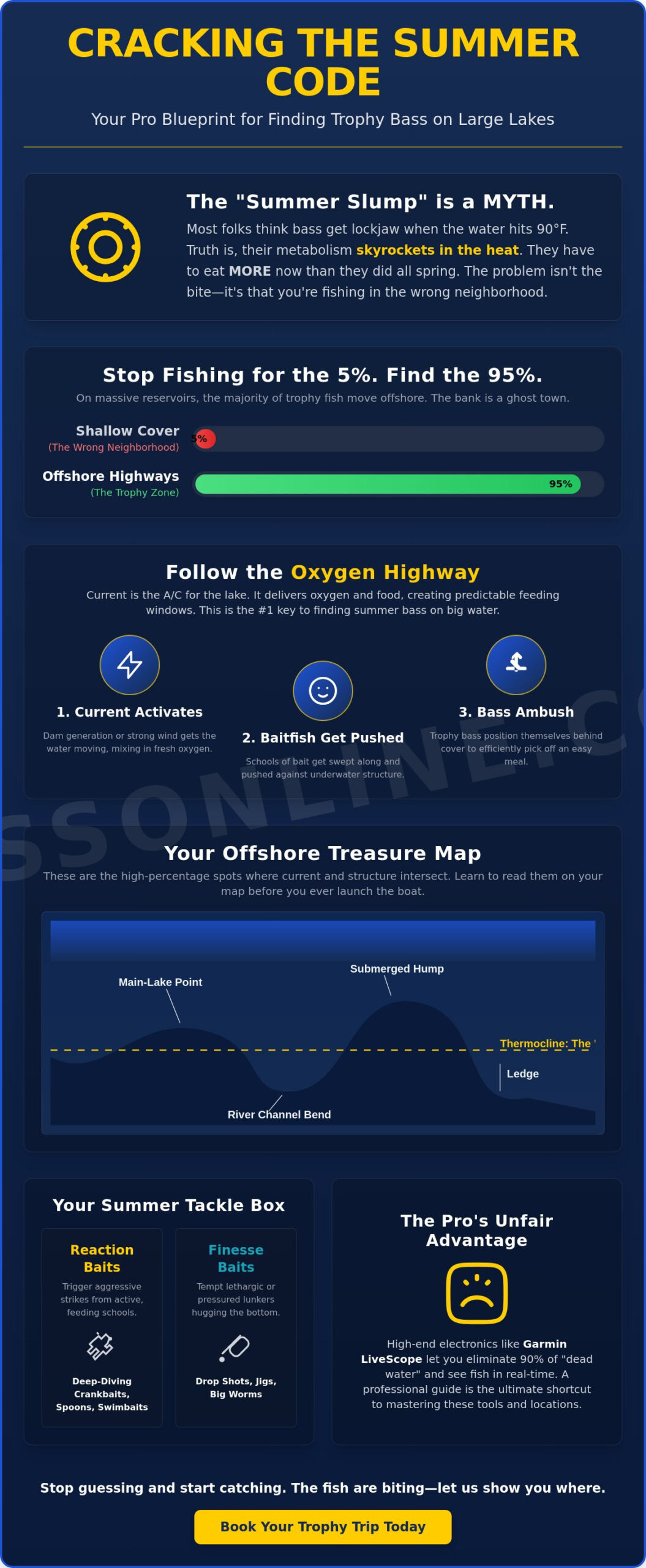
Most anglers I talk to at the dock complain about the "summer slump." They think the fish have lockjaw because the water is ninety degrees. That is a total myth. Bass are cold-blooded, and their metabolism actually skyrockets in the heat. They have to eat more often now than they did in the spring. The problem isn’t the bite; it’s that you’re looking in the wrong neighborhood. Finding bass in summer on large lakes requires a shift in mindset from shallow shoreline cover to deep-water structure.
Large lakes, especially massive reservoirs like Lake Guntersville or Lake Erie, are complex ecosystems with thousands of acres of water. These aren’t farm ponds where you can just cast at every stump. You’re dealing with diverse structures, varying depths, and massive schools of baitfish that move constantly. If you stay tied to the bank, you’re fishing for the 5% of resident fish that stay shallow, while the real trophies have moved out to the offshore highways.
To better understand the movement of these fish, check out this breakdown of summer patterns:
The Scale Challenge: Breaking Down Massive Water
On a 50,000-acre reservoir, 90% of the fish live in 10% of the water. That is a lot of "dead" space you need to ignore. I always start my day with a hydrographic map. I look for high-percentage zones like main-lake points, river channel bends, and underwater humps. Mastering the art of finding bass in summer on large lakes is about eliminating water as fast as possible. If a spot doesn’t have bait or the right bottom composition, I don’t waste time. I am looking for the intersections where current and structure meet.
Biology 101: The Bass Comfort Zone
The Largemouth bass is driven by two things in the heat: oxygen and food. As the sun gets higher, light penetration pushes baitfish deeper, and the predators follow. Shallow water often becomes stagnant and low in oxygen, forcing the bigger fish to find the cool spots. This usually means moving to areas with current or depth where the water stays more oxygenated. Bass are opportunistic, but they won’t sacrifice their physical comfort just for a snack.
The thermocline is the invisible horizontal layer in the water column that separates the warm, oxygen-rich upper layer from the cold, oxygen-depleted deep water, acting as a floor that keeps bass from going too deep. Stay above this line, find the bait, and you’ll find the school. It’s all about understanding that "comfort zone" and using it to narrow your search on massive acreage.
The Oxygen Highway: Finding Current and Cooler Water
Current is the lifeblood of a massive reservoir during the dog days. While shallow coves become stagnant and hot, the main lake remains a dynamic environment. Think of current as the air conditioning for the lake. It mixes the water, keeps oxygen levels high, and most importantly, it tells the bass when to eat. Finding bass in summer on large lakes often comes down to timing your arrival with the water movement. When the current starts, the dinner bell rings.
On many of the systems we fish, like the Tennessee River or the St. Johns River, current is dictated by dam releases. When the turbines start spinning, the water moves, and baitfish get disoriented. Bass are masters of efficiency. They will tuck behind a rock or a ledge, waiting for the current to wash a meal right to them. If you aren’t paying attention to the flow, you are missing the biggest piece of the summer puzzle. Even on lakes without dams, wind-driven current on open-water points can be enough to stack up a school of hungry fish.
The Power of Moving Water
Dam releases and power generation create predictable feeding windows that savvy anglers exploit. I always check the generation schedules before I ever back the trailer down the ramp. When that water moves, you want to target the "upstream" side of points and ledges. This is where the heaviest flow hits the structure, pinning bait against the hard bottom. Look for "neck-down" areas where the lake narrows, such as under bridges or between islands. These spots naturally constrict and accelerate the flow, creating a high-energy buffet for trophy bass. If the water is still, the fish might be scattered, but once it moves, they’ll be right on the "nose" of the structure.
The Thermocline Trap
Understanding the thermocline is just as vital as finding the current. Data from the U.S. Fish & Wildlife Service highlights how largemouth bass require specific habitat conditions to thrive, and oxygen is at the top of that list. In the summer, lakes often "stratify," creating a layer of dead water at the bottom that has zero oxygen. If you see a fuzzy, consistent line on your sonar at twenty-five feet, that is likely the thermocline. Don’t bother fishing deeper than that line. The bass won’t be there because they literally cannot breathe.
The real magic happens where the thermocline intersects with a hard structure. If you find a hump that tops out right at that oxygen-rich boundary, you have found a gold mine. It is the perfect intersection of comfort and cover. If you find yourself struggling to read these deep-water signals, you might want to chat with an expert guide to see how we dial in our electronics. We can show you exactly how to spot these biological highways in real-time so you don’t waste another minute on dead water.
Offshore Geometry: Mastering Ledges, Humps, and Deep Cover
Once you understand the current, you have to master the underwater geometry. Finding bass in summer on large lakes isn’t just about finding depth; it’s about identifying the specific shapes that hold these schools. I think of ledges as the interstate highways of a reservoir. These are the primary travel routes where a shallow flat meets a deep river channel. While the fish might roam the channel, they congregate on the "shoulders" of these ledges to feed. It’s a high-traffic area where the groceries are always in stock.
Submerged humps and islands are just as critical. I call these "islands in the stream." These structures often sit in the middle of nowhere, surrounded by deep water, making them perfect sanctuaries for trophy loners. The real secret to a big bag is the "spot on a spot" theory. You can find a ledge that’s three miles long, but the fish will be stacked on one single rock pile or a lonely stump. Finding that micro-structure is what separates the pros from the weekend grinders. For more on these high-level summer bass fishing tactics, it’s vital to look at how these fish position themselves relative to the sun and current.
Ledge Fishing Fundamentals
Success on the ledges starts with identifying the "drop-off." You’re looking for a sharp change in depth where the bait gets trapped. I focus on the "turns" and "points" along a ledge line. Just like a bend in a road, a bend in a ledge creates an eddy where bass can sit out of the current and wait for food. I rely heavily on side-imaging to find "hard bottom" spots. On your screen, these look like brighter, more intense patches. Bass love the heat-retaining properties of rock and shell beds, even in deep water.
Deep Grass and Brush Piles
Vegetation like Hydrilla and Milfoil is a biological factory. These plants pump oxygen into the water and provide thick shade from the summer sun. I look for the "edge effect," which is the outer wall of a deep grass line. Bass will patrol this wall like a fence. If the grass is too thick, look for man-made brush piles. On many systems, like the Harris Chain of Lakes, Lake Fork, Lake Erie, Lake Guntersville , or Lake Tohopekaliga , guides and locals sink brush in 15 to 25 feet of water. These piles are summer sanctuaries. They offer a physical break in the terrain that gives a big bass a place to ambush bluegill and shad.
Tactical Presentations for Lethargic Summer Lunkers
Finding bass in summer on large lakes is only half the battle; the real work starts when you have to convince a lethargic trophy to actually bite. When the sun is high, bass often enter a neutral or negative feeding mood. I approach these offshore schools with a one-two punch. I start with high-speed reaction baits to trigger the most aggressive fish, then I follow up with finesse presentations to pick off the rest. It is a calculated strategy that keeps the net busy even when the mercury is pushing triple digits.
Deep-diving crankbaits are my primary tool for firing up a school. I don’t just want the lure to swim; I want it to "bang" the bottom. That sudden deflection off a rock or stump is what triggers a strike from a fish that isn’t even hungry. If the bottom is rocky or littered with shell beds, I switch to a football jig. The wide, weighted head prevents it from getting wedged in crevices while perfectly mimicking a crawfish scurrying across an offshore hump. When the school gets pressured and tight-lipped, the drop shot becomes my ultimate safety net. It allows me to keep a bait hovering right in their face, suspended off the bottom, for as long as it takes to annoy them into biting.
Power Fishing the Schools
When I am looking for the biggest fish in a school, I go big. Oversized swimbaits are a fantastic way to target trophy bass that are looking for a substantial meal rather than a snack. If the fish are suspended off the bottom, I use a technique called "strolling." I let out a massive amount of line and use the trolling motor to pull a heavy jig or swimbait through the strike zone. It keeps the bait at a consistent, deep level where the fish are holding. For those times when I need to feel every pebble on the floor, a heavy Carolina Rig is my favorite tool. It tells me exactly what the bottom composition is while keeping a soft plastic trailing naturally in the current.
Finesse Tactics for the Mid-Day Lull
As the afternoon heat peaks, finding bass in summer on large lakes requires a slower, more disciplined approach. The Neko Rig is my secret weapon for fish that have seen every crankbait in the lake. It is a subtle, weighted-worm presentation that stands vertically on the bottom, looking completely different from anything else. Surprisingly, I also love throwing a "walking" topwater bait at high noon over deep standing timber. A big bass will often rise from twenty feet deep to crush a surface bait if it looks like a struggling shad. This requires serious mental discipline; you have to be patient and trust your electronics. If you are ready to see these tactics in action on the water, book your next adventure with us and let’s go land a giant.
Beating the Heat: The Case for a Professional Guide
Navigating a massive reservoir in the middle of July is a daunting task for even the most seasoned weekend warrior. When you are staring at 50,000 acres of blue water under a relentless sun, the "summer slump" feels very real. Finding bass in summer on large lakes is a high-stakes game of hide and seek where the fish have all the advantages. This is where a professional guide becomes your ultimate "knowledge shortcut." Much like the coastal experts at South Louisiana Redfishing navigate complex marshes, a lake guide helps you jump straight to the productive schools that have been patterned for weeks.
Safety is another huge factor that people often overlook. Large lakes can turn dangerous in a heartbeat during summer afternoon thunderstorms. Navigating heavy boat traffic and sudden microbursts requires a level of local experience that goes beyond just looking at a GPS. When you are on a boat with a pro, you can focus entirely on the bite while we handle the logistics and safety of the expedition. We turn a stressful day of searching into a high-energy masterclass on deep-water behavior.
Why Local Expertise Matters
Our fishing guides are on the water nearly every single day. We don’t just track fish movement weekly; we track it by the hour. We know exactly how the current from a specific dam release affects a particular ledge because we were there yesterday when it happened. This level of intimacy with the water allows us to access "secret" offshore waypoints that simply do not appear on public hydrographic maps. You also get the gear advantage. We provide top-tier tackle and the latest marine electronics, saving you from a massive financial investment just to stay competitive on big water.
Booking Your Summer Adventure
Preparation is key to enjoying the peak of the season. When you book a guided bass fishing trip, I always tell my clients to prioritize sun protection and hydration. Lightweight, long-sleeved performance shirts and high-quality polarized sunglasses are mandatory. We usually aim for an early start to catch the dawn topwater bite before the sun pushes the schools into their deep-water sanctuaries. It is a fast-paced environment where the action can be explosive once we find the right oxygen highway.
Don’t spend your summer fighting the lake and coming home with nothing but a sunburn. While you’re out on the water, Mosquito Assassin Pest Control LLC can ensure your home or cabin in the Erie area remains a pest-free sanctuary. Finding bass in summer on large lakes is a science, and we have already done the research for you. Join a pro for a day, learn the "why" behind the patterns, and finally land that trophy fish you have been chasing. The fish are out there, and they are hungry. Let’s go get them.
Ready to Conquer the Dog Days?
Success on massive reservoirs doesn’t happen by accident. It’s the result of understanding how current, oxygen, and structure intersect to create a perfect feeding window. You’ve learned that current is the air conditioning of the lake and that offshore geometry like ledges and humps are the biological magnets for trophy fish. Mastering the art of finding bass in summer on large lakes is about moving past the shorelines and trusting your electronics to find those high-percentage "spots on a spot."
With over 20 years of professional guide experience, we’ve spent decades refining these blueprints on every major US bass lake. Our track record is backed by thousands of verified 5-star fishing charter reviews from anglers who have landed the fish of a lifetime during the peak of the heat. Don’t waste another weekend guessing where the schools are hiding. Book your summer trophy bass expedition with Bass Online today! Our expert local guides are ready to put you on the fish and show you exactly what it takes to win the summer grind. I’ll see you on the water!
Frequently Asked Questions
How deep do bass go in the summer on large lakes?
Bass typically hold in depths between 15 and 25 feet during the summer, but the specific depth is dictated by the thermocline. On ultra-clear reservoirs or northern systems like Lake Erie, they can venture as deep as 35 or 40 feet if the oxygen levels allow. Always look for the depth where the water temperature drops and the baitfish congregate on your sonar.
What is the best time of day to catch bass in the summer?
The best time to target offshore schools is actually during the brightest part of the day, typically from 10:00 AM to 2:00 PM. While early morning offers a fun topwater bite, high sun pushes baitfish deeper and bunches them up against structure. This makes finding bass in summer on large lakes much easier because the fish become highly predictable and concentrated.
Do I need expensive electronics to find bass offshore?
You don’t strictly need high-end sonar, but it certainly shortens the learning curve on massive water. A basic 2D sonar and a good hydrographic map can help you find major ledges and humps. However, modern tech like Garmin LiveScope allows you to see how fish are reacting to your lure in real-time, which is a massive advantage when the bite is tough.
What is the best lure for summer bass fishing in deep water?
A deep-diving crankbait that can reach 20 feet is the most effective tool for triggering reaction strikes from large schools. If the fish are pressured, switch to a drop shot with a 6-inch straight-tail worm. This finesse approach allows you to keep the bait suspended right in their faces, which often coaxes a bite from even the most lethargic lunkers.
How does current affect bass fishing on large reservoirs?
Current acts as a dinner bell that tells the bass exactly where to line up for a meal. Moving water disorients baitfish and forces them over ledges where bass are waiting in ambush. On reservoirs with dams, the bite often intensifies the moment the turbines start spinning and the water begins to flow. It also oxygenates the water, which keeps the fish active when the rest of the lake is stagnant.
Is it better to fish shallow or deep during a summer thunderstorm?
It is often better to move shallower when a thunderstorm approaches. The drop in barometric pressure and the sudden low-light conditions can pull offshore bass up onto the tops of humps or even back toward shallow points. Just remember that safety is the priority; get off the water the moment you hear thunder or see lightning.
Why do bass school up in the summer?
Bass school up in the summer primarily to hunt massive balls of shad or blueback herring more efficiently. By grouping together, they can coral the bait against a ledge or the surface. This pack-hunting behavior is why you can often catch twenty fish from a single offshore spot once you get the school fired up. It is all about competition and the ease of a group meal.
Can I catch trophy bass in 100-degree weather?
You can absolutely catch a trophy fish in 100-degree weather because a bass’s metabolism is at its peak. Finding bass in summer on large lakes during heatwaves just requires finding the right comfort zone with high oxygen. If you find deep cover near a river channel, those big females are still eating despite the surface temperature. They have to eat to survive the heat, so the bite remains active.

Article by
Mr Bass
Todd Kersey, widely known as Mr. Bass by Field & Stream, is a professional angler, accomplished author, and dedicated philanthropist with a lifelong passion for bass fishing. Armed with a degree in Outdoor travel, Mr. Bass has expertly combined his knowledge with his practical fishing experience to become one of the most respected names in the bass fishing, his deep understanding of bass habitats, and fish behavior has earned him numerous accolades as a asset of the sport. Serving 8 years as FWC Stakeholder Chairperson. Leading and passing cutting-edge legislation, such as the Black Bass Management plan, and successfully building, passing, and financing the Trophy Catch program. As CEO, he is committed to giving back to the community through his philanthropic efforts. He supports a variety of causes, especially those centered around physical disabilities. Through his advocacy, his mentorship programs inspire anglers to engage in fishing stewardship, helping to raise more than $ 18 million in donations. Mr. Bass continues to inspire anglers and outdoor enthusiasts alike with his commitment to the sport and the world around him.