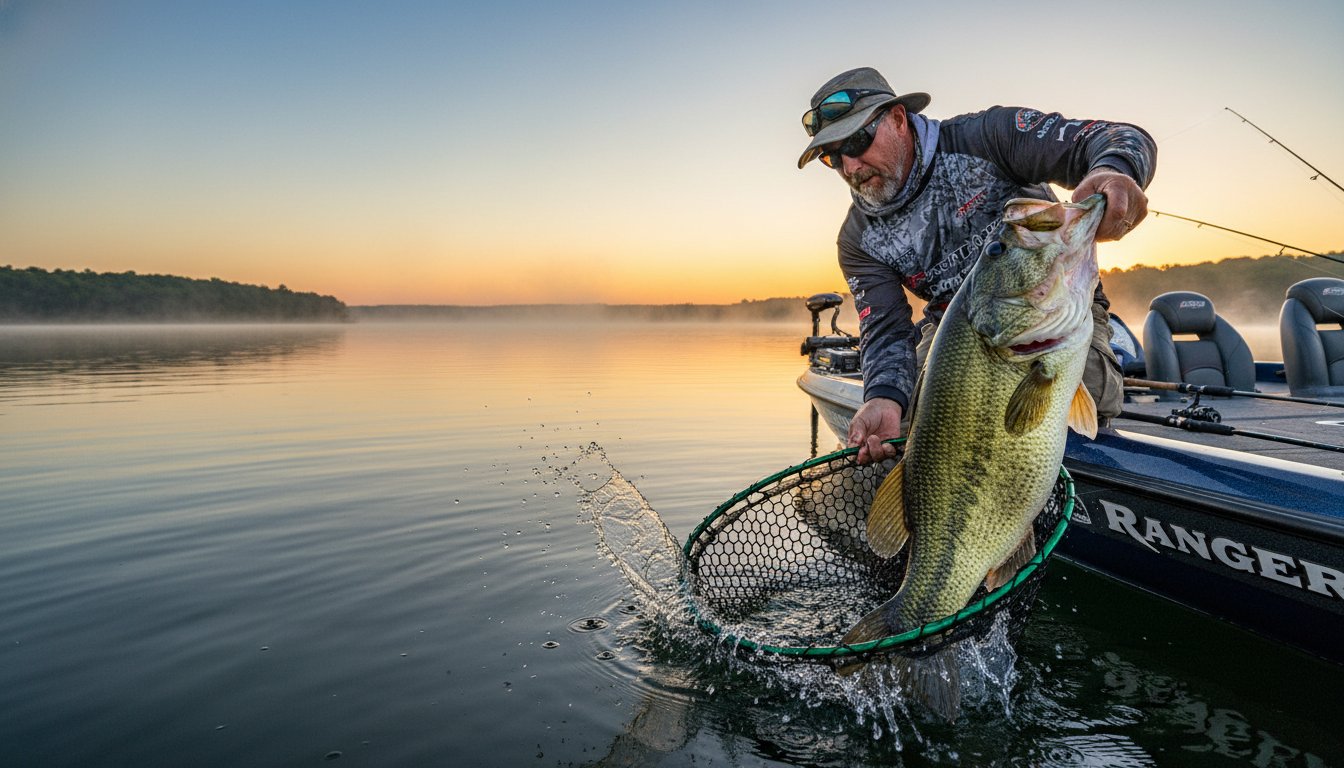

Most anglers waste the best weeks of the year fishing “dead water” because they’re looking where the bass used to be, not where they’re going. It’s incredibly frustrating to watch the thermometer climb while your livewell stays empty. You know the big females are moving, but the transition from winter lethargy to spring aggression often feels like a high-stakes guessing game. I’ve spent years on the water guiding clients through this exact window, and I can tell you that mastering pre-spawn bass fishing techniques is the fastest way to land the heaviest fish of your life.
In this 2026 playbook, I’m handing over the field-tested tactics we use to intercept trophy bass on their way to the shallows. You’ll learn how to identify the specific “highways” and staging points fish use on any lake. We’ll also cover the hottest new gear for the season, including how to work the Berkley PowerBait Chop Block and the Rapala CrushCity Mooch Minnow. Whether you’re navigating the new year-round rules in Minnesota or hunting giants at Lake Okeechobee, this guide ensures you’re always in the right spot at the right time. It’s time to stop guessing and start catching.
Key Takeaways
- Learn why the 50-degree water temperature mark is the ultimate biological trigger that wakes up trophy bass from their winter slumber.
- Master advanced pre-spawn bass fishing techniques to identify “Interception Points” where big females congregate before heading to the beds.
- Discover why lipless crankbaits and suspending jerkbaits are your most effective tools for covering water and triggering aggressive reaction strikes.
- Understand the “Bottom Contact” rule and how making small adjustments to your retrieve speed can turn a slow morning into a personal best.
- Gain the insider knowledge needed to track the transient movement of bass so you spend your time on productive water rather than empty coves.
The Pre-Spawn Window: Understanding the Biological Trigger
Pre-spawn isn’t just a date on the calendar. It’s a massive biological shift where fish wake up from their winter slumber and head toward the shallows. When we talk about pre-spawn bass fishing techniques, we’re really talking about intercepting a migration. This is the time of year when females reach their maximum weight, carrying eggs that make them look like footballs. Understanding Largemouth bass biology is the key to timing your trip. This window begins when fish leave their deep wintering holes and start looking for the first available staging spots. It’s the absolute best time to land a personal best because the fish are at their heaviest phase of the entire year.
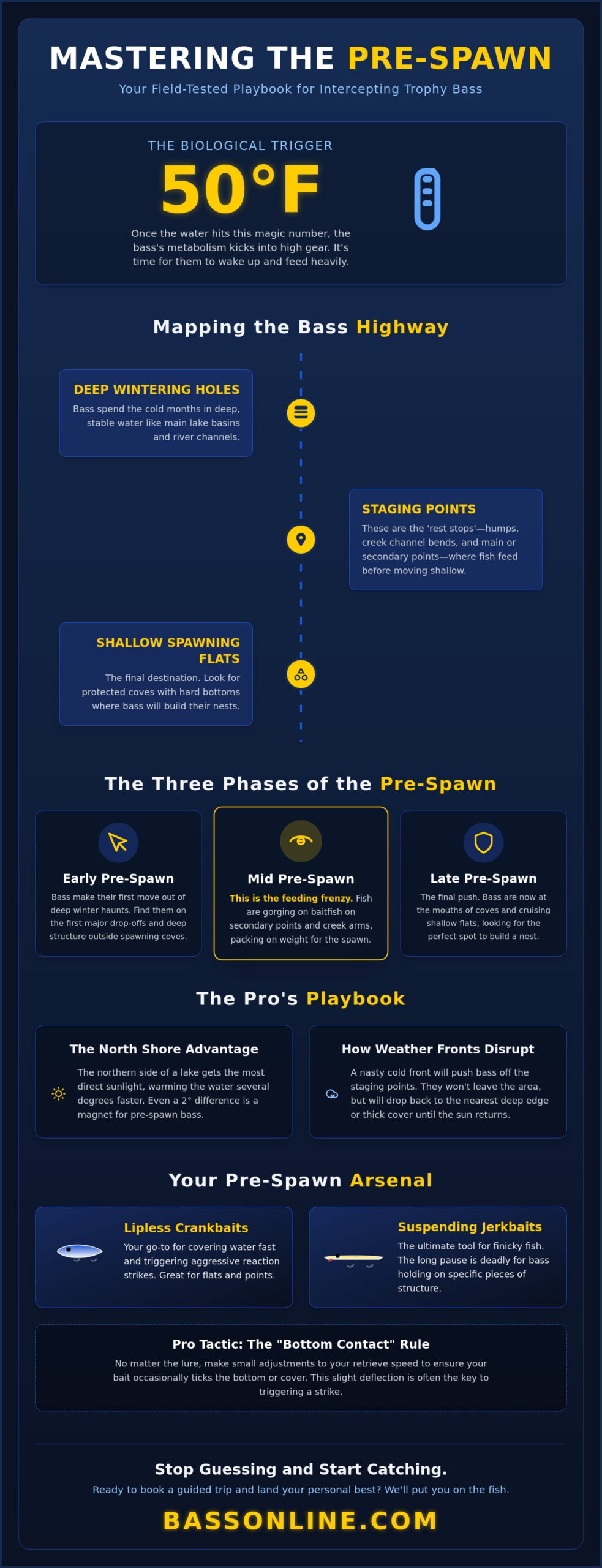
Water temperature is the primary driver, and 50 degrees is the magic number. Once that surface temp hits 50, the switch flips. Bass metabolism kicks into gear, and their need to feed becomes the top priority. In southern waters like Florida, this happens early and fast. Up north in places like Lake Erie, the transition is more gradual and tied to the ice melt. While temperature gets the glory, photoperiod, or daylight length, acts as the internal alarm clock. Even if the water is still chilly, longer days tell the bass it’s time to move. This dual trigger ensures the species survives even during years with unpredictable weather.
To better understand this concept, watch this helpful video:
The Three Phases of the Spring Transition
Success requires knowing exactly which phase you’re in. Each stage demands different pre-spawn bass fishing techniques to keep your rod bent as the fish move closer to the bank.
- Early Pre-Spawn: Bass make their first move. They leave deep basins and hover near the first major drop-offs, humps, or deep structure outside of spawning coves.
- Mid Pre-Spawn: This is the feeding frenzy. Fish move onto secondary points and areas where they gorge on baitfish to build energy for the spawn.
- Late Pre-Spawn: The final push. Bass are in the mouths of coves and scanning shallow flats for the perfect nesting spot.
How Weather Fronts Disrupt the Migration
Spring weather is never a straight line. It’s usually two steps forward and one step back. When a nasty cold front hits, bass don’t just stay put. They often drop back to the nearest deep edge or thick cover to wait it out until the sun returns. A staging area is a temporary holding spot with easy access to both deep and shallow water.
Identifying Staging Points: Mapping the Bass Migration Highways
You can’t just pull up to any bank and expect a bite. You need to look at the lake like a road map. Bass use “highways” to move from deep winter basins toward their eventual nesting sites. My favorite way to find them is using the Interception Point theory. This means identifying the first major piece of structure outside a primary spawning cove. It could be a point, a hump, or a submerged roadbed. Understanding these bass spawning habits is crucial because it tells you exactly where the “stop signs” are during their journey.
While many anglers beat the main lake points, seasoned pros know that secondary points are where the real action happens. These are the points located inside the arms of creeks or bays. They act as the final staging grounds before the fish commit to the shallow flats. If you’re using pre-spawn bass fishing techniques on a body of water like Lake Fork or Lake Guntersville, look for choke points on your contour map. These are narrow areas where the creek channel swings close to a point or a flat, forcing the migrating bass into a concentrated area.
Don’t ignore the North Shore Advantage. The northern side of a lake or cove receives the most direct sunlight during the spring. This means the water warms up several degrees faster than the south side. On a cold spring day, even a two-degree difference can be the trigger that turns the fish on. It’s often the difference between a productive morning and a total skunking.
The Role of Vertical Structure and Cover
Bass love verticality in the early spring. Steep drops like bluff walls or creek channel bends allow them to change depth quickly without swimming long distances. If a cold front hits, they just sink down the wall to find stable water. You also want to look for the “green grass” factor. Early-season vegetation provides oxygen and traps heat. Use your electronics to find hard bottom areas like gravel or shell beds. These spots hold heat better than mud and are the preferred foundation for bass nests as the season progresses.
Parallel Casting and Boat Positioning
Your boat position is just as important as your lure choice. I always suggest parallel casting to a breakline. This keeps your lure in the strike zone for the entire retrieve rather than just a few seconds. When you approach a point, use the “45-Degree Rule.” Position your boat at a 45-degree angle to the tip of the point and cast across it. This prevents you from spooking fish that are often shallower than you think. Learning these local migration routes can be tough on complex lakes, so many anglers choose to work with fishing guides to flatten the learning curve. If you want to see these highways for yourself, get in touch with us to plan your next outing.
Top Pre-Spawn Lures: Selecting the Right Tools for the Transition
Once you’ve mapped out the migration routes, you need the right tools to stop those moving fish. Selecting the right lure during this window isn’t just about what looks good in the tackle box; it’s about matching the aggression level of the bass as they transition from winter lethargy. Lipless crankbaits are my absolute favorite search tool for this. They allow you to cover massive flats quickly while “ticking” the tops of emerging grass. When that lure snags a blade of vegetation and you rip it free, it creates an erratic snap that triggers a violent reaction from any big female nearby.
If the water is hovering between 50 and 55 degrees, nothing beats a jerkbait. A suspending jerkbait is a lure designed to hover perfectly neutral in the water column. This allows you to pull the bait down to the fish’s level and just let it sit. That pause is the most lethal part of the retrieve. In cold water, bass are often too sluggish to chase a fast-moving bait, but they can’t resist a minnow profile that stays right in their face. For those hunting the true “big girls” tucked into wood or heavy cover, a jig or a bladed jig like a Chatterbait is essential. These power fishing techniques for pre-spawn bass combine heavy vibration with a bulky profile that mimics the large meals bass crave before the energy-intensive spawn.
Reaction Baits for Aggressive Staging Fish
When the sun is out and the water is warming, it’s time to get aggressive. This is the “crawfish bite” window. I always reach for reds, oranges, and “craw” patterns because bass are keyed in on high-protein crawfish emerging from the mud. Use a “rip and fall” cadence with your lipless baits or move to a spinnerbait with a large Colorado blade. The heavy thump of that single blade creates massive vibration in stained spring water, helping fish find the bait even in low visibility. If you’re fishing one of the major lakes in the South, these reaction strikes often produce the biggest bags of the year.
Finesse Tactics for Post-Front Conditions
Spring weather is moody, and a sudden cold front can shut down a hot bite in hours. When those fish drop back to deeper cover, you have to slow down. The Wacky Rig is a “slow-motion” approach that often saves the day. I also rely on the Ned Rig or a Shaky Head to mimic lethargic bottom-dwellers. For 2026, new designs like the Z-Man Fuzzy TRD, which uses silicon skirting for added movement, are perfect for these tough days. These finesse pre-spawn bass fishing techniques ensure that even when the weather turns, you aren’t going home empty-handed.
Mastering the Presentation: Pro Tips for More Strikes
You can have the perfect lure on the line, but if your presentation is off, those big females will swim right past it. One of the most important pre-spawn bass fishing techniques I teach my clients is the Bottom Contact Rule. If you aren’t occasionally hitting a rock, a stump, or the top of a grass bed, you aren’t fishing effectively. That sudden deflection when a crankbait bounces off a piece of wood often acts as the trigger. It creates an erratic “panic” movement that a bass simply can’t ignore. It’s not about a smooth retrieve; it’s about causing a scene underwater.
Timing your speed is just as critical. Slower is better. It’s a simple rule for the early morning. When the sun is low, bass are often glued to the bottom and won’t move far to chase a meal. As the afternoon sun warms the upper water column, you can pick up the pace. This temperature shift increases their metabolism, making them more willing to chase a faster moving bait. Don’t make the mistake of staying deep all day. Once that sun has warmed the upper 3 feet of water, those fish will move much shallower than you might expect to soak up the heat.
Spring runoff often brings stained water, making sound and vibration your best friends. In these conditions, bass rely on their lateral lines to “feel” their prey before they see it. Using lures with internal rattles or high-thump blades ensures your bait stands out in the murk. If you want to see these tactics in action on the water, book your spring charter today and let’s get after them.
Adapting to Water Clarity
When you’re faced with “chocolate milk” water, you need to go bold. I reach for dark silhouettes like black and blue or high-contrast chartreuse to help the fish track the bait. In clear water, the opposite is true. Switch to natural, translucent colors and make long casts. Bass in clear spring water are incredibly spooky, and a long cast prevents them from sensing the boat’s vibration. You can check out our species guide to understand how Largemouth and Smallmouth react differently to these clarity changes during the spring push.
Targeting the “Warmest Water” in the Lake
Your boat’s temperature gauge is your most valuable piece of electronics this time of year. I’m constantly scanning for “pockets” of water that are just 2-3 degrees warmer than the surrounding lake. These small thermal gains are magnets for baitfish and bass alike. Look for rip-rap banks and boat docks. These structures act as heat sinks, absorbing the sun’s energy and radiating it back into the water. Also, pay attention to the wind. The “Wind-Blown Bank” theory is real. A steady breeze pushes the warm surface water and active baitfish right into the shoreline, creating a perfect ambush point for staging bass.
Booking a Pre-Spawn Charter: Why Professional Guidance Wins
Pre-spawn is easily the most exciting time of the year, but it’s also the most volatile. Bass are on a mission, and that means they’re transient. A school of trophy females can move a mile in a single day as they follow the warming water toward the shallows. This is where professional guidance makes the difference between a record-breaking day and a long, empty boat ride. When you’re out with a pro, you aren’t just fishing; you’re leveraging years of historical data and daily field reports to stay ahead of the migration.
We use high-end electronics and professional-grade boats to track these movements in real time. While many weekend anglers are still fishing winter patterns, we’re already positioned on the next staging point. Mastering pre-spawn bass fishing techniques requires more than just the right lure; it requires knowing exactly when the “push” is happening. This is the heaviest-weight window of the year. We want to make sure you’re there to capitalize on it when the big ones show up. Local knowledge is the ultimate shortcut to success when spring conditions are changing by the hour.
What to Expect on a Professional Bass Trip
Think of a guided trip as a rolling classroom. I love showing my clients the “why” behind every cast. We’ll go over everything from reading side imaging to fine-tuning your retrieve speed for lethargic fish. You’ll also enjoy the safety and comfort that comes with professional equipment. Spring weather can be unpredictable, but our boats are designed to handle the chop and keep you dry while we hunt for giants. You can browse our fishing charter reviews to see the kind of success stories we’re creating every week during the spring transition.
Preparing for Your Adventure
Preparation is key for a successful day in the field. I always recommend layering your clothing. It’s often freezing when we launch at dawn, but it can feel like mid-summer by the time the afternoon sun hits. Bring a good pair of polarized sunglasses to help spot those shallow cruisers and staging fish. Most importantly, you need to secure your dates as early as possible. The pre-spawn window is the most requested time for our guides because every angler wants a shot at their personal best. Book your trophy bass adventure with Bass Online today! and let’s put some weight in the boat.
Gear Up for Your Biggest Spring Yet
You now have the map, the lure list, and the technical breakdown to dominate the spring transition. Success comes down to intercepting those big females on their migration highways and staying mobile as the water warms. By focusing on secondary points and maintaining consistent bottom contact with your presentation, you’ll be ahead of most anglers on the lake. These pre-spawn bass fishing techniques are the exact same ones we use every day to put our clients on the fish of a lifetime.
If you’re ready to skip the learning curve and get straight to the action, we’re here to lead the way. With over 25 years of professional guiding experience, we provide the local knowledge and professional-grade tackle needed to navigate the nation’s top trophy bass lakes. Our all-inclusive trips take the guesswork out of the equation so you can focus entirely on the fight. We’ve spent decades studying these patterns to ensure every outing is a success.
Join a Professional Guide for the Ultimate Pre-Spawn Hunt
The water is warming and the giants are finally moving toward the shallows. Don’t miss your chance to land a personal best during the heaviest phase of the year. We’ll see you on the water!
Frequently Asked Questions
What is the best water temperature for pre-spawn bass fishing?
The magic window for pre-spawn activity typically falls between 50 and 60 degrees. Once the surface temperature hits 50, bass leave their deep winter haunts and begin their push toward the bank. Activity reaches a fever pitch when temperatures stabilize between 55 and 60 degrees, as this is when the biggest females feed most aggressively before moving onto the beds to spawn.
How far do bass move during the pre-spawn migration?
Bass can migrate anywhere from a few hundred yards to several miles depending on the size of the body of water and the available structure. In large reservoirs, fish often travel significant distances along creek channels to reach suitable spawning flats. On smaller ponds, the move might just be from the center basin to the nearest shallow shelf. They use structural highways like points and ledges to navigate these routes efficiently.
What are the best lures for pre-spawn bass in stained water?
In stained or “chocolate milk” water, you need lures that move a lot of water and create heavy vibration. I reach for a bladed jig or a spinnerbait with a large Colorado blade to help bass feel the bait through their lateral lines. Darker colors like black and blue or loud chartreuse silhouettes work best because they stand out in low-visibility conditions and help the fish track the target.
Do bass bite differently during a spring cold front?
Yes, bass react quickly to spring cold fronts by dropping back to the nearest deep-water edge or burying themselves deep into heavy cover. Their metabolism slows down, making them less likely to chase fast-moving reaction baits. During these shifts, you’ll need to slow down your presentation and use finesse pre-spawn bass fishing techniques like a Ned rig or a weighted wacky rig to coax a bite from sluggish fish.
How do I find staging areas without expensive electronics?
You can find productive staging areas by studying topographic maps and looking for secondary points or the first major structure outside a shallow cove. Visual cues like rip-rap banks, boat docks, and the mouths of creek arms are classic holding spots you can spot with the naked eye. These areas act as natural rest stops for bass as they move from deep basins toward the shoreline.
What is the difference between pre-spawn and spawning behavior?
Pre-spawn behavior is defined by migration and heavy feeding as fish move from deep to shallow water to build energy. During this phase, bass are aggressive and roaming. Once the actual spawn begins, fish stop roaming and focus on building nests and protecting eggs. While pre-spawn fish are looking for a meal, spawning fish are primarily focused on reproduction and defending their territory from intruders.
Which side of the lake should I fish in the early spring?
Always start on the north side of the lake in the early spring. Because the north shore receives the most direct sunlight, the water temperature there can be several degrees warmer than the rest of the lake. This slight temperature increase is often enough to trigger the first wave of big females to move up and start feeding while the south side of the lake is still dormant.
Is live bait or artificial lures better for pre-spawn bass?
While live bait is incredibly effective for trophy fish, artificial lures often have the edge during pre-spawn because they allow you to cover more water. Using artificial pre-spawn bass fishing techniques like throwing a lipless crankbait helps you locate roaming schools much faster. Once you find a concentration of fish, you can decide if you want to slow down with a target-specific presentation or keep power fishing.

Article by
Mr Bass
Todd Kersey, widely known as Mr. Bass by Field & Stream, is a professional angler, accomplished author, and dedicated philanthropist with a lifelong passion for bass fishing. Armed with a degree in Outdoor travel, Mr. Bass has expertly combined his knowledge with his practical fishing experience to become one of the most respected names in the bass fishing, his deep understanding of bass habitats, and fish behavior has earned him numerous accolades as a asset of the sport. Serving 8 years as FWC Stakeholder Chairperson. Leading and passing cutting-edge legislation, such as the Black Bass Management plan, and successfully building, passing, and financing the Trophy Catch program. As CEO, he is committed to giving back to the community through his philanthropic efforts. He supports a variety of causes, especially those centered around physical disabilities. Through his advocacy, his mentorship programs inspire anglers to engage in fishing stewardship, helping to raise more than $ 18 million in donations. Mr. Bass continues to inspire anglers and outdoor enthusiasts alike with his commitment to the sport and the world around him.