
Saving a few bucks on a rental boat feels like a win until you’re staring at a thousand identical acres of sawgrass with no idea where the bass are hiding. I’ve seen plenty of determined anglers head out alone only to return with nothing but a sunburn and a story about getting lost. When you’re debating a DIY everglades fishing vs guided trip, the real question is whether you want to spend your day searching for the water or actually pulling trophy bass over the gunwale.
I know the appeal of the solo trek. There’s a raw satisfaction in conquering the “River of Grass” on your own terms. However, the Everglades is a high-stakes environment where “dead water” can eat up your entire clock. This article will help you decide if the challenge of a DIY trek or the expertise of a professional charter is the right move for your next adventure. We’ll look at the current 2026 park regulations, the specialized gear you’ll need, and how to maximize your catch rate in this massive sawgrass labyrinth. Whether you’re chasing a legendary 100-fish day or just trying to stay safe in the backcountry, you’ll find the answers right here.
Key Takeaways
- Learn why the 1.5-million-acre “River of Grass” requires a total shift from your standard bass tactics to find fish in the shifting sawgrass.
- Break down the hidden costs of specialized gear and rentals to settle the DIY everglades fishing vs guided trip debate for your specific budget.
- Discover how skipping the “search phase” with a local pro leads to those legendary 100-fish days without wasting a single cast on dead water.
- Understand the critical safety risks of navigating the labyrinth where failing GPS signals and changing water levels can quickly turn a trip sideways.
- Get a clear roadmap for choosing your adventure based on whether you’re chasing a personal best trophy or a high-action numbers game.
The Everglades Challenge: Why Fishing the River of Grass is a Different Beast
You can’t approach the Everglades like a typical weekend trip to the lake. This isn’t just a body of water; it is a 1.5-million-acre shifting ecosystem that breathes with the seasons. Most anglers show up with their standard reservoir tactics, only to find that the fish here don’t play by the same rules. When you are weighing a DIY everglades fishing vs guided trip for the 2026 season, you have to understand that you’re stepping into a labyrinth where the water is constantly moving and the fish are always on the hunt.
Tackling the backcountry alone brings a unique rush, but it also comes with a steep price in frustration. I’ve seen guys spend eight hours casting at what looks like “perfect” lily pads without a single strike. The Everglades is a land of extremes. One hour you feel like a pro as you land double-digit numbers, and the next you’re staring at miles of “dead water” wondering where it all went wrong. This dilemma is exactly why local knowledge is the most valuable tool in your tackle box.
What Makes Everglades Bass Different?
The secret to the Glades is the flow. Within the Everglades National Park, the water isn’t stagnant. It moves slowly toward the coast, creating a “River of Grass.” This movement dictates exactly where the bass stack up. While Largemouth Bass often hug the deeper canal ledges during the dry season, Peacock Bass are aggressive heat-seekers that patrol the shallower rocky structures. If you don’t understand how the current water levels are pushing baitfish out of the sawgrass marshes and into the canals, you’ll spend your whole day fishing empty territory.
The Reality of the DIY Learning Curve
Patterning this environment on your own takes a serious time investment. Most first-time DIYers fall into the trap of fishing “pretty” water. In the Everglades, water can look pristine but hold zero fish if the oxygen levels are low or the flow has stalled. It usually takes years of trial and error to learn which specific mile-marker on a canal holds the motherlode. Professional guides spend over 250 days a year on these waters, which means we know exactly which windows of the day the bite will turn on. Without that intel, you might miss the best action by just thirty minutes, leaving you with a long, quiet ride back to the ramp.
The True Cost of DIY: Logistics, Gear, and Hidden Expenses
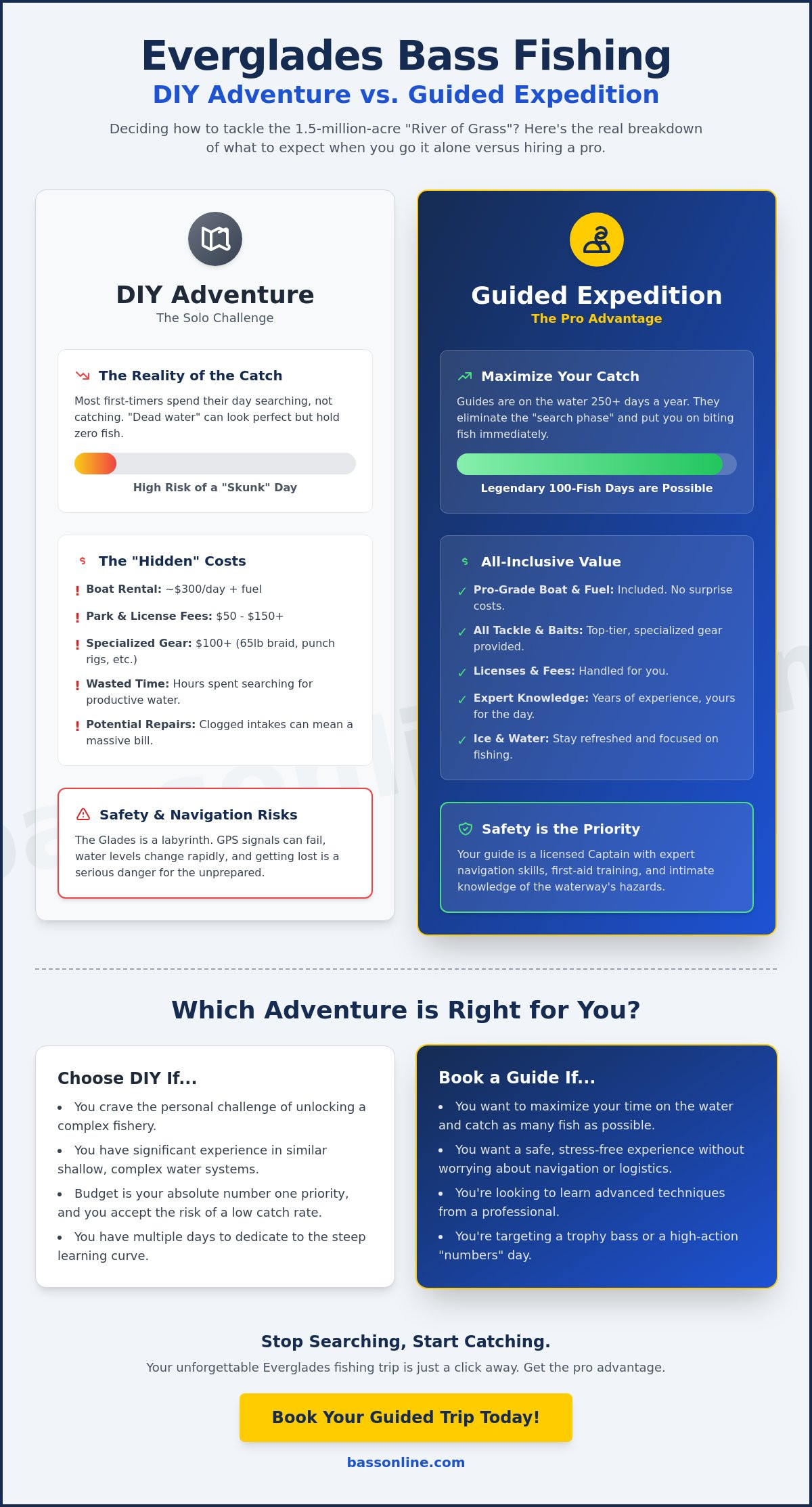
Think DIY is always the cheaper route? Think again. When you start tallying up the logistics, the “savings” often vanish before you even hit the water. Comparing a DIY everglades fishing vs guided trip means looking past just the booking fee and accounting for the gear you’ll break and the fuel you’ll burn. Between the $35 vehicle entrance fee and the $100 nonresident fee for international visitors, your wallet is already open before you’ve made a single cast.
You also have to factor in your license. Florida residents pay $17 for an annual freshwater license, while non-residents shell out $47. Plus, you need to be crystal clear on the Everglades fishing regulations. For instance, using live or dead fish as bait in freshwater areas is a big no-no. If you get caught with a bucket of shiners where they aren’t allowed, that “budget” trip just got a lot more expensive. By the time you add up ice, snacks, and the “Tackle Trap” of buying gear you don’t normally use, the DIY price tag starts to climb fast.
Renting vs. Bringing Your Own Boat
A standard bass boat is great for open lakes, but it’s often a liability in the Glades. A full-day rental for an 18-foot skiff runs about $300, and that doesn’t include the gas you’ll burn searching for fish. If you try to take a heavy hull into the shallow sawgrass, you risk sucking mud into your intake. A clogged cooling system in the middle of the backcountry is a nightmare. It can end your day and result in a massive repair bill that dwarfs the cost of a pro charter.
The Gear Gap: Specialized Everglades Tackle
Your standard 10-pound monofilament will get shredded here. To pull a five-pounder out of the thick sawgrass, you need heavy-duty 50 to 65-pound braided line. You’ll also need lures that can handle the dark, tannin-stained water. Standard colors often disappear in the tea-colored depths. Buying a whole new set of specialized frogs, punch weights, and topwaters can easily add another $100 to your tab. If you want to skip the shopping list and get straight to the action, reach out to a local expert who provides all the top-tier gear you need.
When you calculate the “cost per fish,” a DIY day often ends up being a high-priced scouting mission. You spend more time navigating and rigging than actually catching. On a guided trip, every dollar goes toward keeping your line tight and your drag screaming.
Guided Fishing vs. DIY: Comparing the Catch Rate and Experience
When you’re out on the water, the clock is your biggest enemy. Every minute you spend staring at a GPS or trying to figure out why the bass aren’t biting in a particular canal is a minute you aren’t catching. This is where the DIY everglades fishing vs guided trip debate really gets settled. I spend over 250 days a year on these specific waters. That isn’t just time spent; it’s a massive database of knowledge on where the fish move when the wind shifts or the barometric pressure drops. For a DIY angler, you’re starting from scratch every single morning.
The “Instant Access” factor is the biggest game-changer. On a guided trip, we skip the two-hour search and go straight to the strike. Because we track these patterns daily, a guided outing usually yields three to five times more fish than a solo mission. While a DIY angler might struggle to find five keepers, our clients often experience those legendary 50 to 100 fish days during the peak season from December through May. Plus, you get a front-row seat to a masterclass in bass behavior. I’ll show you exactly why we’re pitching to a specific clump of sawgrass rather than the one next to it, giving you skills you can take back to your home water.
Accessing the ‘Unreachable’ Backcountry
The best fishing holes in the Everglades aren’t sitting right next to the boat ramp. They’re tucked away in hidden pockets that standard rental boats simply can’t reach. We use high-speed, shallow-draft boats and specialized airboats to cover massive acreage in minutes. Navigating these mangrove tunnels and sawgrass trails requires serious skill. In fact, the National Park Service requires a mandatory boater education program for anyone operating a motorized vessel in the park. We’ve already done the homework and have the equipment to put you where the biggest bass hide, far away from the crowded areas that DIYers usually frequent.
The ‘Species Variety’ Advantage
One of the coolest parts about the Glades is the “Everglades Slam.” This means landing a Largemouth Bass, a Peacock Bass, and an Oscar all in the same day. Most DIYers get stuck targeting just one bass species because they’re using a “one-size-fits-all” approach. As a pro guide, I know how to switch tactics mid-day. If the Largemouth bite slows down as the sun gets high, we’ll shift over to rocky structures to hunt aggressive Peacocks. This flexibility keeps the rods bending all day long and ensures you get the full Florida experience rather than just a quiet day on the canal.
Navigating the Labyrinth: Why Local Knowledge is Your Best Safety Gear
I’ve seen it a hundred times. A DIYer enters a canal with a digital map and high hopes, only to realize that every turn in the sawgrass looks identical after five minutes. In the DIY everglades fishing vs guided trip debate, safety is the one factor you simply can’t put a price on. GPS is a fantastic tool, but in the dense mangrove tunnels or deep backcountry trails, signals can lag, bounce, or disappear entirely. If you don’t have a mental map of these waterways, you’re one wrong turn away from a very long, very buggy night in the swamp.
It isn’t just about getting lost. It’s about the water itself. A strong west wind can push water out of a canal faster than you’d believe, leaving a standard rental boat high and dry on a mudbank. If you aren’t tracking the tides and wind patterns like a pro, you could end up trapped in a location that was perfectly navigable two hours earlier. Then there’s the wildlife. Managing an aggressive alligator that decides your topwater lure is a snack is just another Tuesday for me, but for a solo angler, it’s a dangerous distraction that can lead to a hook in the hand or worse. When your engine fails ten miles from the ramp, there are no tow trucks. That’s a “Walk of Shame” nobody wants to experience.
Beyond the Map: Reading the Water
A pro sees things a map can’t show. I’m looking for current breaks where the water swirls around a point or the subtle shimmer of baitfish being pushed against a limestone ledge. While many beginners think “just look for birds,” that’s only a small piece of the puzzle. You need to know which canals are dead ends before you enter them. Entering a five-mile stretch that doesn’t loop back can waste hours of prime fishing time. Local knowledge tells me exactly which “lanes” are open and which ones are choked with vegetation before we even pull the cord on the motor.
Safety Protocols in the Wild
Cell service is a luxury you can’t count on in the backcountry. There are massive dead zones where your phone is nothing more than a paperweight. On my Everglades Bass Fishing Trips, I carry satellite communication and specialized emergency gear that most DIYers overlook. We also use the “Guide’s Secret” for staying on the water longer: a specific regimen of hydration and high-grade sun protection that keeps you from tapping out by noon. Choosing a professional means you have a partner responsible for your safety, allowing you to focus 100 percent on the strike. If you’re ready to skip the navigation stress and get straight to the fish, book your guided bass fishing trip today and let a local expert lead the way.
Choosing Your Adventure: How to Book the Ultimate Everglades Bass Trip
Deciding between a DIY everglades fishing vs guided trip ultimately comes down to what you want to see in your highlight reel. Are you looking for a quiet day of exploring where the catch is a bonus, or do you want to maximize every second of your vacation? For many of the 750,000 people who visited the park in 2024, time is the most limited resource. If your goal is a high-action numbers game where the rods never stop bending, a pro guide is the only way to guarantee that level of success in this massive environment.
When you’re vetting a guide for your 2026 adventure, ask about their specific area of expertise. Do they focus strictly on the main canals, or do they have the equipment to reach the deeper marshes? At Bass Online, our captains are the gold standard because we live and breathe these patterns daily. We don’t just provide a boat; we provide high-end rods, specialized local lures, and tactical knowledge that takes years to master. When you book one of our Everglades Bass Fishing Trips, you’re only responsible for your polarized sunglasses, a hat, and a camera to document the haul. We handle the navigation, the rigging, and the scouting.
Booking the Right Season for Success
Timing is everything in the River of Grass. The winter “Drawdown” is the absolute peak season, typically running from December through May. As water levels drop, bass are forced out of the thick sawgrass and into the deeper canal systems. This concentration creates a feeding frenzy that leads to those legendary 50 to 100 fish days. If you’re planning a trip during the spring transition, you’ll be chasing the spawn where the biggest females are most active. You can check our Everglades fishing reports for real-time updates on water levels and bite strength before you arrive.
The Final Takeaway: Investment vs. Expense
Think of a guided trip as an investment in your skills rather than just another expense. You’ll spend your day learning how to read tannin-stained water and how to punch through heavy vegetation like a professional. A DIY trip often ends in uncertainty and “scouting” time, but a professional charter guarantees a “tight line” experience where the focus is entirely on the strike. You’ve seen the challenges of the labyrinth and the hidden costs of going it alone. If you’re ready for a wild ride and want to land more bass than you ever thought possible, Book your Everglades Bass Fishing Trip with Bass Online! today and let’s get to work.
Dominate the River of Grass on Your Next Expedition
The Everglades is a world-class fishery, but it doesn’t give up its secrets easily. You’ve seen how the hidden costs of specialized gear and the very real risks of navigating the sawgrass labyrinth can turn a budget trip into a major headache. When you weigh the DIY everglades fishing vs guided trip, the choice comes down to whether you want to spend your day searching for water or actually fighting trophy bass. The “River of Grass” is far too large and complex to leave your success to chance.
At Bass Online, we bring over 25 years of professional guiding experience to every outing. Our top-rated captains have earned thousands of 5-star reviews and have been featured on major outdoor networks for our consistent trophy bass success. We take the guesswork out of the equation so you can focus entirely on the strike. It’s time to stop wondering where the fish are and start reeling them in with the best in the business. Book Your Legendary Everglades Adventure Now! We can’t wait to get you out on the water and show you what these legendary canals are truly capable of. Grab your gear and let’s make some memories.
Frequently Asked Questions
Is it easy to get lost while DIY fishing in the Everglades?
Yes, it’s incredibly easy to get turned around in the 1.5 million acres of sawgrass. Many DIYers find that cell service drops and GPS maps don’t always show the small, shifting trails that look identical to the main canal. Without local knowledge of the landmarks, you can easily end up in a dead end miles from the ramp as the sun starts to set.
Do I need a special license for Everglades bass fishing?
You need a standard Florida freshwater fishing license and a separate park entrance pass. Residents pay $17 for an annual license, while non-residents pay $47 for the year or $30 for a seven-day pass. Remember that the park is cashless, so buy your $35 vehicle pass online before you arrive to avoid delays at the gate.
Can I catch Peacock Bass and Largemouth Bass on the same trip?
You can absolutely land both species on a single outing. We call this the “Everglades Slam” when you add an Oscar to the catch list. Canals with rocky structure and moving water are prime spots where aggressive Peacocks and Largemouths hunt side by side. I’ll show you how to switch your retrieve to trigger strikes from both species in the same stretch of water.
What is the best time of year for a guided Everglades fishing trip?
The peak window is the dry season, which runs from December through May. This is the best time for a DIY everglades fishing vs guided trip because falling water levels push the bass out of the marsh and into the canals. You’ll see much higher catch rates during these months because the fish are concentrated in the deeper water.
Are airboats better than bass boats for the Everglades?
It depends on which zone you’re targeting. Airboats are the kings of the shallow sawgrass marshes where standard props would get choked by thick vegetation. However, a high performance bass boat is often more comfortable and efficient for covering the deep canal systems where big Peacocks hang out. I choose the vessel based on the current water levels and where the bite is strongest.
What happens if the weather turns bad during a guided trip?
Safety is my top priority when the clouds roll in. I monitor live radar throughout the day to stay ahead of Florida’s sudden thunderstorms. If the weather becomes dangerous, I’ll pull us off the water immediately. We typically look to reschedule the trip or adjust the start time to ensure you stay safe while still getting your time on the water.
Do guides provide all the tackle and bait for the trip?
I provide all the high end rods, reels, and specialized lures you need for the day. This is a major factor when comparing a DIY everglades fishing vs guided trip, as you won’t have to buy heavy braided line or specific tannin colored lures. Just remember that live bait is prohibited in the park’s freshwater areas, so we focus on tactical lure presentations.
Is DIY fishing in the Everglades safe for families with kids?
DIY trips can be stressful for families due to the intense heat and navigation challenges. The Everglades backcountry is a rugged environment with limited shade and plenty of wildlife like gators and snakes. A guided trip is much safer for kids because I handle the boat and all safety protocols, allowing you to focus entirely on catching fish and having fun.

Article by
Mr Bass
Todd Kersey, widely known as Mr. Bass by Field & Stream, is a professional angler, accomplished author, and dedicated philanthropist with a lifelong passion for bass fishing. Armed with a degree in Outdoor travel, Mr. Bass has expertly combined his knowledge with his practical fishing experience to become one of the most respected names in the bass fishing, his deep understanding of bass habitats, and fish behavior has earned him numerous accolades as a asset of the sport. Serving 8 years as FWC Stakeholder Chairperson. Leading and passing cutting-edge legislation, such as the Black Bass Management plan, and successfully building, passing, and financing the Trophy Catch program. As CEO, he is committed to giving back to the community through his philanthropic efforts. He supports a variety of causes, especially those centered around physical disabilities. Through his advocacy, his mentorship programs inspire anglers to engage in fishing stewardship, helping to raise more than $ 18 million in donations. Mr. Bass continues to inspire anglers and outdoor enthusiasts alike with his commitment to the sport and the world around him.